
If you run procurement for a mechanical engineering department, a polytechnic, or a technical training institute, thermodynamics lab equipment is one of the largest single line items you will handle this year. Most heads of department buy this gear once every 8 to 12 years, so the mistakes are expensive and hard to reverse. This guide is written from the buyer side. It tells you what to specify, what to ignore in the brochure, and where a thermodynamics lab equipment line item usually goes wrong before the tender even closes. For a working AICTE-aligned lab, expect INR 12 to 40 lakh depending on scope, with a good thermodynamics lab equipment manufacturer able to ship most items within 30 to 45 days.
My default position: buy fewer trainers of higher build quality rather than a long list of thin, sheet-metal units that a first-year batch will bend within two semesters. A Scientico-grade unit made in Ambala since 1993, ISO 9001:2015 certified and documentation reviewed per model for the applicable rigs, will still be running after the next NBA cycle. That matters more than shaving 8% off the PO.
Equipment mentioned in this guide
Review the product information, specifications and model before requesting a quotation.
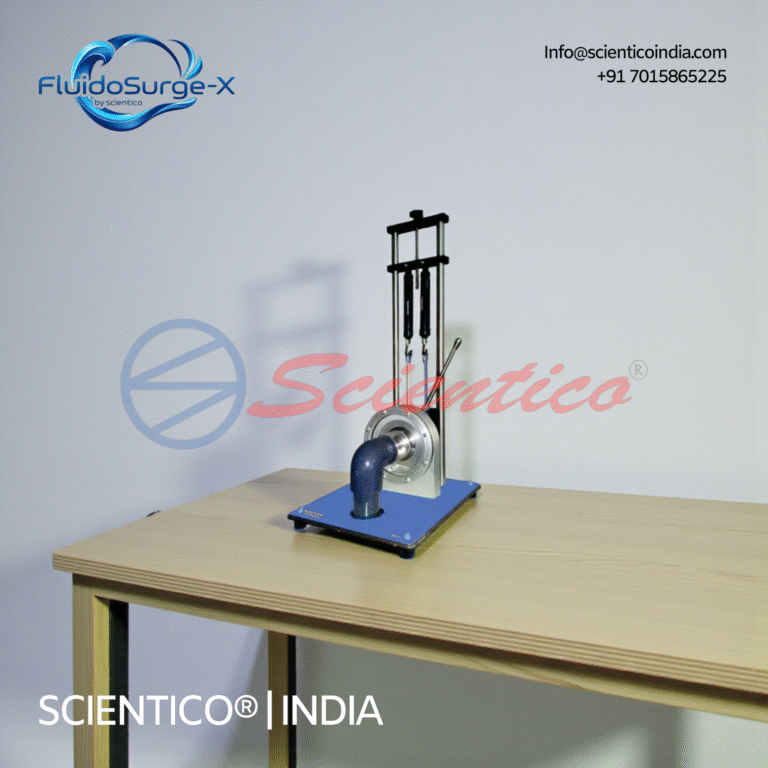
Kaplan Turbine Apparatus | FluidoSurgeX 208
The Kaplan Turbine Apparatus FluidoSurgeX 208 is a laboratory-scale training system designed to study the operating characteristics of a Kaplan reaction turbine. Manufactured by SCIENTICO, the apparatus demonstrates energy conversion from hydraulic power to mechanical power. It is suitable for instructional experiments in fluid mechanics and hydraulic machinery laboratories. The system operates using a controlled water supply from a hydraulic bench.
View product details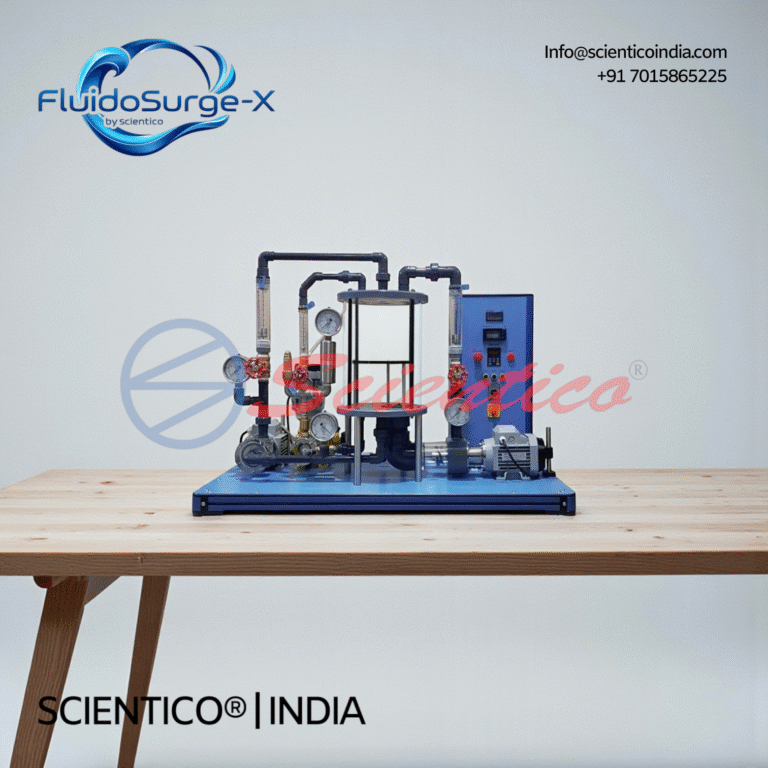
Multi Pump Test Rig Apparatus | FluidoSurge-X 294
The FluidoSurge X-294 is a multi pump test rig (series and parallel centrifugal pump test rig) that lets students run single, series and parallel pump configurations on one apparatus and compare the resulting head–discharge–efficiency characteristics.
View product detailsWhat to look for in a thermodynamics lab equipment purchase
Six things decide whether the rig survives 10 years of undergraduate use.
- Frame and panel gauge. Ask for the mild-steel or stainless-steel thickness in mm. Anything below 1.5 mm on the frame flexes when students lean on it. 2 mm powder-coated MS is the honest floor for teaching labs.
- Instrumentation grade. Digital temperature indicators with PT-100 sensors and 0.1 degC resolution are standard now. If the quote says “digital display” without stating sensor type, accuracy class, and range, that is a red flag.
- Utility footprint. Single-phase 230 V, 15 A is fine for most trainers. Vapour compression and refrigeration test rigs pull 3-phase, and a real Mollier-chart-plotting steam boiler wants a proper drain and water inlet. Confirm the utility list before you approve the drawing.
- Manual and lab-sheet quality. The best predictor of whether the equipment will actually get used is the quality of the experiment manual. Ask for a sample PDF before you sign the PO.
- Calibration certificates. Traceable calibration for pressure gauges, thermocouples, and flowmeters, ideally ISO 17025-accredited. If they cannot email you a sample certificate, walk away.
- Warranty and spares. 12 months is standard. What you actually want is a written commitment on spares availability for 10 years. A local Ambala manufacturer wins here because the sub-assemblies are made in-house.
My recommendation: pay 10 to 15% more for 2 mm frames, PT-100 sensors, and traceable cal certs. You will save it back on the first NBA audit alone.
Thermodynamics lab equipment list for BTech mechanical engineering
An AICTE-approved BTech mechanical thermodynamics lab typically needs to cover the syllabus of Applied Thermodynamics, IC Engines, Refrigeration and Air Conditioning, and Heat Transfer. Here is what I would specify for a 30-student batch running in two half-batches:
- Single-cylinder 4-stroke petrol engine test rig with rope brake or eddy current dynamometer
- Single-cylinder 4-stroke diesel engine test rig, computerised, with cylinder pressure sensor
- Twin-cylinder diesel engine test rig with morse test capability
- Two-stage reciprocating air compressor test rig
- Vapour compression refrigeration test rig with cut-section training panel
- Vapour absorption refrigeration trainer
- Window and split air-conditioning test rigs with psychrometric measurements
- Cooling tower performance test rig (mechanical draft)
- Boiler efficiency test setup or a Marcet boiler for saturation-pressure work
- Junkers gas calorimeter and bomb calorimeter
- Redwood, Saybolt, and flash and fire point apparatus for fuels and lubricants
- Heat transfer bench covering conduction, natural and forced convection, radiation (Stefan-Boltzmann), heat exchanger (parallel and counter flow), and critical heat flux
That is 12 to 14 line items. A polytechnic or diploma lab can drop the computerised diesel rig and the vapour absorption trainer and still meet the syllabus. If you are new to this, the lab equipment for engineering colleges and polytechnic and TVET guides break the two use cases down further.
Specification checklist
Print this and paste it on top of every quote you receive. If the vendor cannot fill every column, downgrade the offer.
| Parameter | What to ask | Acceptable answer |
|---|---|---|
| Frame gauge | MS/SS thickness in mm | 2 mm MS powder-coated or 1.5 mm SS 304 |
| Temperature sensor | Type, class, range | PT-100 Class A, -50 to 400 degC |
| Pressure gauge | Class, range, cal cert | Class 1.0, ISO 17025 cert |
| Flow measurement | Method and accuracy | Rotameter +/- 2% FSD or Coriolis for IC engine fuel |
| Utilities | Voltage, phase, water, drain | 230 V 1-phase or 415 V 3-phase, stated |
| Floor footprint | L x W x H in mm | Actual footprint + service clearance |
| Manual | Experiment count | 6 to 10 experiments with sample readings |
| Warranty | Duration + scope | 12 months on-site, spares 10 years |
| Standards | ISO, CE, IS applicable | ISO 9001:2015, CE where applicable |
| Delivery | Ex-works or CIF, weeks | 30 to 45 days, Incoterm stated |
Standards & compliance
For tender submissions in India, the paperwork matters as much as the hardware. The minimum stack: ISO 9001:2015 quality management certification for the manufacturer, and CE marking on the applicable pressurised or electrical rigs. For central government and PSU tenders you will also see references to IS codes (for example IS 1500 for hardness on ancillary items) and, for accredited testing labs, ISO 17025. NBA and NAAC audits do not certify equipment but they do inspect calibration certificates, so keep a physical file per rig.
If you are exporting or serving an international campus, CE marking is non-negotiable. A manufacturer exporting to 30+ countries, as Scientico does, will already have the technical file ready.
Common mistakes buyers make
These are the five I see repeatedly in Indian colleges.
- Ignoring 3-phase requirements. Vapour compression rigs and larger dynamometers need 415 V 3-phase with proper earthing. Half the delayed installations I have seen were because the lab only had single-phase to the wall.
- No floor drain planning. Cooling towers, condenser rigs, and steam boilers need drainage. A civil-works change after delivery costs more than the equipment.
- Buying the cheapest quote without a cal cert. A rig without traceable calibration is useless for a research paper and dangerous for a tender audit.
- Wrong Incoterm. Ex-Works quotes look 15% cheaper. By the time you add road transport from Ambala to Kerala, packing, and insurance, CIF is the same money with none of the paperwork.
- No AMC quote at PO stage. Ask for a Year-2 AMC price on the same PO. You will pay less and the vendor is locked in.
Price framework
Three variables drive the price. Capacity and instrumentation come first: a manual rope-brake dynamometer on a petrol engine costs a fraction of a computerised eddy current setup with pressure-crank-angle capture, even though both do the “same” experiment. Second is materials: SS 304 wetted parts and stainless heat exchangers roughly double the material cost versus copper and MS. Third is order quantity: a full 12-rig thermodynamics lab tender will get you 8 to 12% better pricing than piecemeal buying, because packing, transport, and single-visit installation collapse into one line.
Rough envelopes I have seen for Indian teaching-grade units, ex-works Ambala: entry rigs INR 45,000 to 1.5 lakh (Redwood viscometer, flash point, small heat transfer modules), mid-tier INR 2 to 6 lakh (single-cylinder engine rigs, cooling tower, VCR trainer), high-tier INR 8 to 20 lakh (computerised twin-cylinder diesel, refrigeration cut-section trainers with data acquisition). Import equivalents typically land at 2 to 3x these numbers before customs.
Delivery, installation & warranty
Realistic lead time from a serious Indian manufacturer is 30 to 45 working days for standard catalogue items, 60 to 75 for computerised or customised rigs. Incoterm CIF to your college gate, road transport insured, is what you want on the PO. Installation should be included, with a 2 to 3 day commissioning visit and one day of faculty training. Warranty is 12 months against manufacturing defects. Consumables (thermocouples, rotameter floats, gaskets) are not warranty items and should be listed separately in the spare-parts price list.
For exports, expect FOB Mundra or Nhava Sheva, 45 to 60 days from PO, with the technical file, CE declaration of conformity, and packing list emailed 7 days before dispatch. Related rigs like the Kaplan turbine apparatus and the multi-pump test rig ship under the same terms if you are combining thermodynamics with fluid mechanics on one PO. Fluid-side procurement teams should also look at the hydraulic bench buyer’s guide and the multi-pump test rig buyer’s guide for cross-reference.
How to request a quote from Scientico
Prepare a Bill of Quantities before you contact any supplier. For each line write: experiment name, expected capacity or range, utility available, footprint you can allocate, and any AICTE or NBA reference. Email the BOQ or WhatsApp it. A serious manufacturer will come back with a CIF quote inside 24 hours, an ex-works quote if you ask, and a proforma invoice within a working day of order confirmation. Reach the sales desk through the contact page. Ask for the sample manual PDF and one calibration certificate on the first reply, before you begin negotiating price. That single filter cuts the shortlist from ten vendors to three.
Frequently Asked Questions
What does a full BTech thermodynamics lab cost in India?
For a 30-student AICTE-aligned lab covering IC engines, refrigeration, heat transfer, and fuels and lubricants, budget INR 12 to 40 lakh ex-works. The wide range reflects instrumentation: manual rope-brake rigs sit near the bottom, computerised twin-cylinder diesel rigs with data acquisition push you toward the top. Add roughly 8 to 12% for CIF delivery, civil-works readiness, and Year-2 AMC. A 12-line-item tender bought as one PO will negotiate better than piecemeal buying.
Which thermodynamics rig should I buy first for a new polytechnic lab?
Start with a single-cylinder 4-stroke petrol engine test rig with rope-brake dynamometer, a two-stage reciprocating air compressor rig, and a vapour compression refrigeration trainer. Those three cover the majority of a polytechnic syllabus and take about 12 sq m of floor space between them. Add a heat transfer bench once the utilities (drainage, 3-phase) are confirmed. Skip computerised rigs at diploma level, the manual versions teach the concepts better.
How long does delivery take from an Ambala manufacturer?
Standard catalogue items ship in 30 to 45 working days after PO and advance. Customised or computerised rigs run 60 to 75 days. Exports on FOB Mundra or Nhava Sheva take 45 to 60 days plus sea transit. Installation and commissioning is usually a 2 to 3 day site visit included in a CIF quote, with one day of faculty training.
Is CE marking required for thermodynamics lab equipment in India?
Not legally required for domestic Indian teaching labs, but strongly recommended for pressurised rigs (steam boilers, refrigeration units) and any equipment going to a private university with international accreditation ambitions. CE is mandatory for export to EU markets and for most Gulf and African tenders. A manufacturer already exporting to 30+ countries will have the technical file ready, so the marginal cost is small.
What is the difference between a Scientico rig and a cheap local supplier?
Three things: frame gauge, instrumentation, and calibration paperwork. Cheap rigs use 1 mm sheet metal that flexes in two semesters, digital displays without stated sensor class, and no traceable calibration certificate. An ISO 9001:2015 manufacturer with CE marking on applicable rigs, in business since 1993, gives you 2 mm frames, PT-100 Class A sensors, and ISO 17025 traceable cal certs. The premium is 10 to 15% and the equipment outlasts an NBA cycle.
Can I get an itemised quote and BOQ template before ordering?
Yes. Send your syllabus, student batch size, and utility list to Scientico via the contact page or WhatsApp. They return a model-specific CIF quote after technical review, along with sample experiment manuals and one calibration certificate for review. Ask for the AMC price to be quoted on the same PO, this is where most buyers forget to negotiate and pay 30% more in Year 2.
One honest ask
We don't gate anything on this site. You just read the whole thing free. If it was useful, leave your email and two things happen: we send you this page as a plain-text block you can paste into a tender file or an internal email, and we notify you the next time we publish a buyer tool like this one. Nothing else. No drip sequence, no sales calls booked without asking.