
This is the guide I wish somebody had handed me the first time I had to spec a full thermo lab on a fixed budget. It walks through how to choose thermodynamics lab equipment for a working teaching or research setup, without over-buying, under-instrumenting, or getting locked into a vendor who goes quiet after the invoice clears. It is written for the procurement officer, the HOD signing the indent, and the lab-in-charge who will actually run the experiments on Monday morning. If you are speccing a fresh Mechanical, Chemical or Aerospace lab, or doing a mid-life upgrade, this covers what to check before you commit.
I have been on the buyer side for 15 years, and the pattern is the same everywhere. Labs get bought on brochure specs, then live or die on calibration, spares, and how honestly the vendor talks about the limits of the rig. Thermodynamics lab equipment is unforgiving here because heat, pressure and time-lag conspire to make a bad rig look fine for the first term, then drift the entire second-year results set.
Equipment mentioned in this guide
Review the product information, specifications and model before requesting a quotation.
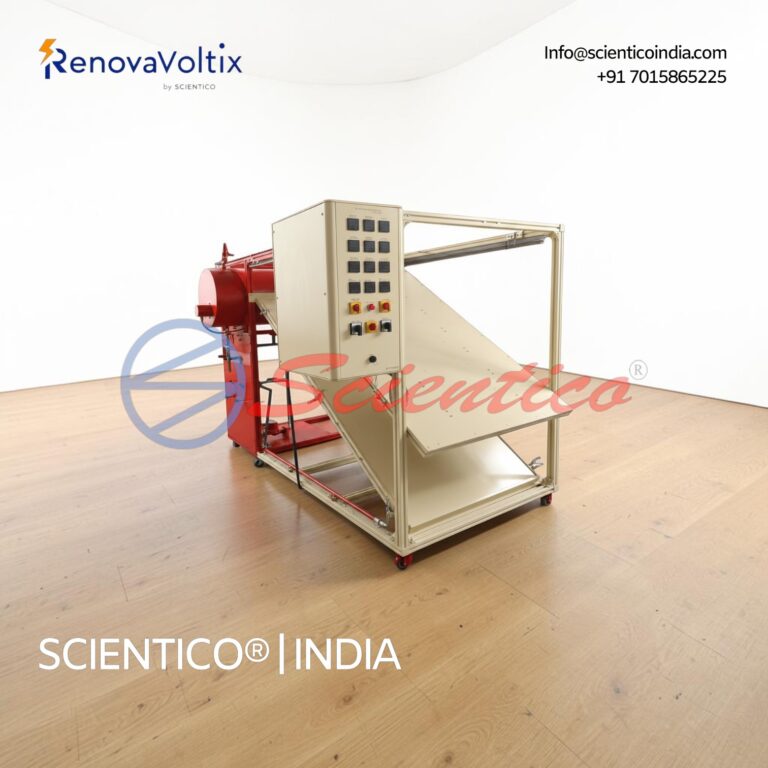
Solar Thermal Trainer | RVX-010
The Solar Thermal Trainer RVX-010 is a laboratory-based solar thermal training platform that demonstrates solar thermal heating of domestic water using both thermosiphon and forced pumping system configurations. It transforms solar energy into usable thermal energy using a high-power artificial solar simulator, enabling a full range of controlled indoor experiments. Product Overview The Solar Thermal Trainer RVX-010 consists of four core elements: a thermal solar collector, a storage tank, an artificial light source solar simulator, and a pumping system. The solar collector is mounted on an aluminium frame with copper tubes through which water flows, designed for maximum absorption efficiency. The accumulator tank is made from anti-corrosive material with an integrated heating element and safety device for over-temperature protection. The solar simulator uses lamps emitting radiation similar to sunlight, measured by a radiation sensor. Three lighting configurations are available: all lamps on, half the lamps on in a zig-zag pattern, or one lamp on. A pump provides forced convection of heat transfer fluid through the accumulator tank. The system supports both thermosiphon and forced pumping operation. Safety valves for overpressure protection are included. Sensors and meters record temperature, flow, and radiation. The unit is mounted on a metallic structure with wheels for mobility and features HDF panel construction with LED digital display instrumentation.
View product details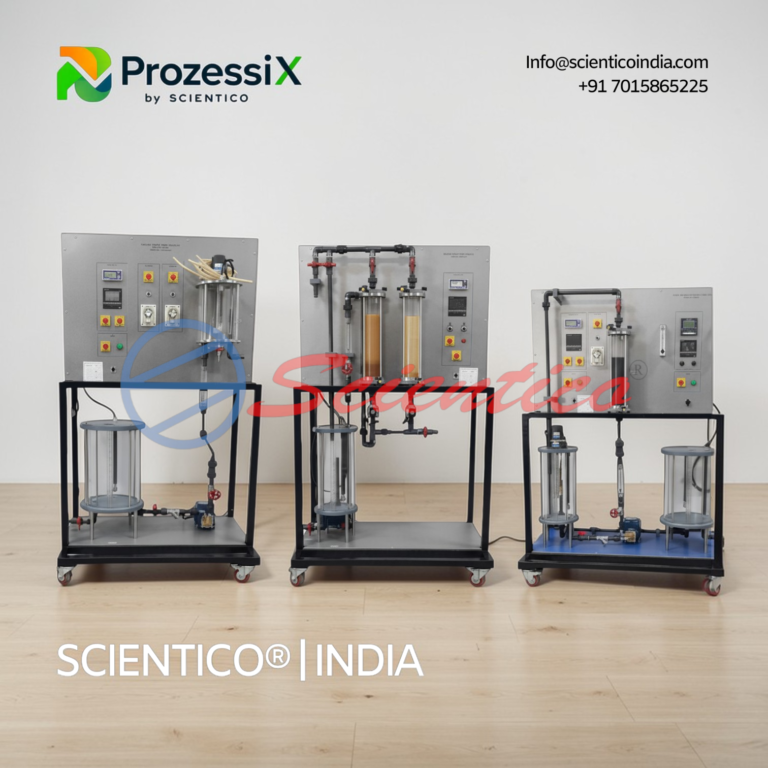
Analytical Process Control Trainer | ProzessiX PX-04
The Prozessix PX-04 is an analytical process control trainer for instrumentation and process engineering laboratories, giving students hands-on PID loop tuning across flow, level, temperature and pressure processes on a single bench.
View product details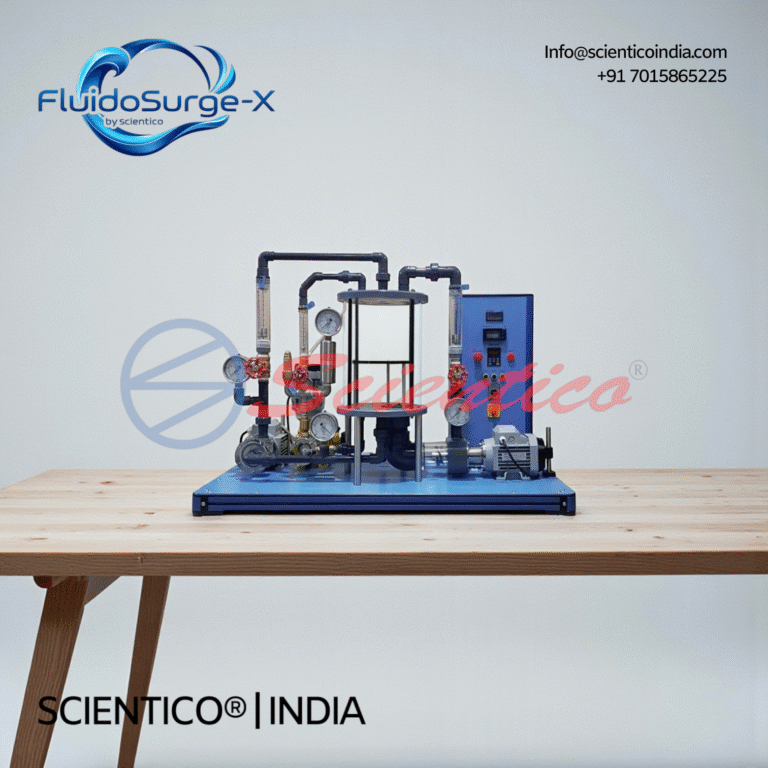
Multi Pump Test Rig Apparatus | FluidoSurge-X 294
The FluidoSurge X-294 is a multi pump test rig (series and parallel centrifugal pump test rig) that lets students run single, series and parallel pump configurations on one apparatus and compare the resulting head–discharge–efficiency characteristics.
View product detailsWhat you need before you start
Before you open a single quote, get these lined up. Skip this step and you will re-tender in six months.
- Course map. List every experiment your syllabus mandates: Otto and Diesel cycle demos, Rankine, refrigeration COP, heat exchanger effectiveness, film vs dropwise condensation, and so on. Regulator lists from AICTE, NBA, DGT, or the local TVET, TCU, CUE, NUC or MOHE authority are your source of truth, not the vendor catalogue.
- Floor plan. Thermo rigs are heavy and hot. Budget 4 to 6 sq m per major bench, 1 m clearance behind boilers and refrigeration trainers, and a fume path for any combustion engine rig.
- Utilities. Confirm 3-phase supply, water inlet and drain, exhaust routing for IC-engine test beds, and compressed air where the rig needs it. Half of the delivery disasters I have seen came from nobody checking the actual amps at the socket.
- Budget bands. Split the indent into teaching-grade, research-grade, and shared industrial-grade. Do not price a Rankine cycle apparatus in the same bucket as a solar thermal trainer, you will short-change one of them.
- Standards reference. Have the ISO 9001:2015 and CE conformity requirements written into the tender before it goes out, not bolted on after.
Step-by-step: thermodynamics lab equipment selection
Follow these steps in order. Each one gates the next. Every serious thermodynamics lab equipment tender I have shepherded through the system used a version of this sequence.
- Anchor to the syllabus. Print the syllabus, tick every experiment that requires a dedicated rig, and group them by domain: pure thermodynamics, heat transfer, refrigeration and air-conditioning, IC engines, and renewable thermal. This becomes your line-item list.
- Set the accuracy class per rig. A diploma-level Marcet boiler at plus-minus 1 percent is fine, a research heat exchanger for a PG dissertation needs plus-minus 0.1 percent on temperature. Do not pay research money for teaching accuracy, and do not accept teaching accuracy where you need to publish.
- Decide standalone vs modular benches. Modular service benches (steam, water, air) save floor space and cabling if you run 8 to 12 experiments off the same utility spine. Standalone is easier to run in parallel batches of 30 students.
- Specify instrumentation on the rig, not around it. Insist on onboard thermocouples of stated grade (K-type Class 1 is a safe default), calibrated pressure gauges, and a data-acquisition port. If the vendor expects you to bring your own multimeter, that is a red flag.
- Ask for the calibration certificate. Every temperature probe, pressure transducer and flow meter should ship with a NABL or ISO 17025 traceable calibration certificate. No certificate, no acceptance.
- Check the safety envelope. Pressure relief valves on boilers, guarded belts on engine test beds, low-water cutouts on Marcet-type rigs, and residual current devices on every power feed. These are cheap for the vendor to include and expensive for you to retrofit.
- Plan the electrical load together. Add up the total kW on your indent list. Combustion engine rigs and refrigeration trainers are the hogs. Get the electrical contractor into the same meeting as the lab-in-charge before you sign the PO.
- Nail the spares list. Insist on a 2-year consumables and spares list with unit prices at time of tender. Heater elements, thermocouples, pump seals, refrigerant charges. This is where captive vendors quietly recover their margin.
- Freeze the acceptance test. Write the site acceptance protocol into the PO: what readings, at what setpoints, over what runtime, before you sign off. Do not rely on the vendor to draft this.
- Book the training. Two days of on-site operator training with the lab-in-charge and at least one lab technician, delivered before students touch the rig. Put it in the PO.
Common mistakes and pitfalls
These four have burnt every buyer I know at some point.
- Buying by brochure photo. The rig in the photo is often the export-spec unit with premium instrumentation. Check the actual scope of supply line by line.
- Ignoring ambient conditions. A refrigeration trainer rated for 25 degrees ambient will misbehave in a 38-degree lab in May. Ask for performance derating curves.
- Underspec on data acquisition. A rig without a proper DAQ port will lock you out of Industry 4.0 electives and any PG-level project work three years from now. Insist on a documented interface.
- No local service footprint. An imported rig with no Indian service partner means a 6-week wait on a 200-rupee sensor. Ask for the service engineer’s actual location.
- Forgetting the exhaust. IC engine test beds must vent. I have seen a brand-new engine bench sit unused for a full academic year because nobody costed the flue.
Standards and compliance
Get these written into every line item, not the tender preamble.
- ISO 9001:2015 for the manufacturer’s quality system, evidenced by the current certificate, not a scanned copy from 2019.
- CE conformity for any electrical, pressure-bearing or safety-critical rig, with the declaration of conformity in the shipping paperwork.
- ISO 17025 or NABL-traceable calibration for every sensor that produces a graded reading.
- Local electrical code compliance on cable gauge, MCB rating and earthing. Non-negotiable.
If you are procuring under NBA, AICTE, DGT, PCI, INC, NUC, CUE, TCU, MOHE or CAA oversight, keep a compliance dossier per rig. It saves you during accreditation visits.
The Scientico angle
Scientico has been manufacturing engineering lab equipment out of Ambala since 1993, shipping to 60-plus countries, and running an ISO 9001:2015 certified system with CE-conformant rigs where applicable. What that means for a thermodynamics lab buyer is a domestic service footprint and a spares chain that does not depend on sea freight.
Two rigs I would flag if you are speccing today: the RVX solar thermal trainer if your syllabus covers renewable thermal energy conversion, and the ProZessix analytical process control trainer for the process side of thermodynamics. Both come with onboard instrumentation and traceable calibration, which is the acceptance-test hurdle most imports fail on arrival.
For the wider fluid and pump side of a combined thermal-fluid lab, the FluidoSurgeX multi-pump test rig is worth pricing into the same indent because it shares utilities and floor plan with a hydraulic bench.
Related reading
- Thermodynamics lab equipment buyer’s guide (India)
- Renewable energy trainer buyer’s guide
- Complete fluid mechanics lab setup buyer’s guide
- Lab equipment for engineering colleges hub
- Lab equipment for polytechnics and TVET hub
- Lab equipment for research labs hub
If you want a shortlist built against your actual syllabus, floor plan and budget bands, send the syllabus PDF and a rough lab layout to the team via the Scientico contact page. You will get a line-item indent back, not a brochure dump.
Frequently Asked Questions
What is the minimum set of thermodynamics lab equipment for an undergraduate engineering course?
At a bare minimum you need a Marcet boiler, a two-stroke and four-stroke IC engine test bed, a vapour compression refrigeration trainer, a heat exchanger unit (parallel and counter flow), and a Rankine cycle demonstrator. That covers the AICTE and most TVET syllabi. Add a solar thermal trainer if your syllabus includes renewable energy electives.
How much floor space should I plan per thermodynamics rig?
Budget 4 to 6 sq m per major bench, with 1 m clearance behind any rig that gets hot or vents combustion gas. IC engine test beds need a dedicated exhaust duct to the outside. Refrigeration trainers need airflow on the condenser side, which many buyers forget.
Do I need CE-marked equipment for a lab in India?
You are not legally required to insist on CE conformity in India, but for pressure-bearing rigs, high-voltage trainers, and any equipment on a shared student floor, CE is the cleanest way to prove a documented safety design. It also matters for accreditation bodies that benchmark against international norms.
Teaching-grade vs research-grade thermodynamics equipment, how do I decide?
Match the accuracy class to the use case. Teaching-grade at plus-minus 1 to 2 percent is fine for undergrad demonstrations where the objective is understanding cycle behaviour. Research-grade at plus-minus 0.1 to 0.5 percent, with NABL-traceable calibration, is what you need if the readings will end up in a dissertation or a journal paper.
What is the biggest hidden cost in a thermodynamics lab tender?
Consumables and spares over the first two years. Heater elements, thermocouples, refrigerant recharges, pump seals, gaskets. Lock unit prices for these into the original PO. Vendors who leave spares open-priced often recover their tender discount on the first spare order.
One honest ask
We don't gate anything on this site. You just read the whole thing free. If it was useful, leave your email and two things happen: we send you this page as a plain-text block you can paste into a tender file or an internal email, and we notify you the next time we publish a buyer tool like this one. Nothing else. No drip sequence, no sales calls booked without asking.