
This is the guide I wish every procurement officer had before floating the first RFQ. If you’re trying to figure out how to shortlist lab equipment supplier India options for an engineering college, polytechnic, ITI, or research lab, most of the mistakes get baked in during the first two weeks, not at the negotiation table. This playbook is written for lab-in-charge faculty, HODs, and procurement teams buying from the engineering training equipment category, whether you’re kitting a new fluid mechanics lab or replacing a 20-year-old hardness tester. I’ll show you the exact filter I use, in the order I use it.
Fair warning: I’ll be opinionated. After 15 years buying rigs for diploma labs, R and D setups, and export projects, I’ve seen the same three failure modes repeat, and they’re preventable in an afternoon of due diligence.
Equipment mentioned in this guide
Review the product information, specifications and model before requesting a quotation.
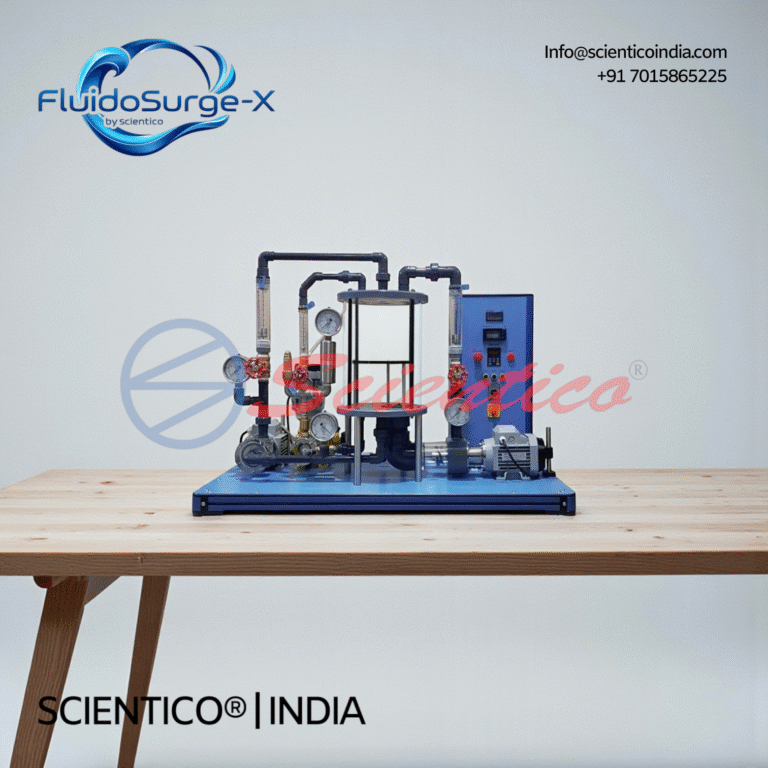
Multi Pump Test Rig Apparatus | FluidoSurge-X 294
The FluidoSurge X-294 is a multi pump test rig (series and parallel centrifugal pump test rig) that lets students run single, series and parallel pump configurations on one apparatus and compare the resulting head–discharge–efficiency characteristics.
View product details
Universal Hardness Tester
The Universal Hardness Tester manufactured by Scientico India combines Brinell, Vickers, and Rockwell hardness testing methods in a single machine. The machine uses interchangeable indenters and a built-in optical measuring system for Brinell/Vickers measurements, with direct-reading digital display for Rockwell hardness.
View product details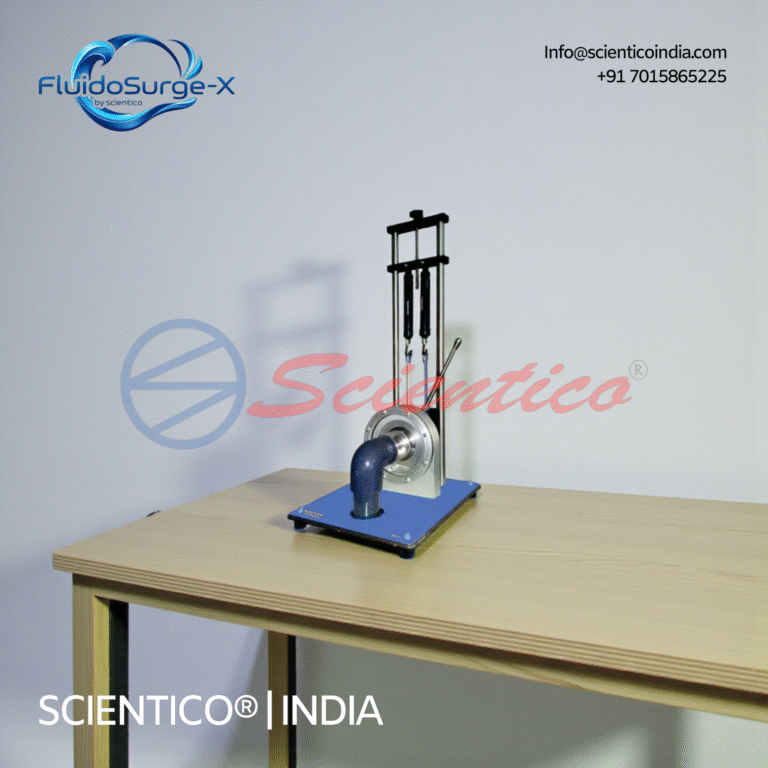
Kaplan Turbine Apparatus | FluidoSurgeX 208
The Kaplan Turbine Apparatus FluidoSurgeX 208 is a laboratory-scale training system designed to study the operating characteristics of a Kaplan reaction turbine. Manufactured by SCIENTICO, the apparatus demonstrates energy conversion from hydraulic power to mechanical power. It is suitable for instructional experiments in fluid mechanics and hydraulic machinery laboratories. The system operates using a controlled water supply from a hydraulic bench.
View product details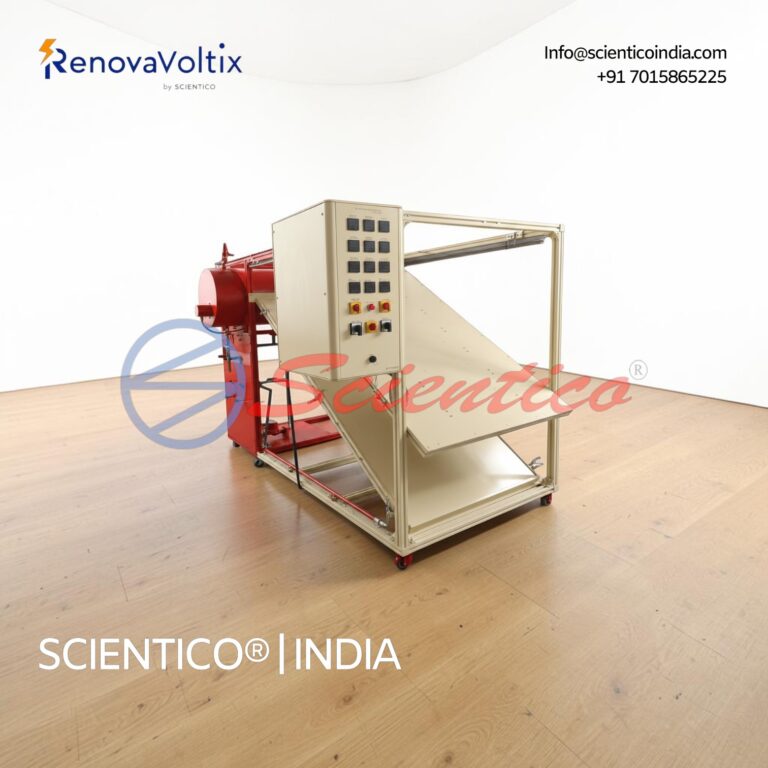
Solar Thermal Trainer | RVX-010
The Solar Thermal Trainer RVX-010 is a laboratory-based solar thermal training platform that demonstrates solar thermal heating of domestic water using both thermosiphon and forced pumping system configurations. It transforms solar energy into usable thermal energy using a high-power artificial solar simulator, enabling a full range of controlled indoor experiments. Product Overview The Solar Thermal Trainer RVX-010 consists of four core elements: a thermal solar collector, a storage tank, an artificial light source solar simulator, and a pumping system. The solar collector is mounted on an aluminium frame with copper tubes through which water flows, designed for maximum absorption efficiency. The accumulator tank is made from anti-corrosive material with an integrated heating element and safety device for over-temperature protection. The solar simulator uses lamps emitting radiation similar to sunlight, measured by a radiation sensor. Three lighting configurations are available: all lamps on, half the lamps on in a zig-zag pattern, or one lamp on. A pump provides forced convection of heat transfer fluid through the accumulator tank. The system supports both thermosiphon and forced pumping operation. Safety valves for overpressure protection are included. Sensors and meters record temperature, flow, and radiation. The unit is mounted on a metallic structure with wheels for mobility and features HDF panel construction with LED digital display instrumentation.
View product detailsWhat you need before you start
Don’t call a single lab equipment supplier until these five things are on paper. Suppliers can smell an unprepared buyer within one email, and you’ll get generic quotes back that you can’t compare like-for-like.
- Equipment list with syllabus mapping. Tie every rig to a specific practical in the AICTE, NBA, DGT, PCI, INC or affiliating university lab manual. “Fluid mechanics lab” is not a spec. “Bernoulli’s apparatus + Reynolds + metacentric height + Kaplan turbine bench” is.
- Floor plan with services. Ceiling height, floor loading, drainage points, single-phase vs three-phase power, water inlet pressure. Turbine rigs need a sump. A UTM needs a level RCC pad. Hardness testers hate vibration from a nearby lathe.
- Budget with a stated grade band. Teaching-grade, research-grade, or industrial-grade. The price gap between them is typically 3x to 10x. Fix this before you talk to anyone.
- Standards reference. Note down which ASTM, ISO or IS standards each instrument must conform to. This is your veto card later.
- Approval trail. Who signs at what value, and by when. If your DPR clearance takes eight weeks, sea freight from a domestic-cast Indian OEM is still faster than an import.
Step-by-step: lab equipment supplier shortlisting
Here is the exact sequence. Follow it in order. Skipping steps is where colleges end up with rigs that fail NBA inspection.
- Longlist 8 to 12 suppliers. Pull from Google, IndiaMART verified filter, past tender awardees, and word-of-mouth from sister institutes. Ignore any lab equipment supplier without a real physical manufacturing address, not just a warehouse.
- Filter on manufacturer vs trader. Ask for GST + Udyam + factory photos + ISO 9001:2015 certificate scan. If they resell rebadged Chinese kit, you’ll pay 30 percent extra for the middleman and lose two weeks on every spare. Scientico, for reference, has manufactured in Ambala since 1993 and exports to 30+ countries, which is the profile you’re looking for.
- Request the exact BOM per rig, not a brochure. Motor rating, pump make, sensor make, PLC brand, tank material and gauge, frame size. Brochures hide substitutions. A real lab equipment supplier will send you a component-level BOM within 48 hours.
- Cross-check standards compliance. For a hardness tester, ask which of ASTM E10, E18, E92 or IS 1500 it conforms to and demand the calibration certificate template. For imports, insist on CE conformity documentation.
- Ask for three reference installs in your state or programme type. Then actually call two of them. Ask about breakdown frequency in year one, spare parts lead time, and whether the trainer showed up on install day sober and on time. You’ll learn more in one call than in five site visits.
- Score quotations on total cost of ownership, not sticker. Add: freight, installation, commissioning, first-year AMC, training days, spare kit, and calibration recertification. The cheapest bid is almost never the cheapest project.
- Visit the factory of your top two. Or ask for a live video walk-through. Look at the machine shop, the QC bench, and the outbound crating area. If crating is loose plywood, your rig will arrive with a bent frame.
- Negotiate the contract, not just the price. Payment milestones tied to factory acceptance test, site acceptance test, and 30-day performance guarantee. Not 100 percent against proforma. This alone will filter out half the low-integrity vendors.
- Lock warranty and AMC terms in writing. Minimum 12 months comprehensive, with defined response SLA. Get the AMC quote for years 2 and 3 before you sign, otherwise it triples at renewal.
- Run a documented FAT. Even a two-hour Zoom FAT catches wrong sensor ranges, missing drain valves, and untested control panels before the crate leaves the factory.
Common mistakes I still see in 2026
- Buying on L1 alone. The lowest quote in a government tender usually wins by cutting sensor grade or motor rating. Your NBA auditor will notice.
- No syllabus mapping. The rig arrives, works fine, and covers 60 percent of the required experiments. Now you’re stuck.
- Ignoring after-sales geography. A Bangalore supplier servicing a lab in Guwahati means three weeks of downtime per breakdown. Prefer vendors with a service partner within 500 km, or with a documented courier-swap policy for spares.
- Skipping calibration traceability. Every measuring instrument in your lab should have an ISO 17025 NABL-traceable calibration certificate at handover. If the supplier can’t produce one, walk.
- Buying research-grade for a teaching lab. Second-year diploma students don’t need a 5000 kN servo-hydraulic UTM. You’ll pay 4x and the extra sensitivity gets destroyed in month two.
Standards and compliance you must reference
Write these into your tender document verbatim. Suppliers who can’t respond in this language are not the right lab equipment supplier for a compliant institutional lab.
- ISO 9001:2015 for the manufacturer’s quality management system.
- CE marking if you’re importing or exporting equipment.
- ASTM E10, ASTM E18, and ASTM E92 for hardness testers. Also IS 1500 for Indian institutional buys.
- ISO 17025 / NABL calibration for every measuring instrument.
For programme-specific compliance, check the relevant regulator: AICTE and NBA for engineering, DGT for ITI, PCI for pharmacy, and INC for nursing. Overseas equivalents include TCU (Tanzania), NUC (Nigeria), CUE (Kenya), MOHE, and CAA.
The Scientico angle
I’ll disclose the bias: this is a Scientico site, and the reason I write for them is that they tick the manufacturer-not-trader box, hold ISO 9001:2015, and ship CE-conformant equipment out of Ambala. If you want to test their responsiveness against my checklist, request the BOM on the FluidoSurge X multi-pump test rig or the universal hardness tester. Both are the sort of rigs where trader-quality kit falls apart in year two, so they’re a fair stress test of any supplier’s real depth. Other useful rigs to benchmark against are the Kaplan turbine apparatus for fluid mechanics labs and the solar thermal trainer for renewable energy programmes.
Related reading
- Hydraulic bench buyer’s guide (India)
- Universal hardness tester buyer’s guide
- Brinell vs Vickers vs Rockwell comparison
- Complete fluid mechanics lab setup guide
- Lab equipment for engineering colleges and for polytechnics and TVET
If you want a second pair of eyes on your shortlist, or a component-level BOM against your tender spec, talk to the Scientico team. Send your equipment list, syllabus reference, and floor plan, and you’ll get a real BOM back, not a brochure.
Frequently Asked Questions
How many lab equipment suppliers should I shortlist before floating a tender?
Longlist 8 to 12, filter to 4 or 5 for detailed BOM requests, and take 2 to a factory visit or live video walk-through. Fewer than 3 shortlisted quotes usually means you’re overpaying; more than 5 in deep evaluation is a waste of your team’s time.
Manufacturer or trader, does it really matter for lab equipment in India?
Yes, a lot. Traders add typically 20 to 30 percent margin, cannot customise, and have no control over spare-part lead times. A direct manufacturer with an ISO 9001:2015 QMS and its own factory (Scientico manufactures in Ambala since 1993) will be faster on spares, cheaper over the project lifetime, and accountable when something breaks.
What certifications should a lab equipment supplier in India hold?
At a minimum: GST + Udyam registration, ISO 9001:2015 for the QMS, and CE conformity on export-grade equipment. Every measuring instrument they ship should come with an ISO 17025 NABL-traceable calibration certificate. Hardness testers should reference ASTM E10, E18, E92 or IS 1500 depending on scale.
How do I compare quotations on a like-for-like basis?
Force a component-level BOM per rig: motor kW and make, pump make, sensor make and range, PLC brand, tank material and gauge, frame size. Then score on total cost of ownership including freight, installation, first-year AMC, training days, spare kit and recalibration, not sticker price alone.
How long does delivery typically take from an Indian lab equipment manufacturer?
Expect several weeks of production for standard rigs and longer for customised setups. Sea freight for exports adds several more weeks. Domestic road dispatch anywhere in India is usually inside two weeks after factory acceptance. Always tie payment milestones to FAT and SAT, not to dispatch.
One honest ask
We don't gate anything on this site. You just read the whole thing free. If it was useful, leave your email and two things happen: we send you this page as a plain-text block you can paste into a tender file or an internal email, and we notify you the next time we publish a buyer tool like this one. Nothing else. No drip sequence, no sales calls booked without asking.