
Solar Cell Measurements | RVX 133
The Solar Cell Measurements RVX 133 investigates photovoltaic cell behavior under varying illumination and temperature. This solar cell measurements trainer features four monocrystalline cells (125x125mm, 3W max), four adjustable 100W lamps, Peltier temperature control (20°C to 60°C), patch panel with bypass diodes, and integrated measurement unit. Optional LABVIEW software enables automated characteristic curve recording via USB data acquisition.
The Solar Cell Measurements RVX 133 is an educational apparatus for studying photovoltaic solar cell behavior under varying illumination and temperature conditions. This solar cell measurements trainer features four monocrystalline silicon cells with adjustable lighting, Peltier temperature control, and patch panel for investigating cell interconnection effects and bypass diode functionality.
Product Overview
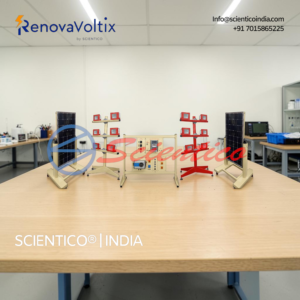
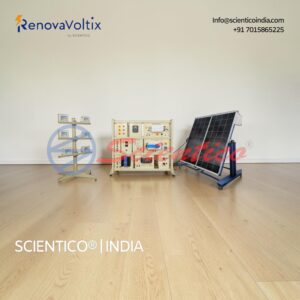
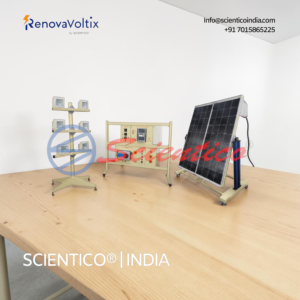
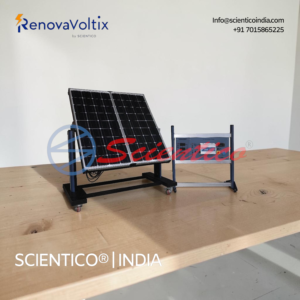
The RVX 133 solar cell measurements trainer comprises four 125x125mm monocrystalline silicon solar cells with 3W maximum output and 70% fill factor. Adjustable lighting unit with four 100W lamps provides variable illuminance control. Peltier module maintains precise cell temperature from 20°C to 60°C. Patch panel enables flexible cell interconnection in series or parallel configurations with integrated bypass diodes for shading loss analysis. Integrated rheostat enables manual current-voltage characteristic curve recording. Built-in measuring unit detects voltage and current across full operating range. Reference cell functions as illuminance sensor. Temperature sensors monitor cell temperature. Corresponding sensors detect voltage, current, and illumination at all test points. Included cable set enables various interconnection configurations. Optional automated measurement function enables software-controlled load pattern definition for characteristic curve capture. Stand-alone operation via manual rheostat or computer-controlled via optional LABVIEW DAQ software with USB data acquisition and Windows compatibility. All measured data logging and visualization available through optional software.
Solar Cell Measurements RVX 133 — Technical Specifications
| Parameter | Value |
|---|---|
| Cell Type | Monocrystalline silicon |
| Number of Cells | 4 units |
| Cell Size | 125 x 125mm approximately |
| Maximum Output Power | 3W per cell |
| Fill Factor | More than 70% |
| Current at Maximum Output | Approximately 4.8A |
| Voltage at Maximum Output | Approximately 0.6V |
| Short-Circuit Current | Approximately 5.4A |
| Open-Circuit Voltage | Approximately 0.6V |
| Peltier Module Temperature Range | 20°C to 60°C |
| Lighting Unit | 4 x 100W lamps |
| Adjustable Illuminance | Variable control |
| Patch Panel Connections | Series and parallel configurations |
| Bypass Diodes | Integrated for shading analysis |
| Load Resistance | Adjustable rheostat |
| Measuring Unit | Voltage and current detection |
| Reference Cell | Illuminance sensor |
| Temperature Control Accuracy | Peltier-regulated 20°C to 60°C |
| Data Acquisition | USB interface (optional software) |
Technical Data
Solar Cells:
- Type: monocrystalline silicon
- Quantity: 4 units
- Size: 125 x 125mm approximately
- Maximum output: 3W per cell
- Fill factor: more than 70%
- Current at maximum output: approximately 4.8A
- Voltage at maximum output: approximately 0.6V
- Short-circuit current: approximately 5.4A
- Open-circuit voltage: approximately 0.6V
Lighting System:
- Lighting unit: 4 x 100W lamps
- Adjustable illuminance control
- Reference cell as illuminance sensor
Temperature Control:
- Peltier module backing for solar cells
- Temperature range: 20°C to 60°C
- Precise temperature regulation
Interconnection and Load:
- Patch panel with bypass diodes
- Series and parallel connection capability
- Adjustable load resistance via rheostat
- Cable set for flexible configurations
Instrumentation:
- Built-in measuring unit
- Voltage detection across cells
- Current detection and measurement
- Temperature sensors
- Illuminance sensor (reference cell)
- Automated characteristic curve measurement function
Data Acquisition:
- USB interface connection
- Optional LABVIEW software compatibility
- Windows operating system support
- Data logging and visualization
Key Features
- Four Monocrystalline Cells: Solar cell measurements trainer features 125x125mm cells with 3W maximum output and 70% fill factor for comprehensive study
- Variable Illumination: Four 100W adjustable lamps enable investigation of illuminance effects on solar cell performance and power output
- Precise Temperature Control: Peltier module maintains cell temperature from 20°C to 60°C for thermal effect analysis
- Flexible Interconnection: Patch panel enables series and parallel cell connection with integrated bypass diodes for shading loss examination
- Bypass Diode Analysis: Built-in bypass diodes enable study of power degradation due to cell shading and partial blockage effects
- Adjustable Load Resistance: Integrated rheostat enables manual current-voltage characteristic curve recording and load variation
- Automated Measurement: Optional software-controlled load pattern enables automated characteristic curve capture at multiple conditions
- Comprehensive Sensing: Temperature, voltage, current, and illuminance sensors provide multi-parameter analysis capability
- Data Logging: Optional USB data acquisition with LABVIEW software enables complete performance monitoring and visualization
Experiments
- Physical behavior of solar cells under varying illuminance
- Physical behavior of solar cells under varying temperature
- Recording of current-voltage characteristic curves
- Current strength calculation using single diode model
- Power output calculation using single diode model
- Bypass diode effect on shaded cell performance
- Power degradation due to partial shading
- Series connection effects on voltage and current
- Parallel connection effects on voltage and current
- Illuminance variation effects on cell output
- Temperature variation effects on cell efficiency
- Fill factor measurement and analysis
- Open-circuit voltage determination
- Short-circuit current determination
- Maximum power point tracking analysis
Construction and Design
The Solar Cell Measurements RVX 133 integrates four monocrystalline silicon solar cells (125x125mm each) mounted on backing with Peltier module for temperature regulation from 20°C to 60°C. Four 100W adjustable lamps provide variable illuminance control directly above cells. Reference cell functions as illuminance sensor. Patch panel provides flexible interconnection capability with integrated bypass diodes for series and parallel configurations. Adjustable rheostat enables manual load variation and current-voltage characteristic curve recording. Built-in measuring unit detects voltage and current across full operating range. Integrated temperature sensors monitor cell temperature during testing. Cable set enables various connection configurations for multi-cell experiments. Compact design accommodates all four cells and measurement equipment on single apparatus. Optional USB interface connects to computer for automated software-controlled measurement sequences and data logging via LABVIEW.
Software
DAQ software in National Instruments LABVIEW environment (optional). Measures and calculates apparatus results. USB data acquisition support. Compatible with Windows operating system. Enables automated characteristic curve measurement and data logging.
Scope of Delivery
- 1 Trainer (four monocrystalline silicon cells with lighting unit, Peltier module, and patch panel)
- 1 Set of cables
- 1 Instructional manual
Q: What type of solar cells are used in the Solar Cell Measurements RVX 133?
A: Four monocrystalline silicon solar cells (125x125mm each) with 3W maximum output per cell and 70% fill factor are included. Short-circuit current approximately 5.4A and open-circuit voltage approximately 0.6V.
Q: How does the Solar Cell Measurements RVX 133 control temperature?
A: Peltier module backing provides precise temperature regulation from 20°C to 60°C, enabling investigation of temperature effects on solar cell performance and power output characteristics.
Q: How can solar cells be interconnected in the Solar Cell Measurements RVX 133?
A: Patch panel enables flexible series and parallel cell connections via included cable set. Integrated bypass diodes allow investigation of shading effects and power degradation in partially blocked configurations.
Q: What illumination control does the Solar Cell Measurements RVX 133 provide?
A: Four adjustable 100W lamps enable variable illuminance control. Reference cell functions as illuminance sensor to measure light intensity effects on cell performance.
Q: Can the Solar Cell Measurements RVX 133 automatically record characteristic curves?
A: Yes. Optional LABVIEW DAQ software enables automated measurement function via USB with software-controlled load pattern definition for unattended characteristic curve capture at multiple conditions.
Need Assistance? We're Here to Help!
Connect with our team for product specifications, pricing, and customized solutions for your institution or project.