
The question I get every quarter from HODs and store officers is the same: “Sir, our syllabus says refrigeration cycle, do we buy the compressor rig or the absorption one, or both?” Nine times out of ten the honest answer is buy the vapour compression trainer first, add absorption only if you teach a heat-utilisation or renewable-energy elective. That is the two-sentence version. The caveat: if you already own a boiler bench or solar collector rig, an absorption unit suddenly earns its shelf space because you can drive it off waste heat and run a genuinely different lab.
Equipment mentioned in this guide
Review the product information, specifications and model before requesting a quotation.
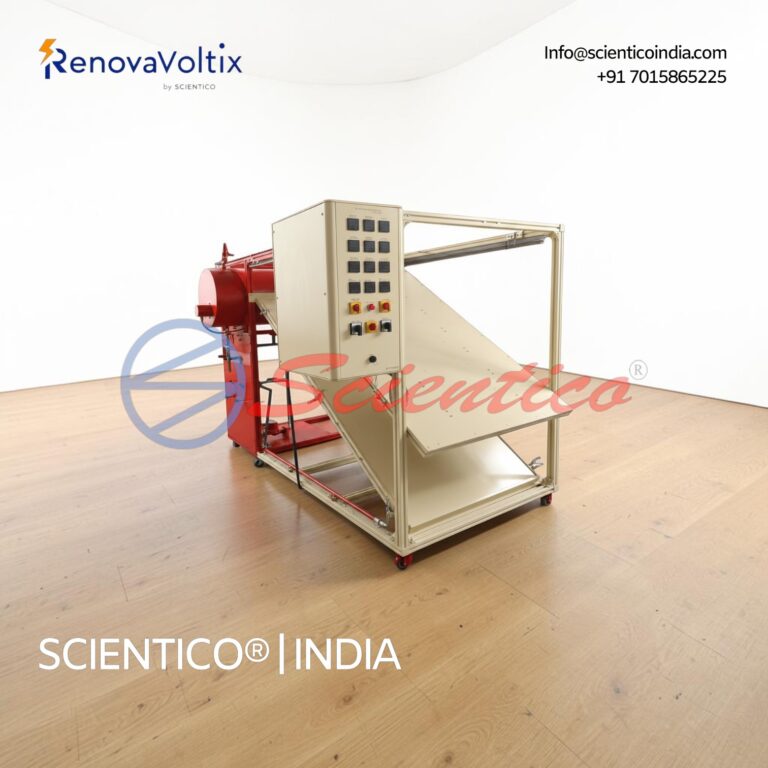
Solar Thermal Trainer | RVX-010
The Solar Thermal Trainer RVX-010 is a laboratory-based solar thermal training platform that demonstrates solar thermal heating of domestic water using both thermosiphon and forced pumping system configurations. It transforms solar energy into usable thermal energy using a high-power artificial solar simulator, enabling a full range of controlled indoor experiments. Product Overview The Solar Thermal Trainer RVX-010 consists of four core elements: a thermal solar collector, a storage tank, an artificial light source solar simulator, and a pumping system. The solar collector is mounted on an aluminium frame with copper tubes through which water flows, designed for maximum absorption efficiency. The accumulator tank is made from anti-corrosive material with an integrated heating element and safety device for over-temperature protection. The solar simulator uses lamps emitting radiation similar to sunlight, measured by a radiation sensor. Three lighting configurations are available: all lamps on, half the lamps on in a zig-zag pattern, or one lamp on. A pump provides forced convection of heat transfer fluid through the accumulator tank. The system supports both thermosiphon and forced pumping operation. Safety valves for overpressure protection are included. Sensors and meters record temperature, flow, and radiation. The unit is mounted on a metallic structure with wheels for mobility and features HDF panel construction with LED digital display instrumentation.
View product details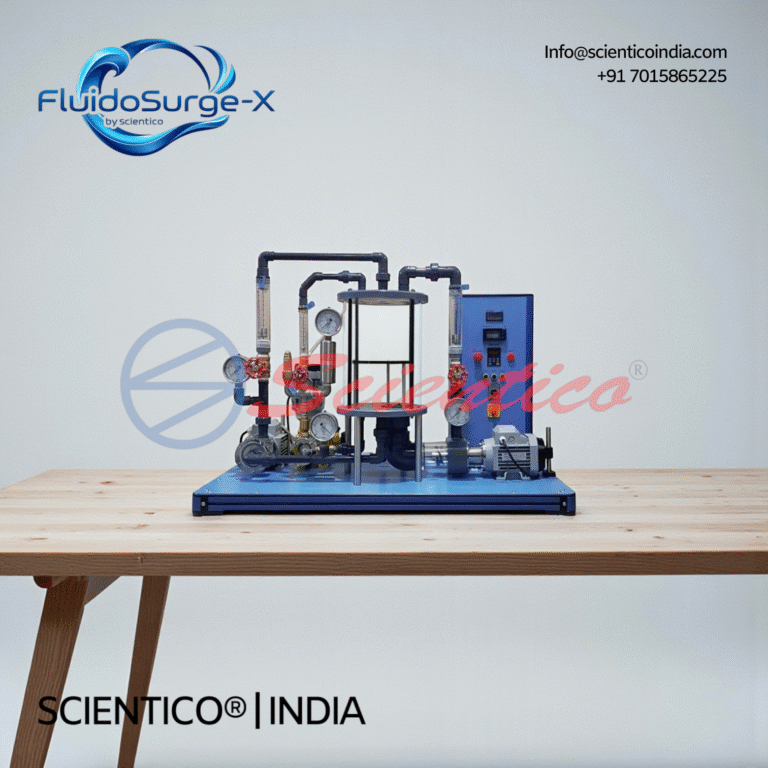
Multi Pump Test Rig Apparatus | FluidoSurge-X 294
The FluidoSurge X-294 is a multi pump test rig (series and parallel centrifugal pump test rig) that lets students run single, series and parallel pump configurations on one apparatus and compare the resulting head–discharge–efficiency characteristics.
View product details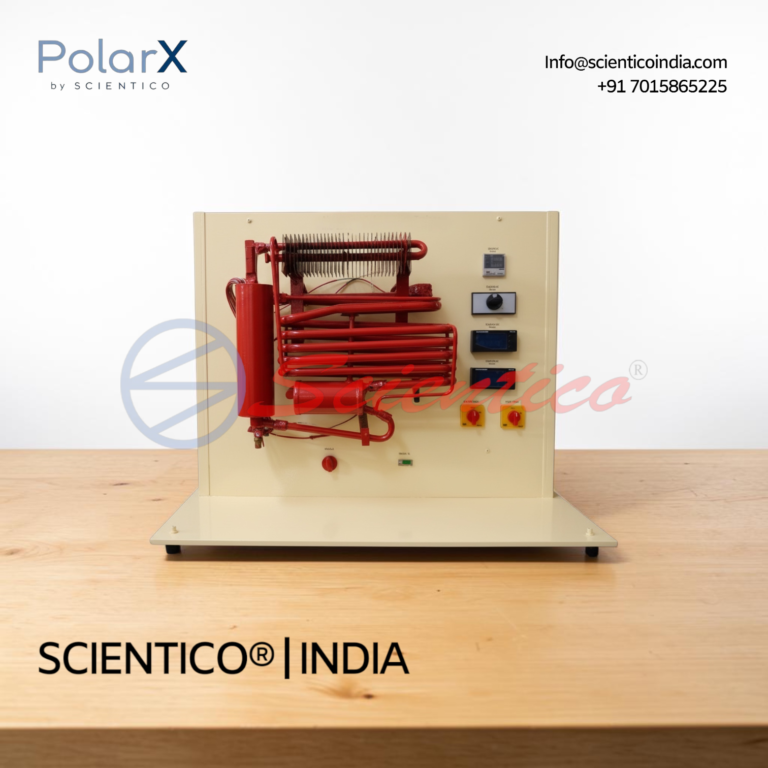
Absorption Refrigeration Trainer | PolarX – 504
The Absorption Refrigeration Trainer PolarX - 504 is a laboratory unit designed to demonstrate the fundamental operation of an absorption refrigeration system using an ammonia-water solution as the working medium and hydrogen as an auxiliary gas. This absorption refrigeration trainer includes an evaporator, absorber, boiler with bubble pump, and condenser as its primary components, with an adjustable electric heater at the evaporator as the cooling load and digital displays for temperature and power measurement across the refrigeration circuit.
View product detailsThe short answer
For a general mechanical engineering or diploma lab, I would put my money on a vapour compression refrigeration trainer from the ThermoFlux family. It covers the AICTE, MSBTE, GTU and AKTU refrigeration experiments verbatim, students see the compressor, condenser, expansion valve and evaporator as four physical boxes, and the COP maths lands in one afternoon. Absorption is the right call only when the department teaches thermal utilisation, tri-generation, or runs a solar/biomass elective and wants to close the loop.
Head-to-head at a glance
| Parameter | Vapour Compression Trainer | Vapour Absorption Trainer |
|---|---|---|
| Working principle | Mechanical compression of a refrigerant (usually R-134a or R-600a on training rigs) | Thermal compression using an absorbent-refrigerant pair (typically LiBr-water or ammonia-water) |
| Prime mover | Hermetic or open compressor, 1/8 to 1/2 HP typical on lab rigs | Heat source: electric heater, steam coil, or solar/waste heat input |
| Typical cooling capacity | Roughly 300 to 900 W at evaporator on a bench-top trainer | Roughly 100 to 400 W, and it responds slowly |
| Measured COP range | 2.5 to 4.0 on a well-tuned rig | 0.5 to 0.8 for single-effect LiBr-water |
| Instrumentation | 4 pressure gauges, 6-8 temperature points, energy meter, rotameter | Heat input meter, 8-10 temperature points, generator and absorber sight glass |
| Time per experiment | 45 to 60 minutes, steady state reached quickly | 90 to 120 minutes, long warm-up and slow response |
| Applicable standard | IS 1500 style safety practice, documentation reviewed per model components, ISO 9001:2015 build | Same build standards, plus IS 15540 handling notes for the working pair |
| Cost tier | Low to mid | Mid to high, and freight is heavier |
| Best fit | Core mechanical, diploma, ITI refrigeration and A/C papers | Elective on non-conventional energy, MTech thermal, research |
Working principle: how each one operates
Vapour compression. The compressor pulls low-pressure refrigerant vapour off the evaporator, squeezes it up to condenser pressure, the condenser rejects heat to ambient and the fluid turns back to liquid. A capillary tube or thermostatic expansion valve drops the pressure, the flashing liquid boils in the evaporator and lifts heat from the cabinet. On our training rigs students measure P1 to P4 and T1 to T8, plot the cycle on a p-h chart, and compute COP as Q_evap divided by W_comp. The whole thing behaves like a small domestic fridge, because functionally it is one, dissected and put on a frame.
Vapour absorption. The compressor is replaced by a generator, absorber, pump and solution heat exchanger. Heat added at the generator boils refrigerant out of a strong solution, refrigerant vapour goes to a condenser exactly as before, expands, evaporates, then returns to the absorber where the weak solution soaks it up again. Because the pump only handles liquid, the electrical input is tiny, but the heat input at the generator is large. That is why COP looks poor on paper yet the technology wins where waste heat is free. LiBr-water works below 5 C only with care, ammonia-water goes lower but needs a rectifier column.
vapour compression vs absorption refrigeration trainer, which for which department
BTech Mechanical, core lab. Vapour compression, no debate. Every syllabus I have seen from VTU, AKTU, GTU, BTEUP and SBTET lists the vapour compression cycle as a compulsory experiment. Absorption is usually one line under “demonstration”.
Diploma and polytechnic (MSBTE, HSBTE, PSBTE, DOTE, WBSCTE). Vapour compression again. Diploma students respond well to visible mechanical parts. Our polytechnic and TVET lab kits pair the compression trainer with a small window-AC cut section, and pass rates on the practical viva go up because students touch the parts they name.
ITI refrigeration and A/C trade (DGT curriculum). Compression trainer plus a charging-and-recovery station. Skip absorption entirely at ITI level, it is not on the DGT trade syllabus.
MTech thermal, research labs, NBA-accredited departments chasing a renewable-energy angle. This is where absorption earns its keep. Pair it with our RVX-010 solar thermal trainer and you have a genuine solar-driven cooling experiment that publishes well. See our renewable energy trainer buyer’s guide for the full pairing logic.
Nursing and pharmacy colleges. Neither. If you landed here from a cold-chain search, you want a lab refrigerator, not a training rig. See the PCI pharmacy lab guide or the INC nursing lab guide.
Common mistakes when choosing
1. Buying absorption because it looks impressive in the tender. I have watched three colleges specify LiBr-water rigs, then use them twice a year because setup takes two hours and the COP number depresses students. Impressive-in-tender is not the same as useful-in-lab.
2. Under-specifying instrumentation on the compression rig. Four gauges and four thermocouples are the bare minimum. If the vendor quotes only two gauges, you cannot plot the cycle, and the experiment collapses to “switch it on and read the ammeter”. Insist on P1-P4 and T1-T8 at least.
3. Ignoring refrigerant choice. R-22 is being phased down globally. Ask for R-134a or R-600a on new orders. Retrofit kits exist but are a headache. Same logic as when I push buyers away from cast-iron flow benches in the thermodynamics lab equipment buyer’s guide.
4. Forgetting ambient conditions. Both trainers behave badly above 40 C ambient. If the lab is on the top floor in Rajasthan or Vidarbha without AC, budget for a room split first. The rig readings will look wrong otherwise and nobody will trust the equipment.
Scientico’s recommendation
For most engineering colleges and polytechnics, my default recommendation is the ThermoFlux vapour compression refrigeration test rig from the refrigeration and air-conditioning trainer category. It is the model that clears every state technical board practical I have seen, and spares are stocked in Ambala. If you also teach solar or waste-heat utilisation, add a single-effect LiBr-water absorption unit as the second rig, and route it from the RVX-010 solar thermal trainer so students see a real heat-source-to-cooling chain. For a broader thermofluids build-out, buyers usually pair these with a hydraulic bench and the FluidoSurgeX multi-pump test rig, and I map the full setup in the complete fluid mechanics lab guide.
Scientico has been building this class of equipment since 1993, we ship to 30+ countries out of Ambala, and every unit is built to ISO 9001:2015 and CE-marked components. That matters when your NBA or NAAC panel starts asking about traceability.
Cost and delivery framework
I am not going to quote a fixed price on a public page, because refrigerant, control panel, and data-acquisition options move the number a lot. A useful mental model:
- Cost tier. A single vapour compression trainer sits in the low-to-mid tier of our thermodynamics range. Absorption is typically mid-to-high because of the heat exchangers and instrumentation.
- Incoterms. For Indian institutions we quote ex-works Ambala or door-delivered. For overseas we default to FOB Mundra or Nhava Sheva, CIF on request. Ammonia-water absorption units need extra IMDG paperwork.
- Lead time. Expect several weeks of production for a compression rig, longer for absorption because of the heat-exchanger fabrication queue. Sea transit adds more, and monsoon slots at Nhava Sheva push things right. Air freight is possible on the compression rig, rarely economical on the absorption one.
- Installation. Compression trainers are largely plug and play. Absorption units need a vacuum-check on arrival and a first charge that we walk you through on video call.
If you want a written quote with the specific instrumentation, refrigerant and data-logging options that fit your syllabus, send your board and department details through the contact page and I will get a spec sheet back to you the same working day. Tell me which state board or university you are affiliated to, and whether the rig is going into a core lab or an elective, that alone changes the recommendation.
Frequently Asked Questions
Which refrigeration trainer is compulsory for AICTE and state board mechanical syllabi?
The vapour compression refrigeration trainer. Every state board practical I have reviewed (MSBTE, GTU, AKTU, VTU, BTEUP, SBTET) lists the vapour compression cycle as a graded experiment. Absorption usually appears only as an optional demonstration under a non-conventional energy elective.
Why is the COP of an absorption trainer so much lower than a compression rig?
Because the driving energy is heat, not electricity. A single-effect LiBr-water unit typically shows COP between 0.5 and 0.8, while a well-tuned vapour compression rig lands at 2.5 to 4.0. Absorption is not less efficient in practice, it is just measured against a large heat input that is often free waste heat in the field.
Can one rig do both cycles?
No, not honestly. Combination rigs exist but they compromise on both sides, gauges are undersized, and the absorption loop is usually a token demonstration coil. If both cycles matter to your curriculum, budget for two separate trainers rather than one hybrid.
What refrigerant should I specify on a new vapour compression trainer?
R-134a for general purpose, R-600a if your institution is chasing a low-GWP profile for accreditation. Avoid R-22, it is being phased down globally and spares will get harder to source over the equipment’s ten-year life.
How long does delivery typically take to an Indian college?
Several weeks of production at Ambala, plus road transit. Overseas orders add sea transit and port clearance. I always tell buyers to place the purchase order at least one semester before the practical exam window, so installation and refrigerant charging finish before students need the rig.
One honest ask
We don't gate anything on this site. You just read the whole thing free. If it was useful, leave your email and two things happen: we send you this page as a plain-text block you can paste into a tender file or an internal email, and we notify you the next time we publish a buyer tool like this one. Nothing else. No drip sequence, no sales calls booked without asking.