
A Venturi meter is a device used to measure the flow rate (discharge) of a fluid moving through a pipe. It works by narrowing the pipe at a section called the throat, which increases the fluid’s velocity and lowers its pressure; by measuring the pressure difference between the wide inlet and the narrow throat, the flow rate can be calculated using Bernoulli’s equation and the continuity equation. It is one of the most accurate and widely taught flow-measurement instruments in fluid mechanics laboratories.
For students in engineering, polytechnic, and applied-science programs, the Venturi meter is a cornerstone experiment because it ties together three fundamental ideas-conservation of mass, conservation of energy, and the practical realities of friction and energy loss. Below is a clear, exam-ready and lab-ready explanation of how it works, the governing equation and its derivation, the main parts, and how it is used in a teaching laboratory.
Equipment mentioned in this guide
Review the product information, specifications and model before requesting a quotation.
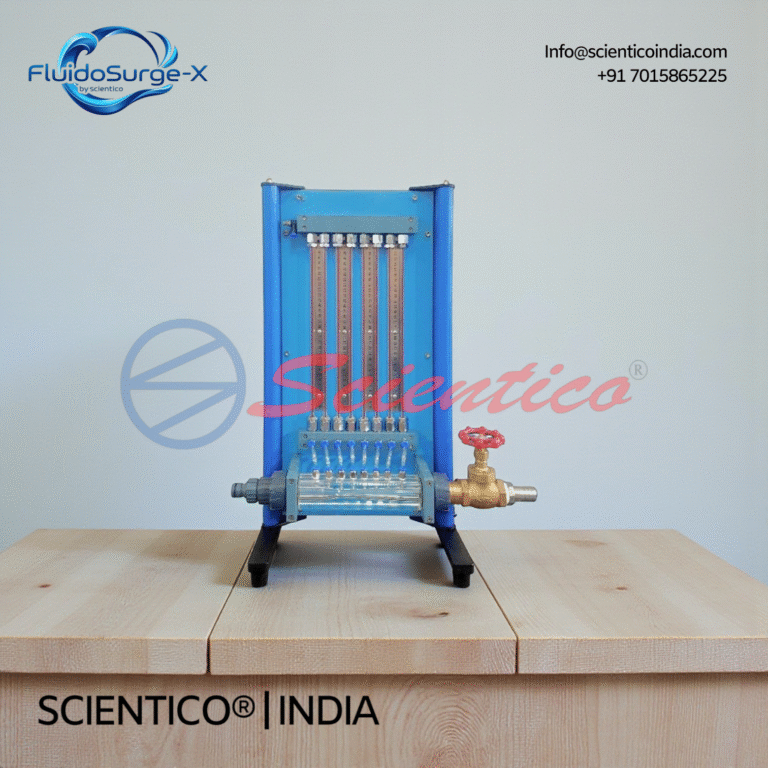
Venturi Meter Apparatus | FluidoSurge-X 176
The Venturi Meter Apparatus FluidoSurge-X 176 is designed for experimental determination of flow rate in pipes using a Venturi tube. It enables measurement of static pressure distribution along a horizontal Venturi section. The apparatus supports analysis of pressure drop and pressure recovery characteristics. It is intended for fluid mechanics laboratory instruction and experimental verification.
View product detailsHow does a Venturi meter work?
A Venturi meter works on the principle that when a fluid is forced through a constriction, it must speed up, and as it speeds up its pressure drops. This is a direct consequence of two laws:
- The continuity equation: the same mass of fluid passing the wide inlet per second must also pass the narrow throat, so the velocity at the throat is higher than at the inlet.
- Bernoulli’s equation: for an ideal, incompressible fluid, the total energy (pressure energy + kinetic energy + potential energy) stays constant along a streamline. Where velocity rises, pressure must fall.
The pressure difference between the inlet and the throat is measured-typically with a U-tube manometer or a differential pressure gauge. Because this pressure difference is directly related to the velocity (and therefore the flow rate), measuring it lets you calculate exactly how much fluid is flowing through the pipe.
Why is the exit cone longer than the inlet cone?
A Venturi meter is intentionally not symmetrical. The converging (inlet) cone is short and steep, while the diverging (exit) cone is long and gradual. The gentle expansion allows the fluid to slow back down smoothly and recover most of its pressure, which keeps the permanent energy loss low. A sudden expansion would create turbulence and waste energy. This pressure-recovery feature is the main reason a Venturi meter is more efficient than a simple orifice plate.
What is the Venturi meter equation?
The discharge (volume flow rate) through a Venturi meter is given by the standard equation:
Q = Cd · (A1 · A2) / √(A1² − A2²) · √(2gh)
Where:
| Symbol | Meaning | Typical unit (SI) |
|---|---|---|
| Q | Discharge / actual flow rate | m³/s |
| Cd | Coefficient of discharge (accounts for real-fluid losses) | dimensionless |
| A1 | Cross-sectional area at the inlet | m² |
| A2 | Cross-sectional area at the throat | m² |
| g | Acceleration due to gravity | m/s² |
| h | Pressure head difference (inlet − throat) | m of fluid |
The term before √(2gh) is fixed by the geometry of the meter, so in practice the only variable you read off during an experiment is the manometer head h. The coefficient of discharge Cd for a well-made Venturi meter is generally high (close to unity), which is why it is considered an accurate instrument.
How is the Venturi meter equation derived?
The derivation combines the two laws mentioned earlier. The logic runs as follows:
- Apply Bernoulli’s equation between the inlet (section 1) and the throat (section 2) for a horizontal meter. The pressure-head difference equals the difference in velocity heads.
- Apply the continuity equation, A1V1 = A2V2, to express the inlet velocity in terms of the throat velocity.
- Substitute and solve to get the theoretical throat velocity, then multiply by area to get the theoretical discharge.
- Because real fluids have friction and minor losses, multiply the theoretical discharge by the coefficient of discharge Cd to obtain the actual discharge.
The difference between theoretical and actual discharge is exactly what Cd captures-and determining Cd experimentally is usually the core objective of the lab exercise.
What are the main parts of a Venturi meter?
A Venturi meter has three distinct sections plus a pressure-measuring arrangement:
- Converging cone (inlet): a short, tapering section that gradually reduces the pipe diameter and accelerates the fluid.
- Throat: the narrowest section, where velocity is maximum and pressure is minimum. One pressure tapping is taken here.
- Diverging cone (outlet): a long, gentle expansion that slows the fluid and recovers pressure.
- Pressure tappings and manometer: connections at the inlet and throat feed a differential manometer (often a U-tube with mercury) or a pressure transducer that reads the head difference h.
What is the Venturi meter used for in a laboratory?
In a teaching fluid mechanics lab, a Venturi meter apparatus is typically used to:
- Determine the coefficient of discharge (Cd) for the meter.
- Verify Bernoulli’s principle and the continuity equation experimentally.
- Study the relationship between pressure head and flow rate.
- Compare actual versus theoretical discharge and understand real-fluid losses.
- Plot calibration curves (for example, Q against √h, or Cd against Reynolds number).
A typical lab setup pairs the Venturi meter with a measuring tank and a stopwatch (or a flow-measuring bench) so students can find the actual discharge by collecting a known volume over a measured time, then compare it with the value predicted by the equation.
Venturi meter vs. orifice meter: how do they compare?
| Feature | Venturi Meter | Orifice Meter |
|---|---|---|
| Energy / pressure loss | Low (good pressure recovery) | High |
| Accuracy | High | Moderate |
| Coefficient of discharge | High (near unity) | Lower |
| Cost & size | Higher, longer | Lower, compact |
| Best for | Permanent installations, accurate metering | Quick, low-cost measurement |
Both devices are usually available together in a hydraulics lab so students can directly observe why a Venturi meter loses less energy than an orifice meter for the same flow.
What should colleges look for when buying a Venturi meter apparatus?
When equipping a fluid mechanics or hydraulics laboratory, buyers typically evaluate a Venturi meter setup on a few practical points:
- Construction and transparency: a clear or sectioned body helps students see the converging-throat-diverging geometry.
- Manometer clarity: easy-to-read differential manometer tappings at the inlet and throat.
- Integration: compatibility with a hydraulic bench or a self-contained sump, pump, and measuring tank.
- Documentation: a clear manual covering the theory, procedure, and sample calculations.
- Certification and calibration records: conformity and calibration documentation that supports lab audits and accreditation requirements.
As an ISO 9001:2015 and model-specific manufacturer based in Ambala, India, exporting to 30+ countries since 1993, Scientico India supplies fluid mechanics teaching apparatus to engineering colleges, polytechnics, and universities in India and abroad, with calibration and conformity documents included. You can browse the full Fluid Mechanics Lab Equipment category, and-being GeM-registered-request a quote-based CIF proforma invoice, typically issued within 24 hours, via WhatsApp at +91-7015865225.
Key takeaways
- A Venturi meter measures pipe flow rate by creating a controlled constriction and reading the resulting pressure drop.
- It is governed by Bernoulli’s equation and the continuity equation, combined into a single discharge formula.
- The coefficient of discharge (Cd) accounts for real-world losses and is often the main quantity determined in lab experiments.
- Its long diverging cone gives excellent pressure recovery, making it more efficient than an orifice meter.
- It is a staple of college hydraulics labs for teaching conservation of mass and energy in real fluids.
Frequently Asked Questions
What is a Venturi meter in simple words?
A Venturi meter is an instrument that measures how much fluid flows through a pipe. It narrows the pipe at a point called the throat, which speeds up the fluid and lowers its pressure. By measuring the pressure difference between the wide and narrow sections, the flow rate can be calculated.
What is the working principle of a Venturi meter?
It works on Bernoulli’s principle combined with the continuity equation. As fluid passes through the narrow throat, its velocity increases and its pressure decreases. The measured pressure difference between the inlet and throat is directly related to the flow rate, allowing the discharge to be calculated.
What is the Venturi meter equation?
The discharge is given by Q = Cd · (A1·A2)/√(A1²−A2²) · √(2gh), where Cd is the coefficient of discharge, A1 and A2 are the inlet and throat areas, g is gravitational acceleration, and h is the pressure head difference between inlet and throat.
Why is a Venturi meter more efficient than an orifice meter?
A Venturi meter has a long, gradual diverging cone that lets the fluid slow down smoothly and recover most of its pressure, so the permanent energy loss is low. An orifice meter causes sudden expansion and turbulence, which wastes more energy.
What is the coefficient of discharge in a Venturi meter?
The coefficient of discharge (Cd) is a correction factor that accounts for real-fluid friction and minor losses. It is the ratio of actual discharge to theoretical discharge. For a well-made Venturi meter it is high and close to unity, which is why the device is considered accurate. Determining Cd is usually the main goal of the lab experiment.
One honest ask
We don't gate anything on this site. You just read the whole thing free. If it was useful, leave your email and two things happen: we send you this page as a plain-text block you can paste into a tender file or an internal email, and we notify you the next time we publish a buyer tool like this one. Nothing else. No drip sequence, no sales calls booked without asking.