
Hydraulics and pneumatics (fluid power) lab equipment is the set of trainers, test rigs, and bench-top apparatus that let mechanical, mechatronics, and production engineering students study how pressurised liquids and compressed air transmit force, motion, and control signals. A well-equipped fluid power lab typically includes a hydraulic trainer kit, a pneumatic trainer board, an electro-pneumatic/PLC add-on, and supporting test rigs such as a hydraulic press, pump, turbine, or actuator setups. These let students wire circuits, measure pressure and flow, and validate textbook theory through hands-on experiments.
This guide explains what belongs in a fluid power lab, how the equipment maps to common engineering syllabi in India, what to check before you buy, and how procurement and export delivery usually work for colleges and polytechnics.
Equipment mentioned in this guide
Review the product information, specifications and model before requesting a quotation.
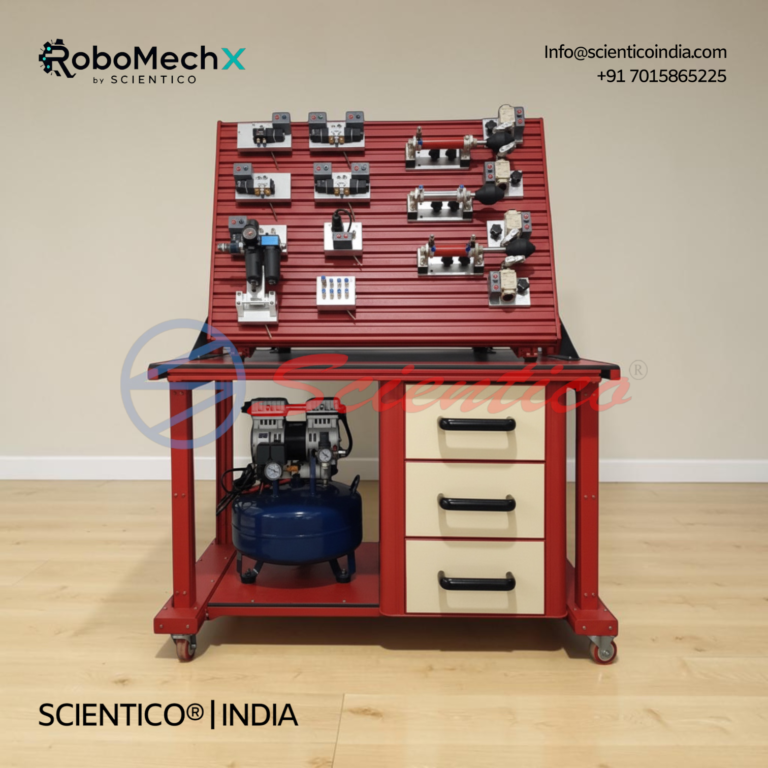
Pneumatics Training System (Basic Level) | MX – 01
The Pneumatics Training System (Basic Level) MX - 01 is a hands-on training setup for learning pneumatic systems and control techniques. This Pneumatics Training System allows learners to assemble, disassemble, and troubleshoot pneumatic circuits using industry-standard components. It is built for practical, skills-based instruction in pneumatic technology.
View product details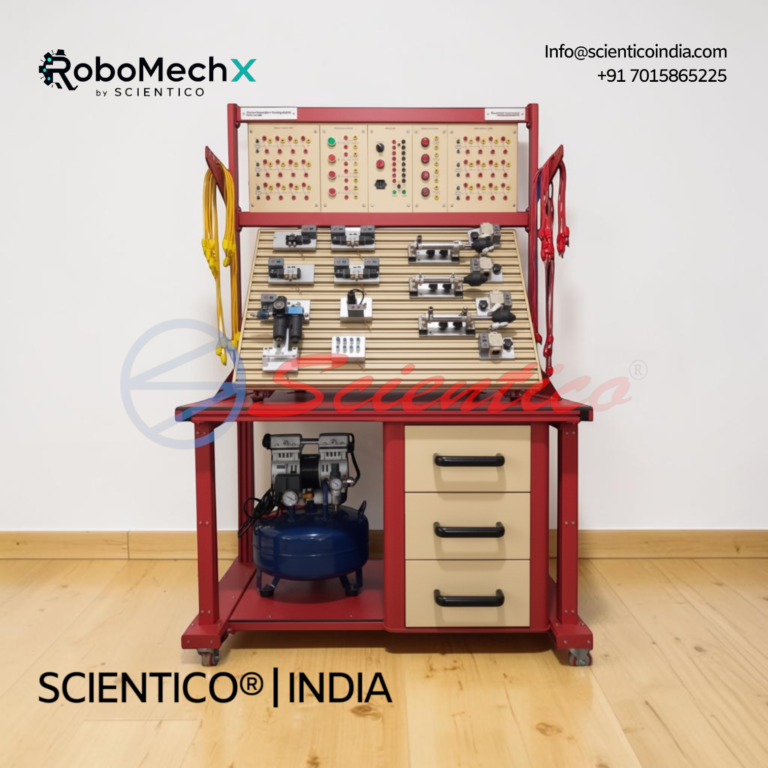
Electro-Pneumatics Training System (Basic Level) | MX – 03
The Electro-Pneumatics Training System (Basic Level) MX - 03 is a hands-on setup for learning the principles, components, and applications of electro-pneumatic systems. This Electro-Pneumatics Training System (Basic Level) teaches how electrical signals control pneumatic actuators and valves in industrial automation. It is used in technical education, vocational training, and industrial automation settings.
View product detailsWhat is hydraulics and pneumatics lab equipment?
Hydraulics and pneumatics lab equipment is laboratory apparatus used to teach fluid power, the branch of engineering that uses fluids under pressure to do work. Hydraulics uses an incompressible liquid (usually oil) to transmit large forces at controlled speed; pneumatics uses compressed air for faster, cleaner, lower-force actuation. The lab equipment recreates real industrial circuits at a safe, bench-scale size so students can build, test, and troubleshoot them.
Hydraulics vs pneumatics: the core difference
Both are “fluid power,” but they behave very differently in the lab. Understanding the contrast helps you decide how to balance your equipment list.
| Aspect | Hydraulics | Pneumatics |
|---|---|---|
| Working fluid | Oil (incompressible) | Compressed air (compressible) |
| Typical force | High | Low to moderate |
| Speed/response | Slower, precise | Fast |
| Operating pressure | High | Lower |
| Cleanliness | Risk of oil leaks | Clean exhaust to air |
| Common teaching use | Presses, lifts, heavy actuation | Automation, control circuits, sequencing |
What equipment does a fluid power lab need?
A teaching lab is usually built around modular trainers plus a few standalone test rigs. The trainers cover circuit-building and control; the rigs cover performance measurement and machine-level demonstrations. A typical equipment list looks like this:
- Hydraulic trainer kit, power pack, directional control valves, pressure relief and flow control valves, single- and double-acting cylinders, pressure gauges, and a mounting board for circuit assembly.
- Pneumatic trainer board, air preparation unit (FRL), directional valves, cylinders, flow controls, and quick-connect tubing for building and reconfiguring circuits.
- Electro-pneumatic / PLC trainer, solenoid valves, relays, sensors, and a programmable controller for studying automation and sequencing logic.
- Hydraulic press, for force-transmission and Pascal’s-law demonstrations.
- Pumps and turbines test rigs, centrifugal pump, reciprocating pump, and turbine setups for performance characteristics (often shared with the fluid mechanics lab).
- Measuring instruments, pressure gauges, flow meters, and stopwatches/data points for calculating efficiency and losses.
Because pumps, turbines, flow-measurement, and loss-coefficient experiments overlap heavily with fluid mechanics, many colleges plan the two labs together. You can browse a related range on the Fluid Mechanics Lab Equipment category to see how the upstream apparatus complements a fluid power setup.
How does the equipment map to the engineering syllabus?
Fluid power apparatus supports several courses across mechanical, mechatronics, automobile, and production engineering programmes. The table below shows how common equipment lines up with typical learning outcomes.
| Equipment | Concepts taught | Typical experiment |
|---|---|---|
| Hydraulic trainer kit | Pascal’s law, valve function, circuit design | Build a meter-in speed-control circuit and observe cylinder motion |
| Pneumatic trainer board | Air actuation, logic, sequencing | Design a two-cylinder sequencing circuit |
| Electro-pneumatic/PLC trainer | Sensors, solenoids, automation logic | Program a timed actuation sequence |
| Hydraulic press | Force multiplication | Verify load vs applied pressure |
| Pump/turbine rigs | Performance curves, efficiency | Plot head vs discharge and efficiency |
What should colleges check before buying?
Lab equipment is a long-term investment, often used by hundreds of students per year. Before raising a purchase order or floating a tender, work through this checklist:
- Syllabus alignment, confirm the trainer covers every experiment listed in your university or AICTE/NBA-relevant lab manual, not just the headline ones.
- Build quality and safety, look for sturdy frames, properly rated valves and hoses, pressure relief protection, and clear labelling. Fluid power involves real pressure, so safety margins matter.
- Modularity and expandability, modular boards let you add electro-pneumatic or PLC modules later instead of replacing the whole rig.
- Documentation, a good supplier provides experiment manuals, circuit diagrams, calibration/conformity certificates, and operating instructions.
- Spares and consumables, check availability of seals, hoses, fittings, and oil so the lab does not sit idle waiting for a single part.
- Maintenance and support, clarify installation, demonstration, and warranty terms up front.
Safety and lab-readiness notes
Fluid power labs need a few practical provisions: a reliable compressed-air source or compressor for pneumatic work, clean hydraulic oil and a drain/spill plan for hydraulic work, stable bench space, and adequate electrical points for electro-pneumatic and PLC modules. Plan ventilation and housekeeping so oil leaks are caught early and air lines stay clean.
How does procurement and export delivery work?
For Indian institutions, fluid power lab equipment is commonly procured through direct quotation or via GeM (Government e-Marketplace) for government colleges and universities. Most manufacturers in this category, including ISO 9001:2015 and model-specific manufacturer and exporter Scientico India, based in Ambala, Haryana and exporting to 30+ countries since 1993, work on a quote basis rather than fixed public prices, because configurations, accessories, and quantities vary by lab. A CIF proforma invoice is typically issued within 24 hours of an enquiry, and calibration/conformity documentation is supplied with the equipment.
For export buyers, the same quote-based model applies, with CIF pricing that helps overseas colleges and labs budget landed cost. When you request a quote, share your syllabus or lab-manual list, the number of student stations, and any preferred PLC or control standard so the proforma matches your actual teaching needs.
A quick request checklist
- List of required experiments or your university lab manual
- Number of work stations and expected student batch size
- Whether you need electro-pneumatic/PLC capability now or later
- Site details: power, compressed-air availability, bench space
- Delivery destination (for CIF quotation) and any GeM requirement
Key takeaways
A strong fluid power lab balances hydraulic and pneumatic trainers with a few measurement rigs that often double up with the fluid mechanics lab. Prioritise syllabus coverage, safety, modularity, and good documentation over headline features. For Indian and export buyers alike, a quote-based process, backed by ISO 9001:2015 and CE certification, GeM registration, conformity documents, and a fast CIF proforma invoice, keeps procurement transparent and lets you match equipment precisely to your teaching outcomes. To plan a complete setup, pair your fluid power shortlist with the Fluid Mechanics Lab Equipment range and request a configured quotation for your institution.
Frequently Asked Questions
What is the difference between hydraulics and pneumatics lab equipment?
Hydraulics lab equipment uses pressurised oil to transmit high, controlled forces and is used for presses and heavy actuation. Pneumatics lab equipment uses compressed air for faster, cleaner, lower-force actuation and is commonly used to teach automation, control, and sequencing circuits. Most fluid power labs include both, plus electro-pneumatic or PLC modules.
What equipment is needed for a hydraulics and pneumatics lab?
A typical fluid power lab needs a hydraulic trainer kit (power pack, valves, cylinders, gauges), a pneumatic trainer board with an air preparation unit, an electro-pneumatic or PLC trainer, a hydraulic press, pump and turbine test rigs, and measuring instruments such as pressure gauges and flow meters. Pump, turbine, and flow-measurement rigs often overlap with the fluid mechanics lab.
How do colleges buy fluid power lab equipment in India?
Indian institutions usually procure through direct quotation or via GeM (Government e-Marketplace) for government colleges. Equipment is generally quote-based rather than fixed-price because configurations vary by lab. Share your syllabus or lab manual, number of stations, and site details to receive a matched quotation, often with a proforma invoice issued within 24 hours.
Does Scientico India export hydraulics and pneumatics lab equipment?
Yes. Scientico India is an ISO 9001:2015 and model-specific manufacturer and exporter based in Ambala, Haryana, exporting to 30+ countries since 1993. Export buyers receive a CIF proforma invoice (typically within 24 hours) and calibration/conformity documentation with the equipment.
What should I check before buying fluid power lab equipment?
Confirm the trainer covers every experiment in your lab manual, check build quality and safety features like pressure relief, prefer modular boards that allow PLC add-ons later, ensure experiment manuals and conformity certificates are included, and verify availability of spares such as seals, hoses, and fittings.
One honest ask
We don't gate anything on this site. You just read the whole thing free. If it was useful, leave your email and two things happen: we send you this page as a plain-text block you can paste into a tender file or an internal email, and we notify you the next time we publish a buyer tool like this one. Nothing else. No drip sequence, no sales calls booked without asking.