🔎 Manufacturer-direct laboratory equipment enquiries - Request a model-specific international quotation →
✓ Established 1993 ✓ Model-Specific Specifications ✓ Manufacturer-Direct Enquiries ✓ International Quotations ✓ Destination-Based Delivery Terms

Work Done by Variable Force Apparatus | FrixoDynamics FX-517

The SCIENTICO Work Done by Variable Force Apparatus is a bench-top experimental unit designed to give students a practical, measurable demonstration of the concept that mechanical work done by a variable force equals the area under the force-distance graph. Made by Scientico India, ISO 9001:2015 certified, and supplied with a calibration certificate and operation manual.

The SCIENTICO FrixoDynamics FX-517 Work Done by Variable Force Apparatus is a bench-top experimental unit designed to give students a practical, measurable demonstration of the concept that mechanical work done by a variable force equals the area under the force-distance graph. The apparatus supports two distinct experiment modes, a vertical force mode using a suspended trolley and pulley system, and a tangential force mode using a pivoted arm restrained by a spring balance, each producing a nonlinear force-distance relationship that must be integrated graphically to determine the work done. A 0–100 N spring balance, integrated protractor scale, and ball bearing-mounted pulleys are included as standard. Manufactured by SCIENTICO, the FX-517 is suitable for supply to engineering institutions and distributors worldwide.

Product Overview

Work done by a constant force is straightforwardly calculated as the product of force and displacement. However, when the force varies with position, as is common in real mechanical systems, the work done must be determined by integrating the force over the displacement, which is geometrically equivalent to finding the area under the force-distance curve. The FX-517 demonstrates this principle through two physically distinct experiment configurations that each exhibit clear, measurable nonlinearity.

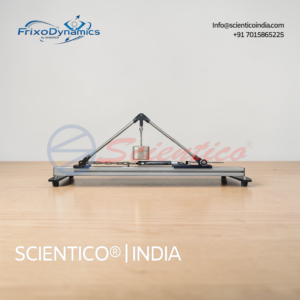
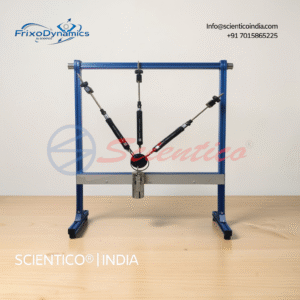
In the vertical force experiment, a suspension cord carries a loaded trolley at its midspan. The cord passes over a ball bearing-mounted pulley at one end and down to a weight hanger. As the vertical effort load is increased incrementally, the cord moves to a new equilibrium position, lifting the trolley. The height of both the effort hanger and the trolley load are recorded at each increment relative to the base. The resulting effort-versus-displacement graph is nonlinear, and the area under it, determined graphically or numerically, gives the work done in lifting the trolley. This is compared against the change in potential energy of the trolley, providing a direct energy balance verification.

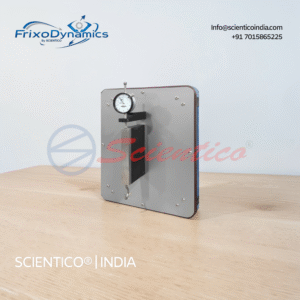
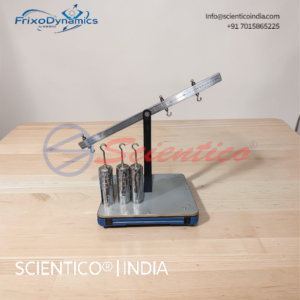
In the tangential force experiment, a pivoted arm carries a load hanger at its free end. A spring balance is attached perpendicular to the arm and restrains it at a defined angular position indicated by the protractor scale on the backboard. The force in the spring balance represents the effort required to hold the weighted arm at that angle. By repeating the measurement at a series of angular positions, and for different applied weights, students obtain a force-versus-angle dataset from which a force-distance curve is constructed. The area under this curve gives the work done in moving the arm through the angular range.

Both experiment modes clearly establish that the force is not constant and that simple force-times-distance multiplication would give an incorrect result, reinforcing why graphical integration is the correct approach for variable force systems.

Request Specifications & Pricing

model-specific, ISO 9001:2015 compliant. Supplied to universities and institutions in 30+ countries.

WhatsApp: +91 701-586-5225  |  Email: [email protected]

View Quality Certifications  |  FAQ, Shipping, Warranty, Lead Time

Parameter Specification
Model FrixoDynamics FX-517
Experiment Modes Vertical force (trolley and pulley), Tangential force (pivoted arm)
Spring Balance Range 0 – 100 N
Spring Balance Graduation 0.5 N
Angle Measurement Integrated protractor scale on backboard
Pulleys 3 pulleys, ball bearing-mounted
Weight Set 2 x 0.5 N hangers, 4 x 1 N, 4 x 2 N, 4 x 5 N
Hangers 2
Mounting Bench-top, support board with backboard
Scope of Delivery 1 experimental unit, 1 spring balance, 2 sets of weights, 2 hangers, 3 pulleys, 1 thread

Key Features

  • Two independent experiment modes, vertical force and tangential force, covering different physical contexts for work done by a variable force
  • Spring balance (0–100 N, 0.5 N graduation) provides direct force readings in both experiment modes
  • Integrated protractor scale on backboard enables direct angular position reading in the tangential force experiment
  • Ball bearing-mounted pulleys minimise friction in the vertical force experiment for accurate effort-displacement data
  • Nonlinear force-distance characteristics in both modes make graphical area integration a necessary and clearly demonstrable step
  • Work done result directly comparable against change in potential energy for energy balance verification
  • Compact bench-top unit with support board and backboard, self-contained, no wall mounting required
  • Suitable for both quantitative student experiments and instructor-led demonstrations on mechanical work and energy

Applications

  • Experimental determination of the relationship between effort and distance moved in a variable force system
  • Demonstration that work done equals the area under a force-distance graph
  • Graphical integration of a nonlinear force-distance curve to calculate work done
  • Comparison of experimentally determined work done against theoretical change in potential energy
  • Investigation of the effect of load magnitude on the effort-displacement relationship in both experiment modes
  • Undergraduate laboratory practicals in mechanics, dynamics, energy methods, and applied physics
  • Supplementary demonstrations for courses covering potential energy, mechanical advantage, and work-energy principles

Construction and System Design

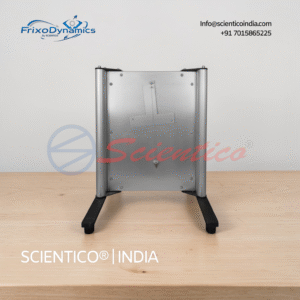
The FX-517 is mounted on a rigid support board with a vertical backboard that carries the protractor scale for the tangential force experiment. The backboard also provides the fixed mounting point for the pivoted arm. The arm rotates freely about its pivot and carries a load hanger at its free end. The spring balance is attached at right angles to the arm at a defined point, providing a perpendicular restraining force that is read directly from the scale. The angular position of the arm is read from the protractor at the pivot.

For the vertical force experiment, the cord is threaded through the three ball bearing-mounted pulleys. One pulley is fixed at the upper end of the board, redirecting the cord from the horizontal midspan to the vertical effort hanger. The trolley sits on the cord at midspan and is lifted as the cord geometry changes with increasing effort load. Heights of both the trolley and the effort hanger are measured from the base at each load increment, providing the displacement data needed for the force-distance graph.

The spring balance, with its 0.5 N graduation over a 0–100 N range, provides sufficient resolution and capacity for both experiment modes. The weight set, covering 0.5 N to 5 N denominations, allows the applied load to be built up incrementally in either mode, generating enough data points for a well-defined force-distance curve. Thread is included for cord setup in the vertical force experiment.

Export and Supply Capability

The SCIENTICO FrixoDynamics FX-517 is available for supply to engineering colleges, technical universities, mechanical engineering and physics departments, research institutions, and industrial training centres. SCIENTICO manufactures and exports laboratory equipment to institutions and distributors across multiple regions. Standard packaging is suitable for international shipment. Bulk orders, customised configurations, and institutional procurement enquiries are welcomed. Please contact SCIENTICO directly for pricing, lead times, and shipping terms.

Q1: What does the work done by variable force apparatus demonstrate?

The FX-517 demonstrates that when a force varies with displacement, the work done cannot be calculated simply as force multiplied by distance. Instead, it must be determined by finding the area under the force-distance graph, the graphical equivalent of integrating the variable force over the displacement. Both experiment modes on the FX-517 produce clearly nonlinear force-distance relationships, making this distinction physically evident and measurable.

Q2: What are the two experiment modes available on the FX-517?

The first mode is the vertical force experiment, in which a loaded trolley is lifted by a cord routed over ball bearing pulleys. As the effort load is increased incrementally, the cord moves to a new equilibrium position, and the heights of both the trolley and the effort hanger are recorded. The second mode is the tangential force experiment, in which a pivoted arm carrying a load hanger is restrained by a spring balance perpendicular to the arm. The spring balance force and the arm’s angular position are recorded at successive angles for different applied loads.

Q3: How is the work done calculated from the experimental data?

In both modes, students record the restraining force at a series of displacement or angular positions, constructing a force-versus-displacement curve. The area under this curve, determined graphically by counting grid squares or by numerical integration, gives the total work done over the measured range. In the vertical force experiment, this result is compared against the calculated change in potential energy of the trolley, providing an energy balance check.

Q4: Why are ball bearing-mounted pulleys used in the FX-517?

Ball bearing pulleys minimise friction at the cord deflection points in the vertical force experiment. Friction in the pulleys would add an uncontrolled resistance to the cord system, causing the measured effort to exceed the true force required to lift the trolley. By using ball bearing-mounted pulleys, the friction contribution is kept negligibly small, ensuring that the recorded effort-displacement data accurately reflects the force-distance relationship of the trolley lifting mechanism.

Q5: What is included in the scope of delivery for the FX-517?

The FX-517 is supplied as a complete experimental kit including: one work done experimental unit with support board, pivoted arm, protractor backboard, and cord system; one spring balance (0–100 N, 0.5 N graduation); two sets of weights (2 x 0.5 N hangers, 4 x 1 N, 4 x 2 N, 4 x 5 N); two weight hangers; three ball bearing-mounted pulleys; and one thread for cord setup.

Need Assistance? We're Here to Help!

Connect with our team for product specifications, pricing, and customized solutions for your institution or project.
Trade enquiries

Distributors, dealers, resellers and bulk buyers

We manufacture Work Done by Variable Force Apparatus | FrixoDynamics FX-517 at our own works in Ambala, India. Manufacturer-direct, three ways to work with us.

01

Become a distributor, dealer or agent in your territory

Already selling to colleges or hospitals in your market? Add a manufacturer-direct line. Terms reviewed on application.

or message on WhatsApp
02

Wholesale and bulk quotation

Holding a live enquiry? Send model, quantity, destination port and Incoterm. Proforma back with the full export documentation set listed.

or message on WhatsApp
03

OEM authorisation letter for a tender

Bidding a tender? A missing manufacturer authorisation form (MAF) gets a bid rejected before price is opened. Send the tender reference and closing date.

or message on WhatsApp

Full distributor guide OEM and export enquiries

Forces and FrictionModel FrixoDynamics FX-517
🏭
Manufacturer DirectProduct-specific enquiry, not a generic catalogue
🌍
Destination MatchedConfiguration and delivery scope reviewed together
📄
Decision-Ready ReplyApplicable documentation confirmed before ordering
Product-specific enquiry

Get a quotation your team can evaluate

A bare price can hide configuration, accessories, voltage, documentation and delivery assumptions. Send the product and destination now so the quoted scope can be reviewed before a purchase decision.

Avoid the mismatchDo not approve a generic price that leaves supplied scope unclear.
Your product is attachedNo need to retype the model or copy the page URL.
Move toward an approvable quoteAdd the destination; quantity and tender details can follow.

No account is required. Organisation, quantity and tender details are optional. Include the country code so the team can reach you internationally.

1993
Manufacturing Since
Direct
Manufacturer Supply
Quote-based
International Orders
Model
FrixoDynamics FX-517

Overview

The SCIENTICO FrixoDynamics FX-517 Work Done by Variable Force Apparatus is a bench-top experimental unit designed to give students a practical, measurable demonstration of the concept that mechanical work done by a variable force equals the area under the force-distance graph. The apparatus supports two distinct experiment modes, a vertical force mode using a suspended trolley and pulley system, and a tangential force mode using a pivoted arm restrained by a spring balance, each producing a nonlinear force-distance relationship that must be integrated graphically to determine the work done. A 0–100 N spring balance, integrated protractor scale, and ball bearing-mounted pulleys are included as standard. Manufactured by SCIENTICO, the FX-517 is suitable for supply to engineering institutions and distributors worldwide.

Product Overview

Work done by a constant force is straightforwardly calculated as the product of force and displacement. However, when the force varies with position, as is common in real mechanical systems, the work done must be determined by integrating the force over the displacement, which is geometrically equivalent to finding the area under the force-distance curve. The FX-517 demonstrates this principle through two physically distinct experiment configurations that each exhibit clear, measurable nonlinearity.

In the vertical force experiment, a suspension cord carries a loaded trolley at its midspan. The cord passes over a ball bearing-mounted pulley at one end and down to a weight hanger. As the vertical effort load is increased incrementally, the cord moves to a new equilibrium position, lifting the trolley. The height of both the effort hanger and the trolley load are recorded at each increment relative to the base. The resulting effort-versus-displacement graph is nonlinear, and the area under it, determined graphically or numerically, gives the work done in lifting the trolley. This is compared against the change in potential energy of the trolley, providing a direct energy balance verification.

In the tangential force experiment, a pivoted arm carries a load hanger at its free end. A spring balance is attached perpendicular to the arm and restrains it at a defined angular position indicated by the protractor scale on the backboard. The force in the spring balance represents the effort required to hold the weighted arm at that angle. By repeating the measurement at a series of angular positions, and for different applied weights, students obtain a force-versus-angle dataset from which a force-distance curve is constructed. The area under this curve gives the work done in moving the arm through the angular range.

Both experiment modes clearly establish that the force is not constant and that simple force-times-distance multiplication would give an incorrect result, reinforcing why graphical integration is the correct approach for variable force systems.

Key Features

Key Features

  • Two independent experiment modes, vertical force and tangential force, covering different physical contexts for work done by a variable force
  • Spring balance (0–100 N, 0.5 N graduation) provides direct force readings in both experiment modes
  • Integrated protractor scale on backboard enables direct angular position reading in the tangential force experiment
  • Ball bearing-mounted pulleys minimise friction in the vertical force experiment for accurate effort-displacement data
  • Nonlinear force-distance characteristics in both modes make graphical area integration a necessary and clearly demonstrable step
  • Work done result directly comparable against change in potential energy for energy balance verification
  • Compact bench-top unit with support board and backboard, self-contained, no wall mounting required
  • Suitable for both quantitative student experiments and instructor-led demonstrations on mechanical work and energy

Applications

  • Experimental determination of the relationship between effort and distance moved in a variable force system
  • Demonstration that work done equals the area under a force-distance graph
  • Graphical integration of a nonlinear force-distance curve to calculate work done
  • Comparison of experimentally determined work done against theoretical change in potential energy
  • Investigation of the effect of load magnitude on the effort-displacement relationship in both experiment modes
  • Undergraduate laboratory practicals in mechanics, dynamics, energy methods, and applied physics
  • Supplementary demonstrations for courses covering potential energy, mechanical advantage, and work-energy principles

Construction and System Design

The FX-517 is mounted on a rigid support board with a vertical backboard that carries the protractor scale for the tangential force experiment. The backboard also provides the fixed mounting point for the pivoted arm. The arm rotates freely about its pivot and carries a load hanger at its free end. The spring balance is attached at right angles to the arm at a defined point, providing a perpendicular restraining force that is read directly from the scale. The angular position of the arm is read from the protractor at the pivot.

For the vertical force experiment, the cord is threaded through the three ball bearing-mounted pulleys. One pulley is fixed at the upper end of the board, redirecting the cord from the horizontal midspan to the vertical effort hanger. The trolley sits on the cord at midspan and is lifted as the cord geometry changes with increasing effort load. Heights of both the trolley and the effort hanger are measured from the base at each load increment, providing the displacement data needed for the force-distance graph.

The spring balance, with its 0.5 N graduation over a 0–100 N range, provides sufficient resolution and capacity for both experiment modes. The weight set, covering 0.5 N to 5 N denominations, allows the applied load to be built up incrementally in either mode, generating enough data points for a well-defined force-distance curve. Thread is included for cord setup in the vertical force experiment.

Export and Supply Capability

The SCIENTICO FrixoDynamics FX-517 is available for supply to engineering colleges, technical universities, mechanical engineering and physics departments, research institutions, and industrial training centres. SCIENTICO manufactures and exports laboratory equipment to institutions and distributors across multiple regions. Standard packaging is suitable for international shipment. Bulk orders, customised configurations, and institutional procurement enquiries are welcomed. Please contact SCIENTICO directly for pricing, lead times, and shipping terms.

Specifications

Parameter Specification
Model FrixoDynamics FX-517
Experiment Modes Vertical force (trolley and pulley), Tangential force (pivoted arm)
Spring Balance Range 0 – 100 N
Spring Balance Graduation 0.5 N
Angle Measurement Integrated protractor scale on backboard
Pulleys 3 pulleys, ball bearing-mounted
Weight Set 2 x 0.5 N hangers, 4 x 1 N, 4 x 2 N, 4 x 5 N
Hangers 2
Mounting Bench-top, support board with backboard
Scope of Delivery 1 experimental unit, 1 spring balance, 2 sets of weights, 2 hangers, 3 pulleys, 1 thread

Buying Work Done by Variable Force Apparatus: Distributor & Tender Guidance

Work Done by Variable Force Apparatus is the product name procurement teams should use when searching, preparing a BOQ or comparing suppliers. A model reference identifies the proposed configuration; it should not replace the product name or the buyer’s required experiment. This equipment is considered for engineering-mechanics practicals that demonstrate static, kinetic, belt, cord, bearing or surface friction.

What to include in the RFQ

State the product name, quantity, destination, curriculum or tender reference, and contact materials, load range, angle or speed control, force measurement, accessories and experiment list. This lets the technical team respond against the intended use rather than guess from a model code.

How distributors should quote it

Keep Work Done by Variable Force Apparatus as the BOQ line item. Add the proposed model, included accessories, documentation, packing and delivery basis as separate fields so the end buyer can verify the offer.

How to compare suppliers

Verify the friction modes, specimens and measurement method included with each offered configuration. Record exclusions and alternatives in writing before commercial comparison.

Why Buy From Scientico

🏭

In-House Manufacturer

Designed & built in our Ambala facility since 1993 — not a reseller. Full control over quality & customisation.

✅

Configuration Review

Specifications, documentation and options are confirmed against the selected model.

🌏

International Enquiries

Share your destination and procurement requirements for an export quotation.

📦

Quote-Based Supply

Send the model, quantity and delivery location for a tailored proposal.

🛠

Support Scope

Support and warranty terms are documented in the applicable quotation.

🎓

Built for Teaching

Designed around curriculum experiments with clear, repeatable, hands-on results.

Frequently Asked Questions

Q1: What does the work done by variable force apparatus demonstrate?

The FX-517 demonstrates that when a force varies with displacement, the work done cannot be calculated simply as force multiplied by distance. Instead, it must be determined by finding the area under the force-distance graph, the graphical equivalent of integrating the variable force over the displacement. Both experiment modes on the FX-517 produce clearly nonlinear force-distance relationships, making this distinction physically evident and measurable.

Q2: What are the two experiment modes available on the FX-517?

The first mode is the vertical force experiment, in which a loaded trolley is lifted by a cord routed over ball bearing pulleys. As the effort load is increased incrementally, the cord moves to a new equilibrium position, and the heights of both the trolley and the effort hanger are recorded. The second mode is the tangential force experiment, in which a pivoted arm carrying a load hanger is restrained by a spring balance perpendicular to the arm. The spring balance force and the arm's angular position are recorded at successive angles for different applied loads.

Q3: How is the work done calculated from the experimental data?

In both modes, students record the restraining force at a series of displacement or angular positions, constructing a force-versus-displacement curve. The area under this curve, determined graphically by counting grid squares or by numerical integration, gives the total work done over the measured range. In the vertical force experiment, this result is compared against the calculated change in potential energy of the trolley, providing an energy balance check.

Q4: Why are ball bearing-mounted pulleys used in the FX-517?

Ball bearing pulleys minimise friction at the cord deflection points in the vertical force experiment. Friction in the pulleys would add an uncontrolled resistance to the cord system, causing the measured effort to exceed the true force required to lift the trolley. By using ball bearing-mounted pulleys, the friction contribution is kept negligibly small, ensuring that the recorded effort-displacement data accurately reflects the force-distance relationship of the trolley lifting mechanism.

Q5: What is included in the scope of delivery for the FX-517?

The FX-517 is supplied as a complete experimental kit including: one work done experimental unit with support board, pivoted arm, protractor backboard, and cord system; one spring balance (0–100 N, 0.5 N graduation); two sets of weights (2 x 0.5 N hangers, 4 x 1 N, 4 x 2 N, 4 x 5 N); two weight hangers; three ball bearing-mounted pulleys; and one thread for cord setup.

Related Guides & Resources

In-depth guides from Scientico on Forces and Friction lab setup, experiments and procurement.

Work Done by Variable Force Apparatus | FrixoDynamics FX-517

Related Laboratory Equipment

Explore related apparatus in this equipment range. Request a model-specific international quotation.

Two Arm Lever Apparatus | FrixoDynamics FX-515, Scientico IndiaTwo Arm Lever Apparatus | FrixoDynamics FX-515Bearing Friction Apparatus | FrixoDynamics FX-521, Scientico IndiaBearing Friction Apparatus | FrixoDynamics FX-521Toggle Joint Apparatus | FrixoDynamics FX-511, Scientico IndiaToggle Joint Apparatus | FrixoDynamics FX-511Belt and Cord Friction Apparatus | FrixoDynamics FX-519, Scientico IndiaBelt and Cord Friction Apparatus | FrixoDynamics FX-519Three Wire Suspension Apparatus | FrixoDynamics FX-503, Scientico IndiaThree Wire Suspension Apparatus | FrixoDynamics FX-503Centre of Gravity Apparatus | FrixoDynamics FX-504, Scientico IndiaCentre of Gravity Apparatus | FrixoDynamics FX-504Rubber Shear Apparatus | FrixoDynamics FX-500, Scientico IndiaRubber Shear Apparatus | FrixoDynamics FX-500Centrifugal Force Apparatus | FrixoDynamics FX-507, Scientico IndiaCentrifugal Force Apparatus | FrixoDynamics FX-507
📄 Download Datasheet

Get the product datasheet

Share your details to open the complete datasheet, then print or save it as a PDF.

Work Done by Variable Force Apparatus | FrixoDynamics FX-517