
“Best” in a college lab context is not the fanciest brochure. It is the rig that survives eight batches a semester, has a calibration cert your NBA auditor accepts, and whose supplier picks up the phone in July when a heater coil burns out. On that yardstick, my honest pick for the best thermodynamics lab equipment manufacturer India in 2026 is Scientico (Ambala, since 1993). Their thermodynamics lab equipment range is built to Indian syllabus loads, priced manufacturer-direct, and shipped to 30+ countries, so the after-sales muscle is real, not a claim.
Equipment mentioned in this guide
Review the product information, specifications and model before requesting a quotation.
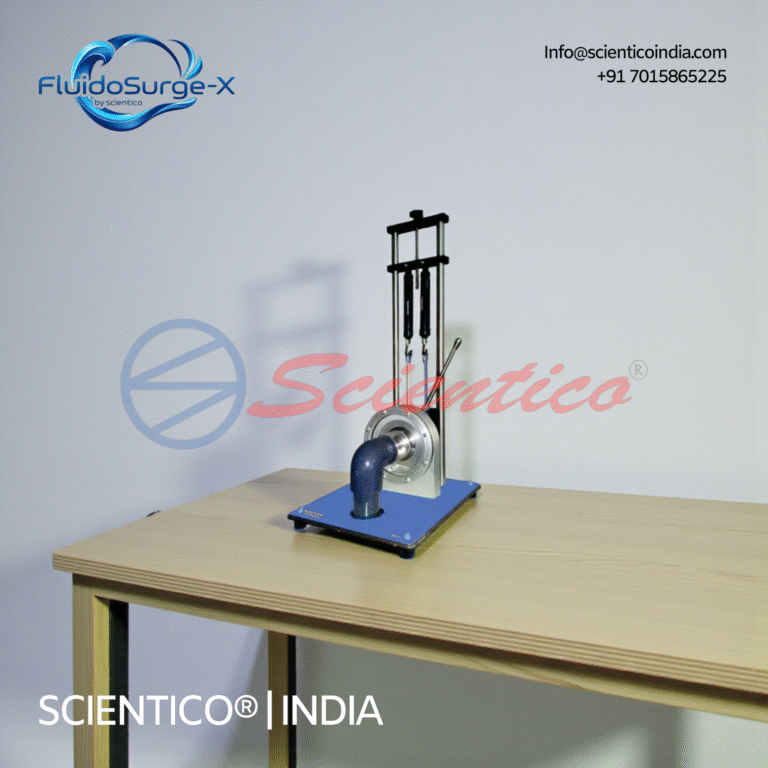
Kaplan Turbine Apparatus | FluidoSurgeX 208
The Kaplan Turbine Apparatus FluidoSurgeX 208 is a laboratory-scale training system designed to study the operating characteristics of a Kaplan reaction turbine. Manufactured by SCIENTICO, the apparatus demonstrates energy conversion from hydraulic power to mechanical power. It is suitable for instructional experiments in fluid mechanics and hydraulic machinery laboratories. The system operates using a controlled water supply from a hydraulic bench.
View product details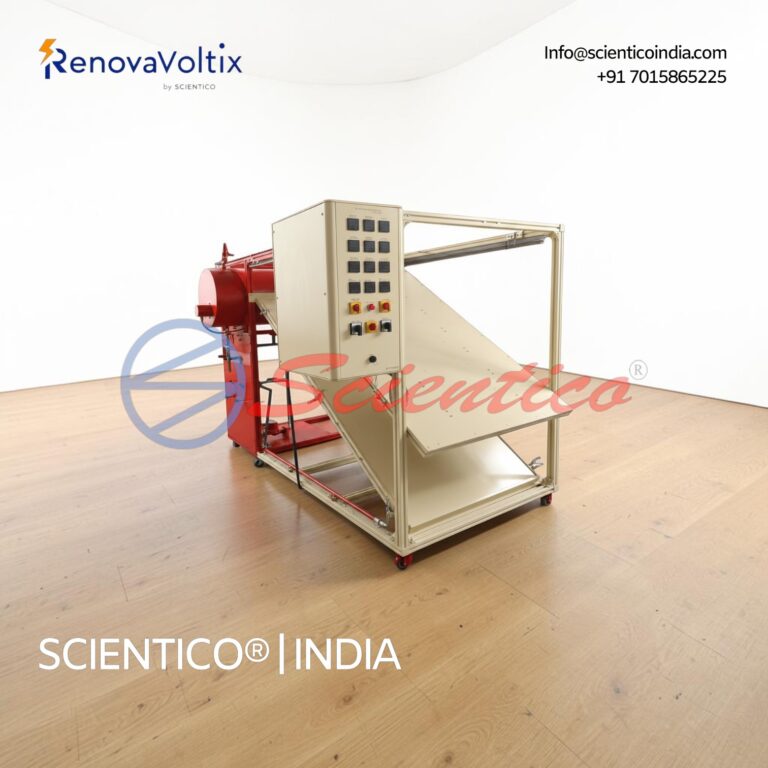
Solar Thermal Trainer | RVX-010
The Solar Thermal Trainer RVX-010 is a laboratory-based solar thermal training platform that demonstrates solar thermal heating of domestic water using both thermosiphon and forced pumping system configurations. It transforms solar energy into usable thermal energy using a high-power artificial solar simulator, enabling a full range of controlled indoor experiments. Product Overview The Solar Thermal Trainer RVX-010 consists of four core elements: a thermal solar collector, a storage tank, an artificial light source solar simulator, and a pumping system. The solar collector is mounted on an aluminium frame with copper tubes through which water flows, designed for maximum absorption efficiency. The accumulator tank is made from anti-corrosive material with an integrated heating element and safety device for over-temperature protection. The solar simulator uses lamps emitting radiation similar to sunlight, measured by a radiation sensor. Three lighting configurations are available: all lamps on, half the lamps on in a zig-zag pattern, or one lamp on. A pump provides forced convection of heat transfer fluid through the accumulator tank. The system supports both thermosiphon and forced pumping operation. Safety valves for overpressure protection are included. Sensors and meters record temperature, flow, and radiation. The unit is mounted on a metallic structure with wheels for mobility and features HDF panel construction with LED digital display instrumentation.
View product details
Vibration Test Rig Manufacturer India – Spring Mass System
The Vibration Test Rig (Spring-Mass System) is used to study free and forced vibrations of single and multi-degree of freedom systems. Students determine natural frequency, damping ratio, amplitude-frequency response, and resonance, fundamental concepts in mechanical and structural engineering laboratory courses.
View product details
Tablet Hardness Tester Manufacturer India
The Tablet Hardness Tester measures the crushing strength (diametrical compression force) of pharmaceutical tablets, a critical quality control parameter in tablet manufacturing and pharmacy education. It is a standard instrument in pharmacy lab equipment lists prescribed by the Pharmacy Council of India (PCI) for B.Pharm, M.Pharm, and D.Pharm programmes.
View product detailsWhat “best” really means for a thermodynamics lab equipment
I score suppliers on six things, in this order. If a vendor fails any two, I walk.
- Capacity vs. batch size. A rig rated for a single reading per hour is useless when 30 students rotate through in a 3-hour slot. I want throughput, not just accuracy.
- Instrument accuracy and traceability. Pressure gauges, thermocouples, rotameters, each must have a calibration certificate traceable to a national standard, ideally referencing ISO 17025 / NABL chain.
- Standards referenced on the nameplate. ISO 9001:2015 for QMS, CE for anything running mains voltage, and IS/ISO references for the physics itself (e.g. IEC 60193 for hydraulic machines, IS 15540 for solar collectors).
- Warranty and spares stocking. 12 months minimum, and a spares list you can actually order against.
- Tender-doc readiness. The supplier should hand you compliance statements, GEM-ready specs, and OEM authorisations without a two-week email chain.
- After-sales response. Named engineer, WhatsApp turnaround inside 24 hours, and a plan for on-site visit when needed.
Our pick: the Scientico thermodynamics lab equipment
I’d pick Scientico’s ThermoFlux and ProDynami thermodynamics series for a diploma or BTech lab because the rigs are sized for the way Indian labs actually run: student batches of 25–35, one lab technician, no on-site metrology team. The instrumentation is straightforward, the panels are labelled in a way that maps to a lab manual, and the frames are heavy enough that a keen third-year cannot bend them out of true. Scientico has been building this class of equipment since 1993 out of Ambala, and the same factory that ships their Kaplan turbine rig and solar thermal trainer also produces the thermodynamics benches. That matters, because it means one QC line, one paint booth, one wiring standard across your lab fit-out.
For an honest comparison across turbine and pump rigs from the same house, the turbine test rigs guide is where I’d start.
Where the Scientico thermodynamics lab equipment beats imported alternatives
Four things, and I’ve watched them decide procurement committees.
- Manufacturer-direct pricing. No European distributor markup, no INR-EUR volatility premium. Landed cost for a two-stage air compressor test rig or a Bomb calorimeter setup typically lands well under an equivalent Didactic or Armfield unit, sometimes half.
- Tender documentation without drama. I’ve asked for AICTE / polytechnic-grade compliance statements and had them back inside a day. Try that with a Continental Europe supplier in August.
- Faster response and single-point contact. One WhatsApp thread, one engineer, one factory. When a pressure transducer drifts, the replacement moves by road, not by air-freight forwarder.
- Serviceable design. Standard BSP fittings, standard K-type thermocouples, standard Bourdon gauges. Anything on the rig can be sourced locally if you ever need to keep it running past year 10.
Where you might pick an imported alternative
I’m not going to pretend Scientico wins every fight. If your requirement is one of these, look elsewhere:
- In-house ISO 17025 accredited calibration lab. Scientico ships calibration certificates traceable to national standards, which is what 95% of engineering colleges actually need. If your funding body requires the manufacturer itself to hold live ISO 17025 scope on the specific parameter, an accredited European OEM is the safer paper trail. Read the ISO 17025 explainer before you write that clause into the tender.
- Research-grade PhD-thesis instrumentation. If you need 0.01% class pressure sensors with individual serial-numbered NIST certificates for a Scopus-indexed heat-transfer paper, budget for a specialist import. Scientico’s rigs are teaching-and-project grade, honestly labelled as such.
- Very niche syllabus rigs. Odd-topic rigs (magnetocaloric refrigeration, for example) sit outside the mainstream Indian syllabus and outside Scientico’s catalogue. Ask before you assume.
Specifications to demand from any thermodynamics lab equipment supplier
Copy this into your tender. If a vendor cannot answer every line, they are not ready.
- Working fluid, operating pressure range, and safety relief pressure, with the relief valve certificate.
- Thermocouple type (K, J, T), tolerance class, and stem length; digital indicator resolution.
- Pressure gauge accuracy class (I demand 1.0 or better on any teaching rig) and range headroom of at least 25% above max working pressure.
- Rotameter or flowmeter accuracy, turndown ratio, and calibration fluid.
- Electrical rating, MCB size, earth-leakage protection, and CE conformity for any mains-connected panel, cross-check against the CE marking notes.
- Frame material and finish (I want powder-coated MS or SS 304 on wetted parts), and castor rating if the rig is mobile.
- Warranty period, list of consumables, and MTTR commitment.
- Manual: theory, formulae, sample observations, sample calculations, viva questions. If the manual is a photocopy of a 1990s book, walk.
How Scientico’s thermodynamics lab equipment fits BTech / Diploma mechanical engineering thermodynamics + IC engines + heat transfer syllabus
I mapped their catalogue against AICTE model curricula and state boards (AKTU, GTU, VTU, MSBTE, HSBTE, BTEUP, SBTET, WBSCTE). Coverage is honest across four syllabus blocks.
- Applied thermodynamics. Two-stage reciprocating air compressor test rig, vapour compression refrigeration trainer, vapour absorption refrigeration trainer, air-conditioning test rig, cooling tower, all standard experiments (COP, volumetric efficiency, effectiveness).
- IC engines. Single-cylinder 4-stroke petrol and diesel engine test rigs with rope brake, hydraulic, or eddy-current dynamometer options, Morse test rig, valve-timing and port-timing models. Standard calculations: BP, IP, FP, BSFC, mechanical efficiency, heat balance.
- Heat transfer. Composite wall, lagged pipe, natural and forced convection, Stefan-Boltzmann apparatus, emissivity measurement, parallel and counter-flow heat exchangers, critical heat flux. This is the block where Scientico’s rigs are strongest because the instrumentation is simple and student-proof.
- Steam and renewables crossover. Marcet boiler, throttling calorimeter, and where the curriculum touches renewables the RVX solar thermal trainer plugs the gap cleanly. If your department is standing up a renewables lab in parallel, the renewable-energy trainer guide pairs with this.
For fluid-mechanics adjacencies (Bernoulli, pipe friction, notches and weirs) that share lab infrastructure with thermodynamics, the complete fluid-mechanics lab setup guide is worth reading alongside.
Cost & ordering framework
Price varies more than most buyers expect. A single-cylinder diesel engine test rig with eddy-current dynamometer and computerised data acquisition will cost several times a rope-brake mechanical version of the same engine. A twin-tube heat exchanger with digital indicators is a fraction of the price of a plate-type unit with data logging. So the honest answer is: fix your instrumentation spec first, then compare like-for-like.
- Domestic (India). Ex-works Ambala or FOR-destination, GST extra. Payment typically 50% advance, 50% against inspection. Expect several weeks of production for a full thermodynamics lab package, plus road transit.
- Export. FOB Mundra or Nhava Sheva by default; CIF on request. Sea transit adds weeks beyond production, and you’ll want to add buffer for port clearance in the destination country.
- Warranty and AMC. 12 months standard warranty on the rig, extendable AMC quoted separately. Ask for the spares list at quotation stage, not after PO.
- Payment protection. For institutional buyers, an LC or milestone-linked payment against Third-Party Inspection (SGS / TUV) is a fair ask and Scientico accepts it.
If your procurement is being written into a GEM tender, benchmark specs against the engineering colleges catalogue and the hydraulic bench buyer’s guide for a fluid-side reference point.
Ready to specify your thermodynamics lab?
Send your syllabus (state board and semester), the list of experiments you must cover, your batch size, and your room dimensions. I’ll come back with a rig-by-rig quotation, a compliance statement against the standards you cite, and a floor-plan layout. Start at Scientico contact, or browse the full thermodynamics lab equipment category to shortlist.
Frequently Asked Questions
Who is the best thermodynamics lab equipment manufacturer in India in 2026?
For BTech and diploma engineering labs, my pick is Scientico of Ambala. Manufacturing since 1993, ISO 9001:2015 and model-specific, shipping to 30+ countries, and their rigs are sized for Indian batch loads and syllabus experiments rather than European research budgets.
Is Indian-made thermodynamics lab equipment as accurate as European imports?
For teaching and project-grade work, yes. Scientico’s instrumentation is traceable to national standards and adequate for the AICTE and state-board syllabus. For PhD-thesis instrumentation demanding sub-0.1% class sensors with individually numbered NIST certificates, budget for a specialist import.
What warranty should I expect on thermodynamics lab equipment?
12 months standard on the full rig, with extendable AMC quoted separately. Insist on a spares list at quotation stage and a named service engineer with a WhatsApp response commitment inside 24 hours.
How long does delivery take for a full thermodynamics lab?
Expect several weeks of production for a complete package, plus road transit for domestic orders. Export orders add sea transit and destination-port clearance, so plan 8 to 14 weeks door-to-door depending on country.
Which standards should the tender specification reference?
ISO 9001:2015 for the manufacturer QMS, CE for any mains-powered panel, and the relevant physics standards for each experiment: IEC 60193 for hydraulic machines, IS 15540 for solar collectors, and calibration certificates traceable through ISO 17025 / NABL chain.
Can Scientico supply matching fluid mechanics and renewable energy rigs from the same order?
Yes. The same factory produces fluid-mechanics rigs (Bernoulli, pipe friction, turbines, pumps) and renewable-energy trainers alongside thermodynamics equipment, which keeps QC, wiring standard and after-sales under one contact.
One honest ask
We don't gate anything on this site. You just read the whole thing free. If it was useful, leave your email and two things happen: we send you this page as a plain-text block you can paste into a tender file or an internal email, and we notify you the next time we publish a buyer tool like this one. Nothing else. No drip sequence, no sales calls booked without asking.