
Every fluid mechanics HOD I speak to lands on the same fork: do I put a centrifugal rig or a reciprocating rig on the lab floor first? If your students only ever need to draw one characteristic curve in their life, buy the centrifugal. If your syllabus (or your research scholars) actually cares about positive-displacement behaviour, indicator diagrams and slip, the reciprocating earns its bench space. Caveat up front: budget, syllabus wording and available floor area move this decision more than physics does.
Equipment mentioned in this guide
Review the product information, specifications and model before requesting a quotation.
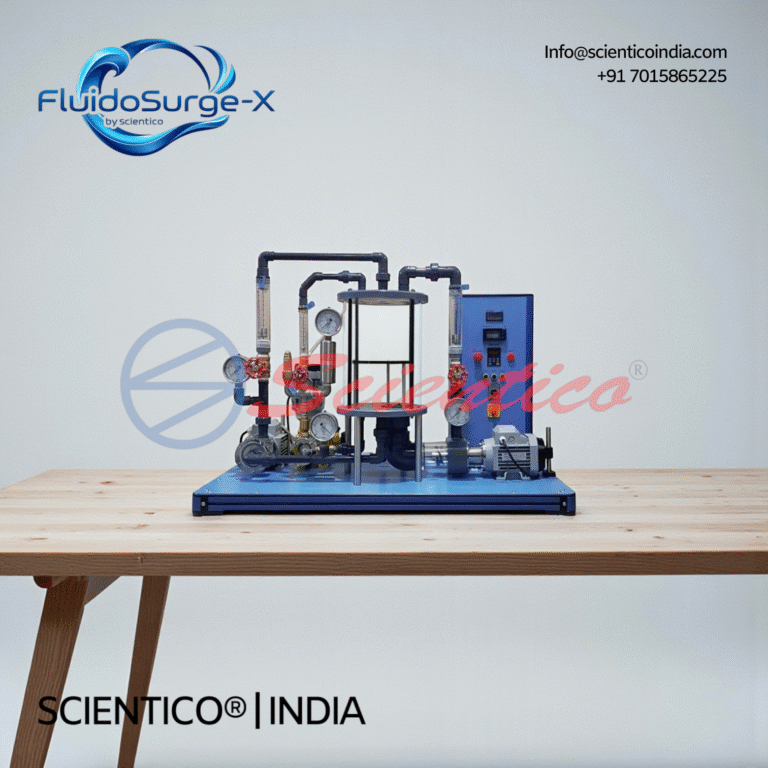
Multi Pump Test Rig Apparatus | FluidoSurge-X 294
The FluidoSurge X-294 is a multi pump test rig (series and parallel centrifugal pump test rig) that lets students run single, series and parallel pump configurations on one apparatus and compare the resulting head–discharge–efficiency characteristics.
View product details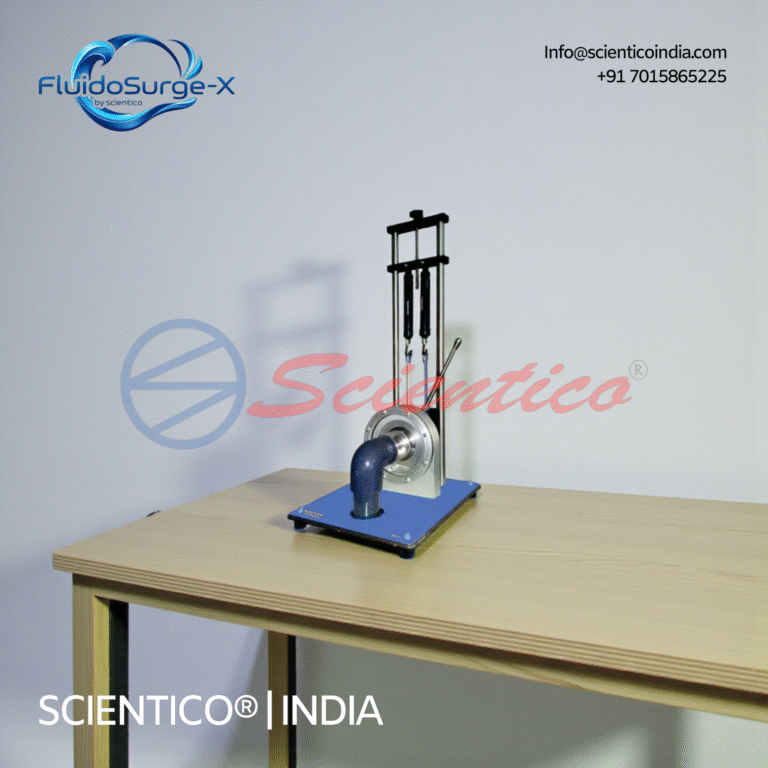
Kaplan Turbine Apparatus | FluidoSurgeX 208
The Kaplan Turbine Apparatus FluidoSurgeX 208 is a laboratory-scale training system designed to study the operating characteristics of a Kaplan reaction turbine. Manufactured by SCIENTICO, the apparatus demonstrates energy conversion from hydraulic power to mechanical power. It is suitable for instructional experiments in fluid mechanics and hydraulic machinery laboratories. The system operates using a controlled water supply from a hydraulic bench.
View product details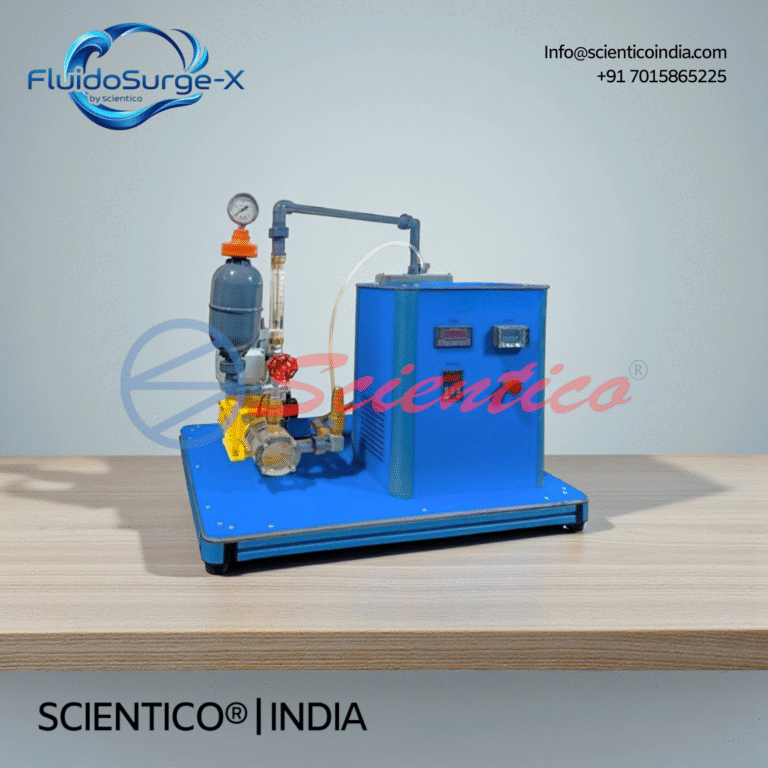
Reciprocating Pump Demonstration Unit | FluidoSurge-X 264
The Reciprocating Pump Demonstration Unit FluidoSurge-X 264 is a laboratory apparatus designed to study the operating characteristics of a reciprocating pump. Manufactured by SCIENTICO, the unit enables experimental determination of pump performance, pressure behavior, and pulsation effects. It is intended for instructional use in fluid mechanics and hydraulic machinery laboratories. Optional data acquisition software supports detailed analysis.
View product details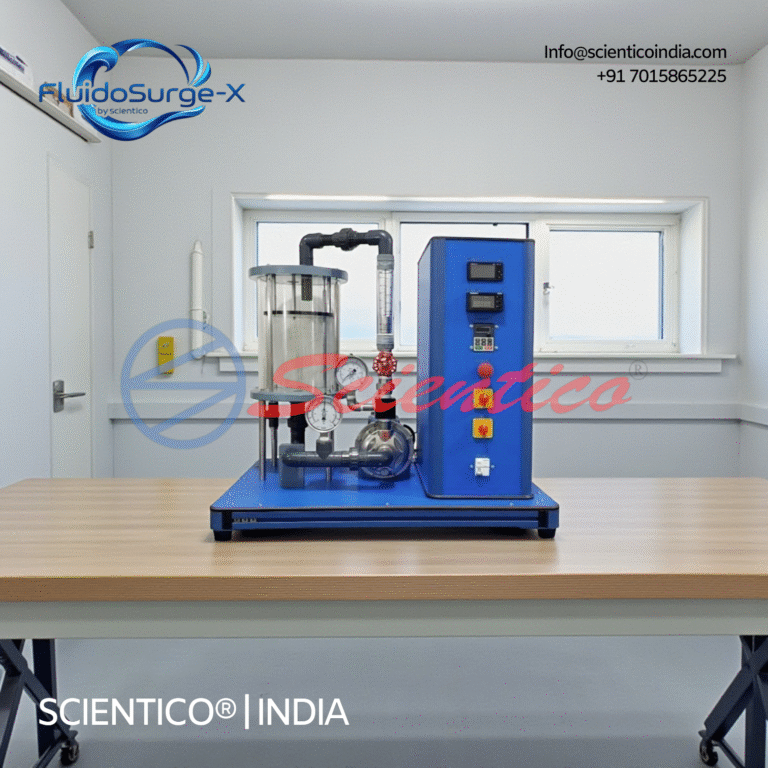
Centrifugal Pump | FluidoSurge-X 188
The Centrifugal Pump FluidoSurge-X 188 is designed for instructional demonstration and experimental study of centrifugal pump performance. It enables controlled investigation of pump characteristics under variable speed and head conditions. The apparatus integrates measurement of flow rate, pressure, and rotational speed. It is suitable for fluid mechanics and hydraulic machinery laboratories.
View product detailsThe short answer
For most Indian diploma and BTech mechanical labs, a centrifugal pump test rig is the correct first purchase. It maps cleanly to the AICTE, HSBTE, MSBTE and BTEUP fluid-mechanics practical lists, spares are cheap, and one bench serves several batches per week without drama. A reciprocating rig belongs in the lab that already owns a centrifugal one, or in a research group studying pulsating flow, air-vessel damping and volumetric efficiency. If you need both experiments on one footprint, look at a multi-pump test rig before you commit to two separate benches.
Head-to-head at a glance
| Parameter | Centrifugal pump test rig | Reciprocating pump test rig |
|---|---|---|
| Working principle | Rotodynamic. Impeller adds kinetic energy, volute converts velocity to head. | Positive displacement. Piston or plunger sweeps a fixed volume per stroke. |
| Typical head (teaching rig) | 8 to 20 m | 15 to 40 m, low discharge |
| Typical discharge | Moderate to high, continuous | Low, pulsating unless an air vessel is fitted |
| Key curves plotted | H vs Q, P vs Q, eta vs Q at constant N | Indicator diagram, slip vs speed, volumetric efficiency |
| Applicable standard | IS 1520 family, IEC 60193 methods for hydraulic testing | IS 5120 family, API 674 as a reference for reciprocating pumps |
| Footprint | Compact, single-skid | Larger, needs crank guarding and stronger foundation |
| Noise and vibration | Low, steady hum | Higher, characteristic knock at each stroke |
| Maintenance | Mechanical seal, bearings, impeller wear ring | Piston rings, suction and delivery valves, packing gland |
| Cost tier (teaching grade) | Low to mid | Mid to high |
| Best fit | Diploma, BTech first year fluid mech | Final year electives, MTech, research |
Working principle: how each one operates
Centrifugal. An electric motor spins an impeller inside a volute casing. Fluid enters axially at the eye, gets flung outward, and picks up kinetic energy that the diverging volute converts to pressure head. Head developed follows H is roughly u2 divided by g minus losses, where u is peripheral velocity. That is why doubling speed roughly quadruples head, halves nothing else. Discharge is continuous. Priming matters, and once you break prime the rig sulks until you refill the suction line. Students plot H, P and eta against Q at a constant N and get the classical dropping head curve.
Reciprocating. A crank drives a piston in a cylinder fitted with spring-loaded suction and delivery valves. Each stroke displaces a theoretical volume equal to the swept volume times strokes per second. Real discharge is lower because of leakage past the valves and rings, and the gap between theoretical and actual is the slip. Without an air vessel, the discharge curve is a chopped-sine mess. Add the air vessel and it smooths out, and now students can read the indicator diagram and compare it against the ideal p-V rectangle. The physics teaches valve dynamics and inertia head in a way a centrifugal never will.
Centrifugal vs reciprocating pump test rig: which for which department
Diploma polytechnic labs (HSBTE, MSBTE, BTEUP, PSBTE, WBSCTE, SBTET, DOTE). Pick centrifugal. The practical wording is almost always “determine the characteristic curves of a centrifugal pump”. Simple, cheap per student hour, and the failure modes are things a lab assistant can fix. Pair it with a hydraulic bench and you cover half the syllabus. Guide: polytechnic lab equipment.
BTech mechanical, first two years (AICTE, GTU, VTU, AKTU, MAKAUT). Still centrifugal first. It is the reference machine for teaching Q-H curves, NPSH and specific speed. Add a reciprocating unit in the elective semester when students meet positive-displacement machinery in fluid power or thermal engineering.
Final year electives, MTech and research. Reciprocating earns its keep here. Pulsation studies, air vessel sizing, cavitation onset in piston pumps, and slip characterisation are all far cleaner on a reciprocating rig. If the scholar is doing hydraulic machinery work, back it with a Kaplan turbine apparatus and a turbine test rig on the same bay. Guide: research lab equipment.
ITI and vocational (DGT). Neither, initially. Start with a single centrifugal rig only after the trade curriculum requires pump curves. See ITI lab equipment for realistic scoping.
Mixed department that runs both syllabi. This is where the FluidoSurgeX multi-pump test rig pays back. One frame, one measurement panel, both pump types plumbed in. You save floor area, share the sump, and students compare the two machines back to back in the same session, which is actually pedagogically better than owning two isolated benches.
Common mistakes when choosing
Buying reciprocating first because it “looks more industrial”. I have seen this cost a lab two semesters. The syllabus asked for centrifugal characteristics, and the students had to borrow a rig from a neighbouring college for their viva. Match the machine to the practical list, not to what looks impressive at NAAC visit.
Ignoring sump capacity. A reciprocating rig with a small sump will cavitate and the students will blame the pump. Insist on sump volume large enough that a full-open discharge run takes at least 60 seconds to visibly drop the level. Same logic applies on the centrifugal side.
Skipping the pressure and vacuum gauges’ calibration certificate. If your instruments do not carry an ISO 17025 NABL calibration trace, your characteristic curve is a drawing exercise, not a measurement. Ask for the certificate at PO stage, not after delivery.
Under-sizing the motor for classroom margins. A rig sized to exactly the syllabus point struggles when a demo class runs 40 minutes with the valve throttled. Pick one motor rating above the minimum. On a reciprocating rig, this also gives you headroom for indicator diagrams at more than one speed.
Scientico’s recommendation
Nine times out of ten I recommend the FluidoSurgeX multi-pump test rig. It carries both a centrifugal and a reciprocating pump on one instrumented frame, with common manometry, tachometer and energy meter. Students draw the centrifugal characteristics in one session and the reciprocating indicator diagram in the next, using the same sump and the same measurement discipline. Floor area works out smaller than two standalone rigs, and there is only one calibration cycle to manage. It ships documentation reviewed per model, built to ISO 9001:2015 under our Ambala quality system. If the lab genuinely only ever needs one machine, we still sell dedicated single-pump rigs from the same fluid mechanics catalogue. For a full lab build, start with the fluid mechanics lab setup guide and the multi-pump test rig buyers guide.
Cost and delivery framework
Teaching-grade single centrifugal rigs sit in the low-to-mid tier. Reciprocating rigs of comparable build sit mid-to-high because of the crank assembly, air vessel and heavier base. A dual multi-pump rig lands between the sum and the max, usually closer to the sum minus one bench worth of structural steel. I do not publish rupee figures on comparison pages because sump size, motor rating, instrumentation grade and NABL certification each move the number materially. Ask for a written quotation against your practical list.
Domestic dispatch typically runs several weeks in production once the PO and advance clear, plus surface transit to your city. Export orders add sea transit and origin documentation, and we quote FOB Nhava Sheva or CIF destination port depending on your Incoterms preference. Scientico has shipped to more than 60 countries since 1993, and we handle the ISO 9001:2015 and CE documentation packet as standard. For the commercial conversation, go to contact us with your syllabus reference, target head and discharge, and preferred delivery city.
Ready to specify? Send your practical list and target ratings to Scientico and I will map them to the right rig, single or multi-pump, with a written quotation and lead time.
Frequently Asked Questions
Is a centrifugal or reciprocating pump test rig better for a diploma lab?
Centrifugal, in almost every case. HSBTE, MSBTE, BTEUP and similar polytechnic boards specify centrifugal characteristic curves as the core practical. The rig is cheaper, easier to maintain, and one lab assistant can keep it running for several batches a week.
Can one rig teach both pump types?
Yes. A multi-pump test rig like the FluidoSurgeX carries a centrifugal and a reciprocating pump on the same instrumented frame, sharing sump and measurement panel. Students compare both machines back to back, which is better pedagogy than two isolated benches.
What standards should the rig meet?
Ask for ISO 9001:2015 manufacturing, CE marking on the electricals, and NABL ISO 17025 calibration certificates for the pressure gauges, vacuum gauge and energy meter. Without traceable calibration, the characteristic curve is a drawing, not a measurement.
How long does delivery take?
Domestic orders typically take several weeks in production after PO and advance clearance, plus surface transit. Export orders add sea transit and origin documents. Ask for a written lead time in the quotation because it moves with instrumentation grade and current queue.
Do you publish prices online?
Not on comparison pages. Sump size, motor rating, instrumentation grade and NABL certification each shift the number materially, so we quote against your syllabus reference and target head and discharge. Send those to Scientico and we will price it in writing.
One honest ask
We don't gate anything on this site. You just read the whole thing free. If it was useful, leave your email and two things happen: we send you this page as a plain-text block you can paste into a tender file or an internal email, and we notify you the next time we publish a buyer tool like this one. Nothing else. No drip sequence, no sales calls booked without asking.