
Equipment mentioned in this guide
Review the product information, specifications and model before requesting a quotation.

Multi Pump Test Rig Apparatus | FluidoSurge-X 294
The FluidoSurge X-294 is a multi pump test rig (series and parallel centrifugal pump test rig) that lets students run single, series and parallel pump configurations on one apparatus and compare the resulting head–discharge–efficiency characteristics.
View product details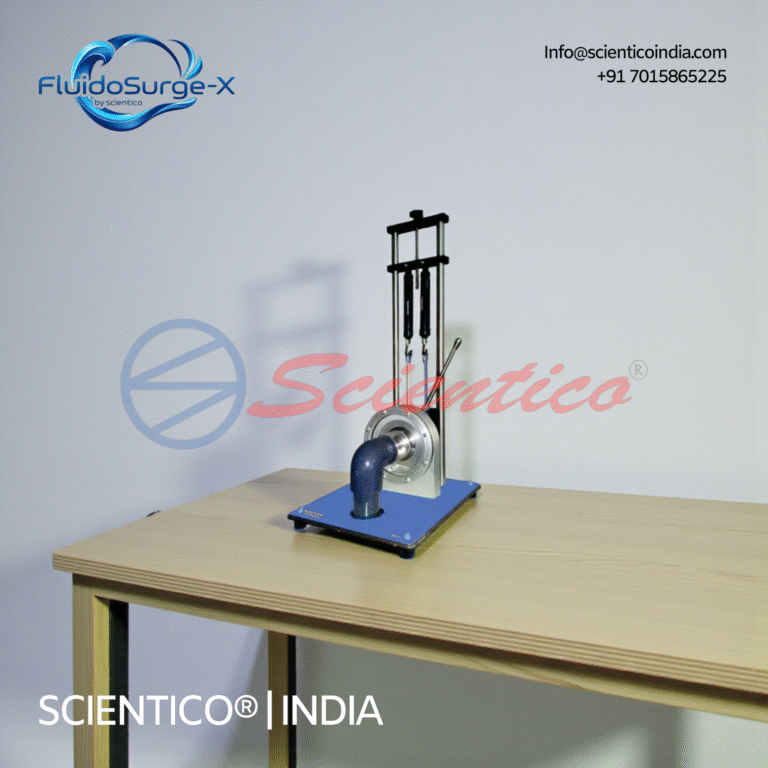
Kaplan Turbine Apparatus | FluidoSurgeX 208
The Kaplan Turbine Apparatus FluidoSurgeX 208 is a laboratory-scale training system designed to study the operating characteristics of a Kaplan reaction turbine. Manufactured by SCIENTICO, the apparatus demonstrates energy conversion from hydraulic power to mechanical power. It is suitable for instructional experiments in fluid mechanics and hydraulic machinery laboratories. The system operates using a controlled water supply from a hydraulic bench.
View product details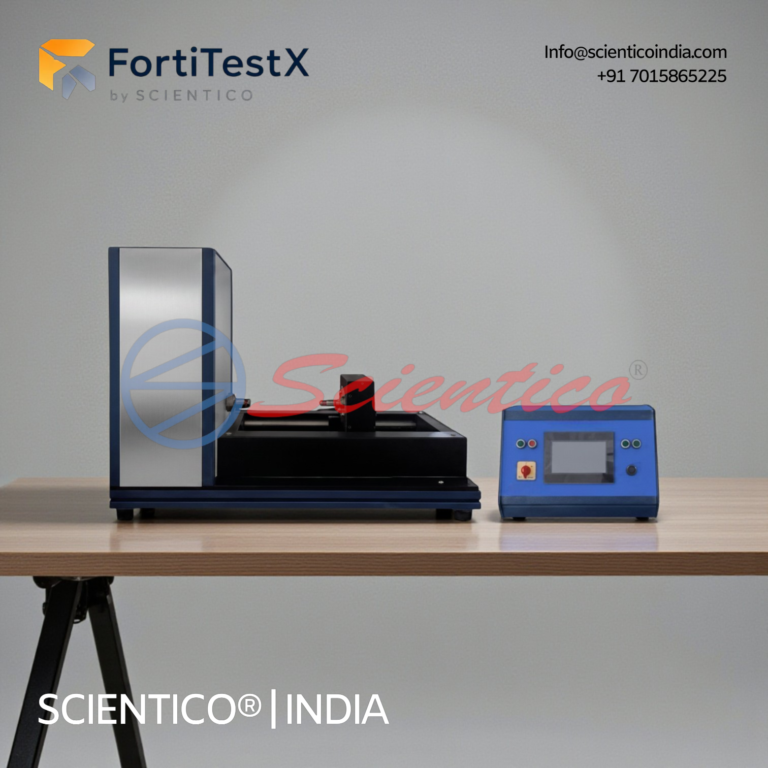
Torsion Testing Machine 300 Nm Motorised | FortiTestX – 10
Torsion Testing Machine FortiTestX 10 is a motorised, benchtop strength of materials lab equipment unit designed for the torsional testing of various material specimens up to fracture. This Torsion Testing Machine applies controlled torque via a worm drive and motor, measuring test torque through a strain gauge and angle of twist through an incremental encoder, with both values displayed on digital readouts in real time. Engineered for undergraduate engineering laboratories, the FortiTestX 10 supports torsional testing of mild steel, aluminium, and brass specimens up to 300 Nm and 300 mm length.
View product details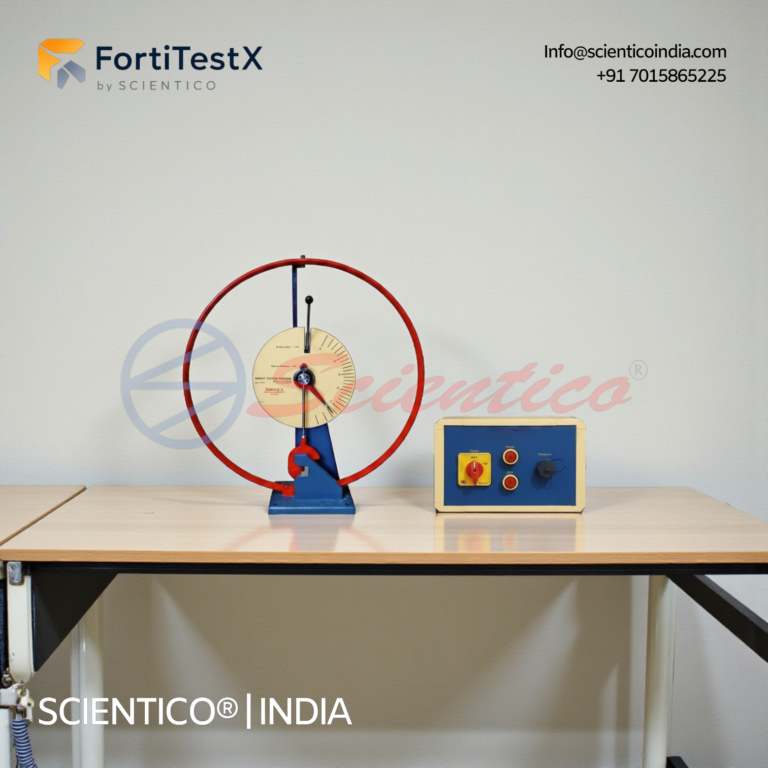
Impact Testing Machine | FortiTestX – 15
Impact Testing Machine FortiTestX 15 is a benchtop strength of materials lab equipment unit designed for notched bar impact bending tests on metallic and non-metallic specimens. This Impact Testing Machine operates on the pendulum principle, delivering a hammer impact speed of 3.8 m/s and a maximum work capacity of 25 Nm, with impact energy read directly from the gauge on a large scale. The FortiTestX 15 supports U, V, and keyhole notch configurations across four specimen materials, making it a complete impact testing machine strength of materials lab equipment unit for undergraduate material testing programmes.
View product details
Universal Hardness Tester
The Universal Hardness Tester manufactured by Scientico India combines Brinell, Vickers, and Rockwell hardness testing methods in a single machine. The machine uses interchangeable indenters and a built-in optical measuring system for Brinell/Vickers measurements, with direct-reading digital display for Rockwell hardness.
View product details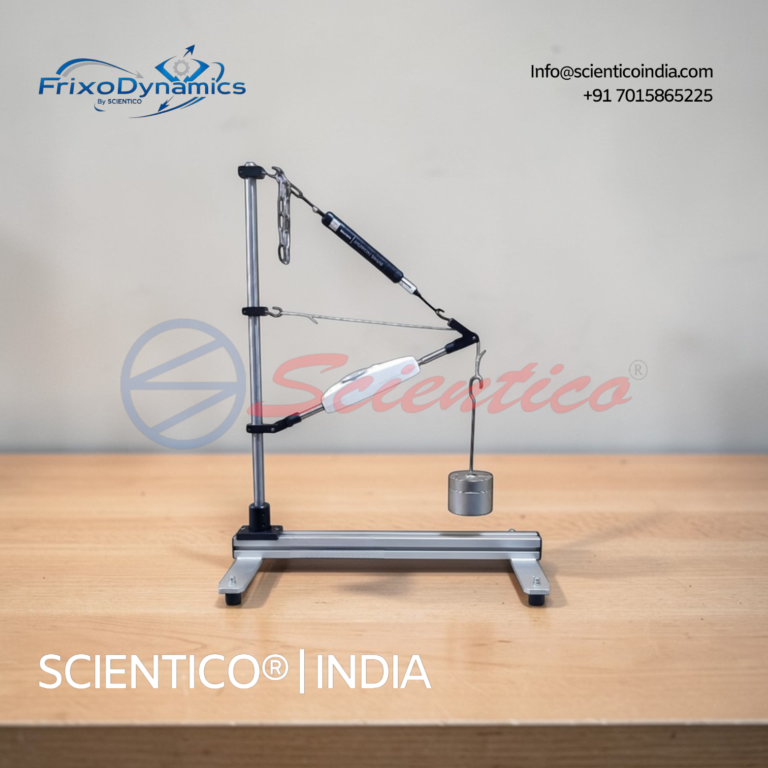
Forces in a Jib Crane Apparatus | FrixoDynamics FX-510
The SCIENTICO FrixoDynamics FX-510 Forces in a Jib Crane Apparatus is a wall-mounted experimental unit designed for the study of force distribution in a two-member jib crane structure. It enables students to measure compressive and tensile forces in the jib and tie members directly using an integrated force gauge and spring balance, and to compare those measured values against theoretical predictions derived from the triangle of forces and polygon of forces methods. The jib inclination and tie angle are adjustable, allowing a range of geometric configurations to be tested. Manufactured by SCIENTICO, the FX-510 is suitable for supply to engineering institutions and distributors worldwide.
View product detailsWhat NAAC actually wants to see about your labs
NAAC lab equipment documentation means one thing in practice: a paper trail that proves each machine exists, was bought properly, is maintained, and is used by students on a schedule you can show. Laboratory infrastructure is assessed mainly under Criterion 4, Infrastructure and Learning Resources, and the same records support your claims about curriculum delivery under Criterion 1 and experiential learning under Criterion 2. The peer team does not grade your equipment, it grades your evidence about the equipment.
That distinction is the whole job. A college with a modest but fully documented lab often scores better than a college with expensive machines and a stock register that stops three years ago.
If you are preparing for programme-level engineering accreditation at the same time, read the sister guide on NBA accreditation lab documentation alongside this page. The two bodies ask different questions of the same lab, and the section below sets out where they diverge.
How the NAAC process consumes lab evidence
The sequence matters because different documents get read at different stages. In broad terms an institution files the Institutional Information for Quality Assessment, then submits the Self Study Report against the Quality Indicator Framework, then answers Data Validation and Verification clarifications on the quantitative metrics, then hosts the peer team visit.
NAAC has been revising its assessment model in recent cycles, including movement toward binary and maturity-based grading. Do not plan your file around a blog post or an old SSR from a neighbouring college. Download the current manual for your institution type from the NAAC site and work from that.
| Stage | What gets looked at | Where colleges lose marks |
|---|---|---|
| SSR submission | Narrative on physical facilities, budget and expenditure on infrastructure, maintenance procedures | Claims written in adjectives instead of counts and dates |
| DVV clarification | Stock register extracts, invoices, audited expenditure statements, geo-tagged photographs | Uploaded scans that do not reconcile with the number claimed in the metric |
| Peer team visit | The lab itself, log books, calibration certificates, staff who can operate the equipment | Equipment present but dusty, unlogged, or nobody on duty can switch it on |
DVV is where most lab claims fail, and it fails on arithmetic rather than on judgement. If your SSR says the department added a given number of major equipment items in a year, the stock register entries, the invoices, and the expenditure statement have to produce the same number. Reconcile those three before you upload anything.
The seven records that carry your lab claim
1. The equipment register
Your permanent asset record, maintained per lab and per department, not one master file in the accounts office. Each row should carry the identification number painted or tagged on the machine, description including make and model, supplier, invoice number and date, quantity, value, warranty expiry, and location. Add a column for the syllabus experiment the item serves. That single column converts an accounts document into an academic one, and it is what lets you answer Criterion 1 questions about curriculum delivery without building a fresh file.
2. Annual stock verification
A dated physical verification signed by a committee, not by one storekeeper. It should record items verified, items not traced, condemned items, and the action taken. Missing verification for the assessment period is a common and completely avoidable finding.
3. Utilisation and log books
Per-machine log with date, batch, experiment performed, number of students, faculty and technician on duty, running hours where relevant, and remarks. This is the record that separates a working lab from a showroom. It also supports experiential and participative learning claims under Criterion 2, since it shows how often students actually put hands on the apparatus.
4. Calibration and traceability records
For any instrument that produces a measured value, keep the calibration certificate, the due date, and the responsible person. Load cells, hardness testers, pressure and flow measurement, temperature indicators, and weighing balances all belong in this file. Build it as a live schedule rather than a folder of old certificates, and set reminders against due dates. Our page on lab equipment maintenance schedules and calibration for engineering colleges sets out a format you can adopt directly.
5. Purchase documentation
The full chain for each item: departmental indent, approval, tender or quotation set, comparative statement, purchase order, invoice, goods receipt, installation and commissioning report, and training or handover note. Public institutions buying through the government marketplace should also keep the bid document and award record, which is covered in the GeM lab equipment procurement guide. Keep the technical specification you floated with the file, because it proves the machine matches the syllabus requirement it was bought for.
6. Photographs
Geo-tagged photographs of labs and major equipment are routinely asked for at the DVV stage. Shoot them properly: the machine with its identification tag visible, the lab with students working, and the safety fittings. Photographs taken during a vacation with empty benches undercut a utilisation claim.
7. Maintenance, safety, and budget
Keep the annual maintenance contracts, the breakdown and repair register with downtime and resolution dates, the maintenance policy approved by the appropriate body, and the year-wise expenditure on infrastructure and equipment tied to audited statements. Safety records belong here too: first aid, fire extinguisher servicing dates, earthing checks, and the lab safety instructions displayed on the wall.
Equipment by lab, with what each item is expected to demonstrate
Assessors ask what a machine teaches, not what it cost. The table below maps common undergraduate labs to representative equipment and the concept each demonstrates. Quantities are typical practice for a 60-student batch split into two sessions of 30, working in groups of five or six, and they are not a regulatory norm. Confirm the required count against your affiliating university’s syllabus and the current AICTE or council handbook for your programme.
| Lab | Equipment | What it demonstrates | Typical qty for 60-student batch |
|---|---|---|---|
| Fluid mechanics and machinery | Multi pump test rig, FluidoSurgeX | Pump characteristics, head and discharge relationships, efficiency curves | 1 rig, rotational |
| Fluid mechanics and machinery | Kaplan turbine apparatus, FluidoSurgeX | Axial flow turbine performance, load versus speed and efficiency | 1 unit, rotational |
| Fluid mechanics and machinery | Bench-scale flow and losses apparatus, FluidoSurge and HydraNexis lines | Bernoulli, friction losses, orifice and notch discharge coefficients | 5 to 6 setups |
| Strength of materials | Torsion testing machine, FortiTestX | Shear modulus, angle of twist, torsional failure behaviour | 1 machine |
| Strength of materials | Impact testing machine, FortiTestX | Izod and Charpy toughness, notch sensitivity, brittle versus ductile fracture | 1 machine |
| Strength of materials | Universal hardness tester | Brinell, Rockwell and Vickers hardness on the same specimen set | 1 to 2 units |
| Engineering mechanics and theory of machines | Forces in a jib crane apparatus, FrixoDynamics | Resolution of forces, equilibrium of a rigid frame, tie and jib member loads | 2 to 3 setups |
| Theory of machines | Governor, gyroscope, cam and follower and balancing apparatus, ProDynami line | Speed control, precession, follower displacement profiles, rotating mass balance | 1 each, rotational |
| Thermodynamics and heat transfer | Conduction, convection and heat exchanger units, ThermoFlux line | Thermal conductivity, heat transfer coefficients, LMTD and effectiveness | 5 to 6 setups across experiments |
| Refrigeration and air conditioning | Vapour compression and air conditioning test rigs, PolarX line | COP determination, psychrometric processes, component-wise energy balance | 1 to 2 rigs |
| Renewable energy | Solar thermal trainer, RVX | Collector efficiency, insolation versus useful heat gain, stagnation behaviour | 1 trainer |
| Process engineering and instrumentation | Analytical process control trainer, ProZessix | Measurement and control loops, sensor response, controller tuning | 1 to 2 trainers |
| Nursing skills laboratory | Manikins, procedure trainers, and ward simulation sets | Clinical procedure competence before patient contact | Per council-prescribed student to unit ratio |
| Pharmaceutics and pharmacology | Dissolution, tablet evaluation, and preparation apparatus | Formulation, evaluation, and dosage form testing skills | Per council-prescribed batch size |
Discipline-specific lists sit on their own pages: the electrical engineering lab equipment list for B.Tech, the soil mechanics lab equipment list for civil engineering, the B.Sc nursing lab equipment list to INC norms, and the B.Pharm lab equipment list to PCI norms.
The procurement angle: buying so the file writes itself
Most documentation pain is created at the purchase stage and paid for three years later. A few decisions remove that cost entirely.
Ask the supplier for the technical specification sheet, the test or inspection certificate, the installation and commissioning report, and the operating and maintenance manual as part of the supply, and make them contractual line items in the purchase order rather than post-delivery requests. Quality documentation such as ISO 9001:2015 evidence for lab equipment and CE marking on lab equipment belongs in the same file, since it answers questions about supplier credibility without further correspondence. Scientico’s own quality certifications are published for exactly this reason.
Insist on identification numbering at the time of delivery. Numbering fifty items retrospectively, two weeks before a visit, is how registers and machines stop matching.
New institutions should sequence the purchase against the semester in which each experiment first appears, which is the approach set out in the first procurement guide for new engineering colleges. If the constraint is money rather than time, the engineering lab equipment cost and budget guide covers how to phase a build without leaving a syllabus experiment uncovered.
NAAC and NBA want different things from the same lab
| Question | NAAC emphasis | NBA emphasis |
|---|---|---|
| Unit of assessment | The institution as a whole, across seven criteria | The individual programme, outcome based |
| Core lab question | Does the facility exist, is it adequate, funded, maintained, and used | Does the lab produce the stated course and programme outcomes |
| Documents that carry weight | Stock register, expenditure and audit statements, maintenance policy, geo-tagged photographs | Lab manuals with CO mapping, rubrics, assessment records, experiments beyond syllabus |
| Verification style | Quantitative metrics validated at the DVV stage, then a peer team visit | Evaluator team examining programme-level attainment evidence |
| Cheapest way to fail | Numbers in the SSR that the supporting scans do not add up to | A well-equipped lab with no outcome mapping or attainment calculation |
Refer to the current manuals of each body for exact criterion and key indicator numbering, since both revise their frameworks. The behaviour of the two teams, though, is stable: NAAC asks whether the institution can sustain the facility, NBA asks whether the facility produces a competent graduate.
What most colleges get wrong
The mistake I see most often is treating the file as a document to be written rather than a system to be run. A register updated once a year in accreditation season reads differently from one maintained continuously, and experienced assessors spot the difference in about a minute: same pen, same handwriting, sequential dates, no corrections.
The second recurring problem is a register that lives only in the accounts department. Finance records purchase value and depreciation. The peer team asks which experiment the machine serves, how many students used it last semester, and when it was last calibrated. Those are departmental facts, so the departmental register has to exist.
Third, log books that record attendance instead of use. “Batch A, present” proves nothing about the equipment. Record the experiment, the machine identification number, and the count of students who operated it.
Fourth, condemned and non-functional equipment left in the register and in the room. An unserviceable machine that is still listed suppresses your credibility on every other entry. Condemn it formally, record the disposal, and remove it from the floor.
Fifth, and most expensive, is a spending pattern with a large spike right before the assessment year and nothing on either side. That pattern reads as preparation for an inspection rather than continuous investment, and it invites questions you would rather not receive. Steady annual expenditure, even at a modest level, tells a better story than a single large purchase.
One more, specific to laboratories: safety documentation that does not exist until someone asks. Fire extinguisher servicing dates, earthing test records, first aid provision, and displayed operating instructions cost almost nothing to maintain and are noticed immediately when absent.
Send us your syllabus or BOQ
If you are putting a lab together or filling gaps before an assessment cycle, send the syllabus or the bill of quantities and we will return a configured quote with the technical specifications, test certificates, and installation documentation you will need for the file. Scientico has supplied teaching laboratories since 1993 from Ambala to institutions in more than 60 countries. Reach us through contact us.
One honest ask
We don't gate anything on this site. You just read the whole thing free. If it was useful, leave your email and two things happen: we send you this page as a plain-text block you can paste into a tender file or an internal email, and we notify you the next time we publish a buyer tool like this one. Nothing else. No drip sequence, no sales calls booked without asking.