
A structured preventive maintenance programme is one of the most cost-effective investments an engineering college or technical institution can make in its laboratory infrastructure. Equipment that is not maintained fails during critical experiments, produces inaccurate results, and has a significantly shorter service life. This guide provides a complete annual maintenance schedule, calibration calendar, and maintenance checklist for engineering laboratory equipment.
Equipment mentioned in this guide
Review the product information, specifications and model before requesting a quotation.
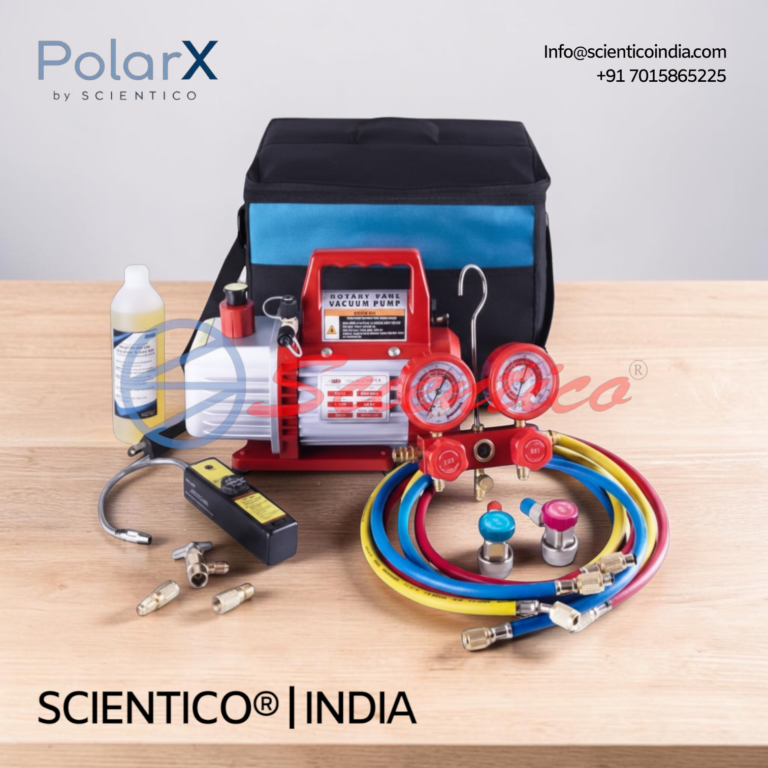
Maintenance Kit | PolarX – 596
The Maintenance Kit PolarX - 596 is a complete refrigeration maintenance set for filling, evacuating, leak detection, and troubleshooting refrigeration systems using refrigerant R134A. This maintenance kit includes a filling station with vacuum pump and filling balance, a battery-operated leak detector, a digital multimeter, manometers for intake, high pressure, and cylinder pressure, a vacuum meter, and a full set of hand tools. All components are common to refrigeration practice, providing direct hands-on exposure to real-world maintenance procedures.
View product detailsWhy Preventive Maintenance Matters for Lab Equipment
Engineering laboratory equipment, universal testing machines, heat exchangers, fluid mechanics rigs, turbine test rigs, is precision-engineered machinery operating under load. Without maintenance:
- Measurement accuracy degrades over time (load cells drift, pressure gauges lose calibration)
- Moving parts wear and seize (pump impellers, bearings, motor brushes)
- Water circuits develop scale, corrosion, and blockages
- Electrical safety deteriorates (insulation breakdown, earthing failures)
- Accreditation bodies (NAAC, NBA) flag unmaintained equipment during inspection
Annual Maintenance Schedule, Engineering Labs
Fluid Mechanics Lab
| Task | Frequency | Personnel |
|---|---|---|
| Drain, flush, and refill hydraulic bench water tank | Every 6 months | Lab technician |
| Inspect pump impeller and seals for cavitation damage | Annual | Qualified engineer |
| Calibrate flow meters (venturimeter, orifice meter) | Annual | NABL lab |
| Inspect and replace pump shaft seal if leaking | As needed / annual inspection | Qualified engineer |
| Check and tighten all pipe connections and flanges | Every 6 months | Lab technician |
| Calibrate pressure gauges and manometers | Annual | NABL lab |
| Lubricate motor bearings (greased bearings) | Annual | Lab technician |
| Check electrical connections and earthing | Annual | Electrician |
| Clean turbine buckets / runner blades of scale | Annual | Lab technician |
| Inspect and replace worn V-belts | Annual or when slipping | Lab technician |
Strength of Materials Lab
| Task | Frequency | Personnel |
|---|---|---|
| Calibrate Universal Testing Machine (UTM), load cells | Annual, NABL lab | Calibration agency |
| Lubricate UTM lead screws and guide columns | Every 6 months | Lab technician |
| Check and replace UTM hydraulic oil | Annual or per manufacturer schedule | Qualified engineer |
| Calibrate hardness tester using verification blocks | Quarterly | Lab technician |
| Calibrate impact testing machine (pendulum), energy scale | Annual | Calibration agency |
| Check torsion machine gear train for backlash | Annual | Qualified engineer |
| Inspect creep machine heating elements and temperature controller | Annual | Qualified engineer |
| Check spring balance accuracy on cam-follower apparatus | Annual | Lab technician |
| Lubricate governor spindle bearings | Annual | Lab technician |
Heat Transfer / Thermodynamics Lab
| Task | Frequency | Personnel |
|---|---|---|
| Calibrate all RTD and thermocouple sensors | Annual, NABL lab | Calibration agency |
| Descale heat exchanger tubes (chemical cleaning) | Annual, more often in hard water areas | Lab technician |
| Check refrigeration system refrigerant charge and pressures | Annual | Refrigeration technician |
| Inspect and clean condenser fins of refrigeration unit | Every 6 months | Lab technician |
| Calibrate temperature display units / data loggers | Annual | Calibration agency |
| Inspect electrical heating elements for resistance drift | Annual | Electrician |
| Check insulation of Stefan-Boltzmann apparatus radiation disc | Annual | Lab technician |
Monthly Quick-Check Maintenance Log
Every laboratory should maintain a monthly quick-check log for all equipment. The log should record:
| Check Item | Pass Criteria |
|---|---|
| Equipment operational status | Powers on, no error codes, mechanical parts move freely |
| Calibration label present and current | Label visible, next calibration date not exceeded |
| Water/oil levels (hydraulic equipment) | Within marked fill range |
| Visible corrosion or physical damage | None, log any damage with photograph |
| Safety guards and interlocks present | All guards in place and functional |
| Earthing continuity | Confirmed with continuity tester |
| Emergency stop function | Tested and operational |
Calibration Calendar, Annual Schedule
To avoid clustering all calibration costs in one month, spread calibration across the year based on equipment criticality and usage:
- June–July (start of academic year): Universal Testing Machine, Hardness Tester, Impact Machine, these are used heavily in Semester 3 and 4 experiments
- July–August: Flow meters, pressure gauges, start of fluid mechanics practical season
- October–November: Temperature sensors, heat transfer rigs, heat transfer practicals in Semester 5–6
- January–February: Torsion machine, creep machine, vibration rig, Theory of Machines and Design of Machine Elements practicals
- March–April: Pharmacy lab equipment (dissolution, hardness tester, analytical balance), before final year practicals
Common Equipment Failures and Prevention
Pump Seal Failure (Fluid Mechanics Lab)
Symptom: Water dripping from pump housing during operation
Cause: Mechanical seal worn due to dry running or abrasive particles in water
Prevention: Always prime pump before starting; use clean water in the hydraulic bench; inspect seal annually
Load Cell Drift (UTM / Hardness Tester)
Symptom: UTM displays non-zero reading with no load applied; hardness readings inconsistent
Cause: Temperature cycling, overload, or moisture ingress into load cell
Prevention: Allow equipment to warm up before use; never apply loads beyond rated capacity; calibrate annually
Thermocouple Drift (Heat Transfer Lab)
Symptom: Temperature readings inconsistent with expected experimental results
Cause: Reference junction oxidation, wire fatigue, or connector corrosion
Prevention: Inspect thermocouple connectors every 6 months; replace thermocouples every 3–5 years as preventive measure
Refrigerant Leak (Refrigeration Lab)
Symptom: Refrigeration unit runs continuously, poor COP values, high discharge pressure
Cause: Refrigerant leak at brazed joints or valve packing
Prevention: Annual pressure test with nitrogen; inspect all joints; only R-134a or approved refrigerant to be used
AMC vs. In-House Maintenance, Decision Guide
Institutions should evaluate Annual Maintenance Contracts (AMC) versus in-house maintenance for each equipment category:
- AMC recommended: Universal Testing Machines, refrigeration systems, CNC equipment, require specialized knowledge and spare parts access
- In-house with periodic calibration: Fluid mechanics rigs, heat transfer apparatus, SOM apparatus, standard maintenance can be performed by trained lab technicians
- Calibration-only contract: All measuring instruments, calibration must be done by a NABL-accredited third party regardless of who does maintenance
Scientico India manufactures model-specific, ISO 9001:2015 laboratory equipment, exported to 30+ countries since 1993. Request a model-specific CIF proforma invoice after technical review.
One honest ask
This article and public product information are available to browse without an account. To open a product datasheet, complete the contact form shown with its download link. If this article was useful, leave your email and two things happen: we send you this page as a plain-text block you can paste into a tender file or an internal email, and we notify you the next time we publish a buyer tool like this one. Nothing else. No drip sequence, no sales calls booked without asking.