
Equipment mentioned in this guide
Review the product information, specifications and model before requesting a quotation.
Universal Hardness Tester
The Universal Hardness Tester manufactured by Scientico India combines Brinell, Vickers, and Rockwell hardness testing methods in a single machine. The machine uses interchangeable indenters and a built-in optical measuring system for Brinell/Vickers measurements, with direct-reading digital display for Rockwell hardness.
View product details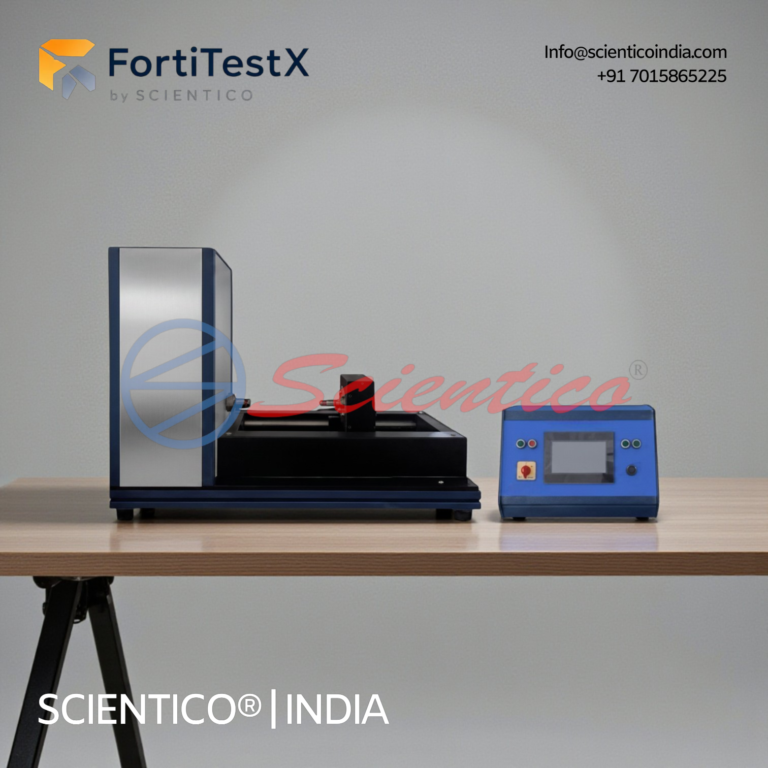
Torsion Testing Machine 300 Nm Motorised | FortiTestX – 10
Torsion Testing Machine FortiTestX 10 is a motorised, benchtop strength of materials lab equipment unit designed for the torsional testing of various material specimens up to fracture. This Torsion Testing Machine applies controlled torque via a worm drive and motor, measuring test torque through a strain gauge and angle of twist through an incremental encoder, with both values displayed on digital readouts in real time. Engineered for undergraduate engineering laboratories, the FortiTestX 10 supports torsional testing of mild steel, aluminium, and brass specimens up to 300 Nm and 300 mm length.
View product details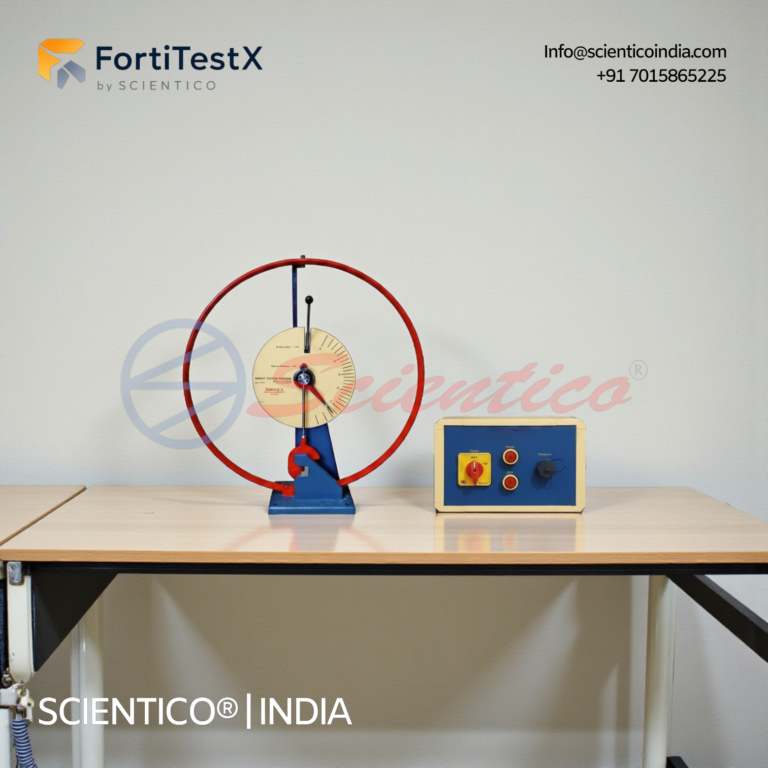
Impact Testing Machine | FortiTestX – 15
Impact Testing Machine FortiTestX 15 is a benchtop strength of materials lab equipment unit designed for notched bar impact bending tests on metallic and non-metallic specimens. This Impact Testing Machine operates on the pendulum principle, delivering a hammer impact speed of 3.8 m/s and a maximum work capacity of 25 Nm, with impact energy read directly from the gauge on a large scale. The FortiTestX 15 supports U, V, and keyhole notch configurations across four specimen materials, making it a complete impact testing machine strength of materials lab equipment unit for undergraduate material testing programmes.
View product details
Multi Pump Test Rig Apparatus | FluidoSurge-X 294
The FluidoSurge X-294 is a multi pump test rig (series and parallel centrifugal pump test rig) that lets students run single, series and parallel pump configurations on one apparatus and compare the resulting head–discharge–efficiency characteristics.
View product detailsNursing and medical training equipment, made in Ambala, sold through partners
This page is written for one reader: the distributor, dealer or trading house that already supplies education and now wants an Indian manufacturer standing behind its quotes for nursing and medical training equipment. Institutions buying for their own labs are welcome to read on, but the commercial terms below are written for the channel.
Scientico manufactures laboratory and engineering teaching equipment at its own works in Ambala, Haryana, India. We have been manufacturing since 1993 and have supplied to more than 60 countries. We are ISO 9001:2015 certified and provide CE conformity documentation on applicable models. The paperwork sits on our quality certifications page. Download it before you attach anything to a tender, because a partner who quotes a certificate they have not read is a partner who eventually loses a bid on a technical objection.
The catalogue runs past 320 products. Most of it is engineering training equipment. Alongside that sits a nursing, pharmacy and medical lab range that a large number of our engineering partners have never quoted, usually because nobody pointed it out to them.
We quote on request and we publish no prices. That is deliberate. Specification level, quantity, destination port and tender conditions all move the number, and a public figure would be wrong for most enquiries within weeks of being posted.
The cross-sell most engineering partners are sitting on
Inside one multi-faculty institution, the engineering block and the health-science block are two separate buying centres. Different heads of department write the specification. Different accreditation pressure sets the timing. The budget line is usually separate, and in many private education groups the nursing college is a distinct legal entity with its own purchase committee and its own principal.
What the two share is the registrar, the finance office and the tender portal. That is your opening.
A partner who has already delivered fluid mechanics lab equipment to the mechanical department has a paid invoice, a named contact in accounts and a delivery record on file. Carrying that record across the campus to the nursing principal is a far shorter conversation than a cold approach, and it is a conversation your competitor selling only medical goods cannot have.
It runs the other way as well. Partners who first came to us through a nursing enquiry have gone on to quote strength of materials lab equipment and renewable energy training equipment to the engineering campus of the same group. One manufacturer behind both quotes, and one authorisation process to manage instead of two.
If you want to see the width of the engineering side before you decide, start with the engineering training equipment catalogue and the two teaching-lab guides we maintain for that audience, the mechanical engineering lab equipment list and the civil engineering lab equipment list.
What the nursing and medical training range covers
Listing catalogue codes helps nobody at the enquiry stage. It is more useful to organise the range the way a nursing or medical programme has to organise its teaching. A syllabus never asks for a manikin. It asks the student to demonstrate a procedure under supervision before going anywhere near a patient. The equipment follows from that demand.
Manikins and procedural simulators
This is the block that generates the search traffic and most of the enquiries. It covers CPR and basic life support training manikins, auscultation trainers for heart, lung and bowel sounds, injection training arms and injection pads, intravenous cannulation arms, urinary catheterisation models in male and female versions, obstetric and childbirth delivery simulators, newborn and infant care manikins, and full-body nursing care manikins used for bed bath, positioning, tube feeding, ostomy care, tracheostomy care and wound dressing practice.
Two things matter to the quoting partner here. First, skill level: an entry-level demonstration manikin and a high-fidelity simulator are different products at very different values, and institutions frequently write a specification that mixes the two by accident. Second, consumables: skins, pads, lungs and replacement parts are a repeat revenue line for you long after the original order closes, so raise them at quotation stage rather than a year later.
Basic clinical skills and ward practice equipment
Around the manikins sits the equipment a demonstration room needs to run a class: hospital beds and bedside furniture, examination couches, dressing and instrument trolleys, IV stands, patient transfer and positioning aids, bandaging and first-aid training sets, sterilisation and disinfection items for the practice lab, and the general instruments a nursing foundation class uses for vital signs and basic procedures.
Anatomical models
Anatomy and physiology teaching in the first year of a nursing or paramedical programme runs on models: skeleton and disarticulated bone sets, torso models, and organ and system models for circulation, respiration, digestion, the nervous system and reproduction. These are low-value lines individually but they appear on almost every institutional list, and they are often what gets a partner a first small order with a new college.
Where pharmacy lab equipment overlaps
Many institutions run nursing, pharmacy and allied health programmes inside the same campus, sometimes inside the same building. If your buyer is one of those, the enquiry will rarely stop at nursing. Our pharmacy lab equipment range covers the pharmaceutics, pharmacology and pharmaceutical chemistry teaching labs, and it is the natural second quote to put in front of the same purchase committee. The full nursing side is at nursing lab equipment.
One blunt point before you build a list. If an item you have been asked for is outside what we manufacture, we will say so rather than quote it and disappoint the college at delivery. Send us the institution’s list and we will mark it item by item.
Reading an institutional requirement list
Health-science requirement lists arrive in a predictable shape. This table is how we suggest a partner sorts one before asking us to quote.
| What the programme must demonstrate | Equipment category to quote | What the partner should check first |
|---|---|---|
| Resuscitation and emergency response | CPR and basic life support manikins, airway management trainers | Whether feedback or monitoring features are specified, since this changes the product tier completely |
| Physical assessment | Auscultation trainers, blood pressure training arms, examination models | Number of sound sets required and whether an instructor control unit is expected |
| Medication administration | Injection arms, injection pads, IV cannulation arms, infusion practice sets | Consumable replacement parts, quoted separately and clearly |
| Fundamentals of nursing and ward procedure | Full-body nursing care manikin, beds, trolleys, positioning aids | Whether furniture is in your scope or the college is buying it locally |
| Maternal and child health | Delivery simulators, newborn care manikins, breast and pelvic models | Whether the midwifery programme has its own separate list |
| Anatomy and physiology | Skeletal, torso, organ and system models | Size and material specified, since these vary widely at similar descriptions |
| Pharmacy programme in the same institution | Pharmaceutics, pharmacology and pharmaceutical chemistry lab equipment | Whether it is a separate tender or an annexure to the same one |
INC, PCI and the equivalent councils abroad
In India, the Indian Nursing Council sets the framework a nursing programme is inspected against, and that framework includes the demonstration and practice lab provision an institution is expected to have in place. The Pharmacy Council of India plays the equivalent role for pharmacy programmes. This is the regulatory pressure that turns an institutional wish list into a funded purchase order, and it is why nursing equipment enquiries cluster around inspection and admission cycles.
Now the caution, and please take it seriously. We do not state current numeric requirements, quantities or item counts from either council on this page, and you should not quote ours or anyone else’s second-hand version of them to a college. Council requirements are revised, and a partner who builds a quotation on a stale requirement list is the partner who gets it thrown out at inspection. Read the current published requirement from the council itself, map the college’s list against it, and then come to us for the equipment.
What we can do is help you build a mapped list: your column for the requirement as published, our column for the model that meets it. That is a document a principal can actually use, and it is worth far more than a price sheet.
For export markets the logic is identical, only the acronym changes. Most countries have a national nursing council, health professions council or ministry-level education authority that sets comparable requirements for nursing and paramedical programmes. If you are bidding in one of those markets, tell us which authority’s requirement you are working to and we will specify against it.
Tender and documentation support
Institutional and government business in this sector is won on documents as much as on product. We support partners on the paperwork side because a bid that fails on an annexure wastes our time as much as yours.
We issue a manufacturer authorisation form for lab equipment tenders on request for a specific tender, once a partner is appointed and the tender reference is confirmed. Before you start drafting, work through the tender documents checklist for government colleges, and use the laboratory equipment tender compliance matrix template to line the specification up clause by clause against what you are actually quoting.
For ordinary private-institution enquiries, the laboratory equipment RFQ checklist is what we would rather receive than a one-line email. A complete RFQ gets a complete quotation faster. Partners working the engineering side of the same campus will also want the NBA accreditation lab documentation guide, since accreditation documentation is frequently the reason an engineering department suddenly has budget.
Shipping, terms and how we price
We supply CIF or FOB, shipping from Nhava Sheva or Mundra. If you are new to importing from India, read how to import lab equipment from India first, because the questions it answers on documentation and packing are the questions that otherwise consume the first two weeks of a new partner relationship.
Every quotation is built for the enquiry. We do not publish prices, and we will not discuss commercial terms in general conversation. Discount structure, order terms and territory are agreed at application review, on the basis of what a partner actually does in the market rather than what is claimed in an introductory email.
Engineering partners who want a feel for build quality before committing to the health-science range usually look at a few representative machines: the universal hardness tester, the torsion testing machine FortiTestX 10, the impact testing machine FortiTestX 15 and the multi pump test rig FluidoSurgeX 294. Our product families include FluidoSurge and FluidoSurgeX, FortiTestX, FrixoDynamics, ThermoFlux, ProDynami, ProZessix, HydraNexis, RVX and PolarX.
Who we appoint
We are looking for partners who already sell into the institutional education channel, or who have a credible route into it. Being able to buy is not the qualification. Being able to hold an institutional relationship from specification through to installation and after-sales support is the qualification.
Concretely, a strong application shows us the segments you serve, the territory you can actually cover, whether you have handled institutional or government tendering before, and what technical or service capability you can offer a college after the crates are opened. If you are a pure trading intermediary with no service capability, say so plainly. We would rather structure around that than discover it after a college complains.
Apply through the distributor application page. We review applications against existing coverage in the territory, and terms are agreed at review, not before it. We would rather say no clearly than string an applicant along.
Talk to us
Send the institution’s requirement list, the tender reference if there is one, the destination port and your target timeline. That is enough for us to come back with something useful instead of a brochure. Email [email protected], or reach us on WhatsApp or phone at +91 7015865225, or use the form at contact us.
One honest ask
We don't gate anything on this site. You just read the whole thing free. If it was useful, leave your email and two things happen: we send you this page as a plain-text block you can paste into a tender file or an internal email, and we notify you the next time we publish a buyer tool like this one. Nothing else. No drip sequence, no sales calls booked without asking.