
Engineering laboratory buying guide
Heat Exchanger Apparatus Selection Guide for Engineering Laboratories
Choose a heat-exchanger apparatus from the learning outcome and measurement plan first. A product name alone does not show whether students can observe the temperatures, flow conditions, utilities and calculations required by the practical. This guide helps a department turn an experiment brief into a model-level equipment request.
1. Start with the experiment outcome, not the equipment name
Write the practical in the language your students will use: determine an overall heat-transfer coefficient, compare co-current and counter-current operation, calculate LMTD, compare effectiveness, observe the effect of flow rate, or compare arrangements. Then state the measurements needed to make that calculation. This prevents a common procurement problem: buying an apparatus that looks appropriate but does not expose every temperature, flow or control point required by the experiment.
A useful internal brief has five short fields: the course or laboratory, the experiment, the variables students must record, the calculation or comparison expected, and the number of simultaneous student groups. These fields also help a supplier identify which configuration needs clarification before a quotation is issued.
2. Choose the heat-exchanger arrangement for the teaching question
Plate arrangement
Use a plate route when the teaching brief calls for a compact plate heat-exchanger configuration. Ask the product record to identify the plate arrangement, available heat-transfer area, circuit connections, operating boundary and each included measurement point.
Concentric-tube arrangement
Use a concentric-tube route when the class needs to examine heat transfer through one tube path within another. Define the required flow relationship, inlet and outlet measurements, and whether the apparatus must support the specific LMTD or effectiveness exercise in the syllabus.
Cross-flow arrangement
Use a cross-flow route when the experiment requires that flow relationship. State which fluid paths, temperatures, flow controls and calculation inputs the practical requires so the offered configuration can be checked against the course.
Do not choose solely from a diagram or category label. The quotation should name the exact offered model and state any variation from the laboratory brief.
3. Check the measurement path before comparing commercial offers
LMTD and effectiveness calculations depend on the readings available to the learner. For a standard two-stream practical, the teaching plan commonly needs hot and cold inlet and outlet temperatures. The flow arrangement, flow indication, heater or hot-side source, cold-side source and method for recording data also need to be visible in the supplied scope. If a calculation will be completed in a worksheet or software, identify the data path and any optional software separately.
| Decision area | Question for the department | What the quotation should identify |
|---|---|---|
| Learning task | Which calculation, comparison or observation must students complete? | Exact model and the experiment capability stated against that task. |
| Temperature points | Which inlet and outlet temperatures must be observed? | Included sensors, display or data arrangement and measurement boundary. |
| Flow path | Which streams and flow relationships must be controlled? | Connections, controls, indicators and required external services. |
| Station capacity | How many groups must work at once? | Number of apparatuses proposed and shared-service assumptions. |
| Supplied scope | Which accessories, hoses, interfaces or services are needed? | Included, optional, excluded and institution-provided items separated. |
| Handover | How will the department verify the equipment at acceptance? | Documents, installation boundary and agreed acceptance exercise. |
4. Plan utilities, room layout and student capacity early
A heat-exchanger apparatus can depend on electrical supply, water source, drainage, bench space and an agreed route for connections. Record what is already available in the laboratory, including voltage and frequency, water and drainage arrangements, and any requirement to use a service unit or bench. If the apparatus is part of a larger thermal laboratory, identify which resources can be shared and which must be available at each station. That avoids a quotation that is technically correct but incomplete for the actual room.
For a new laboratory, phase the plan. Start with the core heat-transfer experiments required for the first cohort. Add specialist arrangements when the curriculum and timetable justify them. Keep the room, utility and handover requirements in the same BOQ as the equipment lines so the programme team can review the full delivery boundary.
5. Review published product routes, then confirm the offered configuration
The routes below lead to current Scientico product records. They are starting points for technical review, not a substitute for a written configuration response. Open the record, compare it with the experiment brief, and ask the quotation to identify the final offered scope.
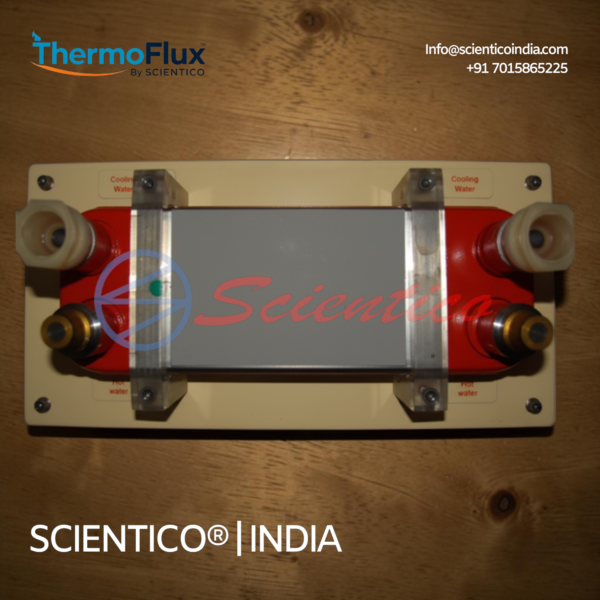 Published product routePlate Type Heat Exchanger | ThermoFlux – 7108/1
A starting route when the brief requires a plate heat-exchanger arrangement and a model-specific configuration review.
Review the current product record →
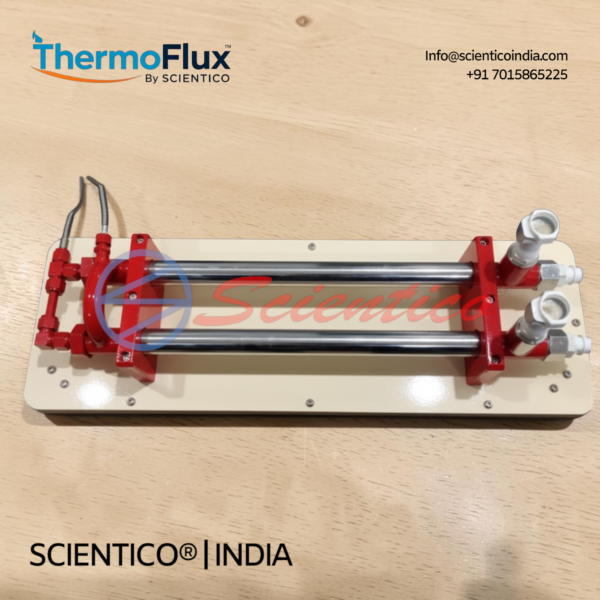 Published product routeConcentric Tube Heat Exchanger | ThermoFlux – 7108/2
A starting route when the experiment needs a concentric-tube arrangement and the associated measurement points.
Review the current product record →
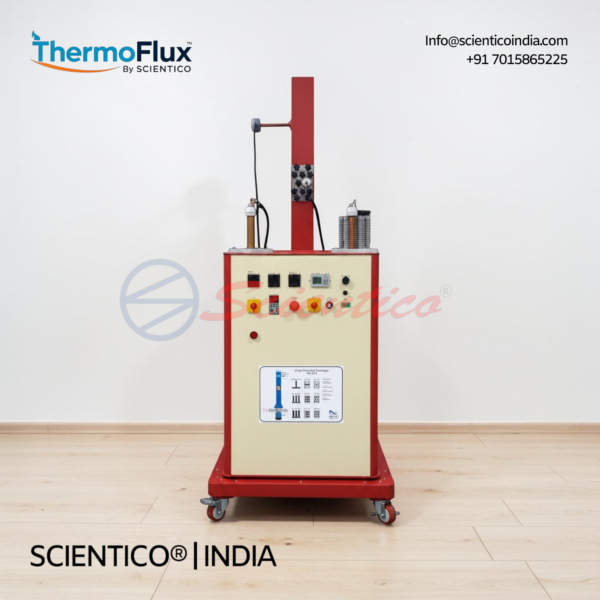 Published product routeCross Flow Heat Exchanger | ThermoFlux – 7078
A starting route when the programme requires a cross-flow heat-exchanger teaching arrangement.
Review the current product record →
Related teaching resources: plate heat-exchanger effectiveness and LMTD, double-pipe heat-exchanger procedure, LMTD versus NTU comparison, and the thermodynamics equipment category.
6. Copy-ready heat-exchanger apparatus RFQ brief
We are planning a heat-transfer laboratory for [institution and course]. The required experiment(s) are [LMTD / effectiveness / flow comparison / other]. Students must observe and record [temperatures, flow conditions and other variables]. We require [number] simultaneous station(s) for groups of [number]. Available site services are [electrical supply, water, drainage, space]. Please respond with the exact offered model, experiment capability, supplied instruments and accessories, required external services, optional and excluded items, documentation, delivery basis, installation boundary and an acceptance exercise that can be completed at handover.
Questions buyers ask before selecting a heat-exchanger apparatus
Should we choose the apparatus before deciding the experiment?
Start with the experiment and calculation. Then check which arrangement, measurements and utilities are required. This makes the model selection reviewable and reduces missing scope in the quotation.
What should be included in a technically comparable quotation?
Ask for the exact model, experiment capability, included measurements and accessories, external services, optional and excluded items, documents, delivery basis and installation or acceptance responsibility.
Can one apparatus serve every heat-exchanger practical?
That depends on the stated learning outcomes and the offered configuration. List the required practicals and ask the supplier to identify which are supported, which need another arrangement and any constraints.