
The LMTD (Log Mean Temperature Difference) and NTU (Number of Transfer Units, or effectiveness-NTU) methods are the two standard approaches to heat exchanger analysis. Use the LMTD method when all four inlet and outlet temperatures are known and you want to size an exchanger (find the required area). Use the NTU method when only the inlet temperatures are known and you want to rate an existing exchanger (predict outlet temperatures and heat transfer). Both methods give identical results for the same exchanger; they simply suit different problems.
For students in engineering, polytechnic, and university heat-transfer labs, understanding when to reach for each method is more valuable than memorising formulas. This guide explains both clearly, compares them side by side, and connects the theory to what you actually observe on a heat exchanger test rig.
Equipment mentioned in this guide
Review the product information, specifications and model before requesting a quotation.
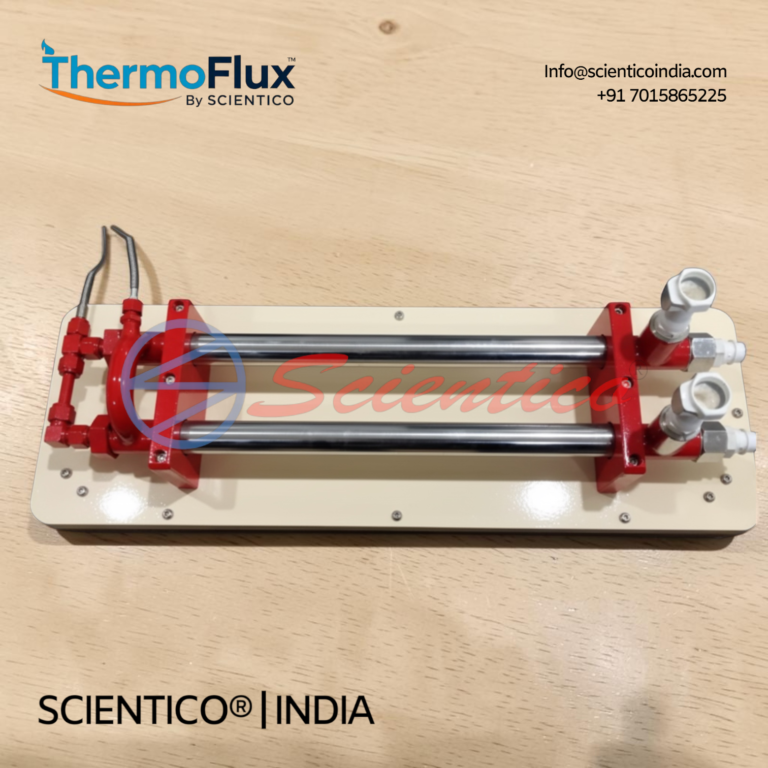
Concentric Tube Heat Exchanger | ThermoFlux – 7108/2
The Concentric Tube Heat Exchanger ThermoFlux - 7108/2 is a laboratory unit designed to study heat transfer through a concentric tube configuration under parallel flow and counter flow conditions. This concentric tube heat exchanger consists of two copper concentric tubes with hot water circulating through the internal tube and cold water circulating through the annular space, with K-type thermocouple sensors at multiple measurement points including inlet, outlet, and midpoint locations for both fluid streams.
View product details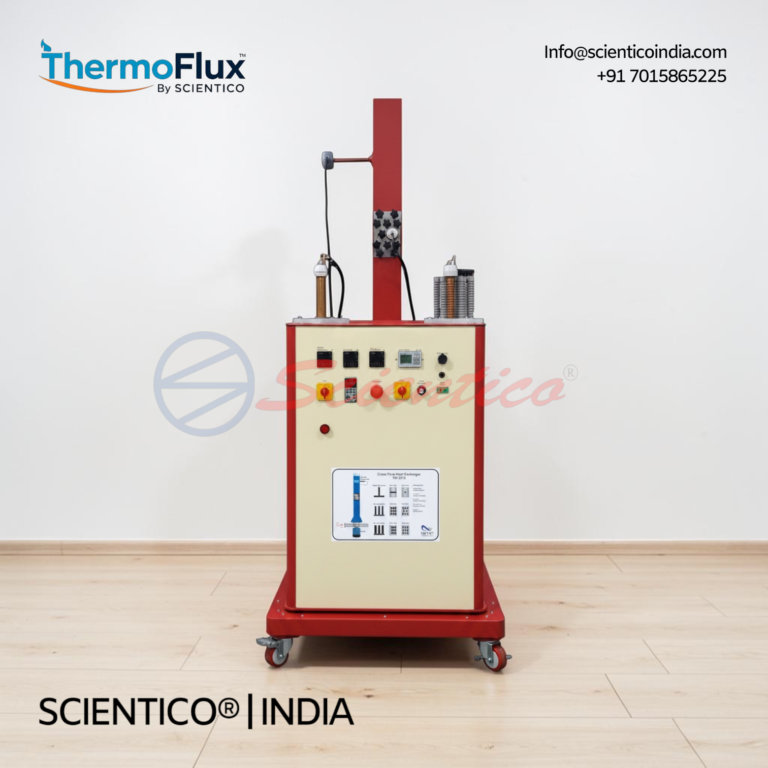
Cross Flow Heat Exchanger | ThermoFlux – 7078
The Cross Flow Heat Exchanger ThermoFlux - 7078 is a laboratory-grade unit designed to enable students to investigate heat transfer rates by free and forced convection. This cross flow heat exchanger provides hands-on experimentation with interchangeable heating elements, adjustable airflow, and digital measurement display, making it a precise tool for thermal engineering studies.
View product detailsWhat is the LMTD method?
The LMTD method calculates the average temperature difference driving heat transfer between the hot and cold fluids along the length of an exchanger. Because the temperature difference between the two streams is not constant, a simple arithmetic average would be inaccurate, so a logarithmic mean is used.
The core sizing equation is:
- Q = U × A × F × ΔTlm
where Q is the heat transfer rate, U is the overall heat transfer coefficient, A is the heat transfer area, F is a correction factor (1.0 for pure counter-flow and parallel-flow, less than 1 for cross-flow and multi-pass shell-and-tube units), and ΔTlm is the log mean temperature difference.
The LMTD itself is found from the temperature differences at each end of the exchanger:
- ΔTlm = (ΔT1 − ΔT2) / ln(ΔT1 / ΔT2)
When the LMTD method works best
The LMTD approach is the natural choice for design and sizing problems where you already know the required duty and all terminal temperatures. It is intuitive because it stays close to the physical temperature profile, which makes it a strong teaching tool in a lab where students can measure those temperatures directly. Its main limitation is that when outlet temperatures are unknown, you must iterate, which becomes tedious by hand.
What is the NTU (effectiveness-NTU) method?
The effectiveness-NTU method describes exchanger performance using three dimensionless groups, avoiding the need to know outlet temperatures in advance. It is built around the idea of how close an exchanger comes to transferring the maximum thermodynamically possible heat.
The three key quantities are:
- Effectiveness (ε), the ratio of actual heat transfer to the maximum possible heat transfer, ε = Q / Qmax. It always lies between 0 and 1.
- NTU, a dimensionless measure of heat transfer size, NTU = UA / Cmin, where Cmin is the smaller of the two fluid heat capacity rates (mass flow × specific heat).
- Capacity ratio (Cr), Cmin / Cmax.
For each exchanger geometry there is a standard relationship ε = f(NTU, Cr). Once effectiveness is known, the actual heat transfer follows directly:
- Q = ε × Cmin × (Th,in − Tc,in)
When the NTU method works best
The NTU method shines in rating problems, you have a fixed exchanger and want to predict how it will perform with given inlet conditions and flow rates. Because it needs only inlet temperatures, it avoids iteration entirely and is well suited to performance checks, computer programs, and parametric studies where flow rates change. The trade-off is that students often find effectiveness less physically intuitive than a temperature difference they can see on a thermometer.
LMTD vs NTU: which method should you use?
Neither method is “better.” They are two views of the same physics. The decision depends on what you know and what you want to find.
| Aspect | LMTD Method | NTU (Effectiveness-NTU) Method |
|---|---|---|
| Best for | Sizing / design | Rating / performance prediction |
| Inputs needed | All four terminal temperatures | Inlet temperatures and flow rates only |
| Typical output | Required heat transfer area (A) | Outlet temperatures and actual Q |
| Iteration | Needed when outlets are unknown | Not required |
| Key variable | Log mean temperature difference | Effectiveness (ε) |
| Intuition for students | High, tied to measurable temperatures | Moderate, dimensionless groups |
A simple rule of thumb:
- If you are designing an exchanger and know the temperatures you want to achieve, use LMTD.
- If you are analysing an exchanger that already exists and only the inlets are fixed, use NTU.
How do both methods apply on a heat exchanger lab rig?
In a teaching laboratory, a parallel-flow / counter-flow heat exchanger apparatus lets students take real readings and apply both methods to the same hardware, which makes the comparison concrete rather than abstract.
A typical experiment runs like this:
- Circulate hot and cold water through the exchanger at measured flow rates.
- Record the four terminal temperatures once steady state is reached.
- Compute the heat lost by the hot stream and gained by the cold stream, and check the heat balance.
- Calculate ΔTlm and, from Q = U × A × ΔTlm, determine the experimental overall heat transfer coefficient U.
- Repeat in counter-flow mode and compare effectiveness with the parallel-flow arrangement.
Students consistently observe that, for the same flow rates, a counter-flow arrangement delivers higher effectiveness than parallel-flow, one of the most important practical lessons in heat transfer. Running the data through the NTU method as well reinforces that both approaches converge on the same U and the same heat duty.
Sourcing lab equipment for these experiments
Reliable, well-instrumented apparatus matters here: stable flow control, accurate temperature sensors, and clear flow-direction switching are what make LMTD and NTU results agree with theory. Thermodynamics Lab Equipment such as heat exchanger trainers, heat-transfer benches, and related apparatus is manufactured for exactly these teaching objectives. Scientico India is an ISO 9001:2015 and model-specific manufacturer based in Ambala, Haryana, supplying engineering and technical institutions in India and exporting to over 60 countries since 1993, with calibration and conformity documentation included so lab results can be traced and trusted.
Common mistakes students make with both methods
A few errors recur in lab reports and exams, and being aware of them improves both your marks and your real measurements:
- Forgetting the correction factor F in the LMTD method for cross-flow or multi-pass exchangers, assuming F = 1 overstates performance.
- Choosing the wrong Cmin in the NTU method, it is the smaller heat capacity rate (ṁcp), not necessarily the smaller flow rate.
- Mixing up ΔT1 and ΔT2, the LMTD formula is symmetric, but defining the end-point differences inconsistently between parallel and counter-flow leads to errors.
- Ignoring heat losses to the surroundings, which is why the hot-side and cold-side Q rarely match exactly in real measurements.
- Treating U as constant when fluid properties vary significantly with temperature.
Key takeaways
Both LMTD and NTU describe the same heat exchanger from different starting points. LMTD is your sizing and design tool when temperatures are known; NTU is your rating and performance tool when only inlets are fixed. Mastering the choice between them, and being able to demonstrate it on a real exchanger rig, is a core competency for any mechanical, chemical, or thermal engineering programme.
For institutions equipping or upgrading a heat-transfer laboratory, a quote-based CIF proforma invoice can typically be arranged within 24 hours, and GeM-registered procurement is supported for Indian government and academic buyers. The right apparatus turns these two methods from textbook equations into measurable, repeatable results.
Frequently Asked Questions
What is the main difference between LMTD and NTU methods?
The LMTD method is used for sizing or designing a heat exchanger when all four inlet and outlet temperatures are known, giving you the required heat transfer area. The NTU (effectiveness-NTU) method is used for rating an existing exchanger when only inlet temperatures and flow rates are known, predicting outlet temperatures and actual heat transfer without iteration.
Which method is better for heat exchanger design?
For design and sizing problems, the LMTD method is generally preferred because it works directly from the desired terminal temperatures and gives the required area through Q = U x A x F x dT_lm. Both methods are equally valid and produce identical results for the same exchanger; the choice depends on whether you are sizing a new unit (LMTD) or rating an existing one (NTU).
Why is the NTU method preferred when outlet temperatures are unknown?
The NTU method needs only the inlet temperatures and the fluid heat capacity rates. It uses the effectiveness relationship for the exchanger geometry to find heat transfer directly, avoiding the trial-and-error iteration that the LMTD method requires when outlet temperatures are not known in advance. This makes it ideal for performance prediction and computer calculations.
Can you use both LMTD and NTU on the same lab experiment?
Yes. On a parallel-flow/counter-flow heat exchanger test rig, students typically measure all four temperatures and flow rates at steady state, then apply the LMTD method to find the overall heat transfer coefficient U, and apply the NTU method to compute effectiveness. Both approaches should converge on the same heat duty and U, which confirms the data.
What lab equipment is needed to demonstrate LMTD and NTU?
A heat exchanger trainer or heat-transfer bench with controlled hot and cold water circuits, accurate flow measurement, calibrated temperature sensors, and the ability to switch between parallel-flow and counter-flow is sufficient. Scientico India, an ISO 9001:2015 and model-specific manufacturer in Ambala, supplies such thermodynamics lab equipment to institutions in India and over 60 countries, with calibration and conformity documents included.
One honest ask
We don't gate anything on this site. You just read the whole thing free. If it was useful, leave your email and two things happen: we send you this page as a plain-text block you can paste into a tender file or an internal email, and we notify you the next time we publish a buyer tool like this one. Nothing else. No drip sequence, no sales calls booked without asking.