🔎 Manufacturer-direct laboratory equipment enquiries - Request a model-specific international quotation →
✓ Established 1993 ✓ Model-Specific Specifications ✓ Manufacturer-Direct Enquiries ✓ International Quotations ✓ Destination-Based Delivery Terms

Liquid/Liquid Extraction Apparatus

Model OperatiX - 11

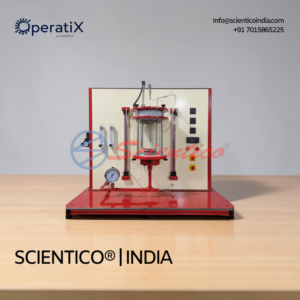
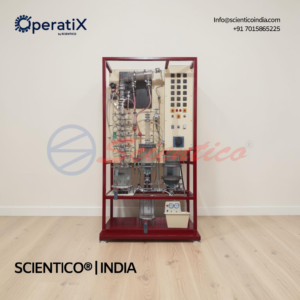
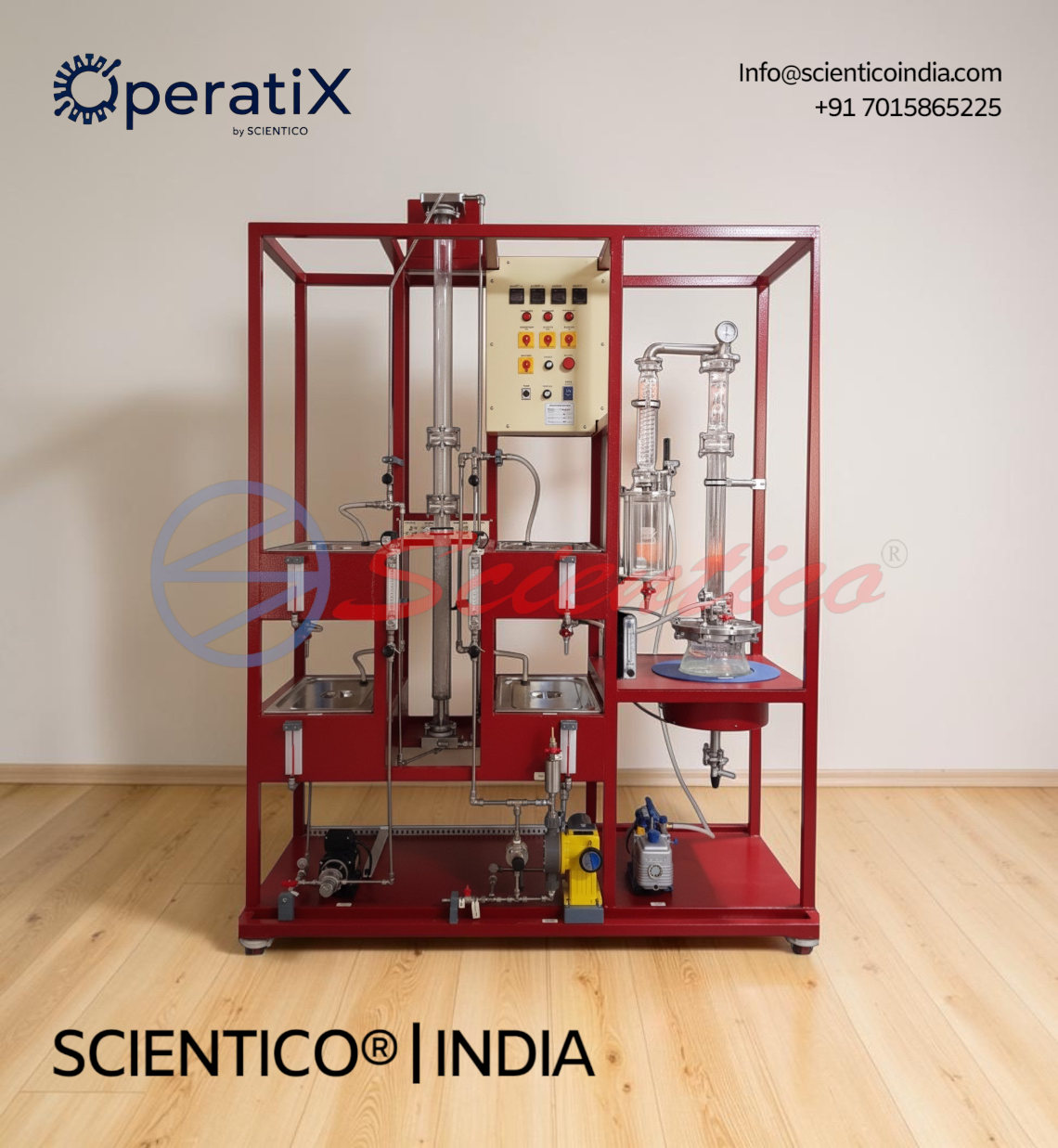
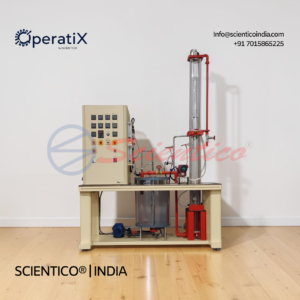
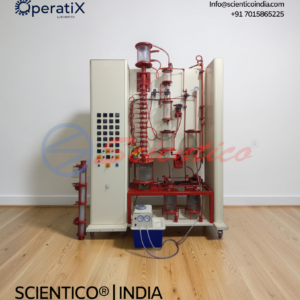
The Liquid/Liquid Extraction Apparatus OperatiX – 11 demonstrates liquid-liquid extraction in counterflow operation with distillation for extract enrichment. This Liquid/Liquid Extraction Apparatus features a glass extraction column, a distillation unit with condenser, and PID-controlled heating. It supports continuous or discontinuous process modes and vacuum operation during distillation. Optional DAQ software enables measurement and calculation of results.

The Liquid/Liquid Extraction Apparatus OperatiX – 11 demonstrates the separation of two liquid mixes to be separated. This Liquid/Liquid Extraction Apparatus pumps the liquid mixture from a feed tank to the base of the extraction column, where it flows counter-current to the solvent pumped into the top. It can be run as a continuous or discontinuous process using two three-way valves.

Product Overview

The separation of two liquid mixes to be separated is demonstrated by the liquid/liquid extraction device. A pump transfers the liquid mixture to be separated from the feed tank to the base of the extraction column. There, it flows against the flow in the direction of the solvent, which is pumped into the top of the extraction column.

The mixture that needs to be separated consists of a carrier liquid and a transitional substance. Because the solvent and the carrier liquid are insoluble in one another, a phase boundary forms in the column. Two valves can be used to examine and modify this. Inside the column, the transition component moves from the carrier liquid into the solvent. The trainer can be run as a continuous or discontinuous process using two three-way valves.

The enrichment of the transition component in the extract is made easier by a distillation unit. This consists of a packed column and a distillation bridge with a condenser in a heated round-bottomed flask. At the top of the column, the enriched extract exits and is collected in a tank. A sensor measures the temperature at the bottom, which is then digitally displayed and controlled by a PID controller. Additionally, the temperature at the distillation column’s top is gauged. The transition component, which collects at the bottom of the unit and can be extracted as a product, has the solvent removed using distillation. The solvent that has been separated is gathered in a tank and can be used again for extraction.

Rapeseed oil is suggested as the carrier liquid, ethanol as the transition element, and water as the solvent for a ternary material system. Density measurements are used to determine the concentrations of extract, top, and bottom products in this ternary material system. A conductivity meter is included for alternative ternary material systems, extending the flexibility of this Liquid/Liquid Extraction Apparatus.

Liquid/Liquid Extraction Apparatus OperatiX – 11, Technical Specifications

Specification Detail
Process Mode Liquid-liquid extraction in counterflow operation with distillation for extract enrichment
Phase Boundary Control 2 valves for fine-tuning the phase boundary
Vacuum Measurement Pressure gauge to measure the vacuum pressure
Fluid Delivery 2 pumps for feed and solvent delivery
Process Switching 2 three-way valves for continuous or discontinuous operation
Extraction Column Glass, in two parts
Distillation Column With condenser
Temperature Control PID control of electrical heating
Vacuum Operation Possible during distillation to reduce evaporation temperature
Tank Material Stainless steel for feed, solvent, raffinate and extract; glass for top product tank (distillation)
Heat Transfer Aid Raschig rings used in extraction and distillation columns

Technical Data

Columns

Extraction (Liquid-Liquid)

Parameter Value
Diameter 40mm
Height 1000mm

Distillation Unit

Parameter Value
Diameter 50mm
Height 400mm
Bottom heater power output 1.2kW

Tanks

Parameter Value
Feed and raffinate approx. 20L each
Solvent and extract approx. 20L each
Top product (distillation) 2.5L
Bottom tank (distillation) approx. 5L

Feed Pump

Parameter Value
Max. flow rate 1000ml/min
Max. head 40m

Solvent Pump

Parameter Value
Max. flow rate 2000ml/min
Max. head 10m

Vacuum Pump

Parameter Value
Type Water circulation
Vacuum ports 2
Final vacuum approx. 200mbar

Measuring Ranges

Parameter Value
Temperature 2x 0~400°C
Flow rate 2x 0.2~1.5l/min
Pressure -1~1bar
Conductivity 0~200mS/cm

Key Features

  • Extraction Column: glass, two parts, 40mm diameter, 1000mm height
  • Distillation Column: 50mm diameter, 400mm height, with condenser
  • Process Modes: continuous or discontinuous, using two three-way valves
  • Phase Boundary Control: 2 valves for fine-tuning
  • Fluid Delivery: feed pump (1000ml/min, 40m head) and solvent pump (2000ml/min, 10m head)
  • Vacuum Operation: possible during distillation to reduce evaporation temperature, water circulation vacuum pump
  • Temperature Control: PID control of electrical heating, bottom heater rated 1.2kW
  • Tank Materials: stainless steel tanks for feed, solvent, raffinate, and extract; glass top product tank
  • Heat Transfer Enhancement: Raschig rings in extraction and distillation columns
  • Ternary System Support: rapeseed oil, ethanol, and water suggested; conductivity meter included for alternative systems, part of this Liquid/Liquid Extraction Apparatus
  • Software: optional DAQ software for measurement and calculation

Experiments

  • Extraction of a component from a two-component liquid mixture into a solvent
  • Separation of a liquid mixture by liquid-liquid extraction in counter flow operation
  • Operation in either continuous or discontinuous process mode is possible
  • Adjustment and observation of phase boundary possible
  • Distillation enrichment of transition component in extract
  • Separation processes are evaluated using concentration measurements and mass balances
  • The effect of several experimental alternatives on separation processes

Construction and Design

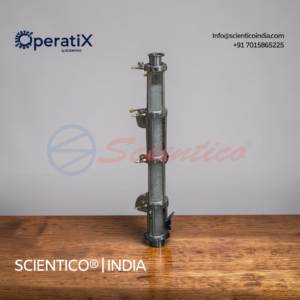
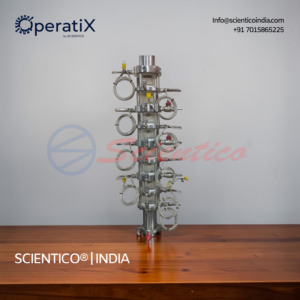
The Liquid/Liquid Extraction Apparatus OperatiX – 11 is built around a glass extraction column in two parts, 40mm in diameter and 1000mm in height. A distillation unit is fitted with a packed column and a distillation bridge with a condenser in a heated round-bottomed flask, 50mm in diameter and 400mm in height. Two pumps handle fluid delivery: a feed pump rated at 1000ml/min with a 40m head, and a solvent pump rated at 2000ml/min with a 10m head. Two three-way valves allow switching between continuous and discontinuous operation. Two valves fine-tune the phase boundary within the extraction column. A water circulation vacuum pump with 2 vacuum ports supports vacuum operation during distillation, reaching a final vacuum of approximately 200mbar. PID control governs electrical heating, with a bottom heater power output of 1.2kW. Stainless steel tanks hold feed, solvent, raffinate, and extract, each approximately 20L, while the top product tank for distillation is made of glass at 2.5L capacity. A bottom tank for distillation holds approximately 5L. Raschig rings increase heat transfer surface area in the extraction and distillation columns.

Software

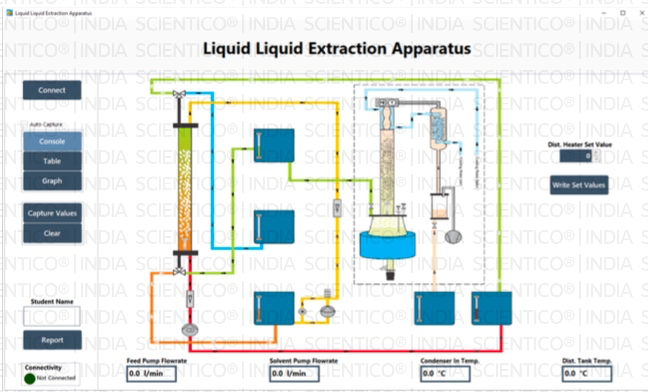
Software OperatiX – 11 (optional). DAQ software specially designed in National Instrument™, LABVIEW™ environment to measure and calculate the results of the apparatus. The software is optional; a set of electronic sensors is included when the software is used. The software can be run in any Windows™ environment.

Scope of Delivery

  • 1 Experimental unit
  • 1 Instruction manual

Q: What is the Liquid/Liquid Extraction Apparatus OperatiX – 11 used for?
A: It is used to demonstrate the separation of two liquid mixes through liquid-liquid extraction in counterflow operation, with distillation for extract enrichment.

Q: What carrier liquid, transition element, and solvent are suggested for the ternary system?
A: Rapeseed oil is suggested as the carrier liquid, ethanol as the transition element, and water as the solvent.

Q: Can the system operate under vacuum?
A: Yes, vacuum operation is possible during distillation to reduce the evaporation temperature, using a water circulation vacuum pump with a final vacuum of approximately 200mbar.

Q: Is data acquisition software available with this system?
A: Yes, Software OperatiX – 11 is available as an optional add-on, designed in National Instrument™ LABVIEW™ environment, and can run in any Windows™ environment.

Q: How is concentration measured in the ternary material system?
A: Density measurements are used to determine the concentrations of extract, top, and bottom products. A conductivity meter is included for alternative ternary material systems.

Need Assistance? We're Here to Help!

Connect with our team for product specifications, pricing, and customized solutions for your institution or project.
Trade enquiries

Distributors, dealers, resellers and bulk buyers

We manufacture Liquid/Liquid Extraction Apparatus | OperatiX – 11 at our own works in Ambala, India. Manufacturer-direct, three ways to work with us.

01

Become a distributor, dealer or agent in your territory

Already selling to colleges or hospitals in your market? Add a manufacturer-direct line. Terms reviewed on application.

or message on WhatsApp
02

Wholesale and bulk quotation

Holding a live enquiry? Send the model, quantity, destination and required Incoterm. We will confirm the supplied scope and available export documents.

or message on WhatsApp
03

OEM authorisation letter for a tender

Bidding a tender that requests a manufacturer authorisation form (MAF)? Send the tender reference, deadline and listed equipment so we can confirm what can be issued.

or message on WhatsApp

Full distributor guide OEM and export enquiries

Unit OperationsModel OperatiX - 11
🏭
Manufacturer DirectProduct-specific enquiry, not a generic catalogue
🌍
Destination MatchedConfiguration and delivery scope reviewed together
📄
Decision-Ready ReplyApplicable documentation confirmed before ordering
Product-specific enquiry

Get a quotation your team can evaluate

A bare price can hide configuration, accessories, voltage, documentation and delivery assumptions. Send the product and destination now so the quoted scope can be reviewed before a purchase decision.

Avoid the mismatchDo not approve a generic price that leaves supplied scope unclear.
Your product is attachedNo need to retype the model or copy the page URL.
Move toward an approvable quoteAdd the destination; quantity and tender details can follow.

No account is required. Organisation, quantity and tender details are optional. Include the country code so the team can reach you internationally.

1993
Manufacturing Since
Direct
Manufacturer Supply
Quote-based
International Orders
Model
OperatiX - 11

Overview

The Liquid/Liquid Extraction Apparatus OperatiX - 11 demonstrates the separation of two liquid mixes to be separated. This Liquid/Liquid Extraction Apparatus pumps the liquid mixture from a feed tank to the base of the extraction column, where it flows counter-current to the solvent pumped into the top. It can be run as a continuous or discontinuous process using two three-way valves.

Product Overview

The separation of two liquid mixes to be separated is demonstrated by the liquid/liquid extraction device. A pump transfers the liquid mixture to be separated from the feed tank to the base of the extraction column. There, it flows against the flow in the direction of the solvent, which is pumped into the top of the extraction column.

The mixture that needs to be separated consists of a carrier liquid and a transitional substance. Because the solvent and the carrier liquid are insoluble in one another, a phase boundary forms in the column. Two valves can be used to examine and modify this. Inside the column, the transition component moves from the carrier liquid into the solvent. The trainer can be run as a continuous or discontinuous process using two three-way valves.

The enrichment of the transition component in the extract is made easier by a distillation unit. This consists of a packed column and a distillation bridge with a condenser in a heated round-bottomed flask. At the top of the column, the enriched extract exits and is collected in a tank. A sensor measures the temperature at the bottom, which is then digitally displayed and controlled by a PID controller. Additionally, the temperature at the distillation column's top is gauged. The transition component, which collects at the bottom of the unit and can be extracted as a product, has the solvent removed using distillation. The solvent that has been separated is gathered in a tank and can be used again for extraction.

Rapeseed oil is suggested as the carrier liquid, ethanol as the transition element, and water as the solvent for a ternary material system. Density measurements are used to determine the concentrations of extract, top, and bottom products in this ternary material system. A conductivity meter is included for alternative ternary material systems, extending the flexibility of this Liquid/Liquid Extraction Apparatus.

Key Features

Key Features

  • Extraction Column: glass, two parts, 40mm diameter, 1000mm height
  • Distillation Column: 50mm diameter, 400mm height, with condenser
  • Process Modes: continuous or discontinuous, using two three-way valves
  • Phase Boundary Control: 2 valves for fine-tuning
  • Fluid Delivery: feed pump (1000ml/min, 40m head) and solvent pump (2000ml/min, 10m head)
  • Vacuum Operation: possible during distillation to reduce evaporation temperature, water circulation vacuum pump
  • Temperature Control: PID control of electrical heating, bottom heater rated 1.2kW
  • Tank Materials: stainless steel tanks for feed, solvent, raffinate, and extract; glass top product tank
  • Heat Transfer Enhancement: Raschig rings in extraction and distillation columns
  • Ternary System Support: rapeseed oil, ethanol, and water suggested; conductivity meter included for alternative systems, part of this Liquid/Liquid Extraction Apparatus
  • Software: optional DAQ software for measurement and calculation

Experiments

  • Extraction of a component from a two-component liquid mixture into a solvent
  • Separation of a liquid mixture by liquid-liquid extraction in counter flow operation
  • Operation in either continuous or discontinuous process mode is possible
  • Adjustment and observation of phase boundary possible
  • Distillation enrichment of transition component in extract
  • Separation processes are evaluated using concentration measurements and mass balances
  • The effect of several experimental alternatives on separation processes

Construction and Design

The Liquid/Liquid Extraction Apparatus OperatiX - 11 is built around a glass extraction column in two parts, 40mm in diameter and 1000mm in height. A distillation unit is fitted with a packed column and a distillation bridge with a condenser in a heated round-bottomed flask, 50mm in diameter and 400mm in height. Two pumps handle fluid delivery: a feed pump rated at 1000ml/min with a 40m head, and a solvent pump rated at 2000ml/min with a 10m head. Two three-way valves allow switching between continuous and discontinuous operation. Two valves fine-tune the phase boundary within the extraction column. A water circulation vacuum pump with 2 vacuum ports supports vacuum operation during distillation, reaching a final vacuum of approximately 200mbar. PID control governs electrical heating, with a bottom heater power output of 1.2kW. Stainless steel tanks hold feed, solvent, raffinate, and extract, each approximately 20L, while the top product tank for distillation is made of glass at 2.5L capacity. A bottom tank for distillation holds approximately 5L. Raschig rings increase heat transfer surface area in the extraction and distillation columns.

Software

Software OperatiX - 11 (optional). DAQ software specially designed in National Instrument™, LABVIEW™ environment to measure and calculate the results of the apparatus. The software is optional; a set of electronic sensors is included when the software is used. The software can be run in any Windows™ environment.

Scope of Delivery

  • 1 Experimental unit
  • 1 Instruction manual

Specifications

Liquid/Liquid Extraction Apparatus OperatiX - 11, Technical Specifications

Specification Detail
Process Mode Liquid-liquid extraction in counterflow operation with distillation for extract enrichment
Phase Boundary Control 2 valves for fine-tuning the phase boundary
Vacuum Measurement Pressure gauge to measure the vacuum pressure
Fluid Delivery 2 pumps for feed and solvent delivery
Process Switching 2 three-way valves for continuous or discontinuous operation
Extraction Column Glass, in two parts
Distillation Column With condenser
Temperature Control PID control of electrical heating
Vacuum Operation Possible during distillation to reduce evaporation temperature
Tank Material Stainless steel for feed, solvent, raffinate and extract; glass for top product tank (distillation)
Heat Transfer Aid Raschig rings used in extraction and distillation columns

Technical Data

Columns

Extraction (Liquid-Liquid)

Parameter Value
Diameter 40mm
Height 1000mm

Distillation Unit

Parameter Value
Diameter 50mm
Height 400mm
Bottom heater power output 1.2kW

Tanks

Parameter Value
Feed and raffinate approx. 20L each
Solvent and extract approx. 20L each
Top product (distillation) 2.5L
Bottom tank (distillation) approx. 5L

Feed Pump

Parameter Value
Max. flow rate 1000ml/min
Max. head 40m

Solvent Pump

Parameter Value
Max. flow rate 2000ml/min
Max. head 10m

Vacuum Pump

Parameter Value
Type Water circulation
Vacuum ports 2
Final vacuum approx. 200mbar

Measuring Ranges

Parameter Value
Temperature 2x 0~400°C
Flow rate 2x 0.2~1.5l/min
Pressure -1~1bar
Conductivity 0~200mS/cm

Buying Liquid/Liquid Extraction Apparatus: Distributor & Tender Guidance

Liquid/Liquid Extraction Apparatus is the product name procurement teams should use when searching, preparing a BOQ or comparing suppliers. A model reference identifies the proposed configuration; it should not replace the product name or the buyer’s required experiment. This equipment is considered for chemical and process-engineering teaching on separation, mixing, drying, filtration, mass transfer or other unit operations.

What to include in the RFQ

State the product name, quantity, destination, curriculum or tender reference, and process capacity, contact or separation section, feed and collection arrangement, instrumentation, materials of construction, utilities and experiments. This lets the technical team respond against the intended use rather than guess from a model code.

How distributors should quote it

Keep Liquid/Liquid Extraction Apparatus as the BOQ line item. Add the proposed model, included accessories, documentation, packing and delivery basis as separate fields so the end buyer can verify the offer.

How to compare suppliers

Confirm the process flow, measurement points and supplied consumables or accessories for the exact operation required. Record exclusions and alternatives in writing before commercial comparison.

Why Buy From Scientico

🏭

In-House Manufacturer

Designed & built in our Ambala facility since 1993 — not a reseller. Full control over quality & customisation.

✅

Configuration Review

Specifications, documentation and options are confirmed against the selected model.

🌏

International Enquiries

Share your destination and procurement requirements for an export quotation.

📦

Quote-Based Supply

Send the model, quantity and delivery location for a tailored proposal.

🛠

Support Scope

Support and warranty terms are documented in the applicable quotation.

🎓

Built for Teaching

Designed around curriculum experiments with clear, repeatable, hands-on results.

Frequently Asked Questions

Q: What is the Liquid/Liquid Extraction Apparatus OperatiX - 11 used for? A: It is used to demonstrate the separation of two liquid mixes through liquid-liquid extraction in counterflow operation, with distillation for extract enrichment.

Q: What carrier liquid, transition element, and solvent are suggested for the ternary system? A: Rapeseed oil is suggested as the carrier liquid, ethanol as the transition element, and water as the solvent.

Q: Can the system operate under vacuum? A: Yes, vacuum operation is possible during distillation to reduce the evaporation temperature, using a water circulation vacuum pump with a final vacuum of approximately 200mbar.

Q: Is data acquisition software available with this system? A: Yes, Software OperatiX - 11 is available as an optional add-on, designed in National Instrument™ LABVIEW™ environment, and can run in any Windows™ environment.

Q: How is concentration measured in the ternary material system? A: Density measurements are used to determine the concentrations of extract, top, and bottom products. A conductivity meter is included for alternative ternary material systems.

Related Guides & Resources

In-depth guides from Scientico on Unit Operations lab setup, experiments and procurement.

Liquid/Liquid Extraction Apparatus | OperatiX - 11

Related Laboratory Equipment

Explore related apparatus in this equipment range. Request a model-specific international quotation.

Gas Absorption/Desorption Column Apparatus by Scientico IndiaGas Absorption/Desorption Column Apparatus | OperatiX – 12Multifunction Distillation Column by Scientico IndiaMultifunction Distillation Column | OperatiX – 05Fluidization and Fluid Bed Heat Exchanger by Scientico IndiaFluidization and Fluid Bed Heat Exchanger | OperatiX – 03Packed Column by Scientico IndiaPacked Column | OperatiX – 15Continuous Distillation Column Apparatus by Scientico IndiaContinuous Distillation Column Apparatus | OperatiX – 06Sieve Tray Column by Scientico IndiaSieve Tray Column | OperatiX – 07Continuous Cooling Crystallization Apparatus by Scientico IndiaContinuous Cooling Crystallization Apparatus | OperatiX – 01Solid-Liquid Extraction by Scientico IndiaSolid-Liquid Extraction | OperatiX – 10
📄 Download Datasheet

Get the product datasheet

Share your details to open the complete datasheet, then print or save it as a PDF.

Liquid/Liquid Extraction Apparatus | OperatiX - 11