

Polariscope | FortiTestX – 19
Polariscope is a dedicated strength of materials lab equipment unit designed for the investigation and measurement of principal stress components and stress directions in photoelastic specimens using the photoelastic method. Made by Scientico India, ISO 9001:2015 certified, and supplied with a calibration certificate and operation manual.
Polariscope FortiTestX 19 is a dedicated strength of materials lab equipment unit designed for the investigation and measurement of principal stress components and stress directions in photoelastic specimens using the photoelastic method. This Polariscope apparatus uses circularly polarised light passed through transparent, optically double-refractive plastic models under mechanical loading to produce visible fringe patterns representing stress distribution. The FortiTestX 19 supports white light and monochromatic light operation, accommodates six polycarbonate model types, and applies bending, tensile, and compressive loads via a threaded spindle, making it a complete polariscope strength of materials lab equipment unit for undergraduate stress analysis and experimental mechanics programmes.
Product Overview
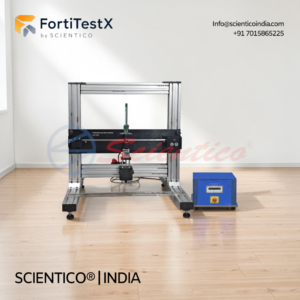
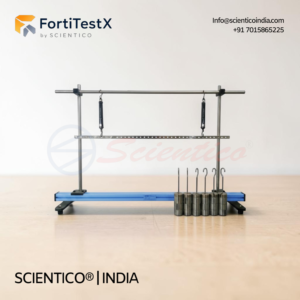
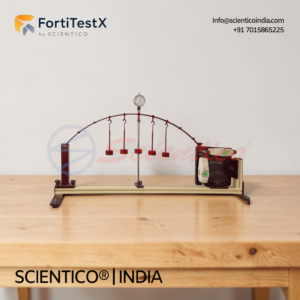
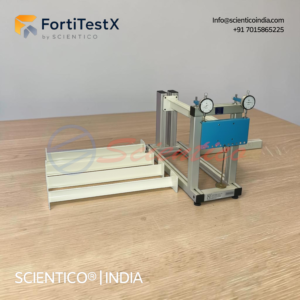
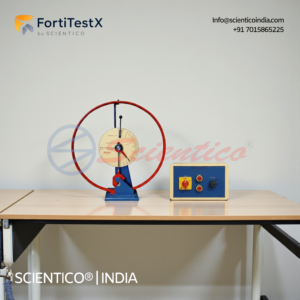
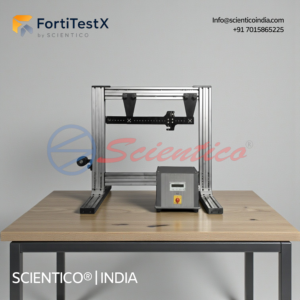
The Polariscope FortiTestX 19 is a self-contained strength of materials lab equipment unit for photoelastic stress analysis on flat, transparent plastic models under external mechanical loading. The experimental setup consists of a light source, four filters arranged to produce circularly polarised light, and a frame with height-adjustable cross-arms and load-bearing attachments for the models. The light source provides two operating modes: white light via a fluorescent tube for coloured stress pattern visualisation, and monochromatic yellow light via a sodium vapour lamp for dark and light contrast fringe patterns. Circularly polarised light is produced by passing light through a polarisation filter followed by a quarter wave plate. A second quarter wave plate perpendicular to the first, together with a second polarisation filter acting as an analyser, is positioned behind the model. All four filters are enclosed in glass with a diameter of 425 mm, mounted on roller bearings with 360 degree angle scales and main optical axis markings, and rotate freely for precise angular adjustment. The frame measures 600 x 750 mm with height-adjustable cross-arms. A load application device uses a threaded spindle to apply bending, tensile, or compressive loads to the model under test. Six polycarbonate model types are supplied: arch model, mounting model, crane hook model, weld seam model, notches model, and wrench model. Stress distribution is observed by identifying bright patches and interpreting isochromatic fringe patterns, with dark isochromatics assessed to determine the principal stress difference. Custom models can also be used, providing flexible experimentation configurations beyond the supplied set.
Polariscope FortiTestX 19, Technical Specifications
| Field | Details |
|---|---|
| Product Name | Polariscope FortiTestX 19 |
| Model Reference | FortiTestX 19 |
| Product Category | Strength of Materials Lab Equipment |
| Apparatus Type | Photoelastic polariscope for stress analysis |
| Frame Dimensions | 600 x 750 mm (w x h) |
| Frame Cross-Arms | Height-adjustable |
| Light Source | Fluorescent tube (white light) and sodium vapour lamp (monochromatic yellow) |
| Polarisation Filters | 2 x plane polarisation filters (dark olive) |
| Quarter Wave Filters | 2 x quarter wave filters (colourless) |
| Filter Diameter | 425 mm (enclosed in glass) |
| Filter Mounting | Roller bearing mounted, rotating, 360 degree angle scale |
| Load Application | Threaded spindle, bending, tensile, and compressive |
| Model Material | Polycarbonate (PC) |
| Models Supplied | Arch, mounting, crane hook, weld seam, notches, wrench |
| Manufacturer | SCIENTICO, Ambala Cantt, India |
| Certifications | ISO 9001:2015, CE Marked |
Technical Data, Light Source
| Parameter | Value |
|---|---|
| White Light Source | Fluorescent tube, lamp box with white diffuser |
| Monochromatic Light Source | Sodium vapour lamp, colour yellow |
Technical Data, Filters
| Filter Type | Specification |
|---|---|
| Polarisation Filters | 2 x dark olive, diameter 425 mm, enclosed in glass |
| Quarter Wave Filters | 2 x colourless, diameter 425 mm, enclosed in glass |
| Filter Mounting | Roller bearing, rotating, 360 degree angle scale with main optical axis marking |
Technical Data, Frame and Models
| Parameter | Value |
|---|---|
| Frame Dimensions | 600 x 750 mm (w x h) |
| Cross-Arms | Height-adjustable |
| Model Material | Polycarbonate (PC) |
| Models Supplied | Arch, mounting, crane hook, weld seam, notches, wrench |
Key Features
- Complete polariscope strength of materials lab equipment unit: light source, four filters, height-adjustable frame, threaded spindle load device, six polycarbonate models, and instruction manual all supplied
- Dual light source operation: white light via fluorescent tube for coloured stress patterns and monochromatic yellow light via sodium vapour lamp for dark and light contrast fringe patterns
- Four filters for circular polarisation: two plane polarisation filters (dark olive) and two quarter wave filters (colourless), all 425 mm diameter, enclosed in glass
- Roller bearing mounted rotating filters with 360 degree angle scales and main optical axis markings for precise angular positioning
- Height-adjustable frame cross-arms (600 x 750 mm) accommodating various model sizes and load configurations
- Threaded spindle load application: bending, tensile, and compressive loads applicable to all supplied models
- Six polycarbonate model types supplied: arch, mounting, crane hook, weld seam, notches, and wrench for comprehensive stress pattern demonstration
- Compatible with custom polycarbonate models for flexible experimentation beyond the standard supplied set
- Supports both plane polarised and circularly polarised light investigation modes
- Stress concentration, zero point, neutral fibre, and stress gradient identification through isochromatic fringe pattern interpretation
- ISO 9001:2015 certified manufacture; documentation reviewed per model product
Experiments
- Generation of planar stress states in various models under bending, tensile, and compressive load
- Investigation of stress diffusion with plane polarised light
- Investigation of stress diffusion with circularly polarised light
- Interpretation of photoelastic fringe patterns including stress concentrations, zero points, neutral fibres, areas of constant stress, and stress gradients
- Determination of occurring stresses and strains visually through fringe pattern analysis
Construction and Design
Polariscope FortiTestX 19 is constructed as a rigid strength of materials lab equipment unit built around a 600 x 750 mm frame with height-adjustable cross-arms that support the load-bearing model attachments and the complete four-filter optical system. The light source assembly houses both a fluorescent tube with white diffuser for white light operation and a sodium vapour lamp for monochromatic yellow light, selectable depending on the type of fringe pattern required for the experiment. Light passes first through a plane polarisation filter, then through a quarter wave plate to produce circularly polarised light, then through the loaded photoelastic model, and finally through a second quarter wave plate perpendicular to the first and a second plane polarisation filter acting as the analyser. All four filters are enclosed in 425 mm diameter glass housings, mounted on roller bearings with freely rotating action and 360 degree angle scales with main optical axis markings for precise and repeatable angular positioning. A threaded spindle integrated into the frame cross-arm assembly applies bending, tensile, or compressive loads to the model under test. Six polycarbonate models covering arch, mounting, crane hook, weld seam, notches, and wrench geometries are supplied for demonstration and quantitative experiments. The open optical layout of this polariscope ensures that every stage of the fringe pattern formation is directly visible and interpretable during the experiment. All construction and materials conform to ISO 9001:2015 quality standards and meet CE marking requirements.
Scope of Delivery
- 1 x Experimental unit (Polariscope FortiTestX 19)
- 1 x Set of test models (arch, mounting, crane hook, weld seam, notches, wrench)
- 1 x Set of filters (2 polarisation filters, 2 quarter wave filters)
- 1 x Instruction manual
Q1: What light sources are available in the Polariscope FortiTestX 19?
Two light sources are provided: a fluorescent tube with a white diffuser for white light operation producing coloured stress patterns, and a sodium vapour lamp for monochromatic yellow light producing dark and light contrast fringe patterns. Both are housed within the same lamp box assembly.
Q2: How is circularly polarised light produced in the FortiTestX 19?
A plane polarisation filter is combined with a quarter wave plate on the illumination side to produce circularly polarised light. A second quarter wave plate, oriented perpendicular to the first, and a second plane polarisation filter acting as the analyser are positioned on the observation side behind the model.
Q3: Which model types are supplied with the Polariscope FortiTestX 19?
Six polycarbonate models are supplied: an arch model, a mounting model, a crane hook model, a weld seam model, a notches model, and a wrench model. Custom polycarbonate models are also compatible with the apparatus for extended experimentation.
Q4: What load types can be applied to the models in the FortiTestX 19?
The threaded spindle load application device integrated into the frame applies bending, tensile, and compressive loads to the model under test, covering the full range of planar stress states demonstrated in the supplied experiments.
Q5: What stress features can be identified from the fringe patterns in the Polariscope FortiTestX 19?
Isochromatic fringe pattern interpretation allows identification of stress concentrations, zero stress points, neutral fibres, areas of constant stress, and stress gradients. The order of dark isochromatics is assessed to determine the principal stress difference at any specific location in the model.
Need Assistance? We're Here to Help!
Connect with our team for product specifications, pricing, and customized solutions for your institution or project.