
The core difference between solar PV and solar thermal is the output: a solar photovoltaic (PV) system converts sunlight directly into electricity (DC) using the photovoltaic effect in semiconductor cells, whereas a solar thermal system absorbs sunlight as heat in a collector to warm a working fluid (water or air) for hot water, process heat, or to drive a turbine. Both harvest the same solar resource, but one produces electrons and the other produces usable heat.
Equipment mentioned in this guide
Review the product information, specifications and model before requesting a quotation.
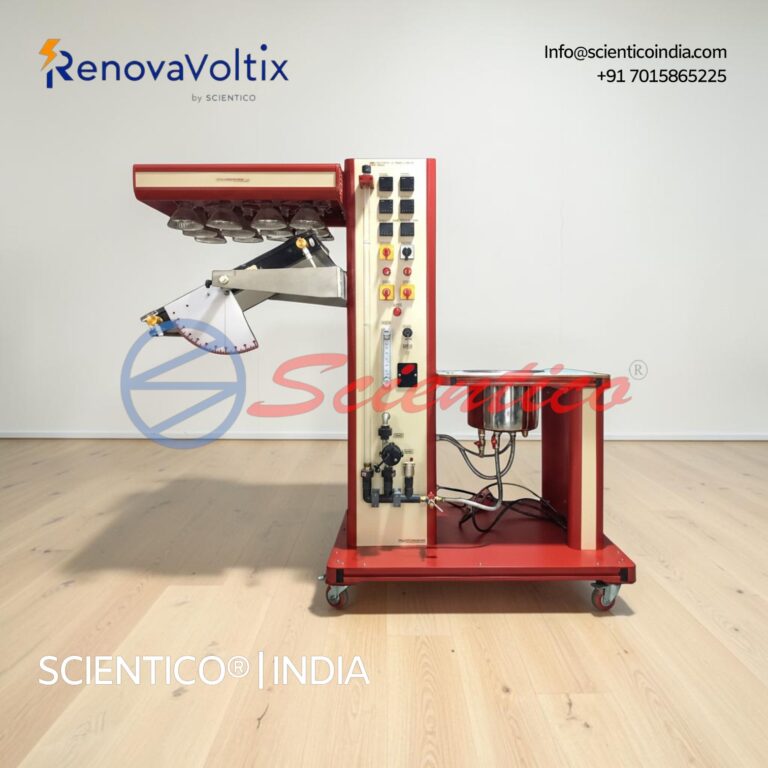
Solar Thermal Energy Training System | RVX-009
The Solar Thermal Energy Training System RVX-009 is a laboratory-based solar thermal training platform that demonstrates the conversion of solar energy into usable thermal energy for domestic water heating. It includes a solar panel for simultaneous light-to-electrical energy conversion, making it a dual-function solar energy training system. Product Overview The Solar Thermal Energy Training System RVX-009 demonstrates solar thermal heating of domestic water in an illustrative laboratory setup. A lighting unit simulates natural solar radiation and enables a range of controlled indoor experiments. Light is converted into heat in an absorber and transferred to a heat transfer fluid. A pump conveys the heat transfer fluid through a hot water tank fitted with an integrated tube coil heat exchanger. A solar panel is included to simultaneously convert light energy into electrical energy and charge a battery. The system supports study of various angles of incidence and different illuminance levels. The pre-installed absorber with selective coating can be replaced with a blackened absorber for comparative measurements of collector losses. External heat consumers can be connected to the tank via two connectors. Sensors detect collector inlet temperature, collector outlet temperature, ambient air temperature, tank temperature, and illuminance. Measured values are displayed on the device and can be transferred to a PC via USB or Ethernet when the DAQ option is selected.
View product detailsWhat is solar PV and how does it work?
A photovoltaic cell is a semiconductor device, typically crystalline silicon, with a p–n junction. When a photon with energy greater than the band gap (about 1.1 eV for silicon) strikes the cell, it frees an electron–hole pair. The junction’s internal electric field separates these charges, driving a direct current (DC) through an external circuit. This is the photovoltaic effect, and it requires no moving parts and no intermediate heat stage.
- Cells are wired in series and parallel into modules, then arrays.
- An inverter converts DC to AC for grid or building use.
- Module electrical output is rated in watt-peak (Wp) under Standard Test Conditions (STC): irradiance 1000 W/m², cell temperature 25 °C, air mass AM1.5.
Electrical power is P = V × I (watts). Module efficiency is η = Pout / (G × A), where G is incident irradiance in W/m² and A is module area in m². Commercial silicon modules typically reach about 18–22% efficiency.
What is solar thermal and how does it work?
A solar thermal collector absorbs incoming solar radiation on a dark, selective surface and transfers that energy as heat to a fluid flowing through it. There is no electricity produced at the collector; the immediate product is a temperature rise in the fluid. Common configurations include flat-plate collectors and evacuated-tube collectors for water heating, and concentrating systems (parabolic trough, dish, or central tower) for high-temperature process heat and Concentrated Solar Power (CSP).
- Flat-plate and evacuated-tube collectors deliver hot water and space heating (typically up to ~80–90 °C).
- Concentrating collectors reach several hundred °C and can raise steam to drive a turbine and generator (CSP), here electricity is produced, but indirectly, via heat.
Useful heat collected is Q = –m cp ΔT, where –m is mass flow rate (kg/s), cp is specific heat capacity (J/kg·K; ~4186 J/kg·K for water), and ΔT is the temperature rise (K). Collector thermal efficiency is η = Quseful / (G × Ac), where Ac is the collector aperture area. Well-designed flat-plate collectors commonly achieve 40–70% thermal efficiency depending on operating temperature.
Solar PV vs solar thermal: comparison table
| Parameter | Solar PV (Photovoltaic) | Solar Thermal |
|---|---|---|
| Primary output | Electricity (DC) | Heat (hot fluid) |
| Conversion principle | Photovoltaic effect in a semiconductor | Absorption of radiation as thermal energy |
| Key device | PV cell / module + inverter | Collector (flat-plate, evacuated-tube, concentrating) |
| Governing relation | P = V × I; η = Pout/(G·A) | Q = –m cp ΔT; η = Quseful/(G·Ac) |
| Rating unit | Watt-peak (Wp) at STC | Thermal power (W) and ΔT / collector efficiency |
| Typical efficiency | ~18–22% (silicon modules) | ~40–70% thermal (flat-plate) |
| Storage method | Batteries (electrical) | Hot-water tank / thermal mass |
| Typical use | Grid power, lighting, motors, electronics | Hot water, process heat, CSP electricity |
What are the main applications of each?
Solar PV applications:
- Rooftop and ground-mount grid-tied power plants.
- Off-grid systems for rural electrification, telecom towers, and water pumping.
- Powering DC loads, street lighting, and battery charging.
Solar thermal applications:
- Domestic and institutional hot water (hostels, hospitals, canteens).
- Industrial process heat and solar drying.
- Concentrated Solar Power (CSP) plants generating grid electricity through steam turbines.
How is the difference shown and measured in a teaching lab?
In an engineering or science laboratory, students compare the two pathways using bench-scale trainers and a controlled light source or natural sunlight:
- Solar PV trainer: Measure the I–V and P–V characteristics of a module with a variable load, multimeters, and a pyranometer for irradiance G. Students plot the I–V curve, locate the maximum power point (MPP), and compute efficiency η = Pout/(G·A). Effects of tilt angle, shading, and temperature are studied directly.
- Solar thermal collector apparatus: Measure inlet and outlet fluid temperatures, mass flow rate, and incident irradiance to evaluate Q = –m cp ΔT and collector efficiency. Students observe how absorber coating, glazing, and flow rate change the temperature rise.
Running both experiments side by side makes the conceptual split concrete: identical sunlight yields measurable electrical watts in one setup and a measurable temperature rise (heat) in the other.
Scientico India is an ISO 9001:2015 and model-specific manufacturer and exporter of engineering and science laboratory equipment, supplying these trainers and apparatus to colleges and universities across 30+ countries. Explore the full range of Renewable Energy Lab Equipment for your laboratory.
Frequently Asked Questions
What is the main difference between solar PV and solar thermal?
Solar PV converts sunlight directly into electricity (DC) using the photovoltaic effect in semiconductor cells, while solar thermal absorbs sunlight as heat to warm a fluid for hot water, process heat, or to drive a turbine. The outputs differ: electricity versus heat.
Which is more efficient, solar PV or solar thermal?
They measure different outputs, so a direct comparison is not like-for-like. Silicon PV modules typically convert about 18-22% of incident sunlight into electricity, while flat-plate solar thermal collectors commonly achieve 40-70% thermal efficiency in capturing heat. Thermal collectors capture a larger share of solar energy, but as heat rather than electricity.
Can solar thermal produce electricity?
Yes, but indirectly. Concentrated Solar Power (CSP) systems use concentrating collectors to reach high temperatures, raise steam, and drive a turbine and generator. Unlike PV, electricity is produced through an intermediate heat stage rather than directly.
What formulas are used to evaluate each system in the lab?
For solar PV, electrical power is P = V x I, and module efficiency is eta = P_out / (G x A), where G is irradiance and A is area. For solar thermal, useful heat is Q = m-dot x c_p x deltaT, and collector efficiency is eta = Q_useful / (G x A_c).
How can students compare both in a teaching lab?
Using a solar PV trainer, students plot the I-V curve, find the maximum power point, and compute electrical efficiency with a pyranometer. Using a solar thermal collector apparatus, they measure inlet/outlet temperatures and flow rate to find heat collected and thermal efficiency. Running both under the same sunlight shows electricity in one setup and a temperature rise in the other.
One honest ask
We don't gate anything on this site. You just read the whole thing free. If it was useful, leave your email and two things happen: we send you this page as a plain-text block you can paste into a tender file or an internal email, and we notify you the next time we publish a buyer tool like this one. Nothing else. No drip sequence, no sales calls booked without asking.