
A governor is a mechanical device that automatically controls and maintains the speed of an engine or prime mover at a desired level despite changes in load. It does this by sensing speed and adjusting the supply of fuel or working fluid: when load increases and speed drops, the governor admits more fuel; when load decreases and speed rises, it reduces fuel. The most common types are centrifugal governors (Watt, Porter, Proell, Hartnell) and inertia governors, and they are a core topic in every Theory of Machines course and laboratory.
Equipment mentioned in this guide
Review the product information, specifications and model before requesting a quotation.
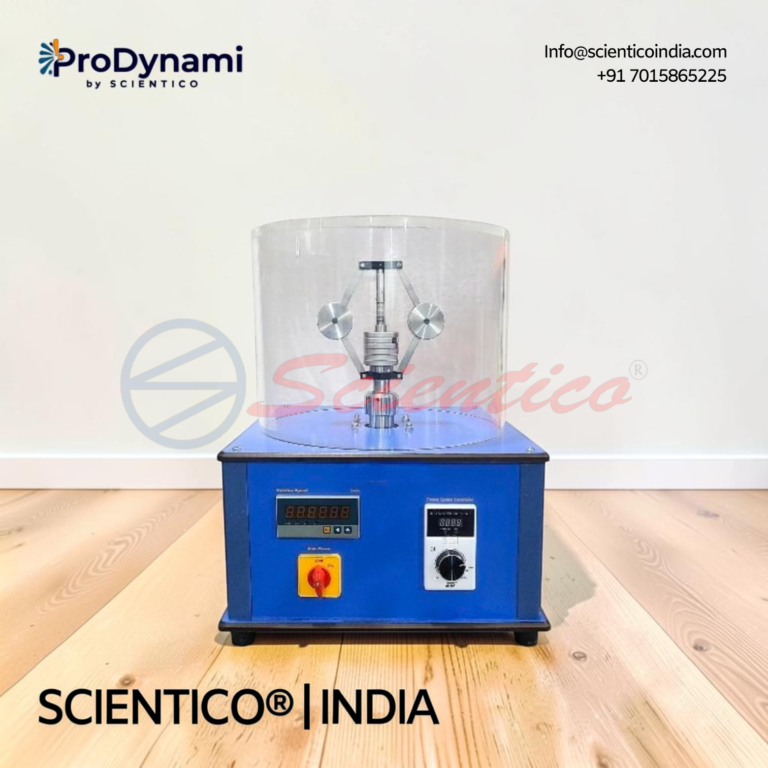
Governor Apparatus | ProDynami 1264
The Governor Apparatus ProDynami 1264 is designed to study the performance of different types of governors. This Governor Apparatus demonstrates the principle of operation of various centrifugal force governors, including the Porter, Proell and Hartnell governors.
View product detailsWhat does a governor actually do in an engine?
An engine rarely runs under a constant load. A generator set may suddenly supply more current, a lathe may bite into harder material, or a vehicle may climb a gradient. Without correction, the engine speed would surge when load drops and stall when load rises. The governor keeps the mean speed within a narrow band by regulating the throttle or fuel rack.
It is important to distinguish a governor from a flywheel, because students often confuse the two:
- Governor: controls the mean speed over many cycles by adjusting fuel supply in response to load variation. It acts only when the average load changes.
- Flywheel: limits the cyclic speed fluctuation within a single cycle by storing and releasing energy. It does not control fuel supply and does not respond to load changes.
In short, the governor manages speed across changing loads, while the flywheel smooths out the fluctuations that happen within each revolution.
What are the main types of governors?
Governors are broadly classified into two families: centrifugal governors, which use the centrifugal force on rotating masses, and inertia governors, which respond to the rate of change of speed (angular acceleration). Centrifugal governors dominate teaching labs because their action is easy to observe and analyse.
Centrifugal governors
In a centrifugal governor, two or more balls rotate about a spindle. As speed rises, centrifugal force throws the balls outward; their movement is transmitted through links and a sleeve to the throttle valve. Centrifugal governors are further divided into gravity-controlled and spring-controlled types.
| Governor | Controlling force | Key feature | Typical teaching use |
|---|---|---|---|
| Watt | Ball weight (gravity) | Simplest type; sleeve directly loaded by ball weight only | Demonstrating basic centrifugal action at low speeds |
| Porter | Ball weight + central load | Added central load on the sleeve increases the controlling force | Comparing effect of a central dead weight on speed range |
| Proell | Ball weight + central load | Balls mounted on extensions of the lower arms | Studying how arm geometry changes sensitivity |
| Hartnell | Spring + ball weight | Spring-controlled; compact and adjustable | Showing spring-controlled, high-speed governor behaviour |
Inertia governors
Inertia governors position the balls so they respond to the angular acceleration of the shaft, not just its speed. Because they react to the rate of speed change, they can respond faster than purely centrifugal designs. They are more difficult to balance accurately, which is why they appear less often in introductory lab setups but remain important in theory.
What is the working principle of a centrifugal governor?
The working principle rests on the balance between two opposing influences at every running speed:
- Centrifugal force on the rotating balls, which acts outward and increases with the square of the speed.
- Controlling force, supplied by the ball weight, a central load, or a spring, which acts inward and resists the outward movement.
At the equilibrium speed for a given radius, these forces balance and the sleeve holds its position. If the load on the engine falls, the speed rises, centrifugal force increases, the balls fly outward, the sleeve lifts, and the linkage closes the throttle to reduce fuel. The speed then settles back. The reverse happens when load increases. A few terms describe how well a governor performs this task:
- Sensitiveness: the ratio of speed range to mean speed. A more sensitive governor reacts to smaller speed changes.
- Stability: a stable governor has one definite radius of rotation for each speed within its range.
- Isochronism: the ideal case where the governor maintains a constant speed for all radii in its working range.
- Hunting: an unwanted condition where an over-sensitive governor oscillates continuously about the mean speed.
- Effort and power: the mean force exerted on the sleeve and the work done in moving it during a given speed change.
How is the governor experiment performed in the lab?
A universal governor apparatus lets students mount Watt, Porter, Proell, and Hartnell configurations on the same motor-driven spindle, change the speed with a controller, and measure the sleeve lift against speed. The typical objective is to plot the relationship between controlling force and radius of rotation, and to find the governor’s range, sensitiveness, and effort.
General procedure
- Assemble the chosen governor configuration on the spindle and record the geometry (arm lengths, ball mass, central load or spring stiffness).
- Switch on the variable-speed drive and gradually raise the speed.
- At each step, note the rotational speed (from the tachometer) and the corresponding sleeve displacement on the scale.
- Record several readings across the working range, both while increasing and decreasing speed.
- Calculate the radius of rotation and controlling force at each point, then plot controlling force versus radius and sleeve lift versus speed.
What does a governor lab apparatus typically include?
| Component | Purpose |
|---|---|
| Variable-speed drive motor | Rotates the spindle and lets students vary speed smoothly |
| Interchangeable governor assemblies | Allow Watt, Porter, Proell, and Hartnell studies on one base unit |
| Sleeve displacement scale | Measures the lift of the sleeve at each speed |
| Tachometer or speed indicator | Reads spindle speed for each reading |
| Set of weights and springs | Vary the central load and spring stiffness for comparison |
Equipment of this kind sits within the broader Theory of Machines Lab Equipment family, alongside cam analysis, gyroscope, balancing, and gear train apparatus used in mechanical engineering laboratories.
What should a college or lab consider when buying governor apparatus?
For engineering colleges, polytechnics, and universities, the value of a governor trainer lies in how clearly it demonstrates theory and how reliably it survives years of student use. Buyers usually weigh:
- Versatility: a single base unit that supports multiple governor types gives more experiments per rupee of capital spend.
- Measurement clarity: a readable sleeve scale and a stable speed readout make results repeatable across student batches.
- Build quality: machined components and a steady drive reduce vibration and keep readings trustworthy.
- Documentation: a clear manual with theory, procedure, and sample calculations shortens lab setup time.
- Compliance and after-sales support: calibration and conformity papers matter for institutional procurement and audits.
Scientico India is an ISO 9001:2015 and model-specific manufacturer based in Ambala, Haryana, producing engineering and laboratory teaching equipment and exporting to 30+ countries since 1993. As a GeM-registered supplier, it provides calibration and conformity documentation with dispatches, and can issue a model-specific CIF proforma invoice after technical review for export buyers. Specifications and quotes are shared on request rather than as fixed public prices, so each institution receives a configuration matched to its syllabus and budget.
Why the governor topic matters beyond the lab
Understanding governors gives students a working model of feedback control that reappears throughout engineering: thermostats, voltage regulators, and electronic engine management all follow the same sense-compare-correct logic. The mechanical governor makes this abstract idea visible and measurable, which is exactly why it remains a fixture of Theory of Machines curricula in India and abroad. A well-built apparatus turns a chapter of equations into a physical demonstration students remember.
Frequently Asked Questions
What is a governor in simple words?
A governor is a device that automatically keeps an engine running at a steady speed by adjusting its fuel or working-fluid supply when the load changes. If the engine slows under heavier load, the governor admits more fuel; if it speeds up under lighter load, it reduces fuel.
What is the difference between a governor and a flywheel?
A governor controls the mean speed of an engine across changing loads by regulating fuel supply, acting over many cycles. A flywheel only smooths out the speed fluctuation within a single cycle by storing and releasing energy, and it does not respond to load changes or control fuel.
What are the main types of governors?
The two broad families are centrifugal governors and inertia governors. Centrifugal governors include the Watt, Porter, Proell, and Hartnell types, with the Hartnell being spring-controlled, while inertia governors respond to the rate of change of speed.
What is the working principle of a centrifugal governor?
It balances the outward centrifugal force on rotating balls against an inward controlling force from ball weight, a central load, or a spring. When speed rises, the balls fly outward and a sleeve moves to close the throttle; when speed falls, the sleeve moves the opposite way to open it.
Does Scientico India supply governor and Theory of Machines lab equipment?
Scientico India is an ISO 9001:2015 and model-specific manufacturer of engineering and laboratory teaching equipment based in Ambala, India, exporting to over 60 countries since 1993. It is GeM-registered, provides calibration and conformity documents with dispatch, and shares specifications and quotes on request, with a CIF proforma invoice available within 24 hours for export buyers.
One honest ask
We don't gate anything on this site. You just read the whole thing free. If it was useful, leave your email and two things happen: we send you this page as a plain-text block you can paste into a tender file or an internal email, and we notify you the next time we publish a buyer tool like this one. Nothing else. No drip sequence, no sales calls booked without asking.