
Water treatment laboratory experiments form the core of the Environmental Engineering and Process Engineering curriculum for civil and chemical engineering students. This guide covers the complete procedure for the four most important water quality and treatment experiments: the Jar Test for coagulation-flocculation, Biological Oxygen Demand (BOD) test, Chemical Oxygen Demand (COD) test, and sand filtration experiment.
Equipment mentioned in this guide
Review the product information, specifications and model before requesting a quotation.
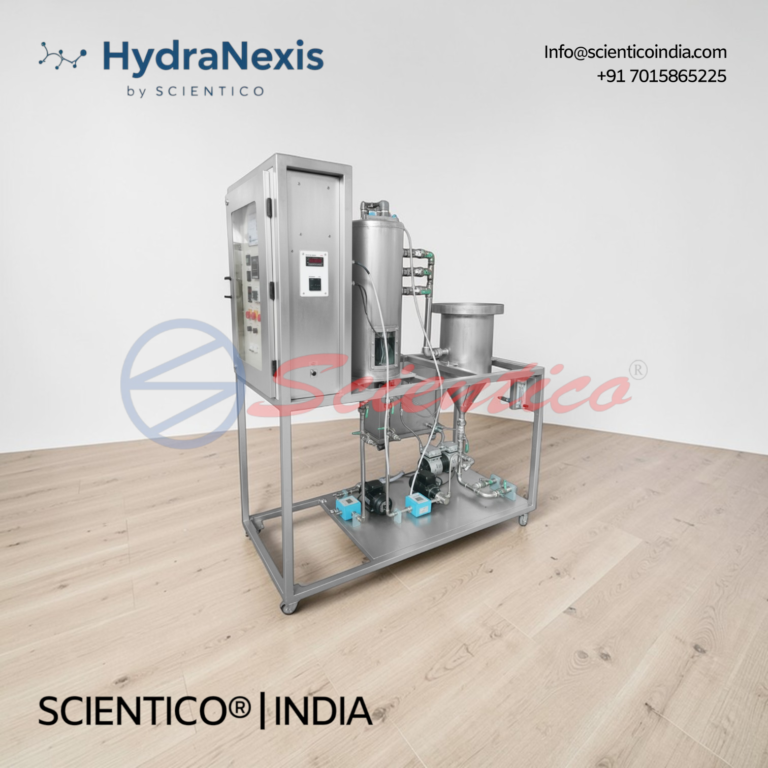
Aerobic Water Treatment Pilot Plant – HydraNexis HNX 06
Product OverviewThe HydraNexis HNX 06 pilot plant is based on the conventional single-stage activated sludge process, consisting of an oxidation (aeration) reactor followed by a secondary settler. Raw water containing dissolved organic matter is pumped into the oxidation reactor, where aerobic microorganisms biodegrade organic pollutants using dissolved oxygen supplied through air diffusion.
View product details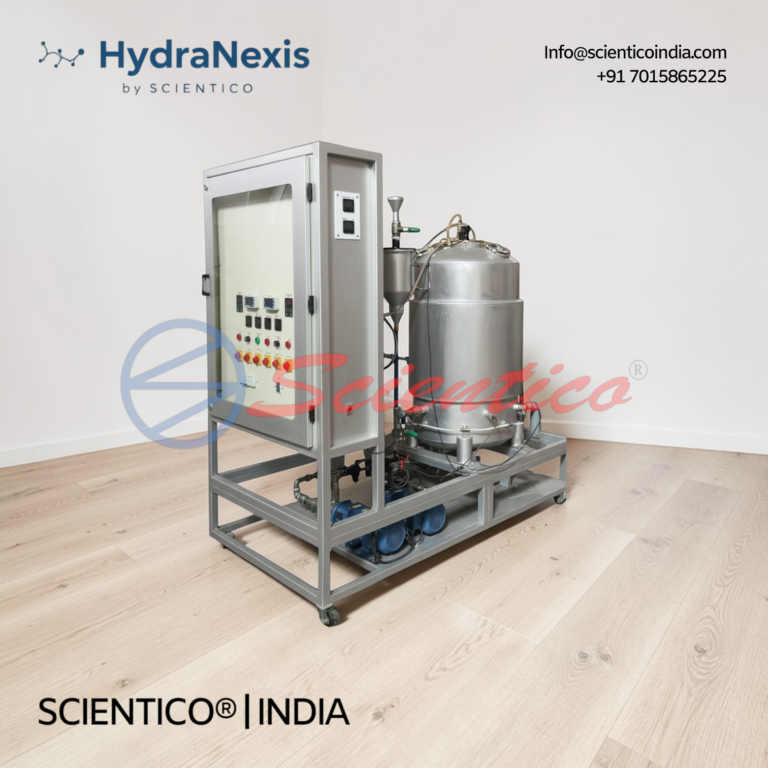
Anaerobic Water Treatment Pilot Plant – HydraNexis HNX 04
The Anaerobic Water Treatment Pilot Plant (HydraNexis HNX 04) is a laboratory and pilot-scale system designed to demonstrate anaerobic degradation of organic pollutants in wastewater. Manufactured by SCIENTICO under the HydraNexis series, this unit is intended for environmental engineering education, research laboratories, and process optimization studies. It enables controlled investigation of anaerobic digestion and biogas generation under measurable operating conditions. morticia xxx
View product detailsExperiment 1: Jar Test, Coagulation and Flocculation
Aim
To determine the optimum dose of coagulant (alum) required for effective coagulation and flocculation of a turbid water sample.
Theory
Coagulation is the process of adding a chemical coagulant (typically alum, aluminium sulphate) to water to destabilise colloidal particles. Flocculation is the gentle mixing that follows, allowing the destabilised particles to collide and form larger aggregates (flocs) that can settle by gravity (sedimentation) or be removed by filtration.
Alum reacts with the alkalinity in water: Al₂(SO₄)₃ + 3Ca(HCO₃)₂ → 2Al(OH)₃↓ + 3CaSO₄ + 6CO₂
The optimum coagulant dose minimises turbidity and colour while maintaining acceptable pH.
Apparatus
- Jar test apparatus (6-paddle gang stirrer)
- Six 1-litre beakers or jars
- Turbidimeter (nephelometer)
- pH meter
- Alum solution (1% w/v stock solution)
- Raw water sample (turbidity 50–200 NTU)
Procedure
- Prepare the raw water sample. Measure and record initial turbidity (NTU) and pH.
- Fill six jars with 1 litre each of raw water.
- Add increasing doses of alum solution to each jar: 5, 10, 15, 20, 25, 30 mg/L.
- Apply rapid mixing at 100 rpm for 1 minute (flash mixing for coagulation).
- Reduce speed to 30 rpm for 15 minutes (slow mixing for flocculation).
- Allow to settle for 30 minutes without mixing.
- Carefully collect the supernatant from each jar and measure turbidity, pH, and colour.
- The dose that gives the lowest residual turbidity at acceptable pH is the optimum dose.
Observation Table
| Jar No. | Alum dose (mg/L) | Initial turbidity (NTU) | Final turbidity (NTU) | pH after treatment | Remarks |
|---|---|---|---|---|---|
| 1 | 5 | ||||
| 2 | 10 | ||||
| 3 | 15 | ||||
| 4 | 20 | ||||
| 5 | 25 | ||||
| 6 | 30 |
Result
Optimum alum dose = _____ mg/L (dose giving minimum turbidity at acceptable pH of 6.5–8.5)
Experiment 2: BOD Test (5-Day BOD)
Aim
To determine the 5-day Biological Oxygen Demand (BOD₅) of a wastewater sample.
Theory
BOD measures the amount of dissolved oxygen (DO) consumed by biological organisms when decomposing organic matter in water at a given temperature (20°C) over a specific time period (5 days for BOD₅). BOD is the most widely used parameter for assessing organic pollution in water bodies.
BOD₅ = (DO_initial – DO_final) × Dilution Factor (mg/L)
IS 3025 (Part 58) / APHA Method 5210B governs the BOD test procedure in India.
Procedure
- Collect a fresh wastewater sample and dilute with aerated dilution water to appropriate dilution (for sewage, typical dilutions are 1:50 to 1:100).
- Fill BOD bottles completely (no air bubbles) with diluted sample.
- Measure initial DO (DO₀) using DO meter or Winkler titration method.
- Incubate BOD bottles at 20°C ± 1°C for exactly 5 days in a BOD incubator.
- After 5 days, measure final DO (DO₅) using the same method.
- Run blank bottles containing only dilution water (no sample) alongside.
- Calculate BOD₅ = [(DO₀_sample – DO₅_sample) – (DO₀_blank – DO₅_blank)] × Dilution factor
Acceptable BOD Values (IS 10500:2012 and CPCB Standards)
- Drinking water: BOD < 2 mg/L
- Bathing water (Class B): BOD < 3 mg/L
- Industrial effluent discharge: BOD < 30 mg/L (IS 2490)
- Raw municipal sewage: 200–400 mg/L
Experiment 3: COD Test
Aim
To determine the Chemical Oxygen Demand (COD) of a wastewater sample by the dichromate reflux method.
Theory
COD measures the total amount of oxygen required to chemically oxidise all organic matter in water using a strong oxidising agent (potassium dichromate K₂Cr₂O₇ in acidic conditions). COD includes both biodegradable and non-biodegradable organic compounds.
COD is always ≥ BOD. The ratio BOD₅/COD indicates the biodegradability of wastewater (ratio > 0.6 = highly biodegradable; < 0.3 = not biodegradable).
COD (mg/L) = [(Volume of FAS for blank – Volume of FAS for sample) × M × 8000] / Volume of sample
(FAS = Ferrous Ammonium Sulphate titrant, M = molarity of FAS)
Apparatus and Reagents
- COD reflux apparatus (round-bottom flask, condenser, heating mantle)
- K₂Cr₂O₇ solution (0.25 N)
- H₂SO₄ + Ag₂SO₄ (catalyst)
- Ferrous Ammonium Sulphate (FAS) titrant 0.1 N
- Ferroin indicator
Procedure
- Take 20 mL of sample in a reflux flask. Add 10 mL K₂Cr₂O₇ and 30 mL H₂SO₄–Ag₂SO₄ reagent carefully (with cooling).
- Attach condenser and reflux for 2 hours.
- Cool and titrate excess dichromate with FAS solution using ferroin indicator.
- Run a blank with 20 mL distilled water in place of sample.
- Calculate COD using the formula above.
Experiment 4: Sand Filtration
Aim
To study the working of a slow sand filter and determine the filter efficiency in terms of turbidity and BOD removal.
Procedure
- Prepare the filter column with gravel (bottom), coarse sand (middle), and fine sand (top) layers.
- Saturate the filter by allowing clean water to flow upward for 30 minutes (backwashing).
- Apply the coagulated and settled water (from Jar Test experiment) to the top of the filter at the design hydraulic loading rate (0.1–0.4 m³/m²/h for slow sand filter).
- Collect filtrate at regular intervals (30 min, 1 hr, 2 hr).
- Measure turbidity, pH, and BOD of the filtrate.
- Calculate filter efficiency: E = (Cin – Cout)/Cin × 100%
Scientico India manufactures this and the full range of Process Engineering equipment, model-specific and supplied to engineering colleges worldwide.
One honest ask
We don't gate anything on this site. You just read the whole thing free. If it was useful, leave your email and two things happen: we send you this page as a plain-text block you can paste into a tender file or an internal email, and we notify you the next time we publish a buyer tool like this one. Nothing else. No drip sequence, no sales calls booked without asking.