
A training centre buying equipment for Commercial Air-Conditioning Installation and Servicing NC III needs more than a refrigeration demonstration bench. Its equipment schedule must distinguish installation practice, service and maintenance practice, fault diagnosis, measurement, and workplace documentation. The TESDA training regulations for this qualification identify two core competencies: installing a commercial air-conditioning unit, and servicing and maintaining one. The regulations also describe practical learning that includes piping and electrical systems, controls, refrigeration components, testing, and commissioning.
This guide is a purchasing framework for a TVET provider, college, or bidder preparing a bill of quantities (BOQ). It is not a claim that any one trainer covers the complete qualification or that a Scientico product is approved by TESDA. Match every line to the institution’s current training plan, facilities, assessment requirements, and tender documents before ordering.
Equipment mentioned in this guide
Review the product information, specifications and model before requesting a quotation.

Air Conditioning Lab Unit | PolarX – 556
The Air Conditioning Lab Unit PolarX - 556 examines how each part of an air conditioning system works and what effect it has on room air conditions. This Air Conditioning Lab Unit changes the air's flow velocity, temperature, and humidity to meet the requirements of a desired room climate.
View product details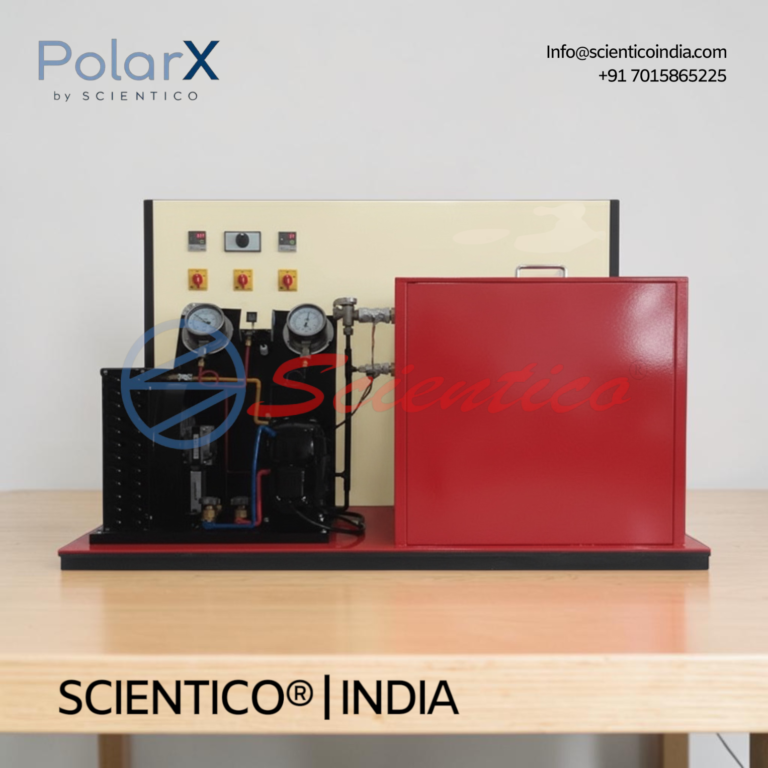
Commercial Refrigeration Training Unit | PolarX – 604
The Commercial Refrigeration Training Unit PolarX - 604 consists of an air-cooled condensing unit with a hermetic compressor featuring high back pressure and high starting torque. This Commercial Refrigeration Training Unit is complete with suction and discharge service valves, gauge manifold connections, and an integrated motor protector.
View product details
Refrigeration Compressor Fault Simulator | PolarX – 572
The Refrigeration Compressor Fault Simulator PolarX - 572 helps students detect electrical issues in refrigeration systems through a thorough understanding of component design, operation, and circuit diagrams. This Refrigeration Compressor Fault Simulator features a real refrigerant compressor from practice with all electrical parts wired and clearly visible.
View product details1. Start the BOQ with the tasks trainees must perform
Write one row per practical task before writing product names. For installation, identify the work on piping, electrical connections, mounting, inspection, start-up, testing, and commissioning that the centre intends to practise. For servicing, separate routine inspection and cleaning, controls and settings, refrigerant-circuit observation, fault identification, and recording work completed. The TESDA document gives the competency framework; the centre must decide which tasks need a live unit, which need a teaching rig, and which need tools or a supervised work site.
For each task, record the number of learners per group, number of simultaneous workstations, instructor demonstration needs, available electrical supply, ventilation, drainage, and safe storage space. This prevents a bid from treating one demonstration unit as enough for every hands-on activity. It also makes later comparisons fair: vendors can price the same required learning outcome and declare exclusions instead of quoting unlike bundles.
2. Separate the teaching units by what they actually show
Use a named unit for a specific learning purpose. Scientico’s Air Conditioning Lab Unit PolarX-556 has an open air duct with an air cooler, steam humidifier, fan, preheater, and reheater that can be switched individually. Its published record describes temperature and humidity measurements before and after stages. It is useful when the curriculum needs observation of air treatment and psychrometric effects. Its description does not make it an installation practice station.
The Commercial Refrigeration Training Unit PolarX-604 has an air-cooled condensing unit, hermetic compressor, forced-air evaporator, suction and discharge service valves, gauge-manifold connections, and high- and low-pressure monitoring. Those published features make it a candidate for demonstrating commercial refrigeration components and service connections. Confirm the exact exercises permitted by the offered configuration, especially any hands-on refrigerant work, in the written technical offer.
The Refrigeration Compressor Fault Simulator PolarX-572 exposes wired compressor starting and protection components and lists simulated electrical faults such as motor-coil fracture, operating-capacitor short circuit, and welded start-relay contacts. Its product record says a multimeter is needed for voltage and resistance tests but is not supplied. This is a focused diagnostic unit, not a substitute for an operating commercial air-conditioning installation. Ask the supplier to state which fault modes are standard and whether any data-acquisition option is included.
3. Add tools, consumables, safety items, and facility work as separate lines
A complete BOQ has lines beyond the three teaching units. The TESDA regulations contain a list of tools, equipment, and materials and describe work involving piping, electrical systems, servicing, and maintenance. Use that list and the centre’s approved delivery plan to specify quantities of relevant tools, measuring instruments, personal protective equipment, work materials, manuals, and storage. Do not assume that a trainer’s product photograph includes loose tools, consumables, or a complete installation workbench.
Put facility preparation in its own section: electrical circuits, earthing, workbench dimensions, ventilation, access, drainage, safe refrigerant handling arrangements, and instructor sightlines. Ask the bidder to mark each item as supplied by the manufacturer, supplied locally, or provided by the institution. This boundary matters in imported equipment tenders: the hardware quotation and the site-readiness work may have different owners and timelines.
4. Require an acceptance check against each BOQ line
For every unit, ask for its exact catalogue name and model, current datasheet, included accessories, options, electrical and other service requirements, manuals, warranty terms, packing, and delivery basis. Then specify what the receiving team will check: model and quantity against the purchase order, visible components against the offer, safe operation of agreed functions, demonstration of stated measurements or fault modes, and handover of documentation. Record whether installation, instructor orientation, and commissioning are included or priced separately.
A useful acceptance schedule pairs each learning task with observable evidence. For example, an air-treatment task might require the instructor to show changing temperature and humidity readings on the offered PolarX-556 configuration. A diagnostics task might require a demonstration of the stated fault modes on PolarX-572 with the required external multimeter available. These are examples for writing a tender; the centre should approve the final test steps and safety procedure before purchase.
5. Send a compact RFQ that vendors can answer line by line
Include the qualification and training plan reference, campus and delivery city in the Philippines, required tasks, number of learners and stations, preferred model or accepted equivalent, quantity, available utilities, required tools and materials, documentation language, and tender closing date. Ask the supplier to identify standard scope, optional scope, exclusions, lead time, shipping terms, installation responsibility, and a compliance response for each BOQ line. If a local bidder will submit the tender, state who must provide the manufacturer authorization and after-sales support commitments.
For the broader purchase process, use Scientico’s Philippines laboratory equipment supplier page and Philippines procurement guide. When requesting a technical offer, attach the centre’s actual training plan and mark which activities need an operating unit, a fault simulator, hand tools, or supervised workplace practice. That makes the quotation testable against the curriculum without implying that any single apparatus delivers the whole NC III programme.
To move from plan to offer, request a model-specific NC III equipment quotation. State the campus, delivery city, required tasks, quantities, desired teaching units and tender deadline in the enquiry; the supplier can then confirm how to exchange the complete BOQ.
One honest ask
This article and public product information are available to browse without an account. To open a product datasheet, complete the contact form shown with its download link. If this article was useful, leave your email and two things happen: we send you this page as a plain-text block you can paste into a tender file or an internal email, and we notify you the next time we publish a buyer tool like this one. Nothing else. No drip sequence, no sales calls booked without asking.