
Equipment mentioned in this guide
Review the product information, specifications and model before requesting a quotation.
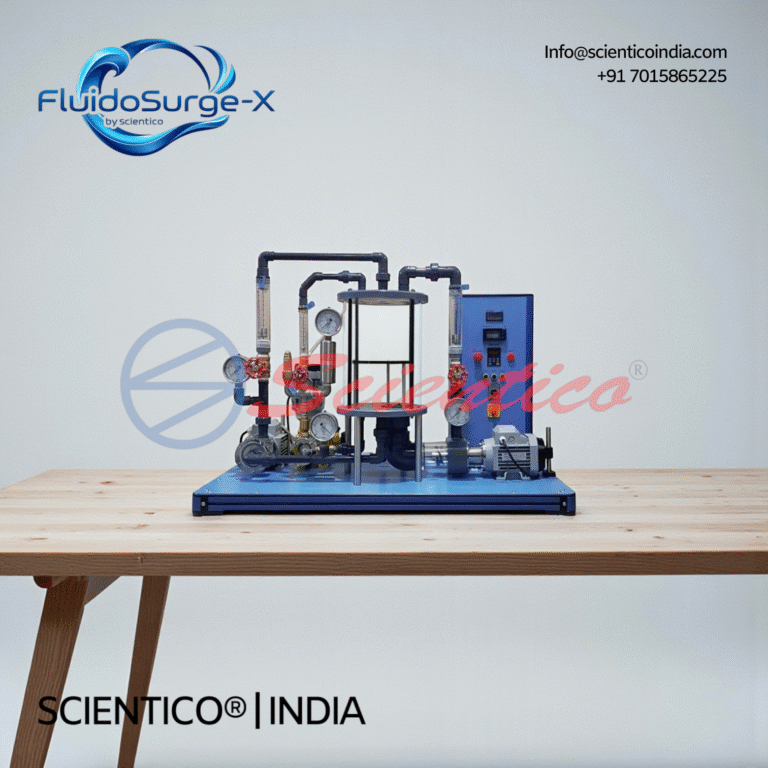
Multi Pump Test Rig Apparatus | FluidoSurge-X 294
The FluidoSurge X-294 is a multi pump test rig (series and parallel centrifugal pump test rig) that lets students run single, series and parallel pump configurations on one apparatus and compare the resulting head–discharge–efficiency characteristics.
View product details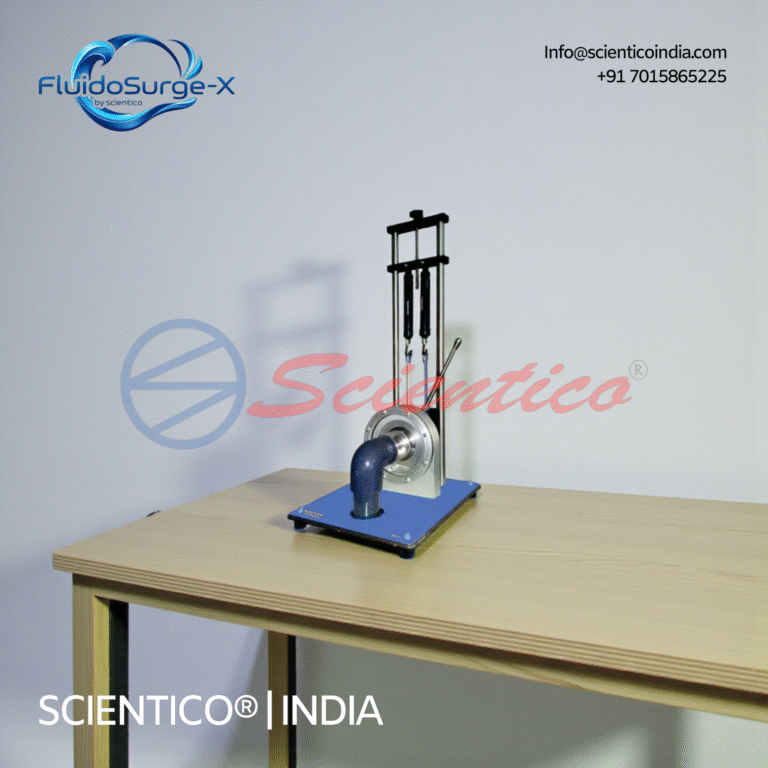
Kaplan Turbine Apparatus | FluidoSurgeX 208
The Kaplan Turbine Apparatus FluidoSurgeX 208 is a laboratory-scale training system designed to study the operating characteristics of a Kaplan reaction turbine. Manufactured by SCIENTICO, the apparatus demonstrates energy conversion from hydraulic power to mechanical power. It is suitable for instructional experiments in fluid mechanics and hydraulic machinery laboratories. The system operates using a controlled water supply from a hydraulic bench.
View product details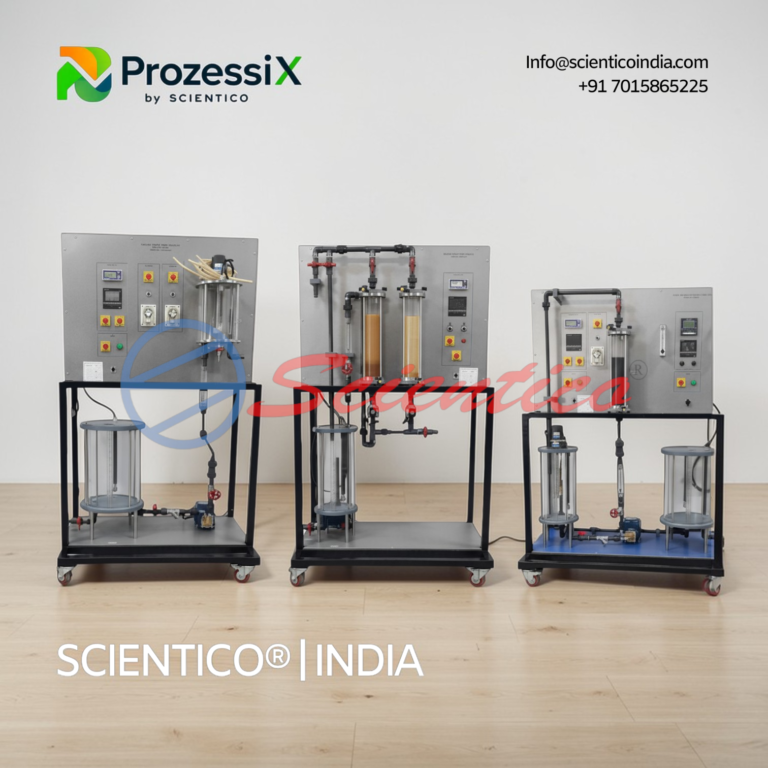
Analytical Process Control Trainer | ProzessiX PX-04
The Prozessix PX-04 is an analytical process control trainer for instrumentation and process engineering laboratories, giving students hands-on PID loop tuning across flow, level, temperature and pressure processes on a single bench.
View product detailsThe short answer: seven labs, and what belongs in each
A B.Tech chemical engineering department runs seven core laboratories: Fluid Flow, Heat Transfer, Mass Transfer, Chemical Reaction Engineering, Mechanical Operations, Process Dynamics and Control, and Chemical Engineering Thermodynamics. Across those seven, a complete equipment list usually lands somewhere between 55 and 75 distinct setups, depending on how many optional experiments your affiliating university keeps in the syllabus. Everything below is organised the way a bill of quantities is organised, lab by lab, with quantities sized for a 60-student batch, so you can lift it into your BOQ and edit rather than start from a blank page.
One note on quantities before the tables. A 60-student batch almost never enters the lab at once. The normal pattern is two sessions of 30, each session split into six groups of five, with six to ten experiments running in parallel and students rotating across the semester. That means one unit per experiment is the working default, and a second unit only makes sense where the experiment is long-running, where the setup is also used by a project or PG group, or where your university insists the whole batch performs the same experiment on the same day. I have flagged the exceptions in the tables.
Fluid Flow lab equipment list
This is the lab that gets used hardest and breaks first, because it involves water, pumps, and undergraduates. Build it around a common sump and recirculation loop where you can, and specify stainless or engineering-plastic wetted parts rather than mild steel.
| Lab | Equipment | What it demonstrates | Typical qty for 60-student batch |
|---|---|---|---|
| Fluid Flow | Reynolds apparatus | Laminar, transitional and turbulent regimes; critical Reynolds number | 1 |
| Fluid Flow | Bernoulli’s theorem apparatus | Energy conservation along a varying-area duct | 1 |
| Fluid Flow | Pipe friction apparatus (major losses) | Friction factor against Reynolds number, Moody chart validation | 1 |
| Fluid Flow | Losses in fittings apparatus (minor losses) | Loss coefficients for bends, elbows, sudden expansion and contraction | 1 |
| Fluid Flow | Flow measurement bench: orifice meter, venturimeter, rotameter | Discharge coefficient, permanent pressure loss, meter calibration | 1, or 2 if flow measurement is examined separately |
| Fluid Flow | Pitot tube setup | Point velocity and velocity profile in a duct | 1 |
| Fluid Flow | Notch and weir apparatus (V-notch, rectangular) | Open channel discharge measurement | 1 |
| Fluid Flow | Centrifugal pump test rig | Head, power and efficiency characteristics at varying speed | 1 |
| Fluid Flow | Reciprocating pump test rig | Positive displacement behaviour, slip, indicator diagram | 1 |
| Fluid Flow | Multi-pump test rig, series and parallel operation | Combined characteristics, system curve matching | 1 |
| Fluid Flow | Impact of jet apparatus | Momentum transfer onto flat, hemispherical and inclined vanes | 1 |
| Fluid Flow | Flow through a packed bed / Ergun equation setup | Pressure drop against superficial velocity in a fixed bed | 1 |
| Fluid Flow | Turbine test rig (Pelton or Kaplan) | Hydraulic machine characteristics, shared with the mechanical department in most colleges | 1, often shared |
For worked examples of how these are specified in practice, the multi-pump test rig from the FluidoSurgeX line and the Kaplan turbine apparatus show the level of instrumentation detail your tender document should be asking for: sensor type, measuring range, and material of construction, not just the equipment name. The wider fluid mechanics lab equipment range covers the rest of this table.
Heat Transfer lab equipment list
Heat transfer is where the difference between a demonstration rig and a teaching rig shows up. If the unit cannot reach steady state inside a two-hour slot, students copy last year’s readings. Ask every supplier for a realistic time-to-steady-state figure, in writing.
| Lab | Equipment | What it demonstrates | Typical qty for 60-student batch |
|---|---|---|---|
| Heat Transfer | Thermal conductivity of metal rod | Fourier’s law, one-dimensional steady conduction | 1 |
| Heat Transfer | Composite wall apparatus | Series thermal resistance, interface temperature drop | 1 |
| Heat Transfer | Thermal conductivity of insulating powder | Conduction in a granular medium, sphere-in-sphere method | 1 |
| Heat Transfer | Lagged pipe apparatus | Radial conduction, critical insulation thickness | 1 |
| Heat Transfer | Natural convection apparatus (vertical cylinder) | Free convection coefficient, Grashof and Nusselt correlation | 1 |
| Heat Transfer | Forced convection apparatus | Convective coefficient in tube flow, Dittus-Boelter check | 1 |
| Heat Transfer | Pin fin apparatus | Fin efficiency and effectiveness, natural and forced modes | 1 |
| Heat Transfer | Emissivity measurement apparatus | Comparative emissivity of a test plate against a black surface | 1 |
| Heat Transfer | Stefan-Boltzmann apparatus | Radiation from a hemispherical enclosure, fourth-power law | 1 |
| Heat Transfer | Double pipe heat exchanger, parallel and counter flow | LMTD, effectiveness-NTU, flow arrangement comparison | 1 |
| Heat Transfer | Shell and tube heat exchanger | Overall heat transfer coefficient, baffle and pass effects | 1 |
| Heat Transfer | Plate type heat exchanger | Compact exchanger performance against tubular equivalents | 1 |
| Heat Transfer | Dropwise and filmwise condensation apparatus | Condensation mode and its effect on the coefficient | 1 |
| Heat Transfer | Boiling heat transfer / critical heat flux apparatus | Pool boiling curve, nucleate to film transition | 1 |
| Heat Transfer | Open pan evaporator or single effect evaporator | Evaporation rate, steam economy | 1 |
| Heat Transfer | Transient heat conduction apparatus | Unsteady state response, lumped capacitance validity | 1 |
The ThermoFlux range covers this table as a family, which matters more than it sounds: when the conduction, convection and radiation rigs share the same controller layout, thermocouple type and terminal block, your lab technician learns one maintenance routine instead of sixteen. That single decision does more for uptime than any spare parts contract.
Mass Transfer lab equipment list
The heaviest lab in the department, and the one where syllabus variation between universities is widest. Distillation, absorption, extraction and drying are non-negotiable. Humidification, adsorption and diffusivity depend on your scheme.
| Lab | Equipment | What it demonstrates | Typical qty for 60-student batch |
|---|---|---|---|
| Mass Transfer | Batch distillation unit with reflux | Rayleigh distillation, effect of reflux ratio on distillate purity | 1 |
| Mass Transfer | Packed or bubble cap distillation column, continuous | Number of theoretical plates, HETP, column efficiency | 1 |
| Mass Transfer | Vapour liquid equilibrium still | Binary VLE data generation, x-y and T-x-y curves | 1 |
| Mass Transfer | Steam distillation unit | Separation of immiscible volatiles below their boiling points | 1 |
| Mass Transfer | Wetted wall column | Gas film and liquid film coefficients, interfacial area known | 1 |
| Mass Transfer | Packed bed gas absorption column | Absorption with chemical reaction, HTU and NTU determination | 1 |
| Mass Transfer | Liquid-liquid extraction: mixer settler | Stagewise extraction, distribution coefficient, stage efficiency | 1 |
| Mass Transfer | Packed extraction column or rotating disc contactor | Differential contact extraction, flooding limits | 1 |
| Mass Transfer | Solid-liquid extraction (leaching) apparatus | Batch leaching rate, solvent to solid ratio effects | 1 |
| Mass Transfer | Tray dryer | Drying rate curve, constant and falling rate periods, critical moisture | 1 |
| Mass Transfer | Rotary dryer | Continuous drying, residence time and holdup | 1 |
| Mass Transfer | Fluidised bed dryer | Drying with intense gas-solid contact, comparison against tray drying | 1 |
| Mass Transfer | Vacuum dryer or spray dryer | Low temperature drying of heat sensitive solids | 1, optional by syllabus |
| Mass Transfer | Diffusivity apparatus (vapour in air) | Gas phase diffusion coefficient by the falling liquid level method | 1 |
| Mass Transfer | Cooling tower / humidification unit | Wet bulb approach, tower characteristic, psychrometry in practice | 1 |
| Mass Transfer | Adsorption column and batch adsorption setup | Isotherms, breakthrough curve, bed capacity | 1 |
| Mass Transfer | Crystalliser (batch, cooling type) | Nucleation and crystal growth, yield against cooling rate | 1 |
Chemical Reaction Engineering lab equipment list
Keep the reactor set consistent in chemistry. Most departments run saponification of ethyl acetate with sodium hydroxide across the whole CRE lab, which means one reagent stock, one titration procedure, and results students can compare across reactor types. That comparison is the actual learning outcome, not the individual reading.
| Lab | Equipment | What it demonstrates | Typical qty for 60-student batch |
|---|---|---|---|
| CRE | Isothermal batch reactor with jacket and stirrer | Rate constant and order determination, Arrhenius behaviour | 1 |
| CRE | Continuous stirred tank reactor, single | Steady state conversion, effect of residence time | 1 |
| CRE | CSTR in series (three tanks) | Conversion gain from staging, approach to plug flow | 1 |
| CRE | Plug flow / tubular reactor | Conversion along reactor length, PFR against CSTR at equal volume | 1 |
| CRE | Packed bed reactor | Heterogeneous catalytic reaction, pressure drop and conversion | 1 |
| CRE | Semi-batch reactor | Controlled feed addition, selectivity and thermal management | 1 |
| CRE | RTD apparatus for CSTR, PFR and packed bed | Pulse and step tracer response, dispersion and dead zones | 1 set |
| CRE | Adiabatic or non-isothermal reactor | Temperature rise with conversion, energy balance coupling | 1 |
| CRE | Recycle or combined loop reactor | Effect of recycle ratio on the residence time distribution | 1, optional |
Mechanical Operations lab equipment list
The particle technology lab. Noisy, dusty, and the one your safety officer will inspect first. Size reduction equipment needs a proper foundation, guarding and dust control; do not let it be squeezed into the corner of a shared hall.
| Lab | Equipment | What it demonstrates | Typical qty for 60-student batch |
|---|---|---|---|
| Mechanical Operations | Jaw crusher | Coarse size reduction, reduction ratio, Rittinger and Bond laws | 1 |
| Mechanical Operations | Roll crusher | Angle of nip, intermediate crushing | 1 |
| Mechanical Operations | Ball mill | Fine grinding, critical speed, energy against fineness | 1 |
| Mechanical Operations | Hammer mill or pulveriser | Impact grinding of brittle solids | 1 |
| Mechanical Operations | Sieve shaker with standard sieve set | Particle size distribution, screen effectiveness | 1 shaker, 2 sieve sets |
| Mechanical Operations | Plate and frame filter press | Constant pressure filtration, cake resistance, filter medium resistance | 1 |
| Mechanical Operations | Leaf filter or rotary vacuum filter | Continuous and batch vacuum filtration comparison | 1 |
| Mechanical Operations | Batch sedimentation apparatus | Settling curve, zone settling, thickener area estimation | 1 |
| Mechanical Operations | Fluidisation apparatus (packed and fluidised bed) | Minimum fluidisation velocity, bed expansion, pressure drop plateau | 1 |
| Mechanical Operations | Cyclone separator | Gas-solid separation efficiency, cut size | 1 |
| Mechanical Operations | Froth flotation cell | Surface property based separation, reagent effects | 1 |
| Mechanical Operations | Basket or laboratory centrifuge | Centrifugal separation of solids from liquids | 1 |
| Mechanical Operations | Agitation and power measurement setup | Power number against Reynolds number, impeller comparison | 1 |
| Mechanical Operations | Elutriator or air permeability apparatus | Classification by terminal velocity, specific surface area | 1 |
Filtration, sedimentation and fluidisation are the three experiments students most often perform badly because the rig leaks, the manometer is fouled, or the bed is channelling. The HydraNexis units in Scientico’s process engineering technology equipment range are built around clear columns and accessible drains for exactly that reason, and that category page is the closest thing to a shopping list for this table.
Process Dynamics and Control lab equipment list
This lab decides whether your graduates are employable in a plant. It is also the lab where budget gets cut first, because a control trainer costs more than a conduction rig and looks less impressive to a visitor who does not know what they are seeing. Protect it.
| Lab | Equipment | What it demonstrates | Typical qty for 60-student batch |
|---|---|---|---|
| Process Control | Level control trainer | Closed loop level regulation, P, PI and PID tuning | 1 |
| Process Control | Flow control trainer | Fast loop dynamics, control valve and transmitter interaction | 1 |
| Process Control | Pressure control trainer | Gas pressure loop, capacity and dead time effects | 1 |
| Process Control | Temperature control trainer | Slow loop with large time constant, derivative action value | 1 |
| Process Control | Analytical (pH) process control trainer | Highly non-linear loop, titration curve, adaptive tuning need | 1 |
| Process Control | Interacting and non-interacting tank systems | First and second order dynamics, step response identification | 1 set |
| Process Control | Control valve characteristics apparatus | Linear, equal percentage and quick opening trim behaviour | 1 |
| Process Control | Thermometer / thermocouple response apparatus | Sensor time constant, lag in the measurement element | 1 |
| Process Control | On-off and PID controller demonstration unit | Cycling under on-off control against continuous control | 1 |
| Process Control | PLC or DCS training panel with SCADA | Industrial control architecture, tag configuration, trending | 1, 2 preferred |
The ProZessix trainers are the reference point I use when writing this section of a BOQ. The analytical process control trainer, ProZessix PX-04, is worth studying even if you buy elsewhere, because a pH loop is the honest test of whether a trainer is a real control rig or a demonstration box with a dial on it. Read its specification and then hold every quotation you receive to that level of detail.
Thermodynamics lab equipment list
| Lab | Equipment | What it demonstrates | Typical qty for 60-student batch |
|---|---|---|---|
| Thermodynamics | Marcet boiler / saturation pressure apparatus | Saturation temperature against pressure, Clausius-Clapeyron check | 1 |
| Thermodynamics | Perfect gas law / PVT apparatus | Deviation from ideal gas behaviour, compressibility | 1 |
| Thermodynamics | Joule-Thomson coefficient apparatus | Throttling, inversion behaviour, real gas effects | 1 |
| Thermodynamics | Vapour pressure of liquids apparatus | Vapour pressure against temperature for pure components | 1 |
| Thermodynamics | Bomb calorimeter | Calorific value of solid and liquid fuels | 1 |
| Thermodynamics | Junkers gas calorimeter | Calorific value of gaseous fuels | 1 |
| Thermodynamics | Heat of solution / reaction calorimeter | Enthalpy change on mixing and reaction | 1 |
| Thermodynamics | Vapour compression refrigeration test rig | COP, cycle plotting on the p-h diagram | 1 |
| Thermodynamics | Two-stage air compressor test rig | Volumetric efficiency, intercooling benefit | 1 |
Several of these overlap with the mechanical department’s setups. If your college runs both branches, check the shared list before ordering duplicates; the thermodynamics lab equipment category and the refrigeration and air conditioning equipment range both feed this table, and the same logic applies when you cross-check against the electrical engineering lab equipment list for shared instrumentation.
The accreditation and procurement angle
Two different documents get confused constantly. The approval document proves the lab exists and meets the norms of the approving body. The accreditation document proves the lab produces learning outcomes. They need different evidence, and a list of equipment satisfies only the first.
For approval, you need the equipment list itself, purchase records, and the lab area and utilities declaration. Do not take numeric norms from a blog, including this one. Norms for laboratory area, equipment value and staffing change between revisions, so open the current approval process handbook of the relevant regulator and copy the figures from there on the day you file.
For outcome-based accreditation, the assessor is looking for a chain: syllabus experiment, mapped course outcome, the equipment that makes that experiment possible, the lab manual that specifies the procedure, the student record, and the assessment of whether the outcome was attained. A rig sitting under a dust cover breaks that chain no matter how expensive it was. The NBA accreditation lab documentation guide sets out the file structure that survives a visit.
Three practical procurement points. First, write your BOQ by experiment, not by equipment name, so a supplier cannot substitute a cheaper unit that technically carries the same title. Second, ask for calibration certificates with traceability at the time of delivery, not later; the lab equipment maintenance and calibration schedule guide explains what to log after that. Third, treat certification as a filter rather than a decoration: an ISO 9001:2015 quality system and CE conformity where applicable tell you the manufacturer has a documented process behind the unit. Scientico has manufactured from Ambala since 1993 and supplies to more than 60 countries under ISO 9001:2015 and CE, and like most institutional manufacturers works on a quote basis rather than published prices, because configuration and freight drive the number.
If this is a first-time department setup rather than an addition, sequence it with the first procurement guide for new engineering colleges and the lab equipment cost and budget guide before you release a single purchase order.
What most colleges get wrong
The mistake I see most often is buying to the syllabus heading instead of to the experiment. “Heat exchanger” in a BOQ gets you a heat exchanger. What the syllabus actually wants is a heat exchanger you can run in parallel and counter flow, with enough temperature tapping points to compute LMTD honestly, at flow rates a student can set and hold. Write that sentence into the BOQ and the substitution problem disappears.
Second: utilities are planned last and then constrain everything. Chemical engineering labs need DM or soft water, compressed air at a stable pressure for pneumatic control valves, steam or an electric boiler for distillation and evaporation, floor drainage that can take chemical effluent, three-phase power at the crushers, and fume extraction over the distillation and absorption units. Retrofitting compressed air into a finished lab costs more than the trainer it feeds.
Third: nobody budgets consumables. Ethyl acetate and sodium hydroxide for the CRE lab, CO2 cylinders for absorption, buffer solutions for the pH trainer, filter cloth, sieve mesh, calcium carbonate slurry for sedimentation. A lab with no consumable budget becomes a lab with a demonstration timetable inside two semesters.
Fourth: faculty and technician training is treated as optional. The control lab is where this hurts. A PID trainer that nobody on staff can tune becomes a unit that runs one fixed experiment forever. Put training days into the purchase order as a deliverable with a date, not as a goodwill promise.
Fifth: sensors are the wear item, and spares are never ordered. Thermocouples, pH electrodes, pressure transmitters and rotameter floats fail on a predictable schedule. Order a small spares kit with the original consignment while you still have commercial bargaining power.
Sixth: everything is ordered from a different supplier to shave the lowest quote per line. You then hold six warranty relationships, six documentation formats and six service contacts for one lab. Consolidating a lab family with one manufacturer is usually worth a small price premium, and it makes the accreditation file coherent.
Send us your syllabus
If you have a syllabus, a draft BOQ or an old equipment list you are updating, send it across and you will get back a configured, experiment-mapped quotation with quantities sized to your batch. No obligation and no pressure to buy: contact Scientico.
Looking for the apparatus itself? See our chemical engineering lab equipment manufacturer page covering unit operations, reactors and process control trainers.
One honest ask
We don't gate anything on this site. You just read the whole thing free. If it was useful, leave your email and two things happen: we send you this page as a plain-text block you can paste into a tender file or an internal email, and we notify you the next time we publish a buyer tool like this one. Nothing else. No drip sequence, no sales calls booked without asking.