
Equipment mentioned in this guide
Review the product information, specifications and model before requesting a quotation.

Batch Distillation Column Apparatus | OperatiX – 04
The Batch Distillation Column Apparatus OperatiX - 04 separates liquid mixtures comprised of distinct liquids that are soluble in one another via distillation. This Batch Distillation Column Apparatus is fed with a recommended ethanol and water mixture, which partially evaporates as it heats on the way to the bottom of the column. It supports batch rectification with different types of columns available as optional.
View product details
Continuous Distillation Column Apparatus | OperatiX – 06
The Continuous Distillation Column Apparatus OperatiX - 06 uses rectification, a fundamental thermal separation technique, to separate homogeneous liquid mixtures in the industrial sector. This Continuous Distillation Column Apparatus works with interchangeable columns, including sieve tray, bubble cap tray, packed, valve tray, and structured packing types. It supports feed at three different heights with heat exchanger preheating.
View product details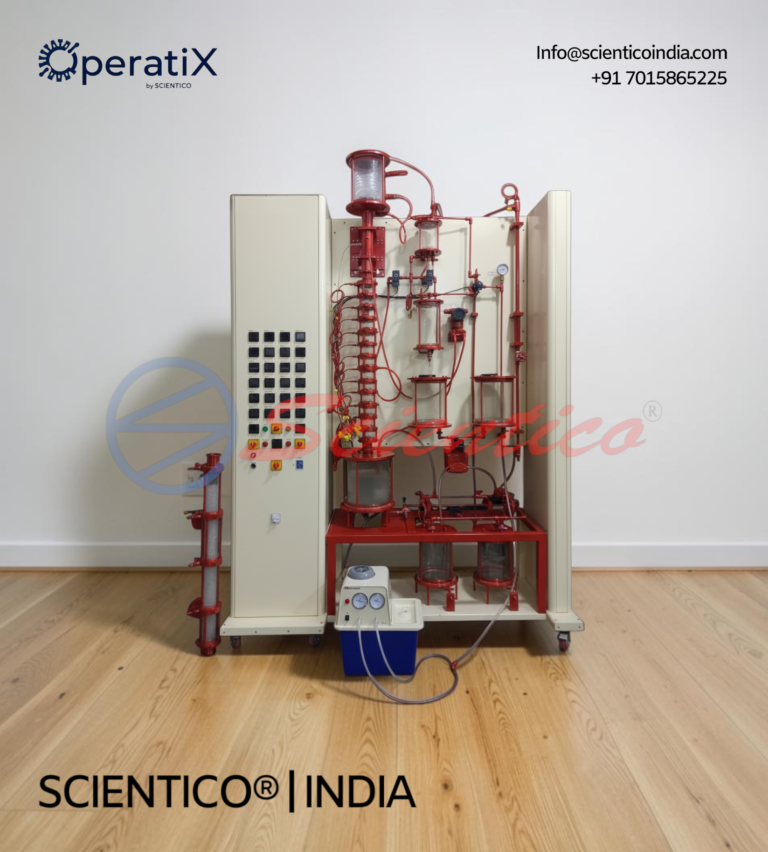
Multifunction Distillation Column | OperatiX – 05
The Multifunction Distillation Column OperatiX - 05 separates soluble liquid mixtures of two different liquids through distillation. This Multifunction Distillation Column uses a recommended ethanol and water mixture, poured into the boiler's evaporator tank, to generate low-temperature liquid vapor that climbs the column. It supports interchangeable columns for batch, continuous, and vacuum distillation modes.
View product details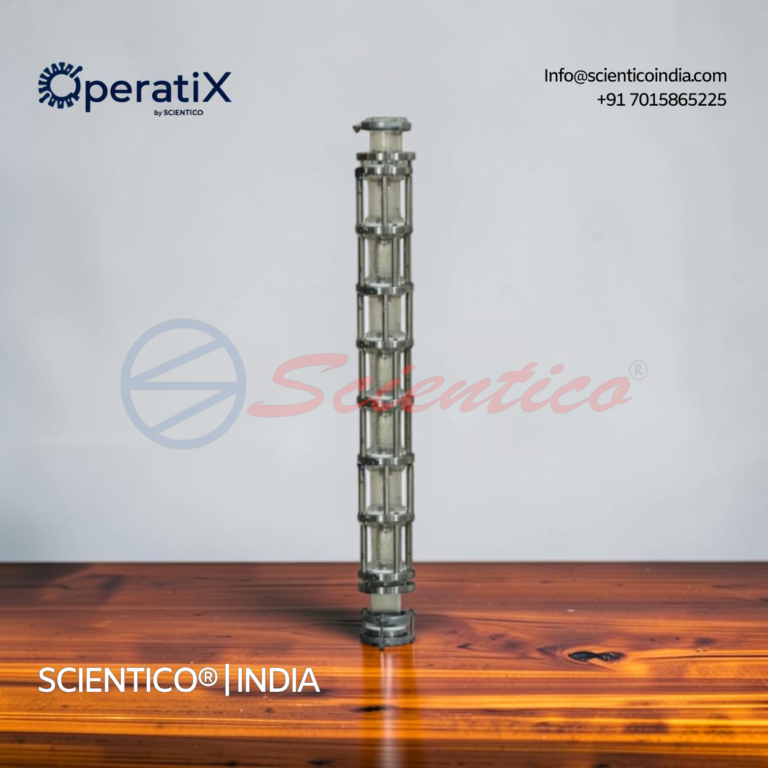
Bubble Cap Tray Column | OperatiX – 08
The Bubble Cap Tray Column OperatiX - 08 allows liquid and vapor to contact as vapor rises through the tower and passes through bubble caps. This Bubble Cap Tray Column uses riser and cap assemblies on each tray to direct vapor downward and bubble it into the surrounding liquid. It is built with a glass construction for laboratory use.
View product details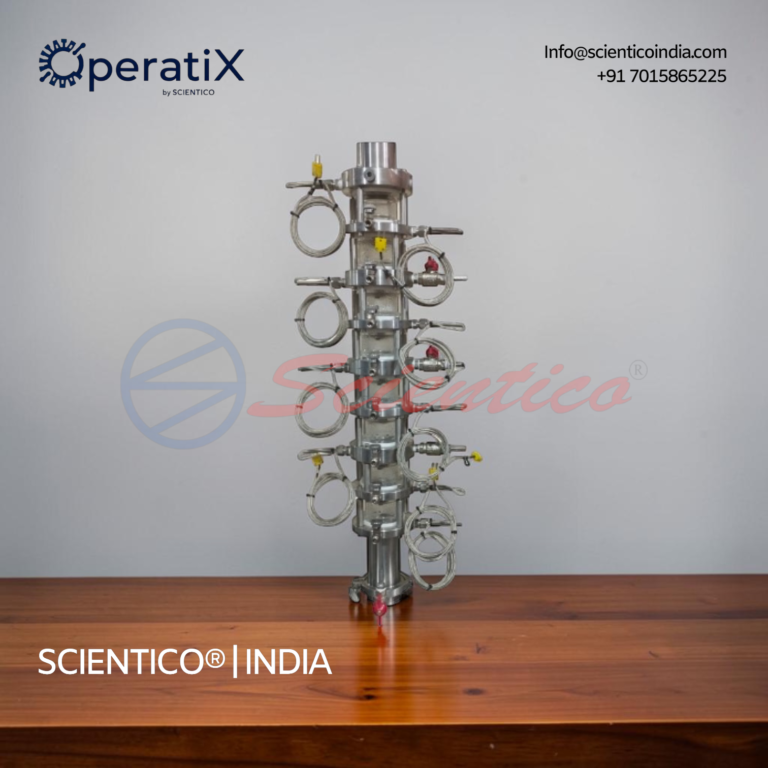
Sieve Tray Column | OperatiX – 07
The Sieve Tray Column OperatiX - 07 is a cross-flow plate column of the sieve tray variety, built for vapor-liquid contact demonstration. This Sieve Tray Column uses perforated trays to allow vapor to bubble uniformly through liquid as it moves across the tray floor. It is constructed with a glass column body for visual observation of tray operation.
View product details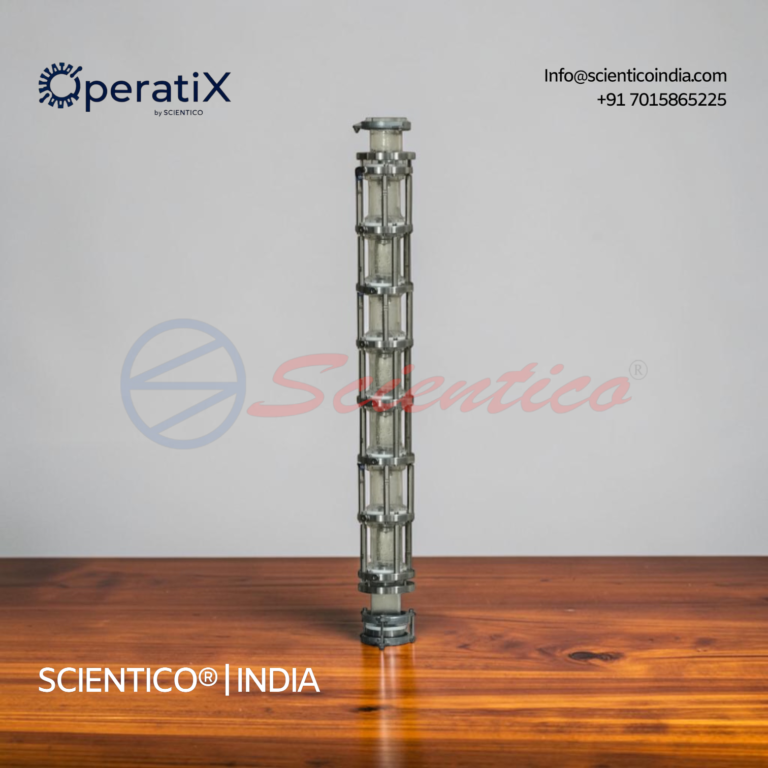
Valve Tray Column | OperatiX – 14
The Valve Tray Column OperatiX - 14 uses liftable caps that self-adjust in accordance with vapor flow to cover the apertures in its trays. This Valve Tray Column prevents liquid from dripping at low vapor rates by closing off the tray valves. It expands the region open to vapor flow as the vapor rate rises.
View product detailsChemical engineering lab equipment built by a manufacturer
A chemical engineering lab is expensive to fill, because it needs unit operations, reactors and process control trainers, and each comes from a different supplier unless you buy from a manufacturer who makes all three. Scientico builds them together at our own works in Ambala, so a college can place one order for a lab that works as a set.
Scientico has built laboratory and engineering teaching equipment at its own works in Ambala, Haryana since 1993. We are ISO 9001:2015 certified, we export to more than 60 countries, and the current catalogue carries over 370 products. Each apparatus is supplied with a calibration certificate and an operation manual.
Unit operations
These are the separation and mass transfer experiments at the heart of the syllabus: distillation, absorption, extraction, crystallisation, adsorption and fluidisation. The tray and packed column variants let students compare column types on the same duty.
- Batch Distillation Column Apparatus
- Continuous Distillation Column Apparatus
- Multifunction Distillation Column
- Bubble Cap Tray Column
- Sieve Tray Column
- Valve Tray Column
- Packed Column
- Structured Packing Column
- Gas Absorption/Desorption Column Apparatus
- Liquid/Liquid Extraction Apparatus
- Solid-Liquid Extraction
- Batch Cooling Crystallization Apparatus
- Continuous Cooling Crystallization Apparatus
- Adsorption Apparatus
- Fluidization and Fluid Bed Heat Exchanger
Chemical reactors
Reaction engineering needs the ideal reactor types side by side: batch stirred tank, continuous stirred tank, plug flow and tubular, with fixed bed, trickle bed and fluidised bed for catalytic work. Stand-alone units suit a small lab, and the service unit lets a lab run several reactor modules from one base.
- Batch Stirred Tank Reactor (Stand Alone)
- Continuous Stirred Tank Reactor (Stand Alone)
- Continuous Stirred Tank Reactor in Series (Stand Alone)
- Discontinuous Stirred Tank Reactor
- Plug-Flow Reactor (PFR)
- Tubular Flow Reactor
- Laminar Flow Reactor
- Fixed Bed Catalysis
- Trickle Bed Reactor
- Fluidized Bed Reactor
- Service Unit for Chemical Reactors
Diffusion and mass transfer
- Diffusion in Liquids
- Gaseous Diffusion Apparatus
- Wetted Wall Gas Absorption Column
- Corrosion Study Unit
Process control and instrumentation
Process control trainers teach the four basic loops, level, flow, pressure and temperature, and add valve characteristics and signal conversion. The process plant trainer ties the loops together.
- Level Control Trainer
- Flow Control Trainer
- Pressure Control Trainer
- Temperature Control Trainer
- Process Plant Trainer
- Control Valve Characteristics Training Panel
- Study of I/P and P/I Converter
- Analytical Process Control Trainer
- Cake & Depth Filtration Trainer
- Flow Through Particle Layers Trainer
Planning the lab
Our B.Tech chemical engineering lab equipment list maps practicals to apparatus. The process engineering lab setup guide covers layout and services, and the reactor selection guide helps you choose between reactor types. For control-side questions read process control trainers for B.Tech chemical engineering. If your lab also covers heat transfer, our thermodynamics range includes heat exchangers and a water cooling tower.
One point of honesty. This is teaching and training grade equipment for instruction and demonstration. We are not a NABL accredited calibration or testing laboratory, and we do not present ourselves as one. If you need third party certification of materials or measurements, tell us early so nobody wastes a quotation cycle.
Some of the larger columns and reactors need utilities such as water, steam, compressed air or a specific power supply. Tell us what your building can provide and we will say what each unit needs before you commit.
What to send us to get a quotation
A quotation is fastest when we can see the real requirement. Send us the apparatus names or the syllabus practical list, the quantity of each, the destination country or state, whether you need a full lab or a few items, and any tender clause numbers you have to comply with. If you are answering a tender, add the closing date so we can prioritise the paperwork.
We do not publish prices for chemical engineering lab equipment. Cost depends on the model, quantity, options and destination, so every quotation is prepared against your list. You can start on the contact page, message us on WhatsApp on +91 7015865225, or call the same number.
Tender and export paperwork
Institutions buying through a tender usually need more than a price. We can supply a tender compliance matrix against your specification, and a manufacturer authorisation letter for bidders who need one, explained in our guide to the Manufacturer Authorisation Form. For overseas orders, our guide on importing lab equipment from India covers the steps, and the supplier evaluation checklist shows what a careful buyer should ask any supplier, including us.
Dealers and trading houses who want to represent our range in their territory can start on the distributor page.
Frequently asked questions
Do you make the columns and reactors yourselves?
Yes. The distillation, absorption, extraction and reactor units are built at our works in Ambala, Haryana, and ship with a calibration certificate and operation manual.
Can one order cover unit operations, reactors and process control?
Yes. This is the main reason to buy from a manufacturer that makes all three. Send your practical list and we will build the quotation as one lab.
What utilities do the units need?
It varies by unit. Tell us what water, power, steam and compressed air your lab has and we will confirm each unit’s requirements in the quotation.
Do you publish prices?
No. Pricing depends on the units, quantity, options and destination, so we quote against your list.
n
Chemical process equipment: five model-selection and RFQ guides
Use these focused guides to compare the documented experiment, module and purchasing scope before requesting a model-specific quotation.
See the full range by discipline on our engineering training equipment manufacturers page.
One honest ask
This article and public product information are available to browse without an account. To open a product datasheet, complete the contact form shown with its download link. If this article was useful, leave your email and two things happen: we send you this page as a plain-text block you can paste into a tender file or an internal email, and we notify you the next time we publish a buyer tool like this one. Nothing else. No drip sequence, no sales calls booked without asking.
Four additional ReaktiLabX models to compare by exact code
These current catalogue records add four model-specific paths to the range above. The combined Diffusion in Liquids and Gases ReaktiLabX 01 covers both phases, while the separate liquid and gas diffusion records remain distinct. The Continuous Stirred Tank Reactor ReaktiLabX 08 and Stirred Tanks in Series ReaktiLabX 09 list the Service Unit for Chemical Reactors 07 as required support; compare those with the separately listed stand-alone reactor records. The Tubular Reactor ReaktiLabX 11 is also listed with that service-unit requirement. Check the exact model page and current datasheet before finalising a BOQ; similar experiment names do not establish identical configuration or included scope.
- Diffusion in Liquids and Gases — ReaktiLabX 01
- Continuous Stirred Tank Reactor — ReaktiLabX 08
- Stirred Tanks in Series — ReaktiLabX 09
- Tubular Reactor — ReaktiLabX 11
For each line, specify the practical, exact model code, quantity and destination, and ask the supplier to confirm utilities, service-unit dependencies, included components and documentation in writing. Use the B.Tech chemical-engineering equipment list for syllabus planning, then send the shortlist through the enquiry page.