🔎 Manufacturer-direct laboratory equipment enquiries - Request a model-specific international quotation →
✓ Established 1993 ✓ Model-Specific Specifications ✓ Manufacturer-Direct Enquiries ✓ International Quotations ✓ Destination-Based Delivery Terms

Radial Heat Conduction Module

Model ThermoFlux - 7049/2

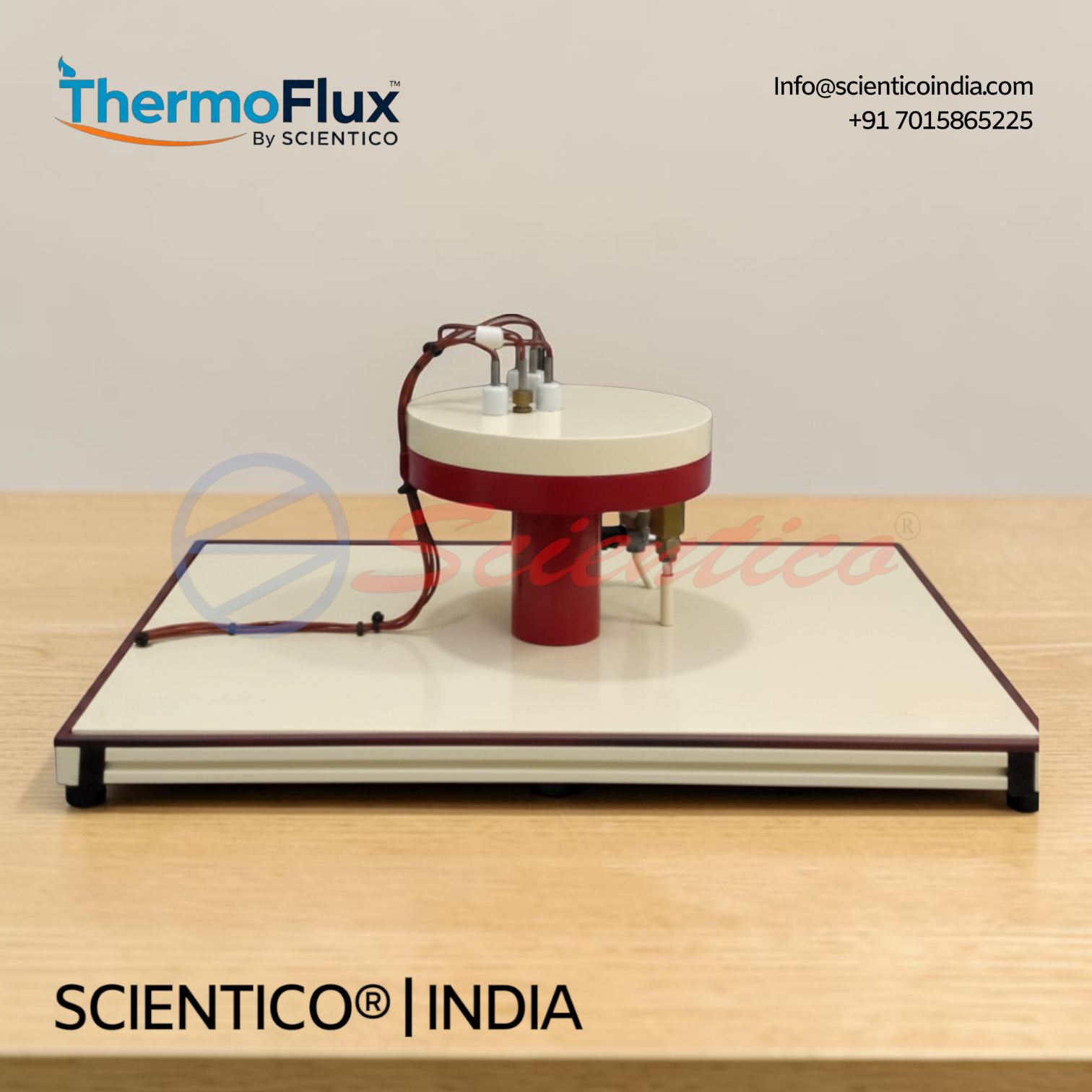
The Radial Heat Conduction Module ThermoFlux-7049/2 is a bench-mounted thermodynamics accessory for investigating radial heat conduction through a solid brass disc (110 mm diameter, 6 mm thickness). This radial heat conduction module uses a centre-mounted electric heater and peripheral water cooling to establish a steady radial temperature gradient, with six equally spaced thermocouple measurement points providing a complete radial temperature profile. It supports steady-state and unsteady-state conduction experiments, Fourier Rate Equation analysis, and thermal conductivity (k) determination for the disc material. The Heat Transfer Service Unit ThermoFlux-7049 is required for operation and sold separately.

The Radial Heat Conduction Module ThermoFlux – 7049/2 is a laboratory module for the experimental investigation of radial heat conduction through a solid brass disc. This radial heat conduction module uses a centrally heated, water-cooled 110 mm diameter brass disc instrumented with six thermocouple positions at equal radial increments to enable direct measurement of the steady-state and unsteady-state temperature distribution. Students determine the thermal conductivity of the disc material and apply the Fourier Rate Equation to quantify radial heat flow through a thick-walled cylindrical geometry.


Product Overview

The ThermoFlux – 7049/2 is built around an insulated brass disc, 110 mm in diameter and 6 mm thick, heated at its centre by an electric heater. Power supplied to the heater is controlled and measured by the Heat Transfer Service Unit, sold separately. The periphery of the disc is cooled by water flowing through a copper tube bonded to the disc edge, maintaining a consistent temperature gradient from centre to rim throughout each experiment.

Six thermocouple holes are positioned at equal radial increments from the heated centre to the outer edge of the disc. Thermocouples connect directly to the Heat Transfer Service Unit, with temperature readings displayed in real time on its digital panel meter. This arrangement provides a full radial temperature profile across the disc under both steady-state and unsteady-state conditions.

The module is mounted on a bench support frame and is specifically configured for radial conduction experiments. This geometry replicates heat flow through the wall of a thick cylinder, a configuration relevant to pipe insulation, pressure vessel walls, and other cylindrical engineering components. Eight structured experiments cover temperature distribution measurement, the effect of heat flow variation, Fourier Rate Equation application, unsteady-state conduction observation, thermal conductivity determination, time-to-stability analysis, comparative material investigation, and real-world engineering applications.

The module requires the Heat Transfer Service Unit ThermoFlux – 7049 for operation.

Technical Specifications

Parameter Detail
Model Reference ThermoFlux-7049/2
Category Thermodynamics
Disc Material Brass
Disc Diameter 110 mm
Disc Thickness 6 mm
Heating Method Electric heater at disc centre
Cooling Method Water flow through copper tube bonded to disc periphery
Thermocouple Positions 6, at equal radial increments from centre to edge
Thermocouple Connection Direct to Heat Transfer Service Unit ThermoFlux-7049
Mounting Bench support frame
Required for Operation Heat Transfer Service Unit ThermoFlux-7049 (sold separately)

Technical Data

Radial Module

Parameter Value
Material Brass
Diameter 110 mm
Thickness 6 mm
Heating Electric heater at centre
Cooling Water flow through bonded copper tube at periphery
Thermocouple Holes 6, equally spaced radially

Key Features

  • Disc Geometry: brass disc, 110 mm diameter, 6 mm thickness, specifically designed for radial conduction experiments
  • Centre Heating: electric heater at disc centre, power controlled and measured by Heat Transfer Service Unit ThermoFlux-7049
  • Peripheral Cooling: water flow through a copper tube bonded to the disc periphery maintains a steady temperature gradient on this radial heat conduction module
  • Thermocouple Layout: 6 holes at equal radial increments from heated centre to cooled edge for complete radial temperature profiling
  • Real-Time Monitoring: thermocouples connect directly to Heat Transfer Service Unit digital panel meter
  • Steady and Unsteady State: supports both steady-state temperature distribution and unsteady-state conduction time analysis
  • Thermal Conductivity Determination: Fourier Rate Equation applied to calculate thermal conductivity (k) of the brass disc
  • Mounting: bench support frame for stable, compact laboratory installation
  • Required for Operation: Heat Transfer Service Unit ThermoFlux-7049, sold separately

Experiments

  • Measure the temperature distribution during steady-state conduction of heat energy through the wall of a thick cylinder, demonstrating radial energy flow
  • Demonstrate the impact of variations in heat flow on the temperature distribution
  • Understand the application of the Fourier Rate Equation in calculating the rate of heat flow during steady-state conduction through the wall of a thick cylinder
  • Observe unsteady-state conduction of heat in the system
  • Use the Fourier Rate Equation to determine the constant of proportionality (thermal conductivity, k) for the disc material
  • Analyse the time required to reach stable thermal conditions during unsteady-state conduction
  • Investigate the effects of different materials on thermal conductivity through comparative measurements
  • Explore practical applications of thermal conductivity in real-world and engineering contexts

Construction and Design

The Radial Heat Conduction Module ThermoFlux-7049/2 is constructed around a circular brass disc measuring 110 mm in diameter and 6 mm in thickness, mounted on a bench support frame. The disc is insulated to minimise external heat loss and ensure that conduction occurs primarily in the radial direction. An electric heater positioned at the centre of the disc provides the heat source, with power supply, control, and measurement handled by the Heat Transfer Service Unit ThermoFlux-7049. A copper tube is bonded to the outer edge of the disc and carries cooling water to maintain the periphery at a lower, consistent temperature, establishing the radial temperature gradient required for conduction experiments. Six thermocouple holes are drilled at equal radial increments between the centre and the edge, providing six discrete measurement points across the full radial span of this radial heat conduction module. Thermocouples inserted into these holes connect directly to the Heat Transfer Service Unit for real-time digital temperature display. The setup allows full investigation of steady-state radial conduction and transient unsteady-state behaviour, with all data required for Fourier Rate Equation calculations available from the six radial temperature readings and the measured heater power input.

Required for Operation (Sold Separately)

  • Heat Transfer Service Unit ThermoFlux-7049: provides heater power control, power measurement, and digital temperature display for thermocouple inputs

Scope of Delivery

  • 1 experimental module
  • 1 set of hoses
  • 1 instruction manual

Q1: What is the disc material and geometry used in the Radial Heat Conduction Module ThermoFlux-7049/2?
The disc is made of brass, 110 mm in diameter and 6 mm thick, with an electric heater at the centre and a copper cooling tube bonded to the periphery.

Q2: How many temperature measurement points are available on this radial heat conduction module?
Six thermocouple holes are positioned at equal radial increments from the heated centre to the cooled edge of the disc, providing a complete radial temperature profile.

Q3: Is the Heat Transfer Service Unit included with the ThermoFlux-7049/2?
No. The Heat Transfer Service Unit ThermoFlux-7049 is required for operation and must be ordered separately. It provides heater power control, power measurement, and digital temperature display.

Q4: What equation is used to determine thermal conductivity from the experimental data?
The Fourier Rate Equation is applied to the measured radial temperature distribution and heater power input to calculate the thermal conductivity (k) of the brass disc material.

Q5: Does the module support unsteady-state as well as steady-state conduction experiments?
Yes. The module supports both steady-state radial temperature distribution experiments and unsteady-state conduction analysis, including measurement of the time required to reach stable thermal conditions.

Need Assistance? We're Here to Help!

Connect with our team for product specifications, pricing, and customized solutions for your institution or project.
Trade enquiries

Distributors, dealers, resellers and bulk buyers

We manufacture Radial Heat Conduction Module | ThermoFlux – 7049/2 at our own works in Ambala, India. Manufacturer-direct, three ways to work with us.

01

Become a distributor, dealer or agent in your territory

Already selling to colleges or hospitals in your market? Add a manufacturer-direct line. Terms reviewed on application.

or message on WhatsApp
02

Wholesale and bulk quotation

Holding a live enquiry? Send the model, quantity, destination and required Incoterm. We will confirm the supplied scope and available export documents.

or message on WhatsApp
03

OEM authorisation letter for a tender

Bidding a tender that requests a manufacturer authorisation form (MAF)? Send the tender reference, deadline and listed equipment so we can confirm what can be issued.

or message on WhatsApp

Full distributor guide OEM and export enquiries

Scientico
🏭
Manufacturer DirectProduct-specific enquiry, not a generic catalogue
🌍
Destination MatchedConfiguration and delivery scope reviewed together
📄
Decision-Ready ReplyApplicable documentation confirmed before ordering
Product-specific enquiry

Get a quotation your team can evaluate

A bare price can hide configuration, accessories, voltage, documentation and delivery assumptions. Send the product and destination now so the quoted scope can be reviewed before a purchase decision.

Avoid the mismatchDo not approve a generic price that leaves supplied scope unclear.
Your product is attachedNo need to retype the model or copy the page URL.
Move toward an approvable quoteAdd the destination; quantity and tender details can follow.

No account is required. Organisation, quantity and tender details are optional. Include the country code so the team can reach you internationally.

1993
Manufacturing Since
Direct
Manufacturer Supply
Quote-based
International Orders
Model
Configuration

Overview

The Radial Heat Conduction Module ThermoFlux - 7049/2 is a laboratory module for the experimental investigation of radial heat conduction through a solid brass disc. This radial heat conduction module uses a centrally heated, water-cooled 110 mm diameter brass disc instrumented with six thermocouple positions at equal radial increments to enable direct measurement of the steady-state and unsteady-state temperature distribution. Students determine the thermal conductivity of the disc material and apply the Fourier Rate Equation to quantify radial heat flow through a thick-walled cylindrical geometry.


Product Overview

The ThermoFlux - 7049/2 is built around an insulated brass disc, 110 mm in diameter and 6 mm thick, heated at its centre by an electric heater. Power supplied to the heater is controlled and measured by the Heat Transfer Service Unit, sold separately. The periphery of the disc is cooled by water flowing through a copper tube bonded to the disc edge, maintaining a consistent temperature gradient from centre to rim throughout each experiment.

Six thermocouple holes are positioned at equal radial increments from the heated centre to the outer edge of the disc. Thermocouples connect directly to the Heat Transfer Service Unit, with temperature readings displayed in real time on its digital panel meter. This arrangement provides a full radial temperature profile across the disc under both steady-state and unsteady-state conditions.

The module is mounted on a bench support frame and is specifically configured for radial conduction experiments. This geometry replicates heat flow through the wall of a thick cylinder, a configuration relevant to pipe insulation, pressure vessel walls, and other cylindrical engineering components. Eight structured experiments cover temperature distribution measurement, the effect of heat flow variation, Fourier Rate Equation application, unsteady-state conduction observation, thermal conductivity determination, time-to-stability analysis, comparative material investigation, and real-world engineering applications.

The module requires the Heat Transfer Service Unit ThermoFlux - 7049 for operation.

Key Features

Key Features

  • Disc Geometry: brass disc, 110 mm diameter, 6 mm thickness, specifically designed for radial conduction experiments
  • Centre Heating: electric heater at disc centre, power controlled and measured by Heat Transfer Service Unit ThermoFlux-7049
  • Peripheral Cooling: water flow through a copper tube bonded to the disc periphery maintains a steady temperature gradient on this radial heat conduction module
  • Thermocouple Layout: 6 holes at equal radial increments from heated centre to cooled edge for complete radial temperature profiling
  • Real-Time Monitoring: thermocouples connect directly to Heat Transfer Service Unit digital panel meter
  • Steady and Unsteady State: supports both steady-state temperature distribution and unsteady-state conduction time analysis
  • Thermal Conductivity Determination: Fourier Rate Equation applied to calculate thermal conductivity (k) of the brass disc
  • Mounting: bench support frame for stable, compact laboratory installation
  • Required for Operation: Heat Transfer Service Unit ThermoFlux-7049, sold separately

Experiments

  • Measure the temperature distribution during steady-state conduction of heat energy through the wall of a thick cylinder, demonstrating radial energy flow
  • Demonstrate the impact of variations in heat flow on the temperature distribution
  • Understand the application of the Fourier Rate Equation in calculating the rate of heat flow during steady-state conduction through the wall of a thick cylinder
  • Observe unsteady-state conduction of heat in the system
  • Use the Fourier Rate Equation to determine the constant of proportionality (thermal conductivity, k) for the disc material
  • Analyse the time required to reach stable thermal conditions during unsteady-state conduction
  • Investigate the effects of different materials on thermal conductivity through comparative measurements
  • Explore practical applications of thermal conductivity in real-world and engineering contexts

Construction and Design

The Radial Heat Conduction Module ThermoFlux-7049/2 is constructed around a circular brass disc measuring 110 mm in diameter and 6 mm in thickness, mounted on a bench support frame. The disc is insulated to minimise external heat loss and ensure that conduction occurs primarily in the radial direction. An electric heater positioned at the centre of the disc provides the heat source, with power supply, control, and measurement handled by the Heat Transfer Service Unit ThermoFlux-7049. A copper tube is bonded to the outer edge of the disc and carries cooling water to maintain the periphery at a lower, consistent temperature, establishing the radial temperature gradient required for conduction experiments. Six thermocouple holes are drilled at equal radial increments between the centre and the edge, providing six discrete measurement points across the full radial span of this radial heat conduction module. Thermocouples inserted into these holes connect directly to the Heat Transfer Service Unit for real-time digital temperature display. The setup allows full investigation of steady-state radial conduction and transient unsteady-state behaviour, with all data required for Fourier Rate Equation calculations available from the six radial temperature readings and the measured heater power input.

Required for Operation (Sold Separately)

  • Heat Transfer Service Unit ThermoFlux-7049: provides heater power control, power measurement, and digital temperature display for thermocouple inputs

Scope of Delivery

  • 1 experimental module
  • 1 set of hoses
  • 1 instruction manual

Specifications

Technical Specifications

Parameter Detail
Model Reference ThermoFlux-7049/2
Category Thermodynamics
Disc Material Brass
Disc Diameter 110 mm
Disc Thickness 6 mm
Heating Method Electric heater at disc centre
Cooling Method Water flow through copper tube bonded to disc periphery
Thermocouple Positions 6, at equal radial increments from centre to edge
Thermocouple Connection Direct to Heat Transfer Service Unit ThermoFlux-7049
Mounting Bench support frame
Required for Operation Heat Transfer Service Unit ThermoFlux-7049 (sold separately)

Technical Data

Radial Module

Parameter Value
Material Brass
Diameter 110 mm
Thickness 6 mm
Heating Electric heater at centre
Cooling Water flow through bonded copper tube at periphery
Thermocouple Holes 6, equally spaced radially

Buying Radial Heat Conduction Module: Distributor & Tender Guidance

Radial Heat Conduction Module is the product name procurement teams should use when searching, preparing a BOQ or comparing suppliers. A model reference identifies the proposed configuration; it should not replace the product name or the buyer’s required experiment. This equipment is considered for engineering laboratory teaching, demonstration and practical skill development for the applicable discipline.

What to include in the RFQ

State the product name, quantity, destination, curriculum or tender reference, and required experiment, operating range, measurement method, included accessories, utilities, documentation, quantity and delivery destination. This lets the technical team respond against the intended use rather than guess from a model code.

How distributors should quote it

Keep Radial Heat Conduction Module as the BOQ line item. Add the proposed model, included accessories, documentation, packing and delivery basis as separate fields so the end buyer can verify the offer.

How to compare suppliers

Compare the offered experiment coverage, measurable parameters and supplied scope line by line before selecting an equivalent model. Record exclusions and alternatives in writing before commercial comparison.

Why Buy From Scientico

🏭

In-House Manufacturer

Designed & built in our Ambala facility since 1993 — not a reseller. Full control over quality & customisation.

✅

Configuration Review

Specifications, documentation and options are confirmed against the selected model.

🌏

International Enquiries

Share your destination and procurement requirements for an export quotation.

📦

Quote-Based Supply

Send the model, quantity and delivery location for a tailored proposal.

🛠

Support Scope

Support and warranty terms are documented in the applicable quotation.

🎓

Built for Teaching

Designed around curriculum experiments with clear, repeatable, hands-on results.

Frequently Asked Questions

Q1: What is the disc material and geometry used in the Radial Heat Conduction Module ThermoFlux-7049/2? The disc is made of brass, 110 mm in diameter and 6 mm thick, with an electric heater at the centre and a copper cooling tube bonded to the periphery.

Q2: How many temperature measurement points are available on this radial heat conduction module? Six thermocouple holes are positioned at equal radial increments from the heated centre to the cooled edge of the disc, providing a complete radial temperature profile.

Q3: Is the Heat Transfer Service Unit included with the ThermoFlux-7049/2? No. The Heat Transfer Service Unit ThermoFlux-7049 is required for operation and must be ordered separately. It provides heater power control, power measurement, and digital temperature display.

Q4: What equation is used to determine thermal conductivity from the experimental data? The Fourier Rate Equation is applied to the measured radial temperature distribution and heater power input to calculate the thermal conductivity (k) of the brass disc material.

Q5: Does the module support unsteady-state as well as steady-state conduction experiments? Yes. The module supports both steady-state radial temperature distribution experiments and unsteady-state conduction analysis, including measurement of the time required to reach stable thermal conditions.

Related Guides & Resources

In-depth guides from Scientico on Scientico lab setup, experiments and procurement.

Radial Heat Conduction Module | ThermoFlux - 7049/2

Related Laboratory Equipment

Explore related apparatus in this equipment range. Request a model-specific international quotation.

Pneumatics Training System (Advanced Level) by Scientico IndiaPneumatics Training System (Advanced Level) | MX – 02Refrigeration Cycle Demonstration Unit | PolarX – 516, Scientico IndiaRefrigeration Cycle Demonstration Unit | PolarX – 516Mechanical Heat Pump by Scientico IndiaMechanical Heat Pump | PolarX – 540Sieve Tray Column by Scientico IndiaSieve Tray Column | OperatiX – 07Three-span bridge influence line demonstration apparatusInfluence Line Apparatus | FortiTestX – 47Simple Compression Refrigeration | PolarX – 501, Scientico IndiaSimple Compression Refrigeration | PolarX – 501Free & Forced Vibration Apparatus by Scientico IndiaFree & Forced Vibration Apparatus | Vibrano X – 08Three Hinged Arch Apparatus | FortiTestX – 26, model-specific lab equipment manufactured by Scientico IndiaThree Hinged Arch Apparatus | FortiTestX – 26
📄 Download Datasheet

Get the product datasheet

Share your details to open the complete datasheet, then print or save it as a PDF.

Radial Heat Conduction Module | ThermoFlux - 7049/2