Mechanical Heat Pump | PolarX – 540
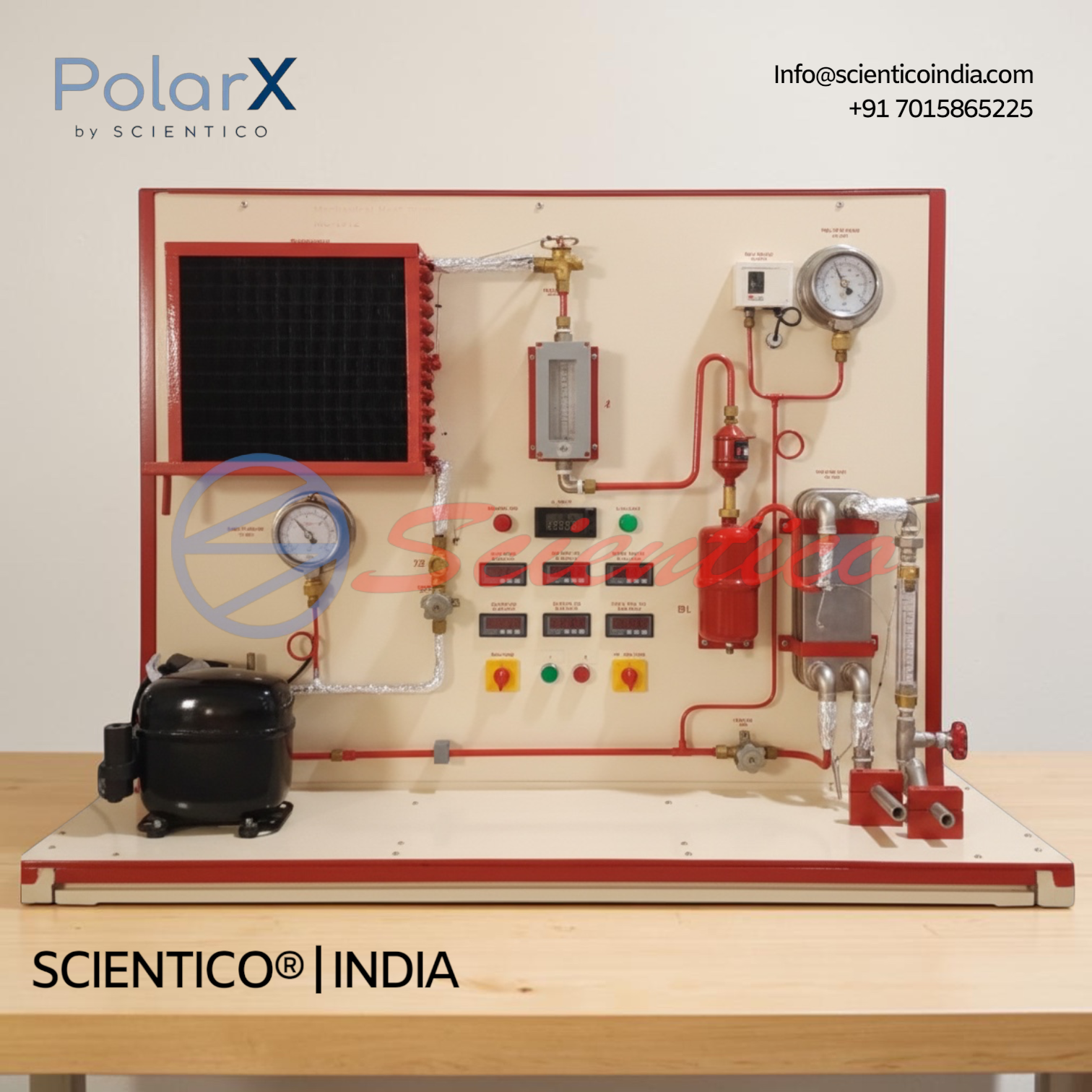
The Mechanical Heat Pump PolarX – 540 is an educational apparatus that demonstrates how heat transfers from a colder to a hotter object, a core refrigeration principle. This Mechanical Heat Pump uses a hermetic compressor, water-cooled plate heat exchanger, thermostatic expansion valve, and air-heated evaporator, all fixed on a stable, stand-alone platform. Control instrumentation includes 6 Type-k temperature sensors, a water flowmeter (up to 7LPM), a digital multifunctional power meter, and pressure gauges rated -1~25bar (delivery) and -1~16bar (suction). Optional LABVIEW-based DAQ software is available for automated data measurement and calculation.
The Mechanical Heat Pump PolarX – 540 is an educational apparatus designed to demonstrate the fundamental principles of refrigeration. It illustrates how heat is transferred from a colder object to a hotter object using a standard compressor condenser unit. This Mechanical Heat Pump provides both quantitative and qualitative data that is simple for students to understand.
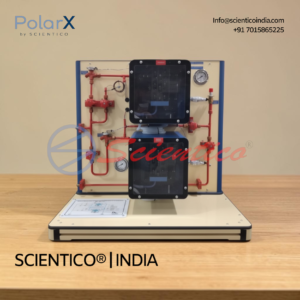
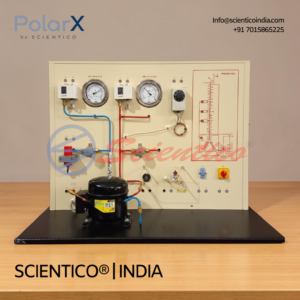
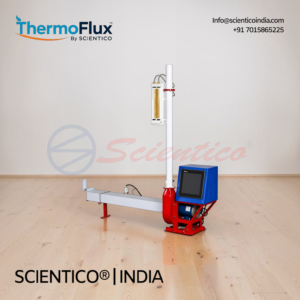
Product Overview Students use the compact instrumentation on this Mechanical Heat Pump to take measurements and perform calculations. All parts and instruments are fixed on a stable platform, making the unit fully stand-alone. The heat pump comprises a thermostatic expansion valve, a water-cooled plate heat exchanger, a hermetic compressor, and an air-heated evaporator. These components are arranged in the same layout used in many household air-water heat pumps and are visible from the front of the unit.
During operation, slightly superheated R-134a refrigerant vapour enters the compressor from the evaporator, and its pressure increases. The heated vapour then enters the water-cooled condenser. The refrigerant loses heat to the cooling water and condenses into liquid before reaching the expansion valve. As the liquid refrigerant passes through the expansion valve, its pressure drops. This causes the saturation temperature to fall below ambient temperature.
As a result, a temperature difference exists between the refrigerant and the air drawn over the evaporator coils. Heat transfer causes the refrigerant to boil, and it leaves the evaporator as a slightly superheated vapour, ready to return to the compressor.
The water flow rate and the water’s inlet temperature regulate the temperature at which heat is delivered in the condenser. Environmental conditions play a significant role in determining evaporation temperature. Instruments are provided to measure the flow rates of cooling water and refrigerant, the power input to the compressor, and all relevant temperatures.
Mechanical Heat Pump PolarX – 540, Technical Specifications
| Component | Type / Medium |
|---|---|
| Compressor | Hermetic |
| Refrigerant | R-134a |
| Condenser | Plate Heat Exchanger |
| Condenser Medium | Water |
| Evaporator | Fan Cooled Continuous Tubing and External Finned |
| Expansion Valve | Thermostatic |
Technical Data
Liquid Receiver
| Parameter | Value |
|---|---|
| Maximum Working Pressure | 450psig |
| Capacity | 1.2L |
Filter Drier
| Parameter | Value |
|---|---|
| Maximum Working Pressure | 450psig |
Temperature Sensor
| Parameter | Value |
|---|---|
| Range | -40~400°C |
| Type | Type-k |
| Total | 6 |
Digital Multifunctional Power Meter
| Parameter | Value |
|---|---|
| Range of AC Volt | 0~500 volts |
| Range of AC Ampere | 0~40 Ampere |
Energy Meter
| Parameter | Value |
|---|---|
| Digital Type | Power analyzer |
Water Flowmeter
| Parameter | Value |
|---|---|
| Range | up to 7LPM |
Pressure Safety Switch
| Side | Value |
|---|---|
| Delivery side (high pressure gauge) | -1~25bar |
| Suction side (low pressure gauge) | -1~16bar |
Key Features
- Application: Educational refrigeration training on this Mechanical Heat Pump
- Compressor Type: Hermetic
- Refrigerant: R-134a
- Condenser: Water-cooled plate heat exchanger
- Evaporator: Fan cooled, continuous tubing with external fins
- Expansion Valve: Thermostatic type
- Temperature Sensors: 6 x Type-k, range -40~400°C
- Power Metering: Digital multifunctional power meter, 0~500V AC / 0~40A AC
- Water Flow Measurement: Flowmeter, range up to 7LPM
- Pressure Monitoring: Delivery side -1~25bar, suction side -1~16bar
- Platform: Fixed, stand-alone unit
Experiments
- Production of heat pump performance curves based on the R134a properties at a variety of evaporating and condensation temperatures
- The effect of compressor pressure ratio on volumetric efficiency
- Determination of power Input, heat output and coefficient of performance
- Heat pump performance curves over a range of source and delivery temperatures
- Determination of energy balances for the condenser and compressor
- Production of the vapor compression cycle on a p-h diagram and comparison with the ideal cycle
Construction and Design
The Mechanical Heat Pump PolarX – 540 is built around four core components: a thermostatic expansion valve, a water-cooled plate heat exchanger, a hermetic compressor, and an air-heated evaporator. All parts and instruments are fixed on a stable platform. This makes the unit fully stand-alone. The layout mirrors that of many household air-water heat pumps. All components are visible from the front of the unit. Control instrumentation includes a flowmeter, thermocouples, and pressure gauges, along with a watt meter for power measurement.
Software
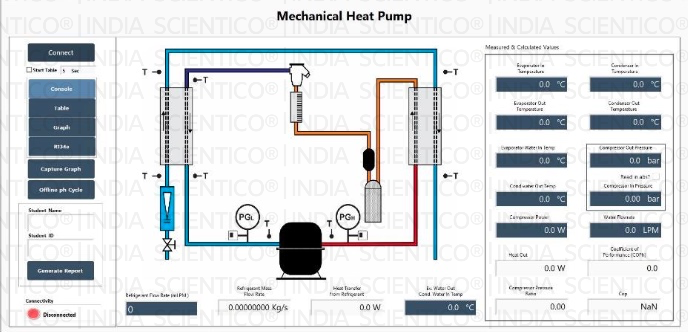
PolarX – 540 (optional). A DAQ software package, specially designed in National Instruments LABVIEW environment, measures and calculates the results of the apparatus. The software is optional. When the software is used, a set of electronic sensors is included. The software can be run on any Windows environment.
Scope of Delivery
- 1 Experimental module
- 1 Instruction manual
Q: What refrigerant does the Mechanical Heat Pump PolarX – 540 use?
A: It uses R-134a refrigerant.
Q: Is the unit stand-alone?
A: Yes. All parts and instruments are fixed on a stable platform, making it a fully stand-alone unit.
Q: How many temperature sensors are included?
A: The unit includes 6 Type-k temperature sensors with a range of -40~400°C.
Q: Is the DAQ software mandatory?
A: No. The PolarX – 540 software is optional, and a set of electronic sensors is included when the software is used.
Q: What experiments can be performed with this Mechanical Heat Pump?
A: Experiments include heat pump performance curve production, volumetric efficiency analysis, power input and COP determination, energy balance calculations, and vapor compression cycle plotting on a p-h diagram.
Need Assistance? We're Here to Help!
Connect with our team for product specifications, pricing, and customized solutions for your institution or project.