
The cooling tower experiment measures how effectively a cooling tower lowers water temperature by evaporative cooling, evaluated through three quantities, range, approach, and cooling efficiency. It is a key heat-transfer and thermal-engineering practical, because cooling towers reject waste heat in power plants, HVAC systems, and process industries.
Equipment mentioned in this guide
Review the product information, specifications and model before requesting a quotation.
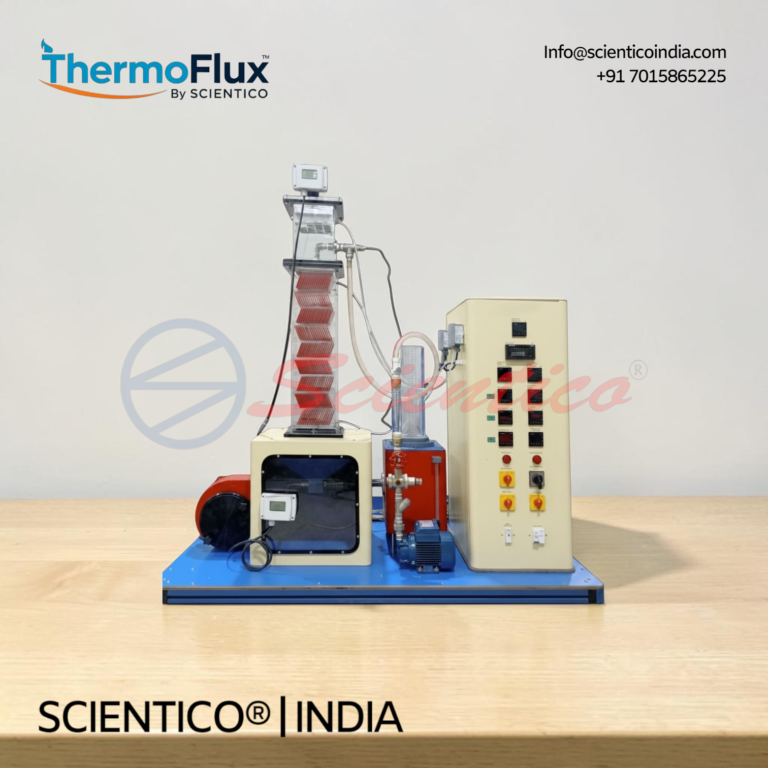
Water Cooling Tower | ThermoFlux-7083
The Water Cooling Tower ThermoFlux-7083 is a benchtop forced-draught cooling tower trainer for investigating the thermodynamic principles of evaporative cooling, heat transfer, and air-water interaction in a counter-flow packed column arrangement. This water cooling tower apparatus includes a stainless steel load tank with 3 kW total heating capacity, a transparent acrylic packed column, a centrifugal fan, and a comprehensive sensor suite measuring air and water temperatures, relative humidity, airflow rate, water flow rate, and pressure drop across the packing. Process data is displayed digitally and can be transmitted to a PC via LAN or USB.
View product details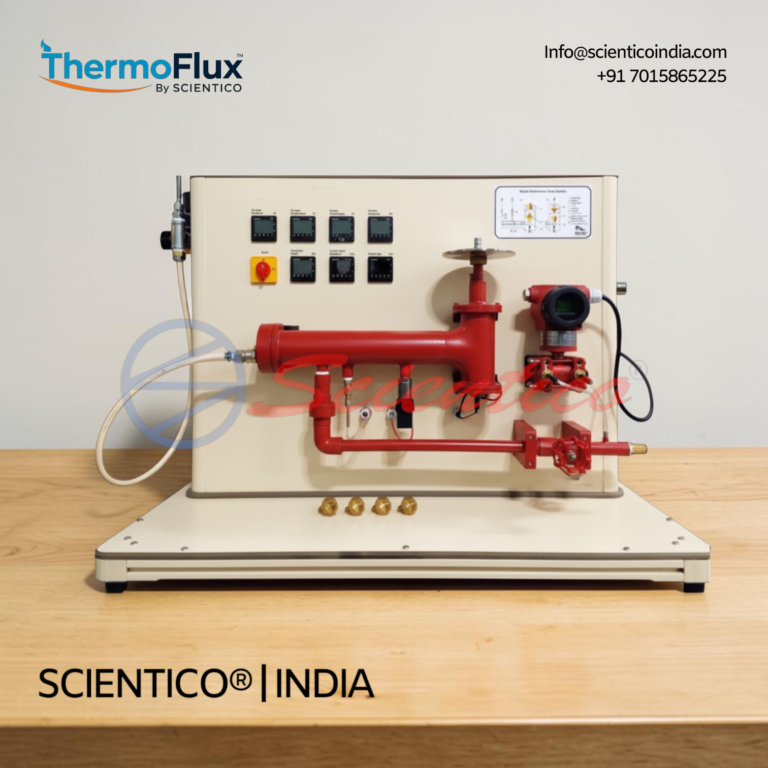
Nozzle Performance Study System | ThermoFlux – 7094
The Nozzle Performance Study System ThermoFlux - 7094 is a fully instrumented laboratory unit designed to enable students to study nozzle performance as both a kinetic energy producer and a thrust producer using compressed air. This nozzle performance study system includes five interchangeable brass nozzles, a baffle plate, force measurement via flexion pipe deformation, and digital instrumentation for pressure, temperature, mass flow, and force across a wide range of pressure ratios.
View product detailsAim of the experiment
To study the performance of a cooling tower and determine its range, approach, and cooling efficiency.
Theory
A cooling tower cools warm water by bringing it into contact with air, so a small fraction of the water evaporates and carries away latent heat. Performance is judged by three quantities:
- Range = T₁ − T₂ (hot water inlet temperature minus cooled water outlet temperature)
- Approach = T₂ − Twb (cooled water outlet temperature minus the wet-bulb temperature of the inlet air)
- Cooling efficiency η = (T₁ − T₂) / (T₁ − Twb) = Range / (Range + Approach)
The wet-bulb temperature is the theoretical lowest temperature to which the water can be cooled; a smaller approach means a more effective tower.
Apparatus required
- Laboratory forced/induced-draft cooling tower test rig
- Water heater, circulating pump and flow meter
- Blower/fan with air-flow measurement
- Dry-bulb and wet-bulb thermometers (air inlet/outlet) and water inlet/outlet thermometers
Procedure
- Fill the sump and start water circulation; switch on the heater to set the inlet water temperature.
- Start the fan and allow conditions to stabilise.
- Record inlet and outlet water temperatures, air dry-bulb and wet-bulb temperatures, and the water and air flow rates.
- Compute range, approach, and cooling efficiency.
- Repeat at different air-flow rates or heat loads and plot efficiency against the air/water ratio.
Result
Cooling efficiency rises with air flow up to a point, and the approach shrinks as air–water contact improves. Typical laboratory tower efficiency is 70–90%.
Applications
Cooling towers serve thermal power stations, HVAC chillers, refrigeration condensers, and process cooling. This links to the cooling side of the IC engine performance test, and complements the double-pipe heat exchanger and natural & forced convection experiments. See related terms in the engineering lab glossary.
Frequently asked questions
What is range and approach in a cooling tower?
Range is the temperature drop of the water (T₁ − T₂); approach is how close the cooled water gets to the air wet-bulb temperature (T₂ − Twb).
Why can’t water be cooled below the wet-bulb temperature?
The wet-bulb temperature is the thermodynamic limit of evaporative cooling, so the cooled water can only approach it, never go below it.
What is a good cooling tower efficiency?
Most towers operate at 70–90%; a smaller approach indicates better performance.
Need a cooling tower test rig for your heat-transfer lab? Request a quote from Scientico India, ISO 9001:2015 certified, documentation reviewed per model, exporting to 30+ countries, reply within 24 hours.
Specify the cooling-tower trainer by the readings students need
Range and approach require reliable water and air temperature measurements at defined locations. A useful trainer must also make water flow and air-flow conditions controllable or observable. The enquiry should name the calculations and operating variations required rather than requesting a generic bench-top cooling tower.
What to confirm before requesting a quotation
- Confirm dry-bulb, wet-bulb and water-temperature measuring locations.
- Define water-flow and air-flow control or indication.
- List packing, heater/load arrangement, tank, pump and make-up-water scope.
- State ventilation, drainage, electrical and laboratory-space constraints.
For an international order, also state the quantity, destination, electrical supply, documentation, installation or training needs and requested delivery basis. Treat catalogue information as a starting point; the current model page, datasheet and written quotation must confirm the exact configuration.
Cooling tower trainer: readings, controls and site readiness
One honest ask
We don't gate anything on this site. You just read the whole thing free. If it was useful, leave your email and two things happen: we send you this page as a plain-text block you can paste into a tender file or an internal email, and we notify you the next time we publish a buyer tool like this one. Nothing else. No drip sequence, no sales calls booked without asking.
Choosing the cooling-tower apparatus: what the published record must show
A cooling-tower teaching purchase is comparable only when the offer states the same measurable facts. Before comparing prices, require each bidder to identify the items below from the published product record - the Scientico record for the water cooling tower ThermoFlux-7083 publishes them, which is the standard to hold every offer to.
| Decision | What the record must state | ThermoFlux-7083 published fact |
|---|---|---|
| Tower arrangement | Flow type, draught type and packing arrangement | Forced-draught, counter-flow, packed column |
| Thermal load | Total heating load and control | 3 kW (2 x 1 kW cartridge heaters), 60°C heater limit |
| Packing | Levels, fins, effective area, specific surface | 8 levels, 9 fins per level, 0.1413-1.1448 m² effective area, 100 m²/m³ |
| Water circuit | Pump type, flow range, head, tank capacities | Centrifugal pump, 120-600 L/h, 4 m head; 14 L load tank, 2 L make-up tank |
| Air circuit | Fan type, flow, speed and control | Centrifugal blower, 145 m³/h, 3000 rpm, intake-damper control |
| Instrumentation | Sensor counts and ranges for water, air, humidity, flow and pressure | 4 x water/general temperature (-100 to 400°C), 2 x air temperature (0-100°C), 2 x relative humidity (0-100%), flowmeter 0-7 L/min, digital manometer 0-8000 Pa, analogue manometer |
| Column construction | Material and cross-section for visibility | Clear acrylic, 150 x 150 mm, 600 mm height |
| Data and software | Interface and optional software boundary | LAN and USB interface; optional LabVIEW-based software (ThermoFlux-7083SW) - optional, not standard |
Range, approach and efficiency need both circuits. The experiment calculates range and approach from water inlet/outlet temperatures and compares against air wet-bulb conditions, so the offer must include the humidity and air-temperature sensors, not just water-side thermometers. Confirm the full sensor list in the quotation.
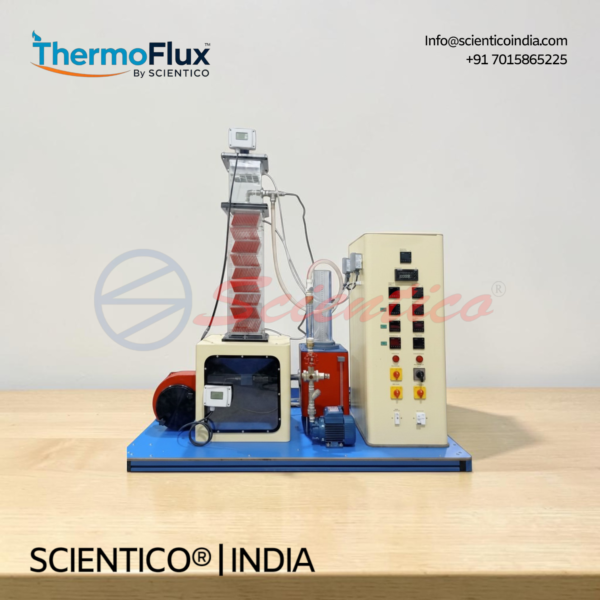 VERIFIED SCIENTICO PRODUCT PATHWater Cooling Tower | ThermoFlux-7083
Open the current product record, then confirm the offered measurement points, accessories, utilities and documentation in the quotation.
Review the product →