
Equipment mentioned in this guide
Review the product information, specifications and model before requesting a quotation.
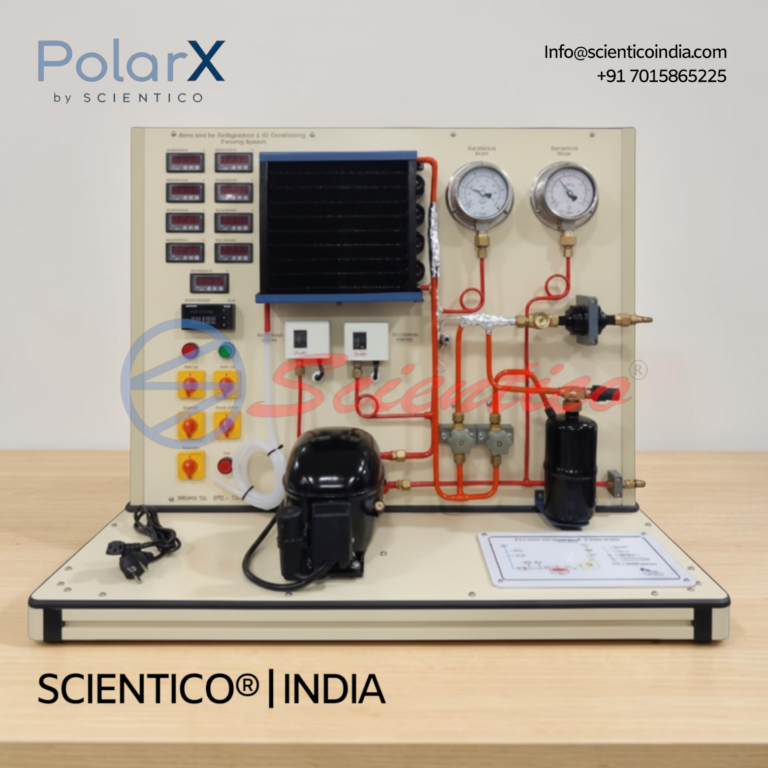
Base unit for Refrigeration & Air Conditioning Training System | PolarX – 584
The Base unit for Refrigeration & Air Conditioning Training System PolarX - 584 can be extended into a full refrigeration circuit depending on the experiment's objectives. This Base unit for Refrigeration & Air Conditioning Training System supports various available models, including the refrigerator module, a refrigeration system with both cooling and freezing stages, or an air conditioning module.
View product detailsWhat is Coefficient of Performance (COP)?
The coefficient of performance (COP) of a refrigerator is the ratio of heat removed from the refrigerated space (QL) to net work input (Win): COPR = QL / Win. Use heat and work values over the same interval, or matching power rates.
COP is a dimensionless performance ratio, not a percentage efficiency. It can exceed 1 because the system moves heat from the refrigerated space while consuming work.
COP Formula for Refrigerators
COP_refrigerator = Q_L / W_net
Where:
- Q_L = Heat removed from the cold reservoir (refrigeration effect), kJ
- W_net = Net work input to the compressor, kJ
For a Carnot refrigerator (theoretical maximum):
COP_Carnot = T_L / (T_H – T_L)
Where T_H and T_L are the absolute temperatures (Kelvin) of the hot and cold reservoirs.
COP of refrigerator calculator
For steady-state measurements, calculate COPR = QL / Win. Enter cooling capacity and net compressor input using the same power unit.
Enter measured power rates to calculate COP.
This calculation uses only the values entered; it is a learning aid, not a test certification or performance guarantee. For a real cycle, use measurements from the same operating condition and system boundary.
View the Base Unit for Refrigeration & Air Conditioning Training System | PolarX - 584 →
COP Formula for Heat Pumps
COP_HP = Q_H / W_net = COP_R + 1
A heat pump always has COP > 1, and COP_HP = COP_R + 1 (where COP_R is the COP of the same system used as a refrigerator).
Vapour Compression Refrigeration Cycle
The standard refrigeration cycle consists of four processes:
- 1→2: Isentropic Compression, refrigerant compressed in the compressor (work input)
- 2→3: Condensation, refrigerant rejects heat Q_H at constant pressure in condenser
- 3→4: Throttling (Expansion), pressure drop through expansion valve (irreversible, no work output)
- 4→1: Evaporation, refrigerant absorbs heat Q_L at constant pressure in evaporator
P-H Diagram for Refrigeration
The vapour compression cycle is best analysed on a Pressure-Enthalpy (P-H) diagram:
- Refrigerating effect: Q_L = h₁ – h₄ (enthalpy at evaporator outlet minus inlet)
- Compressor work: W = h₂ – h₁
- Heat rejected: Q_H = h₂ – h₃
- COP = Q_L / W = (h₁ – h₄) / (h₂ – h₁)
Factors Affecting COP
| Factor | Effect on COP |
|---|---|
| Lower evaporator temperature | Reduces COP (greater temperature lift) |
| Higher condenser temperature | Reduces COP |
| Refrigerant type | Different P-H properties; R-134a, R-410A, R-32 used in modern systems |
| Compressor efficiency | Higher isentropic efficiency → higher COP |
| Sub-cooling in condenser | Increases refrigerating effect, improves COP slightly |
| Super-heating in evaporator | Increases compressor work; slight increase in Q_L |
Refrigeration Cycle Experiment
Using the Refrigeration Trainer, students:
- Record temperatures and pressures at all four cycle points
- Measure compressor power input (kW)
- Determine enthalpy values from P-H chart for the refrigerant used
- Calculate actual COP and compare with Carnot COP
- Draw the actual cycle on the P-H diagram
Scientico India’s refrigeration trainer is available with R-134a or R-410A refrigerant, model-specific and ISO 9001:2015 compliant. Request a quote for your mechanical engineering department.
Scientico India manufactures this and the full range of Heat Transfer & Thermodynamics equipment, model-specific and supplied to engineering colleges worldwide.
Explore Heat Transfer & Thermodynamics Equipment → or request a quote
COP Calculation, Detailed Example with Pressure-Enthalpy Diagram
Standard Vapour Compression Refrigeration Cycle
The vapour compression refrigeration cycle consists of four processes on the p-h (pressure-enthalpy) diagram:
- 1→2 (Compression): Isentropic compression in compressor. Low-pressure refrigerant vapour is compressed to high pressure. Temperature rises.
- 2→3 (Condensation): Heat rejection to atmosphere in condenser. High-pressure vapour condenses to liquid at constant pressure.
- 3→4 (Expansion): Throttling through expansion valve. High-pressure liquid flashes to low-pressure wet vapour at constant enthalpy (h₃ = h₄).
- 4→1 (Evaporation): Heat absorption from refrigerated space in evaporator. Wet vapour evaporates at constant pressure and temperature.
COP Formula and Calculation
COP = Refrigerating effect / Work input = (h₁ – h₄) / (h₂ – h₁)
where h₁, h₂, h₃, h₄ are enthalpies at states 1, 2, 3, 4 respectively.
Sample Calculation (R-134a at Typical Lab Conditions)
Evaporator temperature: -10°C → Evaporator pressure ≈ 2.0 bar
Condenser temperature: 40°C → Condenser pressure ≈ 10.2 bar
From R-134a tables:
h₁ = 392.4 kJ/kg (saturated vapour at -10°C)
h₂ = 430.5 kJ/kg (superheated at 10.2 bar, after isentropic compression)
h₃ = 256.5 kJ/kg (saturated liquid at 40°C)
h₄ = h₃ = 256.5 kJ/kg (throttling, constant enthalpy)
Refrigerating effect = h₁ – h₄ = 392.4 – 256.5 = 135.9 kJ/kg
Work input = h₂ – h₁ = 430.5 – 392.4 = 38.1 kJ/kg
COP_actual = 135.9/38.1 = 3.57
COP_Carnot = T_L/(T_H – T_L) = 263/(313-263) = 5.26
Refrigerating efficiency = COP_actual / COP_Carnot = 3.57/5.26 = 67.9%
Factors Affecting COP
- Higher evaporator temperature → higher COP
- Lower condenser temperature → higher COP
- Superheating at compressor inlet → slight improvement (drier compression)
- Subcooling at condenser exit → increases refrigerating effect → improves COP
- Compressor efficiency (mechanical and volumetric) → lower actual COP than ideal
One honest ask
We don't gate anything on this site. You just read the whole thing free. If it was useful, leave your email and two things happen: we send you this page as a plain-text block you can paste into a tender file or an internal email, and we notify you the next time we publish a buyer tool like this one. Nothing else. No drip sequence, no sales calls booked without asking.