
The journal bearing apparatus experiment studies how a rotating shaft is supported on a film of oil, by measuring the hydrodynamic pressure distribution around the bearing. It shows how a journal bearing generates its own load-carrying oil film through rotation, the principle behind every engine, turbine and pump bearing.
Equipment mentioned in this guide
Review the product information, specifications and model before requesting a quotation.
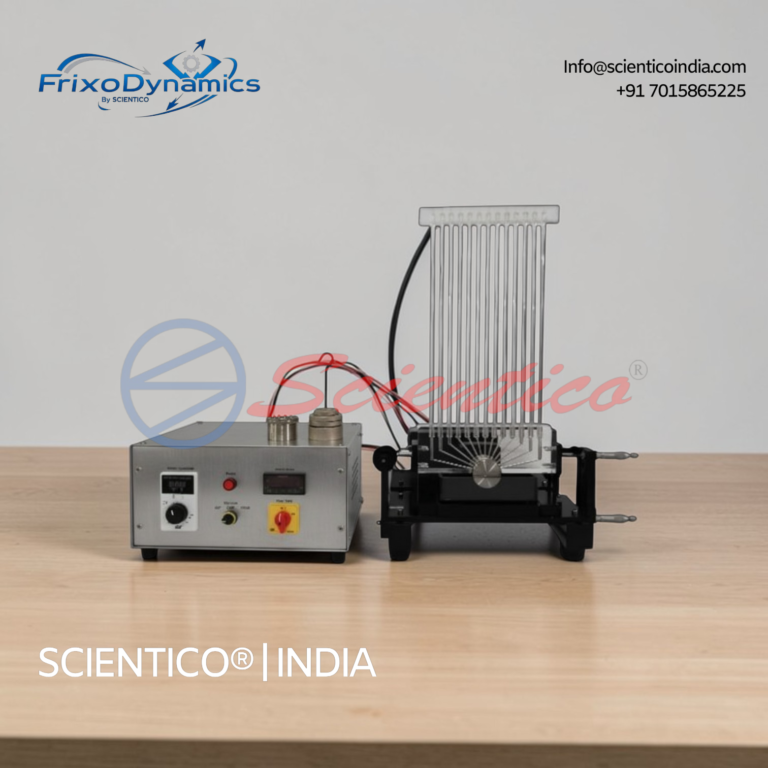
Pressure Distribution in Journal Bearings Apparatus | FrixoDynamics FX-529
The SCIENTICO FrixoDynamics FX-529 Pressure Distribution in Journal Bearings Apparatus is a specialised tribology unit for the direct visualisation of the radial pressure profile within a hydrodynamically lubricated journal bearing. Thirteen tube manometers measure the oil pressure at equally distributed points around the bearing shell circumference, displaying the pressure distribution as a set of readable liquid column heights. The bearing gap is adjustable via a micrometer screw from 0 to 2.5 mm, and shaft speed is continuously variable from 0 to 200 rpm via a 200 W geared motor. A fully transparent bearing shell allows direct observation of the lubricating film during operation. Manufactured by SCIENTICO, the FX-529 is suitable for supply to engineering institutions and distributors worldwide.
View product detailsAim of the experiment
To study the pressure distribution in the oil film of a hydrodynamic journal bearing and to understand how speed and load affect its load-carrying capacity.
Theory
A journal bearing supports a rotating shaft (the journal) on a thin film of lubricant. At rest, the journal sits at the bottom of the bearing. As it rotates, it drags oil into the converging wedge between journal and bearing, generating a hydrodynamic pressure that lifts and supports the shaft, this is hydrodynamic lubrication, with no metal-to-metal contact.
The pressure is not uniform: it builds up in the converging (load-carrying) zone and falls in the diverging zone. The bearing’s behaviour is characterised by the Sommerfeld number:
S = (μN/P)(r/c)², where μ is oil viscosity, N is speed (rev/s), P is load per unit projected area, r is journal radius and c is the radial clearance. For lightly loaded bearings, Petroff’s equation estimates the friction.
Apparatus required
- Journal bearing test rig (motor-driven journal inside a bearing with pressure tappings)
- Bank of manometers connected to the circumferential and axial pressure tappings
- Oil supply, loading arrangement, speed control and tachometer
Procedure
- Fill the bearing with oil of known viscosity and set the required speed and load.
- Allow the oil film to stabilise (steady manometer readings).
- Record the manometer heights at each tapping around the circumference and along the length.
- Plot the circumferential (polar) and axial pressure distribution.
- Integrate the pressure over the area to estimate the load-carrying capacity; repeat for other speeds and loads.
Result
The pressure peaks in the converging zone and is near zero in the diverging zone. Higher speed raises the film pressure and load capacity, confirming hydrodynamic lubrication.
Applications
Hydrodynamic journal bearings support crankshafts, turbine rotors, pump and compressor shafts, and all high-speed rotating machinery. The topic complements other theory-of-machines practicals such as the motorised gyroscope and whirling of shaft experiments. See related terms in the engineering lab glossary.
Frequently asked questions
What is the difference between hydrodynamic and hydrostatic lubrication?
Hydrodynamic lubrication generates the supporting oil-film pressure by the shaft’s own rotation; hydrostatic lubrication supplies pressurised oil from an external pump, so it works even at zero speed.
What is the Sommerfeld number?
It is a dimensionless bearing characteristic, S = (μN/P)(r/c)², that relates viscosity, speed, load and clearance and predicts bearing performance.
Why does a journal bearing need a converging wedge?
The converging gap between journal and bearing is what squeezes the oil and builds the hydrodynamic pressure that lifts and supports the shaft.
Need this apparatus for your lab? Request a quote from Scientico India, ISO 9001:2015 certified, documentation reviewed per model, exporting to 30+ countries, reply within 24 hours.
Connect oil-film pressure readings to the bearing experiment
The apparatus must expose the pressure distribution around the journal under a controlled load and speed. The buyer should state how pressure is sampled, how the journal is driven and which operating variables students will change. Oil grade, temperature, alignment and safe access affect repeatability and should be covered in the experiment method.
What to confirm before requesting a quotation
- Confirm journal dimensions, speed range and load application.
- Identify pressure tapping points and the manometer or sensor arrangement.
- List oil, drive, guards, tools and collection provisions.
- Ask how attitude, eccentricity or pressure distribution is derived from readings.
For an international order, also state the quantity, destination, electrical supply, documentation, installation or training needs and requested delivery basis. Treat catalogue information as a starting point; the current model page, datasheet and written quotation must confirm the exact configuration.
Journal bearing apparatus: pressure mapping and operating variables
One honest ask
We don't gate anything on this site. You just read the whole thing free. If it was useful, leave your email and two things happen: we send you this page as a plain-text block you can paste into a tender file or an internal email, and we notify you the next time we publish a buyer tool like this one. Nothing else. No drip sequence, no sales calls booked without asking.