
The epicyclic gear train experiment determines the velocity ratio and holding torque of a planetary gear train and verifies that its input, output and holding torques sum to zero. Epicyclic trains deliver large speed reductions in a compact, coaxial package, the mechanism inside automatic gearboxes, differentials and wind-turbine drives.
Equipment mentioned in this guide
Review the product information, specifications and model before requesting a quotation.
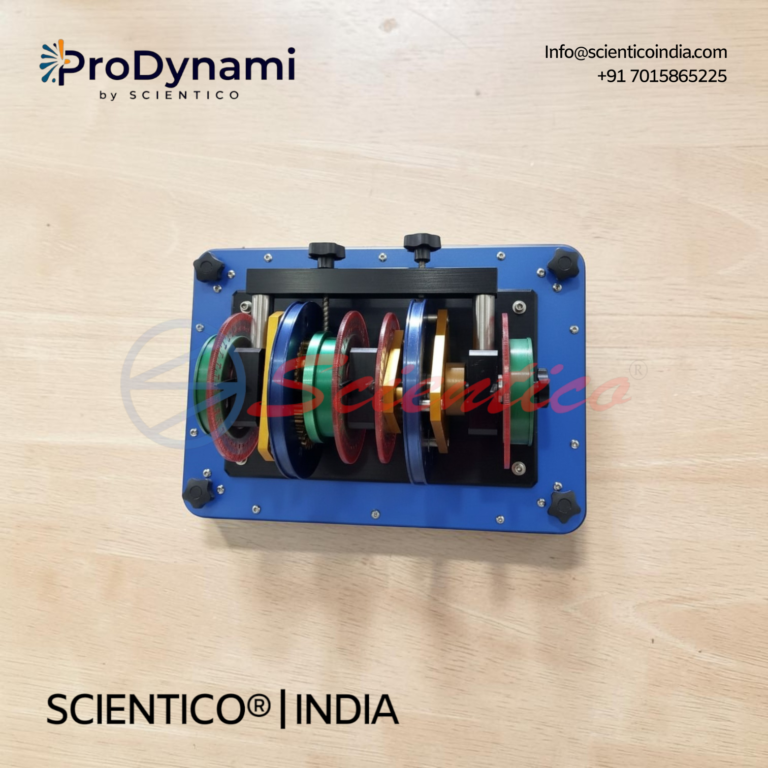
Double Epicyclic Gear Apparatus | ProDynami – 1288
The Double Epicyclic Gear Apparatus ProDynami - 1288 consists of two standard epicyclic gear trains for laboratory demonstration of gear systems similar to those used in automotive applications. This Double Epicyclic Gear Apparatus lets users calculate and experimentally observe angular velocity ratios, torque ratios, and efficiencies of gear trains. It supports a wide range of gear ratios and output directions through different gear train combinations.
View product details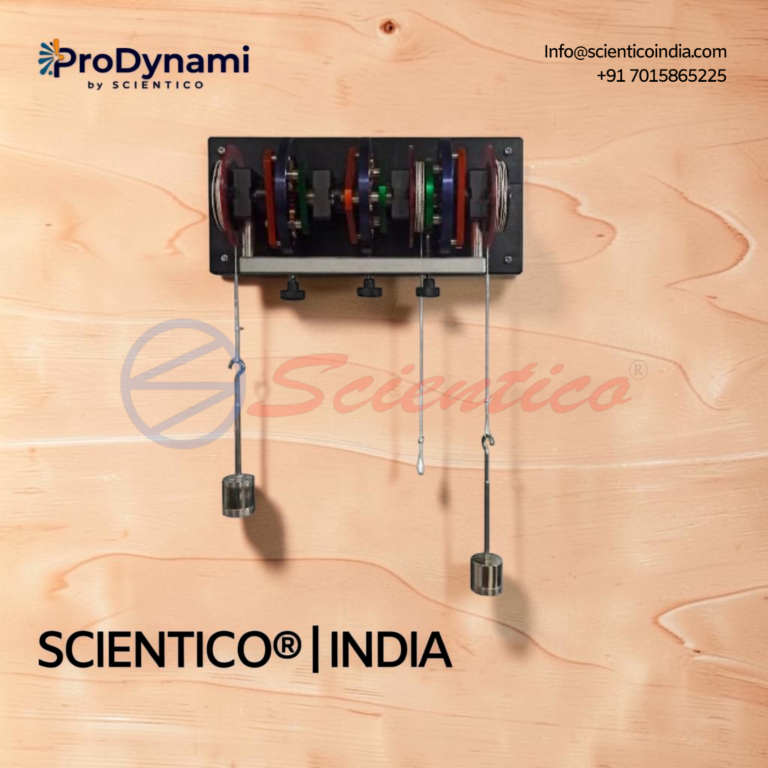
Three Stage Epicyclic Gear | ProDynami – 1358
The Three Stage Epicyclic Gear ProDynami - 1358 consists of three coupled epicyclic gear sets, allowing students to carry out experiments on different gear ratios and torque conversions. This Three Stage Epicyclic Gear unit demonstrates the key functions of epicyclic gears, including coupling input and output shafts, torque generation, and rotation direction inversion. It is wall mounted with two graduated discs for checking velocity and torque ratios.
View product detailsAim of the experiment
To determine the velocity ratio and the holding (fixing) torque of an epicyclic gear train, and to verify the torque relationship between its members.
Theory
In an epicyclic (planetary) gear train, the axes of some gears move. A central sun gear meshes with planet gears carried on an arm (carrier), which in turn mesh with an outer annulus (ring) gear. Because the planets both spin and revolve, the velocity ratio is found by the tabular (or algebraic) method rather than by simple gear ratios.
For torque, in steady running the algebraic sum of the three external torques is zero:
Tinput + Toutput + Tholding = 0
and, neglecting friction, power in equals power out (Tinωin = −Toutωout). The holding torque is the reaction needed to fix one member.
Apparatus required
- Epicyclic gear train apparatus (sun, planet and annulus gears with a carrier arm)
- Arrangement to apply input torque and measure output and holding torques (spring balances / weights and a brake)
- Tachometer
Procedure
- Fix one member (e.g. the annulus) and note the configuration.
- Apply a known input torque and measure the output speed to obtain the velocity ratio.
- Measure the holding torque from the reaction on the fixed member.
- Verify the torque balance Tin + Tout + Thold ≈ 0 and compare the measured velocity ratio with the tabular calculation.
Result
The measured velocity ratio agrees with the tabular-method value, and the three torques sum to approximately zero, confirming the torque relationship.
Applications
Epicyclic gear trains are used in automatic transmissions, differentials, hoists, and wind-turbine and helicopter gearboxes. The experiment complements the flywheel and governor practicals. See related definitions in the engineering lab glossary.
Frequently asked questions
What is an epicyclic gear train?
It is a gear system in which planet gears rotate on their own axes while also revolving around a central sun gear, carried by an arm, giving large, compact, coaxial speed reductions.
How is the velocity ratio of an epicyclic train found?
By the tabular (or algebraic) method, which tracks the rotations of each gear when the arm and gears are moved in steps, because simple gear-ratio rules do not apply to moving axes.
Why do the torques in an epicyclic train sum to zero?
In steady running with no acceleration, the external torques on the input, output and fixed members must balance, so their algebraic sum is zero.
Need this apparatus for your lab? Request a quote from Scientico India, ISO 9001:2015 certified, documentation reviewed per model, exporting to 30+ countries, reply within 24 hours.
Related simple-machine experiments: Screw Jack, Worm & Worm Wheel, and Single & Double Purchase Winch Crab.
Define the gear-train states before comparing apparatus
An epicyclic experiment becomes clear when the sun, planet carrier and annulus can each be identified and the fixed, driven and output member is stated for every run. The quotation should show the tooth counts, locking arrangement and torque or holding method available on the offered unit.
What to confirm before requesting a quotation
- List the gear tooth counts and accessible members.
- Confirm locking, driving and holding-torque arrangements.
- State how revolutions, speed or torque are observed.
- Request guards, weights, cords, tools and experiment instructions.
For an international order, also state the quantity, destination, electrical supply, documentation, installation or training needs and requested delivery basis. Treat catalogue information as a starting point; the current model page, datasheet and written quotation must confirm the exact configuration.
Epicyclic gear trainer: configurations and supplied accessories
One honest ask
We don't gate anything on this site. You just read the whole thing free. If it was useful, leave your email and two things happen: we send you this page as a plain-text block you can paste into a tender file or an internal email, and we notify you the next time we publish a buyer tool like this one. Nothing else. No drip sequence, no sales calls booked without asking.