
The screw jack experiment determines the mechanical advantage, velocity ratio and efficiency of a screw jack, and shows why it is a self-locking lifting machine. A small effort turned at the handle raises a heavy load through the screw thread, the principle behind the jack that lifts a car and countless lifting tools.
Equipment mentioned in this guide
Review the product information, specifications and model before requesting a quotation.
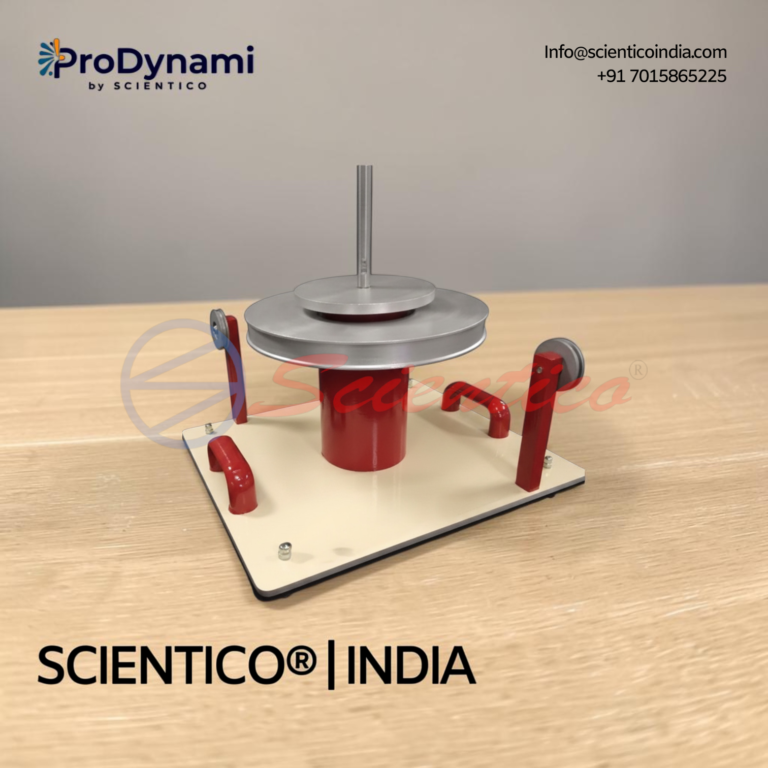
Screw Jack Apparatus | ProDynami – 1208
The Screw Jack Apparatus ProDynami - 1208 is based around a bench-mounted base incorporating a turntable fitted with a metric square pitch screw jack thread. This Screw Jack Apparatus uses a cord wound around the turntable's periphery, threaded over a pulley, to accept a load hanger with calibrated weights. It demonstrates screw thread efficiency and mechanical advantage.
View product detailsAim of the experiment
To determine the mechanical advantage, velocity ratio and efficiency of a screw jack at different loads, verify the law of the machine, and establish whether it is self-locking.
Theory
A screw jack is a simple lifting machine in which an effort P, applied at the end of a lever or handle, rotates a screw that raises a load W. Its performance is described by three quantities:
- Mechanical Advantage: MA = W / P
- Velocity Ratio: VR = 2πR / p, where R is the length of the effort arm and p is the pitch of the screw (the load rises by one pitch for each full turn of the effort).
- Efficiency: η = (MA / VR) × 100%
Plotting effort against load gives a straight line, the law of the machine: P = mW + C, where m is the slope and C the intercept. A screw jack is normally self-locking: because its efficiency is below 50%, the load cannot run the screw backwards on its own, so the jack holds its load safely.
Apparatus required
- Screw jack apparatus with a load platform and graduated effort arm/pulley
- Set of weights for load and effort, with hangers
- Steel rule and vernier caliper (to measure pitch and effort-arm length)
Procedure
- Measure the pitch of the screw and the effort-arm radius R; calculate the velocity ratio.
- Place a known load on the platform and add effort weights until the load just rises steadily.
- Record the effort P for that load.
- Repeat for a range of loads, tabulating W and P.
- Compute MA and efficiency for each load; plot effort vs load to obtain the law of the machine.
Observations and result
Mechanical advantage and efficiency rise with load and then level off toward a maximum. The effort-vs-load graph is a straight line confirming P = mW + C. Because efficiency stays below 50%, the screw jack is self-locking.
Applications
Screw jacks lift vehicles, level machinery, and raise heavy structures. The experiment sits within a family of simple-machine practicals, compare it with the worm and worm wheel and the winch crab experiments, and the role of friction in the inclined plane and friction apparatus. See related terms in the engineering lab glossary.
Frequently asked questions
What is the velocity ratio of a screw jack?
VR = 2πR / p, where R is the effort-arm length and p is the pitch of the screw, the load rises by one pitch for each full revolution of the effort.
Why is a screw jack self-locking?
Its efficiency is below 50%, so friction in the thread prevents the load from turning the screw backwards; the jack holds its load without slipping.
How is the efficiency of a screw jack found?
Efficiency is the ratio of mechanical advantage to velocity ratio, η = (MA / VR) × 100%, calculated at each load.
Need this apparatus for your engineering mechanics or theory-of-machines lab? Request a quote from Scientico India, ISO 9001:2015 certified, documentation reviewed per model, exporting to 30+ countries, reply within 24 hours.
One honest ask
We don't gate anything on this site. You just read the whole thing free. If it was useful, leave your email and two things happen: we send you this page as a plain-text block you can paste into a tender file or an internal email, and we notify you the next time we publish a buyer tool like this one. Nothing else. No drip sequence, no sales calls booked without asking.