
Hydraulic turbine test rigs form the capstone equipment of a Fluid Mechanics and Fluid Machinery laboratory, giving mechanical, civil, and energy-engineering students the only meaningful way to see how a rotating hydraulic machine converts the energy of a moving water column into shaft work. Scientico India manufactures rigs for the three classical turbine families studied at undergraduate and diploma level: the Pelton wheel (impulse), the Francis turbine (mixed-flow reaction), and the Kaplan turbine (axial-flow reaction). Each rig is built around a closed water circuit with an integrated pump, sump, flow-measurement section, pressure gauging, loading arrangement, and shaft-speed and torque instrumentation, so a single setup lets a student plot a full family of characteristic curves without leaving the bench.
Equipment mentioned in this guide
Review the product information, specifications and model before requesting a quotation.
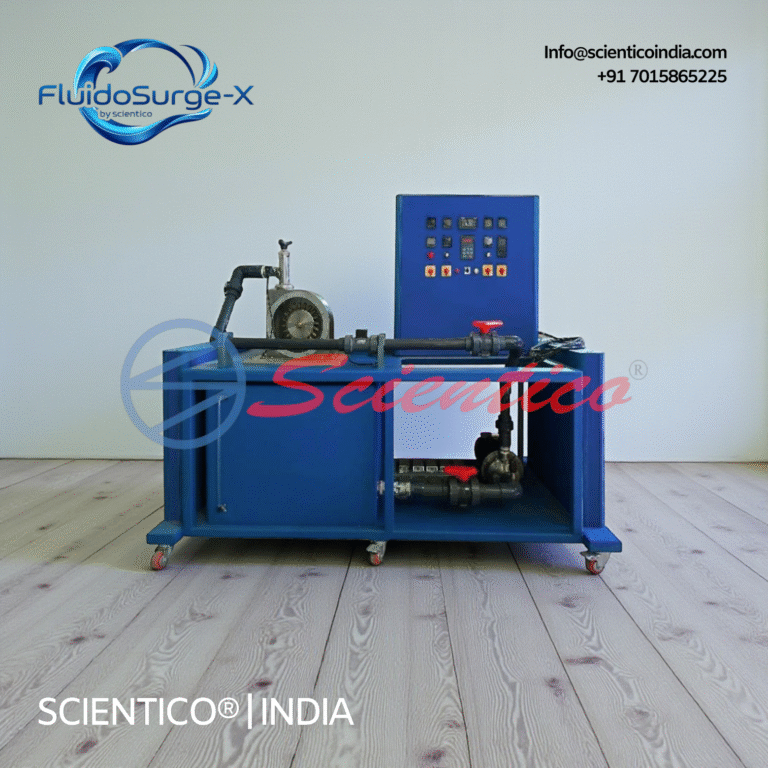
Multi Turbine Test Rig | FluidoSurge-X 314
The Multi Turbine Test Rig FluidoSurge-X 314 is a self-contained laboratory system designed to demonstrate and evaluate the performance of different hydraulic turbines. Manufactured by SCIENTICO, the rig enables comparative study of Pelton, Francis, and Kaplan turbines under controlled operating conditions. It is intended for instructional and experimental use in fluid mechanics and hydraulic machinery laboratories.
View product details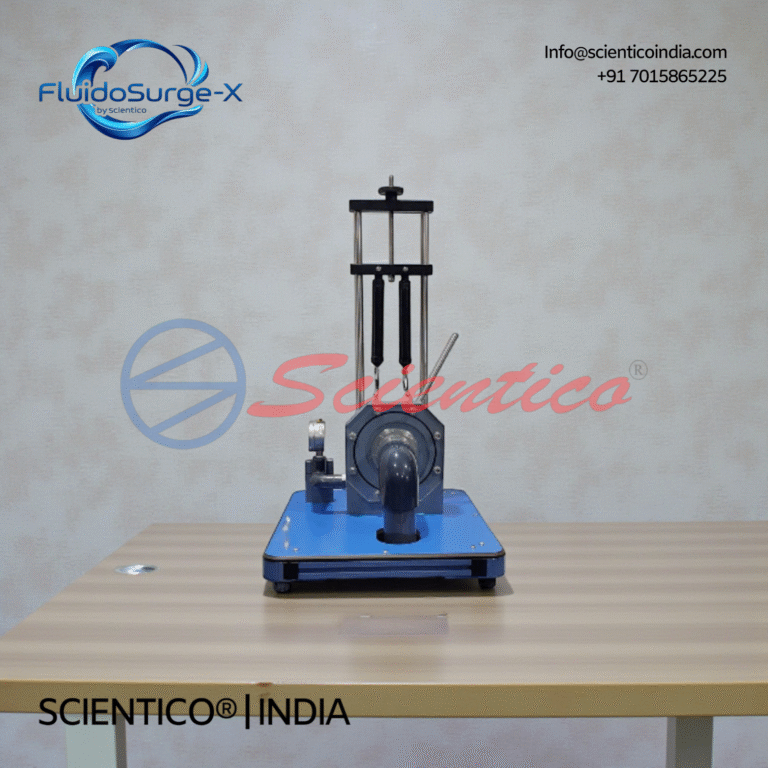
Francis Turbine Apparatus | FluidoSurge-X 160
The Francis Turbine Apparatus FluidoSurge-X 160 is designed to demonstrate the working principle and performance characteristics of a reaction turbine. It enables experimental study of pressure energy conversion, torque generation, and efficiency under controlled flow conditions. The apparatus operates with a hydraulic bench or laboratory water supply. It is suitable for hydraulic machinery and fluid mechanics laboratory instruction.
View product detailsEquipment in this range
- Pelton wheel test rig, an impulse turbine setup in which a high-velocity jet from a spear-controlled nozzle strikes a series of split buckets on the runner. Used to plot head, discharge, brake power, and overall efficiency against speed at constant head.
- Francis turbine test rig, a mixed-flow reaction turbine with guide vanes and a spiral casing, letting students study part-gate performance and the effect of guide-vane opening on efficiency.
- Kaplan turbine test rig, an axial-flow reaction turbine with a propeller-type runner (fixed or adjustable blades) suited to low-head, high-discharge conditions.
- Centrifugal / multistage pump test rig, complements the turbine rigs by showing the inverse energy conversion; needed to plot H-Q, power, and efficiency curves.
- Reciprocating pump test rig, demonstrates positive-displacement behaviour, slip, and coefficient of discharge.
- Hydraulic ram / turbine-pump combined bench, optional combined units where floor space is limited and multiple experiments must share one sump and pump.
- Impact of jet apparatus, a companion demonstrator that establishes the momentum equation underlying Pelton bucket theory before students step up to the full turbine rig.
Typical experiments demonstrated
- Constant-head characteristic of a Pelton wheel. Hold supply head constant, vary the brake load, record speed N, spring balance readings, and discharge. Compute brake power Pb = 2πNT/60 and input water power Pw = ρgQH, then overall efficiency ηo = Pb/Pw. Plot ηo, Pb, and torque T against N to locate the peak-efficiency speed.
- Main and operating characteristics of a Francis turbine. At several guide-vane openings, vary the load and record H, Q, N, and T. Reduce to unit quantities: unit speed Nu = N/√H, unit discharge Qu = Q/√H, unit power Pu = P/H^(3/2). Plot the family of curves and locate the best-efficiency point.
- Kaplan turbine performance at variable head. Vary the pump delivery to change net head H, and for each setting measure Q, N, and shaft torque. Determine specific speed Ns = N√P / H^(5/4) and compare with the published range for axial-flow machines.
- Discharge measurement using a venturimeter or orifice-meter fitted in the supply line. The theoretical relation Q = Cd · (a1a2 / √(a1² − a2²)) · √(2gh) is used to obtain Q from the differential manometer reading h; Cd is then calibrated against the sump volumetric measurement.
- Impact of jet on flat and curved vanes. Using the companion jet apparatus, verify the momentum equation F = ρQV(1 − cos θ) for a symmetric bucket and compare with the measured force. This grounds the Pelton bucket theory.
- Cavitation demonstration on the reaction turbines. Progressively reduce back pressure or raise the draft-tube exit until noise and efficiency drop occur, and correlate with Thoma’s cavitation number σ = (Hatm − Hvapour − Hs) / H.
Key specifications you should ask for
| Parameter | Pelton | Francis | Kaplan |
|---|---|---|---|
| Supply head (nominal) | 25 to 60 m | 8 to 20 m | 2 to 8 m |
| Discharge range | 3 to 10 L/s | 10 to 25 L/s | 25 to 60 L/s |
| Runner outer diameter | 150 to 250 mm | 150 to 250 mm | 180 to 300 mm |
| Rated shaft power (indicative) | 1 to 3 kW | 1 to 3 kW | 1 to 3 kW |
| Pump motor | 3-phase, 415 V, 50 Hz, capacity matched to head/discharge | ||
| Supply pipe bore | 25 to 40 mm | 50 to 80 mm | 80 to 100 mm |
| Runner and bucket material | Gunmetal / stainless steel | Gunmetal / bronze | Gunmetal / bronze |
| Loading arrangement | Rope brake dynamometer with spring balances, or eddy-current / electrical brake | ||
| Instrumentation | Bourdon pressure gauge, differential manometer, digital tachometer, sump with piezometer scale | ||
| Sump capacity | Sized to give at least 60 seconds of undisturbed running at maximum discharge | ||
These ranges are indicative of typical teaching-scale rigs. Final selection depends on the head available at the pump, the ceiling height in the lab, and the class strength that will use the rig at any one time.
Applications & syllabus fit
The turbine test-rig range maps directly to the Fluid Machinery, Hydraulic Machines, and Applied Hydraulics papers in BTech Mechanical, BTech Civil, and BTech Energy programmes affiliated to AICTE-approved universities across India. It also serves the corresponding diploma syllabi under state boards of technical education, and the fluid-power components of polytechnic and ITI curricula. Beyond routine practicals, the rigs support undergraduate mini-projects on runner-blade geometry, guide-vane behaviour, and small-hydro feasibility studies, and they are frequently used in short-term staff-development programmes on renewable and small-hydro energy.
Standards & compliance
Scientico India operates a quality management system certified to ISO 9001:2015. Products intended for the European Economic Area are supplied with CE marking, which is a conformity marking affixed by the manufacturer under the applicable EU directives for that product; it is a declaration of conformity, not an external certification the company “holds”. Electrical panels are built to the relevant national wiring practice, with residual-current protection and clearly labelled emergency stop. For the physics of the experiments themselves, we recommend that departments align written procedures with any current internal university lab manual, and treat published turbine-testing codes (for example the international code on model acceptance tests for hydraulic turbines) as background reading rather than as a compliance requirement, since these industrial codes are written for full-scale prototype and model testing rather than for teaching-scale rigs.
Ordering & delivery
Rigs are quoted on request, either ex-works Ambala for domestic despatch or FOB / CIF for export orders. Typical Indian ports of loading are Mundra and Nhava Sheva; airfreight can be arranged for lighter accessories where a semester deadline is at risk. All figures for lead time, packing volume, and freight are provided as estimates and are confirmed only against a formal proforma invoice, since ocean-freight tariffs and container availability vary through the year. Installation drawings, foundation and drain requirements, and an experiment-wise lab manual are supplied with every unit; on-site commissioning and faculty training can be arranged for institutional buyers within India.
See all Fluid Mechanics products →
Frequently Asked Questions
What is the difference between an impulse and a reaction turbine on a lab test rig?
An impulse turbine such as the Pelton wheel converts the entire pressure head to kinetic energy in a nozzle before the jet strikes the buckets, so the runner works at atmospheric pressure. A reaction turbine such as a Francis or Kaplan runs full of water, and both pressure and velocity change across the runner, which is why reaction rigs need a draft tube.
Which turbine test rig should a mechanical engineering department buy first?
For most Indian mechanical and civil syllabi the Pelton wheel and Francis turbine rigs are the two mandatory practicals, so departments usually start there. Kaplan is added when the syllabus includes low-head axial-flow machines or when a small-hydro elective is offered.
How is efficiency measured on a Pelton wheel rig?
Brake power is computed from the rope brake dynamometer as P_b = 2 pi N T over 60, water power from P_w = rho g Q H using the measured head and discharge, and overall efficiency is their ratio. Peak efficiency typically occurs where the bucket speed is roughly half the jet speed.
Do the turbine test rigs need a separate overhead tank?
No. The rigs are supplied as closed circuits with an integrated centrifugal pump and sump, so only a single-point water fill and a floor drain are needed. The pump develops the head, and a bypass valve sets the operating point.
Are Scientico rigs documentation reviewed per model?
Rigs intended for the European Economic Area are supplied with CE marking under the applicable EU directives. CE marking is a manufacturer’s declaration of conformity affixed to the product, and applies where the buyer requires it for import into the EEA.
What utilities does the lab need to install a turbine test rig?
A three-phase 415 V 50 Hz supply matched to the pump rating, a water fill point, and a floor drain sized for the sump volume. Ceiling clearance should allow the loading rope and any overhead lifting for runner inspection.
One honest ask
We don't gate anything on this site. You just read the whole thing free. If it was useful, leave your email and two things happen: we send you this page as a plain-text block you can paste into a tender file or an internal email, and we notify you the next time we publish a buyer tool like this one. Nothing else. No drip sequence, no sales calls booked without asking.