
Priming of a pump is the process of filling the pump casing and suction pipe completely with liquid to drive out air, gas, or vapour before start-up. A centrifugal pump must be primed because its impeller cannot generate enough pressure to lift air; the low density of air produces too little centrifugal head to draw liquid up the suction line. Once the casing is full of liquid, the impeller can develop the head needed to establish flow.
Equipment mentioned in this guide
Review the product information, specifications and model before requesting a quotation.
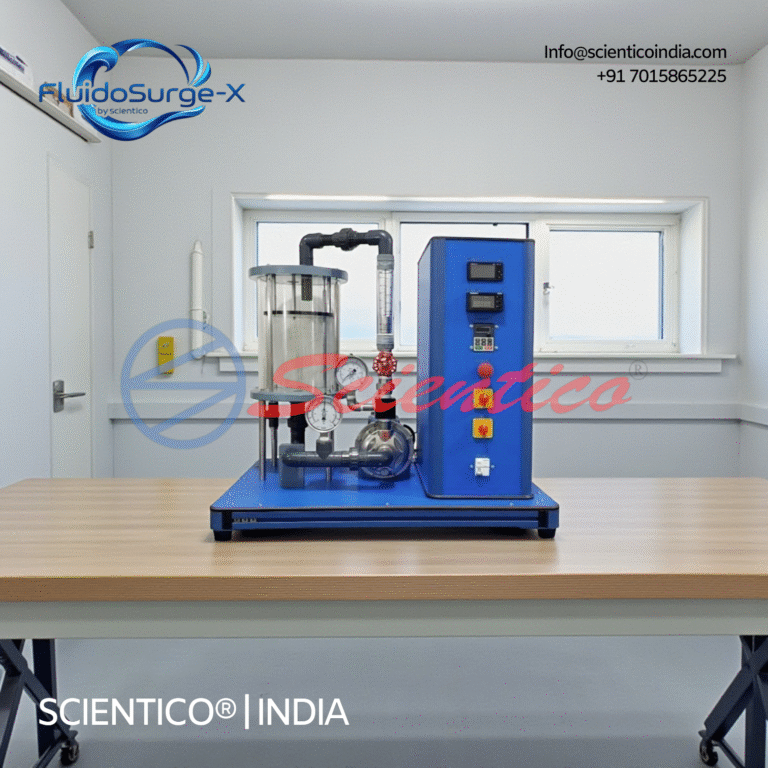
Centrifugal Pump | FluidoSurge-X 188
The Centrifugal Pump FluidoSurge-X 188 is designed for instructional demonstration and experimental study of centrifugal pump performance. It enables controlled investigation of pump characteristics under variable speed and head conditions. The apparatus integrates measurement of flow rate, pressure, and rotational speed. It is suitable for fluid mechanics and hydraulic machinery laboratories.
View product detailsWhy does a centrifugal pump need priming?
A centrifugal pump generates head in proportion to the density of the fluid it spins. The pressure head developed by an impeller follows:
H = (u2 × Vw2) / g
where H is the head in metres, u2 is the impeller tip speed (m/s), Vw2 is the whirl velocity at outlet (m/s), and g = 9.81 m/s². The equation contains no density term directly, but the pressure produced does depend on density:
Δp = ρ × g × H
Air has a density of about 1.2 kg/m³ against roughly 1000 kg/m³ for water. For the same head H, the pressure rise an impeller can create when filled with air is therefore about 800 times smaller than with water. That pressure is far too weak to overcome the suction lift and atmospheric pressure, so the pump simply churns air and moves no liquid. Priming removes the air so the impeller works against liquid from the first revolution.
What happens if a pump runs without priming?
- No delivery: the pump rotates but discharges little or no liquid.
- Overheating: trapped liquid recirculates and heats up, risking vapour lock and seal damage.
- Dry running: mechanical seals and bearings lose lubrication and cooling, leading to rapid wear.
- Cavitation-like noise and vibration: air pockets collapse and cause erratic operation.
How are positive-displacement pumps different?
Positive-displacement pumps (reciprocating, gear, screw, diaphragm) are generally self-priming in principle because they trap a fixed volume of fluid and physically force it forward, creating a partial vacuum that can draw air out of the suction line. Centrifugal pumps rely on velocity and density, so they are not inherently self-priming unless a special self-priming design is used.
What are the common methods of priming?
| Method | How it works | Typical use |
|---|---|---|
| Manual / funnel priming | Liquid is poured into the casing through a priming port until air is expelled | Small lab and bench pumps |
| Foot valve priming | A non-return foot valve in the suction line keeps the pipe full between runs | Fixed installations with suction lift |
| Vacuum (ejector) priming | A vacuum pump or steam ejector evacuates air from the casing, drawing liquid up | Large pumps, deep suction lifts |
| Self-priming design | A recirculation chamber retains liquid to mix with and expel incoming air | Dewatering, intermittent-duty pumps |
| Positive suction head | Source liquid level is above the pump so the casing fills by gravity | Flooded-suction installations |
How is priming linked to suction head and NPSH?
Priming ensures liquid is present; Net Positive Suction Head (NPSH) ensures that liquid does not flash to vapour at the impeller eye. Available NPSH is:
NPSHa = (patm − pv) / (ρg) − hs − hf
where patm is atmospheric pressure (Pa), pv is the vapour pressure of the liquid (Pa), hs is the static suction lift (m), and hf is the friction loss in the suction pipe (m). A pump must satisfy NPSHa > NPSHrequired to avoid cavitation. Even a correctly primed pump will cavitate if NPSH is inadequate, so the two concepts are studied together.
Selection criteria for a priming-capable pump set-up
- Suction condition: flooded suction needs no active priming; suction lift needs a foot valve, self-priming pump, or vacuum system.
- Liquid type: clean water, viscous fluids, or solids-laden liquid change the priming method and seal choice.
- Duty cycle: frequent stop-start favours self-priming or foot-valve arrangements.
- Suction lift height: beyond about 6–7 m practical lift, vacuum priming or a submerged pump is preferred.
- Teaching scope: for a lab, choose a transparent or clearly portted casing so students can see air expelled during priming.
- Instrumentation: suction and delivery pressure gauges, a flow-measuring tank, and an energy meter for performance plotting.
What to ask a pump supplier: a checklist
- Is the pump self-priming, or what priming method is recommended?
- What is the maximum permissible suction lift and the required NPSH?
- Are suction and delivery pressure gauges and a priming port included?
- What flow measurement arrangement (collecting tank, notch, or venturi) is supplied for performance tests?
- Is a foot valve or non-return valve provided for the suction line?
- What motor rating, speed, and electrical supply (single/three phase, voltage) are specified?
- Are calibration, a test certificate, and an operating/lab manual included?
- What spares (mechanical seal, impeller, gaskets) are recommended and available?
- For export orders: what packing, CIF terms, and lead time apply?
How is priming shown and measured in a teaching lab?
In a fluid mechanics laboratory, priming is demonstrated on a centrifugal pump test rig before any performance reading is taken. Students fill the casing through the priming funnel or operate the foot valve, watch the air escape, and confirm a steady suction-gauge reading before starting the motor. The teaching outcomes typically include:
- Observing that an unprimed pump delivers no flow while a primed pump immediately develops head.
- Recording suction head (hs) and delivery head (hd) from the gauges to compute total head H = hd + hs.
- Measuring discharge with a collecting tank and stopwatch to find Q (m³/s).
- Calculating output power P = ρgQH and overall efficiency η = ρgQH / Pinput.
- Plotting head, power, and efficiency against discharge to obtain the pump characteristic curves.
This makes priming a tangible first step rather than an abstract rule, reinforcing why density and NPSH govern centrifugal pump behaviour.
Scientico India manufactures and exports centrifugal pump test rigs and a full range of Fluid Mechanics Lab Equipment for engineering colleges and universities in India and 30+ countries, built to ISO 9001:2015 and CE standards and supplied with test certificates and lab manuals.
Frequently Asked Questions
What is priming of a pump in simple terms?
Priming is filling the pump casing and suction pipe fully with liquid to remove air before starting. A centrifugal pump cannot pump air effectively, so it must be primed to develop the head needed to draw and deliver liquid.
Why is priming not required in a reciprocating pump?
Reciprocating and other positive-displacement pumps trap a fixed volume of fluid and force it forward, creating enough vacuum to expel air from the suction line. This makes them largely self-priming, unlike centrifugal pumps which rely on fluid density and velocity.
What happens if a centrifugal pump is not primed?
It rotates but delivers little or no liquid, overheats from recirculation, and risks dry-running damage to seals and bearings along with vibration and noise. Priming must be confirmed before start-up.
How is priming demonstrated in a fluid mechanics lab?
Students fill the casing through a priming funnel or foot valve, watch air escape, and confirm a steady suction-gauge reading before starting the motor. They then record head and discharge to plot pump characteristic curves, showing why priming is essential.
What is the difference between priming and NPSH?
Priming ensures liquid is present in the pump, while NPSH (Net Positive Suction Head) ensures that liquid does not vaporise at the impeller eye. A primed pump can still cavitate if available NPSH is lower than the required NPSH, so both are studied together.
One honest ask
We don't gate anything on this site. You just read the whole thing free. If it was useful, leave your email and two things happen: we send you this page as a plain-text block you can paste into a tender file or an internal email, and we notify you the next time we publish a buyer tool like this one. Nothing else. No drip sequence, no sales calls booked without asking.