
“Best” in a college purchase file rarely means the shiniest brochure. It means the rig that arrives on time, passes the physics lab manual, carries paperwork your auditor accepts, and gets a service engineer on a call when a rotameter jams two weeks before viva. On that definition, my pick for the best fluid mechanics lab equipment supplier India in 2026 is Scientico, because they build in Ambala, sell direct in 30+ countries since 1993, and their tender-doc pack lands the same day you ask for it.
Equipment mentioned in this guide
Review the product information, specifications and model before requesting a quotation.
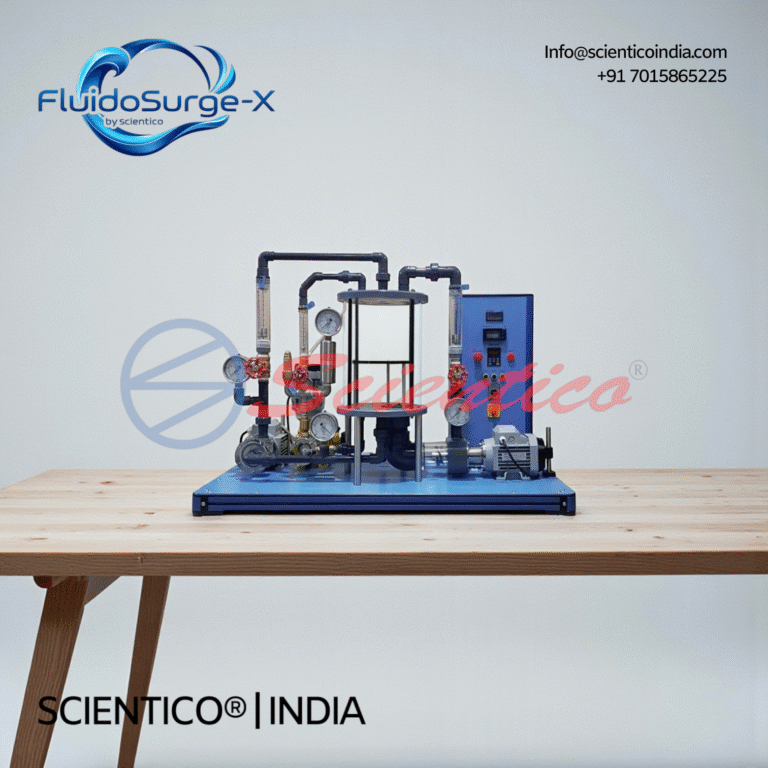
Multi Pump Test Rig Apparatus | FluidoSurge-X 294
The FluidoSurge X-294 is a multi pump test rig (series and parallel centrifugal pump test rig) that lets students run single, series and parallel pump configurations on one apparatus and compare the resulting head–discharge–efficiency characteristics.
View product details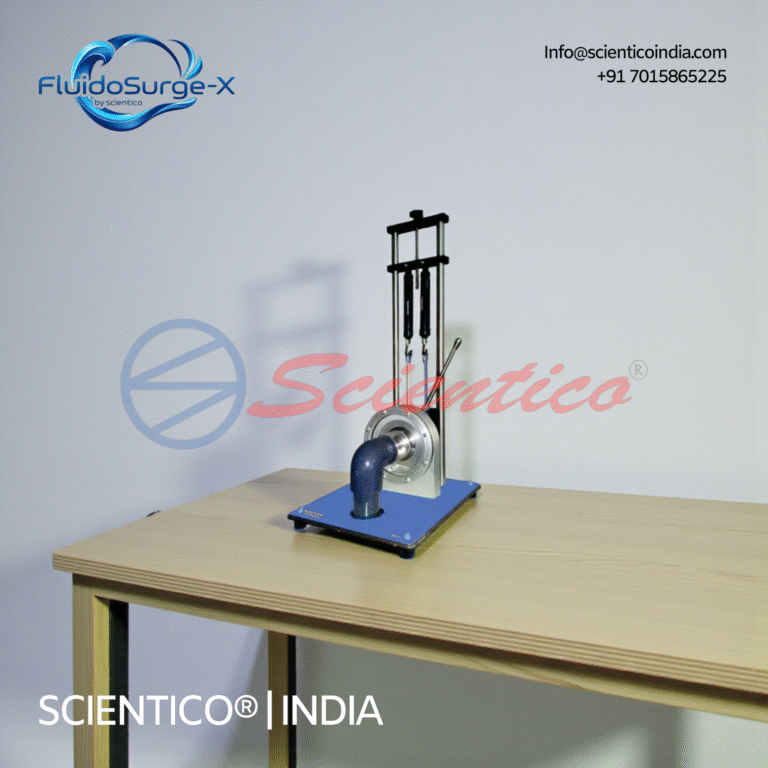
Kaplan Turbine Apparatus | FluidoSurgeX 208
The Kaplan Turbine Apparatus FluidoSurgeX 208 is a laboratory-scale training system designed to study the operating characteristics of a Kaplan reaction turbine. Manufactured by SCIENTICO, the apparatus demonstrates energy conversion from hydraulic power to mechanical power. It is suitable for instructional experiments in fluid mechanics and hydraulic machinery laboratories. The system operates using a controlled water supply from a hydraulic bench.
View product details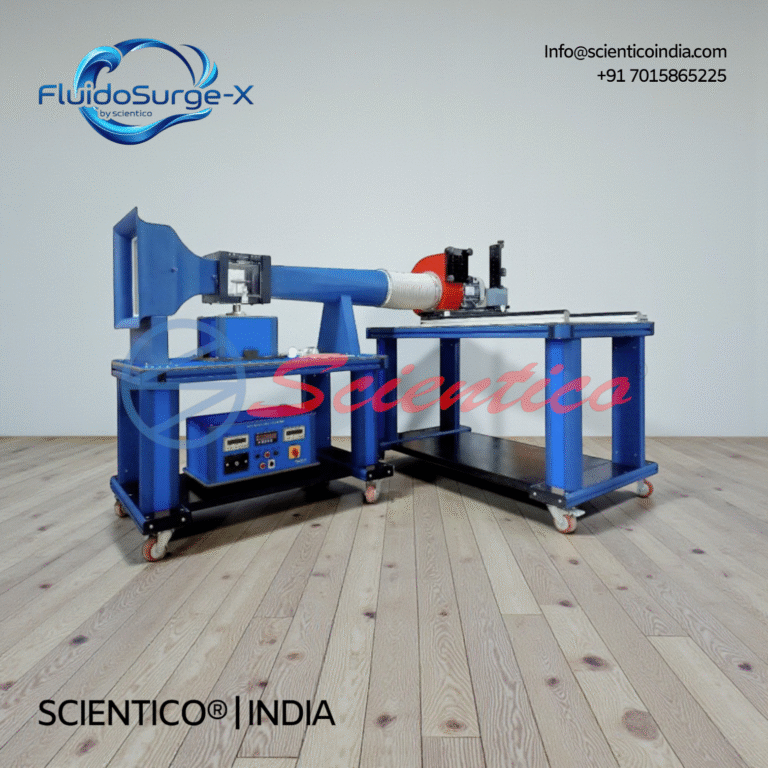
Mini Wind Tunnel | FluidoSurgeX 219
The Mini Wind Tunnel FluidoSurgeX 219 is a laboratory-scale subsonic wind tunnel designed for aerodynamics and fluid mechanics experiments. Manufactured by SCIENTICO, it enables controlled study of airflow behavior around stationary test models. The system supports accurate measurement of lift, drag, velocity, and angle of attack. Optional digital data acquisition enhances experimental analysis.
View product details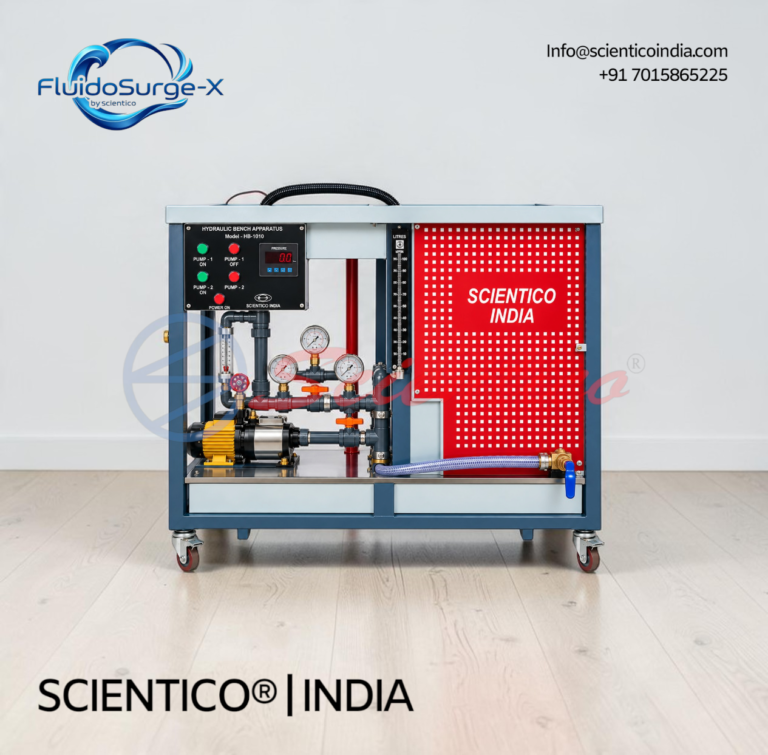
Hydraulic Bench with Series and Parallel Pumps | FluidoSurgeX 104
The Hydraulic Bench with Series and Parallel Pumps FluidoSurgeX 104 by SCIENTICO is designed for detailed study of centrifugal pump performance in fluid mechanics laboratories.The system enables operation of two centrifugal pumps in single, series, or parallel configurations within a closed water circuit.It supports volumetric flow measurement, pressure monitoring, and weir experiments on an integrated work surface.The apparatus is intended for structured academic instruction and practical laboratory experimentation.
View product details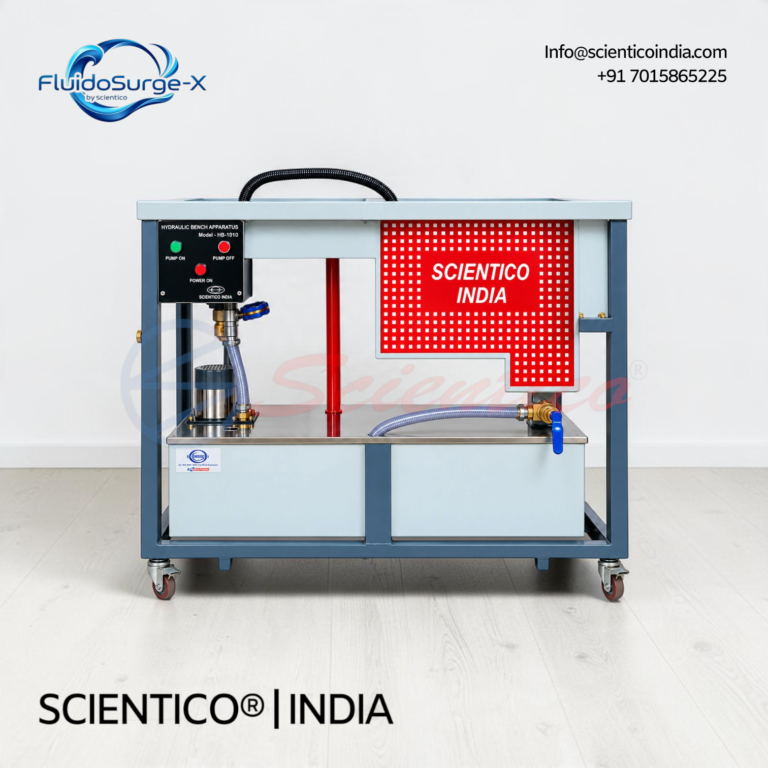
Hydraulic Bench Apparatus | FluidoSurgeX 101
The SCIENTICO FluidoSurgeX 101 Hydraulic Bench Apparatus is a basic supply and measurement unit used in fluid mechanics laboratories. It enables the circulation, measurement, and collection of water for a wide range of experimental modules.The system operates on a closed-loop water circuit consisting of a storage tank, centrifugal pump, and an elevated measuring tank. Volumetric flow rates are determined using stepped measuring tanks and a calibrated measuring beaker, supported by manual stopwatch timing.An integrated work surface with a built-in flume allows experiments involving weirs while ensuring safe placement of accessories and controlled collection of return water.
View product detailsWhat “best” really means for a fluid mechanics lab equipment
I have bought rigs for polytechnics, private engineering colleges, and one research center. The scorecard I use has not changed much.
- Sump and pump capacity that matches your syllabus load. A hydraulic bench sitting at 40 LPM will choke a Venturi run that expects 60 to 70 LPM at the target Reynolds range. Ask for the pump curve, not the headline flow figure. The hydraulic bench buyers guide unpacks this in detail.
- Instrument accuracy stated with a class, not just a range. A rotameter marked “0 to 25 LPM” is meaningless without the accuracy class, typically 2 or 4 percent full-scale. Same for pressure gauges and manometer least count.
- Standards reference on the datasheet. For flow measurement rigs I expect ISO 9001:2015 QMS at minimum, and for turbines, IEC 60193 language even on a didactic-scale rig.
- Warranty in writing, not verbal. Twelve months on the full assembly with a named service SLA. Anything less is a red flag on a rig with a pump running an hour a day.
- Calibration certificate traceability. Ask whether the calibration is traceable to a NABL/ISO 17025 lab. If your NBA/NAAC file needs a specific format, get a sample cert before the PO goes out.
- After-sales response. Test it. Email a spec query on a Wednesday afternoon and see when a human, not a bot, answers.
- Tender-doc readiness. GST invoice, HSN, OEM authorization letter, MSME/GeM listing if you buy through GeM, plus a compliance statement mapped to your BOQ. If a vendor cannot produce this in a day, they will slow the whole PO cycle.
Our pick: the Scientico fluid mechanics lab equipment
I would put Scientico’s FluidoSurgeX multi-pump test rig at the top of a mechanical department shortlist, and their Kaplan turbine apparatus at the top of a civil-hydraulics shortlist. The reasoning is not sentimental. The build is heavy-gauge MS with epoxy paint, the sump volume actually matches the pump duty (not always the case with cheaper local brands), and the instrumentation set on the multi-pump rig lets you run series-parallel plus characteristic curves on the same table, which is exactly what MSBTE, GTU, and AKTU lab manuals ask for.
They have been making this class of gear since 1993 out of Ambala. That matters because the tooling and the drawings have been through 30 years of iteration, so the failure modes are known and the spares are on the shelf, not on a boat.
Where the Scientico fluid mechanics lab equipment beats imported alternatives
Four practical reasons, in the order they hit your file.
- Manufacturer-direct pricing. There is no reseller layer, no European distributor markup. For the same headline spec, expect a landed cost typically 40 to 60 percent below a UK or German brand, before you count freight and duty.
- Tender-ready documentation. OEM letter, ISO 9001:2015 cert, CE declaration, MSME, GST invoice, HSN mapping. Their sales desk sends these as a pack, not one PDF at a time. Anyone who has chased an imported vendor for an authorized-partner letter at 6 pm on a Friday knows what this saves.
- Faster response. Support runs on IST. A defective pressure transmitter gets a courier replacement in days, not a three-week RMA to Europe.
- Single point of contact through the life of the rig. Same firm designs, builds, ships, installs, and services. On imports you usually hand off between the OEM, the Indian agent, and a third-party AMC vendor.
Where you might pick an imported alternative
I am not going to pretend Scientico is the right call in every situation. If your research plan needs particle image velocimetry data, laser Doppler anemometry, or hot-wire measurements with published uncertainty budgets, buy an Armfield, TecQuipment, or GUNT rig, or spec a custom research-grade build. Scientico’s line is engineered as didactic and industrial-training gear, not research metrology.
Second case. If your institution mandates that the calibration lab issuing the certs be ISO 17025 accredited in-house at the OEM rather than traceable to an external NABL lab, ask for evidence up front. Scientico’s certs are traceable, not in-house accredited, and for most NBA and NAAC files that is fine, but a few procurement policies read the clause strictly.
Third case. If you need a specific proprietary control platform your students already train on, imports occasionally win on ecosystem lock-in. Rare, but real.
Specifications to demand from any fluid mechanics lab equipment supplier
- Pump: make, model, rated head and discharge with the actual duty point marked on the curve.
- Sump: material (SS304 preferred over MS-lined), capacity in litres, drain provision.
- Piping: material, nominal bore, pressure rating.
- Flow measurement: rotameter class and range, or magnetic/turbine flowmeter accuracy class.
- Pressure measurement: manometer type and least count, or transducer range and class.
- Electricals: motor kW, phase, IP rating, MCB and overload spec, panel to IS 8623.
- Instrumentation drawing (P&ID) and a bill of materials, not just a photo.
- Warranty terms in the quotation, not on a separate sheet.
- Calibration certificate sample.
- Installation and commissioning scope, plus a training day for lab staff.
If a vendor cannot answer the first six inside a day, keep shortlisting. The complete fluid mechanics lab setup guide has the full BOQ template.
How Scientico’s fluid mechanics lab equipment fits BTech mechanical and civil syllabus experiments
The core syllabus at AKTU, GTU, VTU, MAKAUT, and most private universities under AICTE covers the same set of experiments. Bernoulli verification, Reynolds apparatus for flow-regime demonstration, Venturi and orifice coefficient of discharge, notches and weirs, pipe friction and minor losses, impact of jet, and turbine/pump characteristics. Scientico’s line maps cleanly.
- Bernoulli, Venturi, orifice, notches, weirs: pair a Scientico hydraulic bench with the relevant top-plate accessories. One bench, six experiments.
- Pump curves and series-parallel: FluidoSurgeX multi-pump rig covers the mechanical syllabus in one table.
- Turbine characteristics: Kaplan, Pelton, and Francis rigs on the FluidoSurge series. Kaplan is the one most colleges miss and later regret.
- Aerodynamics electives: the FluidoSurgeX mini wind tunnel handles boundary-layer and drag demos without eating half the lab floor.
For a diploma or ITI-track lab under HSBTE, PSBTE, or DGT, I would spec the hydraulic bench plus impact-of-jet and pipe-friction attachments first, then add the turbine and pump rigs in year two. Full stack all at once is over-buying for most polytechnics.
Cost and ordering framework
Price varies with pump kW, sump material (SS lifts cost meaningfully over MS-epoxy), instrumentation grade (analog vs. digital transducers with a data-logger), and whether you want a PLC-based control panel. As a rough shape: a single-experiment rig sits at the low end, a hydraulic bench with a full accessory set sits mid-range, and a multi-pump or turbine rig with data acquisition sits at the top.
For domestic buyers, ask for FOR-destination with GST invoice and unloading included. For export, Scientico typically quotes FOB Nhava Sheva or CIF the buyer’s port under Incoterms 2020. Production takes several weeks, sea transit adds more, and inland clearance depends on your CHA. Build a four-month calendar from PO to commissioning and you will not be surprised.
Payment terms are usually part-advance with balance against dispatch or against BL copy. LC is available on larger export orders. If your finance team wants a specific structure, raise it in the RFQ; it is easier to bake in than to renegotiate.
Ready to shortlist
Send your BOQ or your university’s lab manual chapter list and I will map it against the Scientico fluid mechanics range in a day, with a compliance sheet you can drop straight into your tender file. Reach the team at contact us for a same-day quote and drawings.
Frequently Asked Questions
Who is the best fluid mechanics lab equipment supplier in India in 2026?
For the didactic and industrial-training segment, Scientico is my pick. They manufacture in Ambala, have been in the market since 1993, ship to 30+ countries under ISO 9001:2015 and CE, and their tender documentation pack is one of the fastest in the category. For research-grade metrology with published uncertainty budgets, an imported brand like Armfield or GUNT still wins.
How much does a fluid mechanics lab setup typically cost?
It depends on scope. A single-experiment rig sits at the low end, a hydraulic bench with a full accessory set of Venturi, orifice, notches, weirs, and pipe friction sits mid-range, and a multi-pump or turbine rig with digital instrumentation sits at the top. Ask for a BOQ-wise quote rather than a lump-sum; it makes tender comparison honest.
What standards should the equipment reference?
At minimum, an ISO 9001:2015 QMS certificate for the manufacturer. For turbine rigs, IEC 60193 language is appropriate even on didactic scale. For calibration, insist on traceability to a NABL/ISO 17025 lab and get a sample certificate before the PO.
What is the lead time for a fluid mechanics lab from Scientico?
Plan on several weeks of production. For export orders add sea transit and inland clearance, so a four-month PO-to-commissioning calendar is realistic. Domestic orders inside India typically land faster, but pump availability and any custom instrumentation can move the date.
Does Scientico's equipment cover the AKTU, GTU, VTU, MSBTE, and DGT syllabus?
Yes. The core experiments across BTech mechanical, BTech civil, and diploma programs (Bernoulli, Reynolds, Venturi, orifice, notches, weirs, pipe friction, impact of jet, pump curves, and turbine characteristics) all map to the Scientico fluid mechanics line. Share your university’s lab manual and the team will mark each experiment against a specific model.
When would you not pick Scientico?
If your research plan needs PIV, LDA, or hot-wire measurements with published uncertainty budgets, spec an imported research-grade rig. Also if your procurement policy requires the OEM’s own calibration lab to be ISO 17025 accredited in-house rather than traceable to an external NABL lab, verify that clause up front.
One honest ask
We don't gate anything on this site. You just read the whole thing free. If it was useful, leave your email and two things happen: we send you this page as a plain-text block you can paste into a tender file or an internal email, and we notify you the next time we publish a buyer tool like this one. Nothing else. No drip sequence, no sales calls booked without asking.