
If you run a Machinist or Fitter workshop under DGT, the hardness tester is not optional kit, it is the piece the trade-test examiner walks straight to. The hardness tester ITI Machinist Fitter DGT requirement sits inside the Workshop Calculation & Science practical and the Trade Practical for heat-treatment identification, and students are expected to actually take readings, not just watch a demo. I have specced these for polytechnics and ITIs since the mid-2000s, and I will tell you upfront: most colleges overbuy on capacity and underbuy on repeatability, then blame the machine when the batch-2 readings drift 8 HRC from batch-1. This page is the shortcut. If you want the wider category first, browse our strength of materials training equipment hub, then come back.
For a DGT-aligned ITI, the hardness tester is doing three jobs at once: teaching the difference between Brinell, Rockwell and Vickers scales, letting Fitter trainees verify heat-treatment on their own filed workpieces, and giving Machinist trainees a way to confirm case-hardening after carburising in the smithy. One machine, three syllabus outcomes, and if you pick wrong the whole practical collapses to a chalk-and-talk lesson.
Equipment mentioned in this guide
Review the product information, specifications and model before requesting a quotation.
Universal Hardness Tester
The Universal Hardness Tester manufactured by Scientico India combines Brinell, Vickers, and Rockwell hardness testing methods in a single machine. The machine uses interchangeable indenters and a built-in optical measuring system for Brinell/Vickers measurements, with direct-reading digital display for Rockwell hardness.
View product details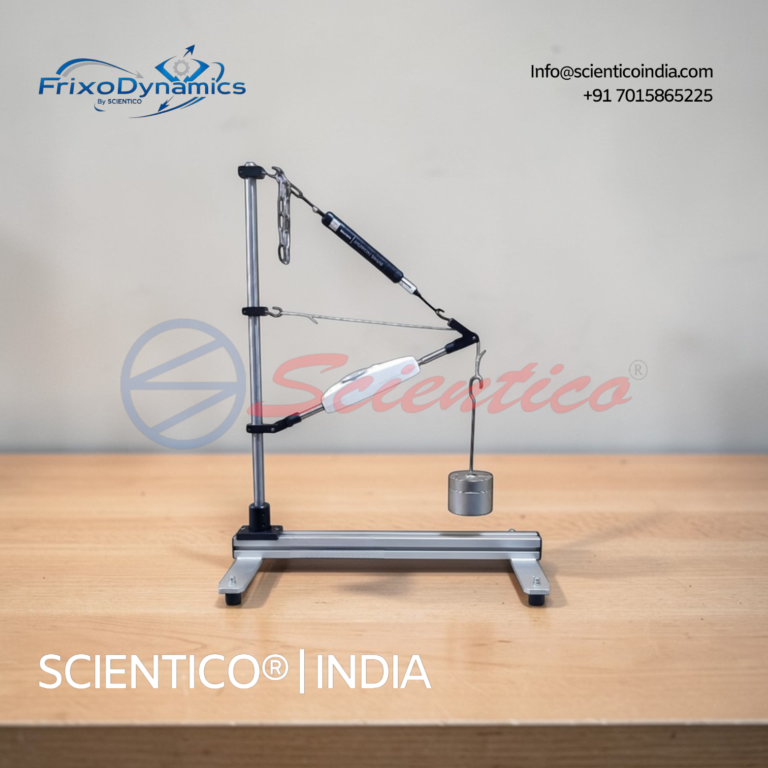
Forces in a Jib Crane Apparatus | FrixoDynamics FX-510
The SCIENTICO FrixoDynamics FX-510 Forces in a Jib Crane Apparatus is a wall-mounted experimental unit designed for the study of force distribution in a two-member jib crane structure. It enables students to measure compressive and tensile forces in the jib and tie members directly using an integrated force gauge and spring balance, and to compare those measured values against theoretical predictions derived from the triangle of forces and polygon of forces methods. The jib inclination and tie angle are adjustable, allowing a range of geometric configurations to be tested. Manufactured by SCIENTICO, the FX-510 is suitable for supply to engineering institutions and distributors worldwide.
View product details
Tablet Hardness Tester Manufacturer India
The Tablet Hardness Tester measures the crushing strength (diametrical compression force) of pharmaceutical tablets, a critical quality control parameter in tablet manufacturing and pharmacy education. It is a standard instrument in pharmacy lab equipment lists prescribed by the Pharmacy Council of India (PCI) for B.Pharm, M.Pharm, and D.Pharm programmes.
View product detailsITI Machinist / Fitter (DGT) syllabus, where the hardness tester fits
The DGT NSQF Level 5 syllabus for Machinist trade lists hardness testing under the heat-treatment module of the second semester, with roughly 25 practical hours attached across the year when you add the workshop-science tie-in. For Fitter trade, it appears in the first-year workshop practical (identification of ferrous and non-ferrous samples by hardness) and again in the second-year assignment on file-hardness comparison. In both trades, the trainee has to log at least Brinell and Rockwell readings on supplied samples and correlate them to a heat-treatment condition. Vickers is nice-to-have at ITI level, essential the moment you move up to diploma or the CITS instructor course.
Where colleges get caught out at the annual DGT affiliation inspection is on the machine’s ability to demonstrate all three scales. A single-scale Rockwell-only bench unit will get you through Fitter first year and nothing else. If you are building the lab from scratch, buy the Universal once, not a Rockwell now and a Brinell later, because the second purchase always gets stuck in the following year’s grant cycle.
Specifications that matter for ITI Machinist / Fitter (DGT)
- Load range covering Brinell, Rockwell and Vickers on one frame: typically 1 kgf to 187.5 kgf for the low end (Vickers micro and Rockwell superficial) up to 3000 kgf for full Brinell on cast iron and mild steel. Anything less and you cannot run the full syllabus.
- Compliance to ASTM E10 for Brinell, E18 for Rockwell, E92 for Vickers, plus IS 1500 for Brinell in the Indian standard set. Ask for the certificate on the quotation, not after delivery.
- Repeatability within ±1% of scale on reference blocks. If the vendor cannot commit that in writing, walk away. Cheap imports often quote ±2% and drift worse in humidity.
- Optical measuring microscope with at least 20x for Brinell indent reading, ideally with a digital eyepiece so you can project the indent for a batch of 30 trainees.
- Dead-weight loading, not spring-loaded. Springs age, dead weights do not. This is the single biggest reliability call on the machine.
- documentation reviewed per model and ISO 9001:2015 manufactured. For DGT files you want both. See CE marking on lab equipment and ISO 9001:2015 for lab equipment if the principal asks you to explain the difference.
Common mistakes ITI Machinist / Fitter (DGT) colleges make when buying a hardness tester
Mistake 1: buying a digital Rockwell-only tester because it looks modern. Digital is fine, but if it only runs Rockwell scales you have killed the Brinell practical for the Fitter first-year batch. The examiner will mark you down. Buy Universal first, then a second dedicated Rockwell as a backup once the grant refreshes.
Mistake 2: ignoring the reference test-block set. A hardness tester without at least three certified blocks (one soft, one medium, one hard) cannot be calibrated in-house. Trainees also need blocks to practise on before they touch their own filed samples. Budget for the block set on day one, not day 180.
Mistake 3: skipping the anvil set. The V-anvil for round work, the flat anvil for plates, and the small spot-anvil for thin sheet. If you only get the flat anvil, half the Machinist samples are untestable. This is a Rs. small-money item that kills a Rs. big-money machine.
Mistake 4: putting the tester on a wooden workbench. Vibration ruins Brinell readings. It needs a dedicated cast-iron or heavy-steel stand, bolted, ideally on a concrete plinth. I have seen a brand-new machine give 15 HRC scatter because it was sat next to a bench grinder.
Mistake 5: not training the workshop instructor. Ask the supplier for on-site commissioning and at least one day of instructor training. Most Indian vendors will do this for free within a 500 km radius if you ask at the quotation stage, not after the PO.
How the Scientico hardness tester fits ITI Machinist / Fitter (DGT)
Our Universal Hardness Tester covers Brinell, Rockwell and Vickers on one dead-weight frame, ships with a starter block set and the three standard anvils, and is built to ASTM E10 / E18 / E92 and IS 1500 out of the box. It is what I would put into a DGT-affiliated Machinist / Fitter ITI if the principal asked me to spend the money once and be done with it. For colleges that also run mechanical trades, pair it with our jib crane forces apparatus from the FrixoDynamics line for the workshop-science bench, and you have covered the strength-of-materials block cleanly. If you want to compare scales before deciding, our Brinell vs Vickers vs Rockwell comparison lays out which scale suits which sample.
Compliance: NBA / NAAC / INC / PCI / AICTE / DGT requirements
For DGT affiliation of a Machinist or Fitter trade, the tester needs to demonstrate multi-scale capability, have current calibration traceable to a NABL lab, and sit inside a workshop with adequate floor loading. NBA and NAAC inspections for the diploma stream applied later will additionally want the calibration certificate on file and evidence the instructor is trained. ISO 17025 NABL calibration is the phrase you want on the annual certificate. If your ITI plans to upgrade to a polytechnic diploma in the next three years, buying to the higher spec now saves you a replacement cycle. See our broader notes on lab equipment for ITI vocational trades and lab equipment for polytechnics and TVET.
Ordering & delivery for ITI Machinist / Fitter (DGT) labs
Scientico manufactures at Ambala and has supplied to 30+ countries since 1993, so domestic ITI orders in India are the shortest lead-time route. Expect several weeks from confirmed PO to dispatch for a Universal Hardness Tester, and add a week for road transit to most state capitals. If you are on a semester-start deadline, order 8 to 10 weeks before the practical block, not 3. Payment terms for government ITIs are usually against advance plus balance on inspection, and we accept the standard GeM route where the buyer has that channel. Overseas ITIs and TVET colleges should factor in sea transit weeks on top, and confirm Incoterms up front, CIF is the cleanest for first-time buyers, FOB Ambala road-to-Nhava-Sheva for anyone with their own freight forwarder. For a full spec-sheet review before you raise the PO, check the Universal Hardness Tester buyer’s guide for India and the price positioning notes.
Ready to spec it out? WhatsApp the workshop drawing and student batch size to us, or use the contact form and we will send back a DGT-aligned quotation with calibration certificate, anvil options and instructor-training terms inside two working days.
Frequently Asked Questions
Which hardness scale is compulsory for the ITI Machinist and Fitter DGT syllabus?
Brinell and Rockwell are both examined. Fitter first-year practicals use Brinell for identifying cast iron versus mild steel samples, Rockwell shows up in second-year heat-treatment verification, and Machinist trade second semester needs both. Vickers is not compulsory at ITI level but becomes essential if you upgrade to a diploma or run the CITS instructor course, which is why I always recommend a Universal machine over a single-scale tester.
What load capacity do I need on the hardness tester for an ITI lab?
Look for a machine that covers roughly 1 kgf on the low end for Vickers microhardness up to 3000 kgf on the top end for full Brinell on cast iron and mild steel. If your budget only stretches to a Rockwell-only unit at 60-150 kgf, you will fail the Fitter Brinell practical, so buy the Universal frame once rather than splitting the purchase across two grant cycles.
Do I need NABL calibration or is the manufacturer's certificate enough for DGT?
For the initial DGT affiliation inspection the manufacturer’s calibration certificate against ASTM E10, E18 and E92 is accepted, but for annual re-verification and any future NBA or NAAC scrutiny you will need a NABL-traceable calibration certificate to ISO 17025. Scientico ships the manufacturer certificate on delivery, then most colleges get an annual NABL recalibration locally, which typically costs a small fraction of the machine.
How long does a hardness tester take to deliver to an Indian ITI?
Expect several weeks from confirmed PO to dispatch from our Ambala works, plus roughly a week for road transit anywhere in mainland India. Overseas TVET buyers should add sea-transit weeks on top. For a semester-start practical you want to raise the PO 8 to 10 weeks before the first lab session, not 3, especially if your finance office runs slow on advance payment release.
Is a digital hardness tester worth the extra cost for an ITI trade lab?
Not really, for ITI Machinist and Fitter. The syllabus outcome is that trainees can read a Brinell indent under a microscope and interpret a Rockwell dial, so an analog dead-weight machine actually teaches the principle better. Digital models cost more, need power conditioning that ITIs rarely have, and lock you into vendor-specific service. Save the digital budget for the diploma upgrade later.
One honest ask
We don't gate anything on this site. You just read the whole thing free. If it was useful, leave your email and two things happen: we send you this page as a plain-text block you can paste into a tender file or an internal email, and we notify you the next time we publish a buyer tool like this one. Nothing else. No drip sequence, no sales calls booked without asking.