
How to Choose Fluid Mechanics Lab Equipment: A Practical Buyer’s Guide for Engineering Colleges
If you’ve ever sat through a vendor demonstration where everything looked perfect, then received equipment that barely worked by the time it arrived on campus, you know the frustration. Choosing fluid mechanics lab equipment is not just about finding the lowest price in a tender. It’s about finding apparatus that will work reliably for five years, survive the hands of 400 students per semester, and still be calibrated within acceptable tolerance when your accreditation committee shows up.
This guide is written for the people who actually make these decisions: Heads of Department, lab-in-charge faculty, and purchase committee members at engineering colleges. We’ll cover what to look for in every major piece of fluid mechanics apparatus, how to evaluate vendors honestly, and what the market actually costs, so you’re never misled by an inflated catalogue price.
Equipment mentioned in this guide
Review the product information, specifications and model before requesting a quotation.
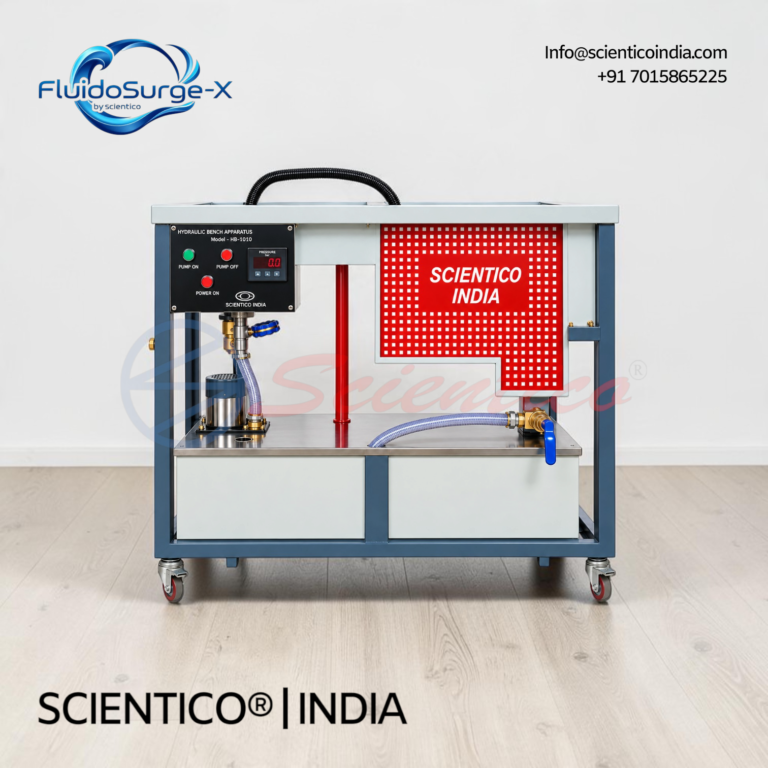
Digital Hydraulic Bench Apparatus | FluidoSurgeX 102
The SCIENTICO FluidoSurgeX 102 Digital Hydraulic Bench is designed to supply water, measure volumetric flow rates, and support a wide range of fluid mechanics experiments.The apparatus operates on a closed-loop water circuit consisting of a storage tank, centrifugal pump, and an elevated stepped measuring tank.Volumetric flow rates can be determined using a measuring tank and stopwatch, supported by a digital flowmeter for direct flow indication.The integrated work surface includes a flume for weir experiments and provides safe placement and drainage for experimental units.
View product details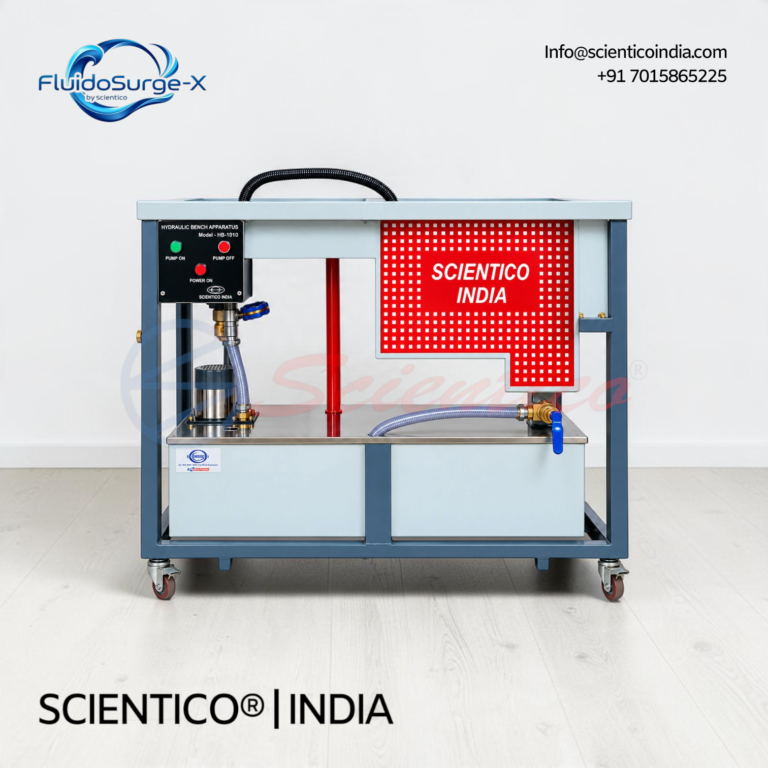
Hydraulic Bench Apparatus | FluidoSurgeX 101
The SCIENTICO FluidoSurgeX 101 Hydraulic Bench Apparatus is a basic supply and measurement unit used in fluid mechanics laboratories. It enables the circulation, measurement, and collection of water for a wide range of experimental modules.The system operates on a closed-loop water circuit consisting of a storage tank, centrifugal pump, and an elevated measuring tank. Volumetric flow rates are determined using stepped measuring tanks and a calibrated measuring beaker, supported by manual stopwatch timing.An integrated work surface with a built-in flume allows experiments involving weirs while ensuring safe placement of accessories and controlled collection of return water.
View product detailsStart With Your Syllabus, Not the Catalogue
The single biggest mistake purchasing committees make is opening a vendor catalogue first. The right starting point is your university syllabus or curriculum document. List every experiment that your fluid mechanics course requires students to perform. Then build your equipment list from that, not from what a vendor is eager to sell you.
For a standard B.Tech Civil or Mechanical Engineering fluid mechanics lab aligned with AICTE guidelines, the core experiments typically include: Bernoulli’s theorem verification, Reynolds number demonstration (laminar vs. turbulent flow), flow measurement (Venturimeter, orifice, rotameter), pipe friction losses (major and minor), notch and weir discharge, metacentric height determination, and centrifugal pump characteristics [AICTE Model Curriculum, Mechanical Engineering].
Once you have this list, every purchasing decision becomes easier. You’re not evaluating options, you’re filling requirements. Our Fluid Mechanics Lab Setup Guide maps every AICTE-standard experiment to the specific apparatus it requires, which is a useful cross-check against your university’s own curriculum document.
The Hydraulic Bench: The Backbone of Your Fluid Lab
If there is one piece of equipment your fluid mechanics lab cannot function without, it is the hydraulic bench. This self-contained unit recirculates water and provides the pressurised supply that all flow-based experiments depend on. Buying a good hydraulic bench upfront saves you from having to reroute plumbing, fix leaks, and deal with pump failures every semester.
When evaluating a Hydraulic Bench Apparatus, check these five things before you sign a purchase order:
- Tank capacity: Minimum 120–150 litres for a lab serving batches of 20+ students. Smaller tanks require frequent refilling and cause pressure fluctuations that corrupt readings.
- Pump motor rating: 0.5 HP minimum; 1 HP recommended for high-head experiments. Check that the motor is enclosed and IP-rated for wet environments.
- Flow measurement accuracy: The bench’s built-in measuring tank should use a volumetric method with a calibrated hook gauge, not just a sight glass, to allow accurate discharge measurement.
- Top-plate accessory compatibility: The bench should accept interchangeable experiment modules, Bernoulli apparatus, pipe friction rig, etc., without requiring custom adapters. Ask the vendor for a module compatibility list.
- Corrosion resistance: The frame and tank should be stainless steel or FRP, not mild steel that will rust within two monsoon seasons.
Choosing a Centrifugal Pump Test Rig
The Centrifugal Pump Test Rig is the most frequently used, and most frequently abused, piece of equipment in any fluid mechanics lab. Students run it for hours, forget to close valves properly, and occasionally run it dry. The rig needs to survive all of this.
Look for rigs with a permanently coupled mechanical seal (not a gland-packing seal that drips), an energy meter for accurate power measurement (not just an ammeter-voltmeter combination, which gives lower accuracy), and inlet/outlet pressure gauges with damping glycerine fill. The pump casing should be cast iron or bronze, not plastic. Ask specifically for the characteristic curves the manufacturer has generated from their own testing, and compare the published H-Q curves against your expected operating range.
Questions to Ask Every Vendor Before Ordering
No vendor will voluntarily tell you about their equipment’s weaknesses. You have to ask directly. These seven questions separate serious manufacturers from catalogue intermediaries:
- “Can you share the calibration certificate for this specific model, not just a general ISO certificate?”
- “What is the standard warranty period and what does it cover, parts, labour, or both?”
- “Do you have an Annual Maintenance Contract option, and what is the typical response time for on-site service?”
- “How many institutions currently use this model? Can you provide two reference contacts?”
- “Does the equipment come with a student experiment manual that maps to AICTE / your university syllabus?”
- “What is the lead time from purchase order to delivery and installation?”
- “What certifications does the equipment carry, ISO 9001:2015, CE, BIS?”
A vendor who struggles to answer any of these questions in writing, not just verbally during the sales pitch, is a vendor you should think twice about. The fluid mechanics equipment market in India is crowded with intermediaries who buy from small workshops and rebrand. The difference in quality between a genuine manufacturer and a reseller is often not visible until Year Two.
Understanding Specifications: What Numbers Actually Matter
Equipment catalogues are full of numbers. Not all of them matter equally. Here’s a quick guide to which specifications are meaningful and which are marketing:
| Specification | Why It Matters | Red Flag |
|---|---|---|
| Flow measurement accuracy (±%) | Determines how accurate student results will be | No accuracy spec listed at all |
| Pressure gauge range and accuracy | Must match the experiment’s operating range | 0–10 bar gauge on a 0.5 bar experiment |
| Material of wetted parts | Affects lifespan, corrosion resistance | “Suitable material” without specifics |
| Motor protection class (IP rating) | Safety in wet lab environment | No IP rating mentioned |
| Calibration traceability | Required for accreditation documentation | “Factory calibrated” with no certificate |
Cost Benchmarks: What Should You Expect to Pay?
Pricing for fluid mechanics lab equipment varies enormously depending on origin, quality tier, and certification. As a general benchmark for Indian-manufactured, model-specific equipment delivered to an engineering college in India or exported CIF to an African or Middle Eastern port:
- Hydraulic bench (120L, 0.5 HP): INR 85,000–1,20,000 / USD 1,000–1,450
- Centrifugal pump test rig: INR 75,000–1,10,000 / USD 900–1,350
- Bernoulli theorem apparatus: INR 35,000–55,000 / USD 420–660
- Pipe friction apparatus: INR 45,000–70,000 / USD 540–840
- Complete fluid mechanics lab setup (8–10 experiments): INR 6–12 lakhs / USD 7,200–14,500
European-made equivalents (leading European manufacturer, European lab equipment manufacturer) typically run 3–5× these prices, which is why export-quality Indian manufacturers have become the dominant supplier to emerging-market universities. The quality gap, for standard educational apparatus, has narrowed significantly over the past decade, especially among ISO 9001 and model-specific manufacturers.
For a more detailed specification guide covering each fluid mechanics experiment’s recommended apparatus, read our Fluid Mechanics Equipment Specifications and Buying Guide. To request a proforma invoice with CIF pricing to your port, email [email protected] with your institution name, country, and experiment list.
Get Specifications & Pricing
Scientico India manufactures laboratory apparatus under an ISO 9001:2015 quality system. Conformity documentation is confirmed for each quoted model. Contact us for full specifications, pricing, and documentation.
WhatsApp: +91 701-586-5225 | [email protected] | FAQ, Shipping, Payment & Warranty
Scientico India manufactures model-specific, ISO 9001:2015 laboratory equipment, exported to 30+ countries since 1993. Request a model-specific CIF proforma invoice after technical review.
View Fluid Mechanics Lab Equipment →Request a QuoteOne honest ask
We don't gate anything on this site. You just read the whole thing free. If it was useful, leave your email and two things happen: we send you this page as a plain-text block you can paste into a tender file or an internal email, and we notify you the next time we publish a buyer tool like this one. Nothing else. No drip sequence, no sales calls booked without asking.