
Radiation Heat Transfer Module | ThermoFlux – 7049/3
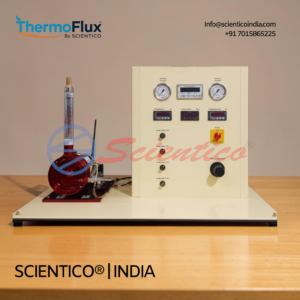
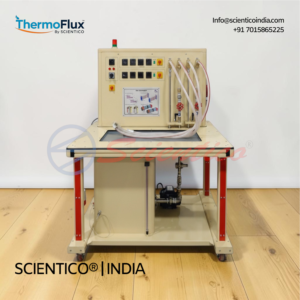
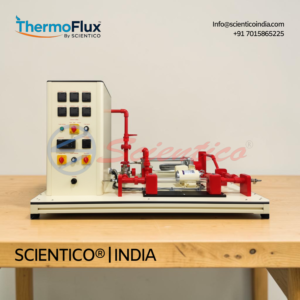
The Radiation Heat Transfer Module ThermoFlux – 7049/3 is a laboratory module for verifying the fundamental laws of thermal radiation through direct experimentation. This radiation heat transfer module provides a 300 W electrically heated plate reaching approximately 460°C, seven metal specimens in stainless steel, aluminium, and copper across multiple surface finishes (135 x 145 mm each), and an aperture plate assembly for view factor experiments. Students verify the inverse square law, Stefan-Boltzmann Law, Kirchhoff’s Law, emissivity, absorptivity, and geometric view factor relationships. Operation requires the Heat Transfer Service Unit ThermoFlux – 7049/3.
The Radiation Heat Transfer Module ThermoFlux – 7049/3 is a laboratory module for demonstrating and verifying the fundamental laws governing thermal radiation heat transfer. This radiation heat transfer module provides an electrically heated radiant source rated at 300 W with a maximum temperature of approximately 460°C, a set of seven metal specimens across three materials, and an aperture plate assembly for structured experimental investigation. Students verify the inverse square law, Stefan-Boltzmann Law, Kirchhoff’s Law, emissivity, absorptivity, and geometric view factor relationships through direct measurement.
Product Overview
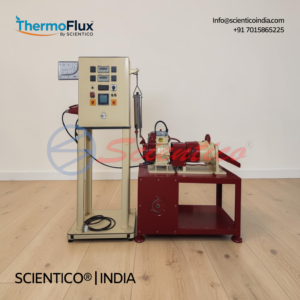
The ThermoFlux – 7049/3 is designed to illustrate how thermal radiation, as a mode of heat transfer distinct from conduction and convection, behaves according to established physical laws. A 300 W electrically heated plate serves as the radiant source, reaching a maximum temperature of approximately 460°C. A radiometer measures radiation intensity at the specimen surface. Seven metal specimens in three materials, stainless steel, aluminium, and copper, each measuring 135 x 145 mm, provide a range of surface finishes and coatings for comparative emissivity and absorptivity measurement.
The specimen set covers bright, matt anodized, nickel-plated, and high-temperature painted surfaces. Stainless steel specimens oxidise over time due to high operating temperatures, providing an additional surface condition for study. Aluminium specimens are supplied in three variants: matt anodized on both sides, painted on both sides with high-temperature paint, and matt anodized with one painted side. Copper specimens are supplied in two variants: nickel-plated and bright, the latter also oxidising over time.
An aperture plate assembly, consisting of two plates with insulation on one side, is used in view factor experiments. The insulated surface faces the heated source during experiments to control radiation geometry. All experiments compare measured results against theoretical predictions from the relevant radiation equations.
The module requires the Heat Transfer Service Unit ThermoFlux – 7049 for operation.
Radiation Heat Transfer Module ThermoFlux – 7049/3, Technical Specifications
| Parameter | Value |
|---|---|
| Model | ThermoFlux – 7049/3 |
| Heated Plate Power | 300 W |
| Heated Plate Max. Temperature | Approx. 460°C |
| Specimen Face Dimension (W x H) | 135 x 145 mm |
| Stainless Steel Specimens | 1x bright (oxidises over time at high temperature) |
| Aluminium Specimen 1 | 1x matt anodized on both sides |
| Aluminium Specimen 2 | 1x painted on both sides (high-temperature paint) |
| Aluminium Specimen 3 | 1x matt anodized with one painted side |
| Copper Specimen 1 | 1x nickel-plated |
| Copper Specimen 2 | 1x bright (oxidises over time) |
| Total Specimens | 7 |
| Aperture Plate | Two plates, insulation on one side, insulated side faces heated surface |
| Required for Operation | Heat Transfer Service Unit ThermoFlux – 7049 |
| Scope of Delivery | 1 experimental module, 1 instruction manual |
Technical Data
Heated Plate
| Parameter | Value |
|---|---|
| Electrical Power | 300 W |
| Maximum Temperature | Approx. 460°C |
Stainless Steel Specimens
| Specimen | Surface Finish | Dimension (W x H) |
|---|---|---|
| 1 | Bright, oxidises over time at high temperature | 135 x 145 mm |
Aluminium Specimens
| Specimen | Surface Finish | Dimension (W x H) |
|---|---|---|
| 1 | Matt anodized on both sides | 135 x 145 mm |
| 2 | Painted on both sides (high-temperature paint) | 135 x 145 mm |
| 3 | Matt anodized with one painted side | 135 x 145 mm |
Copper Specimens
| Specimen | Surface Finish | Dimension (W x H) |
|---|---|---|
| 1 | Nickel-plated | 135 x 145 mm |
| 2 | Bright, oxidises over time | 135 x 145 mm |
Aperture Plate
| Parameter | Value |
|---|---|
| Number of Plates | 2 |
| Insulation | On one side of each plate |
| Orientation During Experiment | Insulated side facing heated surface |
Key Features
- Heated Plate: 300 W, maximum temperature approx. 460°C, electrically heated radiant source
- Radiation Heat Transfer Specimens: 7 metal specimens across three materials: stainless steel, aluminium, and copper
- Specimen Dimension: 135 x 145 mm, uniform across all specimens
- Stainless Steel: 1 bright specimen, oxidises over time at operating temperature
- Aluminium: 3 variants: matt anodized both sides, painted both sides (high-temperature paint), matt anodized with one painted side
- Copper: 2 variants: nickel-plated and bright (oxidises over time)
- Aperture Plate: Two plates with one insulated side each, used for view factor and geometry experiments
- Laws Demonstrated: Inverse square law, Stefan-Boltzmann Law, Kirchhoff’s Law, view factor geometry
- Measurable Parameters: Radiation intensity, surface emissivity, absorptivity, surface temperature, heat exchanged between surfaces
- Required for Operation: Heat Transfer Service Unit ThermoFlux – 7049/3
Experiments
- Demonstrate that the intensity of radiation on a surface is inversely proportional to the square of the distance from the radiation source, illustrating the inverse square law for thermal radiation
- Illustrate that the intensity of radiation increases with the fourth power of the source temperature, demonstrating the Stefan-Boltzmann Law
- Show that the intensity of radiation recorded by the radiometer is directly related to the radiation emitted by a source, influenced by the view factor between the radiometer and the source
- Measure the emissivity of radiating surfaces with various finishes, including polished and grey (silver anodized), in comparison to matt black
- Demonstrate how the emissivity of radiating surfaces in close proximity affects their surface temperatures and the amount of heat exchanged
- Validate Kirchhoff’s Law, which states that the emissivity of a grey surface equals its absorptivity of radiation received from another surface when in thermal equilibrium
- Illustrate that the exchange of radiant energy between two surfaces depends on their geometry, specifically the extent to which each surface can see the other
Construction and Design
The Radiation Heat Transfer Module ThermoFlux – 7049/3 is built around a 300 W electrically heated plate as the primary radiant source, capable of reaching approximately 460°C. Seven metal specimens, each 135 x 145 mm, are supplied in three base materials across a range of surface treatments to enable direct comparison of emissivity and absorptivity values. Stainless steel is supplied as a single bright specimen that naturally oxidises over time at high operating temperatures, introducing a changing surface condition for observation. Three aluminium specimens cover matt anodized on both sides, high-temperature painted on both sides, and matt anodized with one painted side. Two copper specimens cover nickel-plated and bright finishes, the latter also subject to oxidation over time.
This radiation heat transfer module includes an aperture plate assembly of two plates, each with insulation applied to one face. During experiments, the insulated face is oriented toward the heated surface to control the radiation geometry and support view factor investigations. The radiometer measures radiation intensity at the specimen surface for all quantitative experiments. All measured outcomes are compared against the predictions of the governing radiation equations, including the inverse square law, Stefan-Boltzmann Law, and Kirchhoff’s Law. The module connects to and operates through the Heat Transfer Service Unit ThermoFlux – 7049.
Scope of Delivery
- 1 experimental module
- 1 instruction manual
Required for Operation
- Heat Transfer Service Unit ThermoFlux – 7049
Q1: What radiation laws and principles does the ThermoFlux – 7049/3 cover?
The module covers the inverse square law, the Stefan-Boltzmann Law (intensity proportional to the fourth power of temperature), Kirchhoff’s Law (emissivity equals absorptivity at thermal equilibrium), view factor geometry, and the relationship between surface finish, emissivity, and heat exchange.
Q2: What specimen materials and surface finishes are supplied?
Seven specimens are supplied across three materials. Stainless steel: 1 bright specimen. Aluminium: matt anodized on both sides, painted on both sides with high-temperature paint, and matt anodized with one painted side. Copper: nickel-plated and bright. All specimens measure 135 x 145 mm.
Q3: What is the aperture plate used for in this radiation heat transfer module?
The aperture plate assembly consists of two plates, each with insulation on one side. The insulated side faces the heated source during experiments. It is used to control and vary the radiation geometry for view factor investigation experiments.
Q4: What is the maximum temperature reached by the heated plate?
The electrically heated plate is rated at 300 W and reaches a maximum temperature of approximately 460°C.
Q5: Is additional equipment required to operate the ThermoFlux – 7049/3?
Yes. The Heat Transfer Service Unit ThermoFlux – 7049 is required for operation. It provides the power supply, instrumentation, and display functions for the module.
Need Assistance? We're Here to Help!
Connect with our team for product specifications, pricing, and customized solutions for your institution or project.