
Nine out of ten buyers who email me asking for a “tensile testing machine” actually need a Universal Testing Machine, and about one in ten genuinely needs a dedicated tensile-only rig. The confusion costs money either way, so let me settle it. TL;DR: buy a UTM if your syllabus or QC scope touches more than one test mode (tension, compression, bending, shear). Buy a dedicated tensile testing machine only if you test wire, rebar, or thin sheet all day and need a compact, higher-throughput bench. One caveat first: the phrase “tensile testing machine” is used loosely in Indian tenders, so read the spec sheet before you argue with a purchase officer.
Equipment mentioned in this guide
Review the product information, specifications and model before requesting a quotation.
Universal Hardness Tester
The Universal Hardness Tester manufactured by Scientico India combines Brinell, Vickers, and Rockwell hardness testing methods in a single machine. The machine uses interchangeable indenters and a built-in optical measuring system for Brinell/Vickers measurements, with direct-reading digital display for Rockwell hardness.
View product details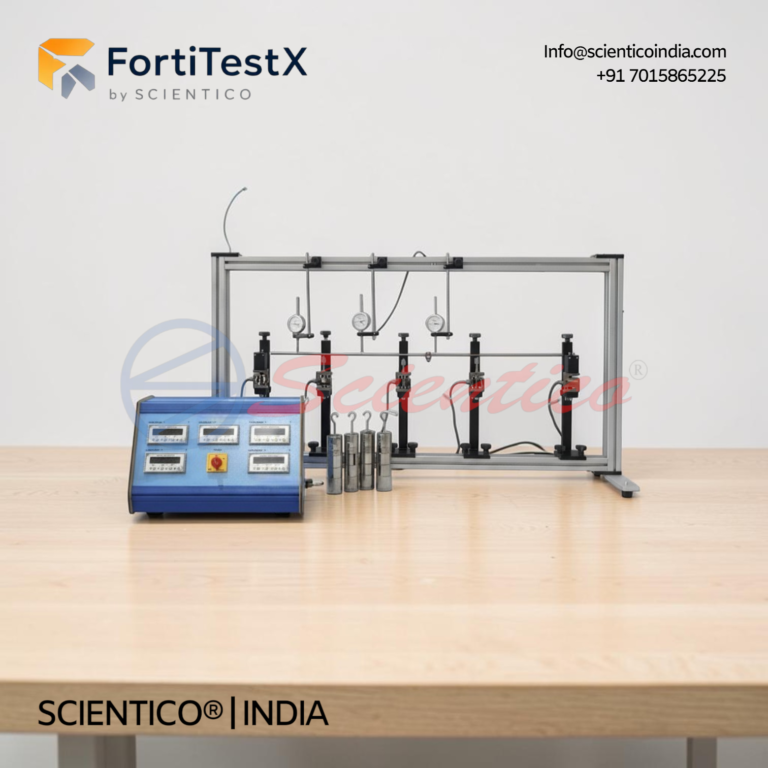
Continuous and Indeterminate Beams Apparatus | FortiTestX 07
The FortiTestX 07 Continuous and Indeterminate Beams Apparatus is an electronically instrumented experimental unit designed for the investigation of beam deflection, support reactions, and elastic line behaviour under statically determinate and indeterminate conditions. It advances beyond dial gauge-based beam testing by incorporating electronic load cells at each support position, providing direct digital measurement of vertical reaction forces and enabling a broader range of structural analysis experiments.
View product details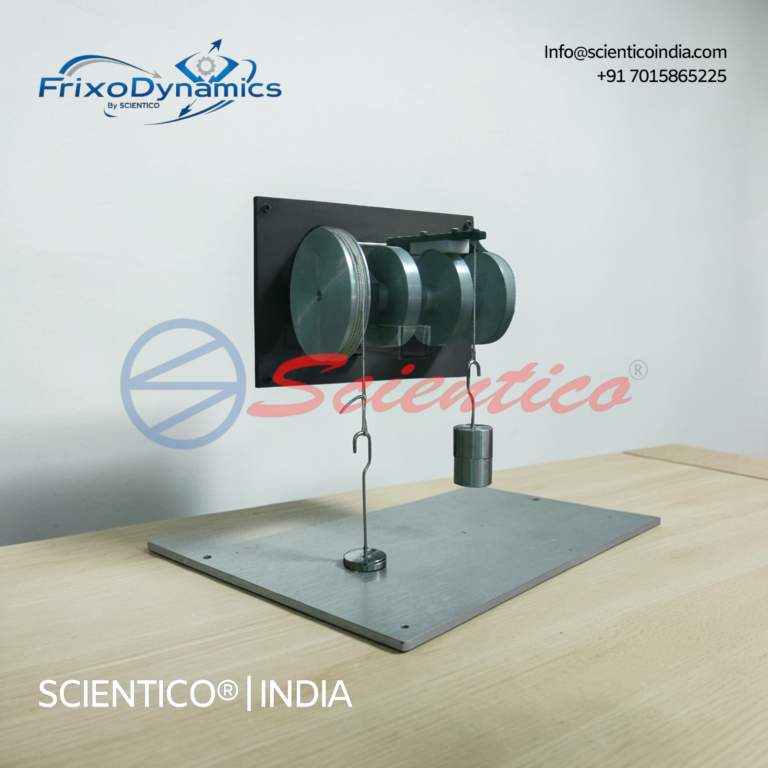
Dry, Rough and Lubricated Friction Apparatus | FrixoDynamics FX-524
The FrixoDynamics FX-524 is a complete friction board apparatus and friction experiment kit for measuring static and kinetic friction across dry, rough and lubricated surfaces, the standard friction experiment in engineering mechanics and physics laboratories.
View product detailsThe short answer
For 90% of engineering colleges, polytechnics, and general QC labs in India, a UTM is the correct buy. It runs tension, compression, transverse bending, and shear on the same load frame, which matches the AICTE, HSBTE, MSBTE, and VTU strength-of-materials syllabi. A dedicated tensile testing machine is narrower by design: single-axis pull, usually a smaller footprint, often faster crosshead speeds, and cheaper per test if all you do is wire or rebar. If your lab is mixed-use, the UTM wins on cost per capability. If it is a single-product QC line, the tensile machine wins on cost per test.
Head-to-head at a glance
| Parameter | Universal Testing Machine (UTM) | Tensile Testing Machine |
|---|---|---|
| Working principle | Hydraulic or servo-electric load frame with reversible crosshead; tension, compression, bend, shear via grip/fixture swap | Single-axis pull, usually screw-driven, occasionally hydraulic on higher capacities |
| Load capacity range | Typically 10 kN to 1000 kN in college labs; 2000 kN available for civil/research | Typically 1 kN to 100 kN; wire/rebar variants go to 300 kN |
| Accuracy class | Class 1 per ISO 7500-1 is standard; Class 0.5 available | Class 1 typical; Class 0.5 in metrology-grade units |
| Applicable standard | IS 1828, ISO 7500-1, ASTM E4/E8 | ISO 7500-1, ASTM E8/E9 (tension-specific) |
| Fixture library | Wedge grips, compression platens, three-point bend, shear jig | Wedge or pneumatic grips only |
| Footprint | Larger; hydraulic power pack sits alongside | Compact bench-top possible up to 50 kN |
| Typical cost tier | Mid to high | Low to mid |
| Best fit | Teaching labs, mixed QC, R&D | Wire drawing, rebar, thin-sheet QC |
Working principle: how each one operates
A UTM applies force through a moving crosshead driven either by a hydraulic ram (most common in the 400-1000 kN class in India) or by twin ball-screws with a servo motor (common under 100 kN). Load is read by a strain-gauge load cell in the load train. Because the crosshead reverses direction and the fixtures are interchangeable, one machine covers tension (grips pull apart), compression (platens push together), transverse bending (three-point fixture, load computed as F = 3PL/2bd² for the modulus of rupture calculation your students actually need to do), and single/double shear via a shear jig. That flexibility is the whole point of the word “universal.”
A tensile testing machine strips the frame down to what pulling actually needs. The crosshead moves in one direction, the grips are optimised for wire or flat specimens, and the control system usually targets stress-rate or strain-rate control from ASTM E8. No compression platens, no bend fixture, no shear jig. That is not a weakness. It is a deliberate choice that keeps the machine smaller, quieter, and cheaper. On a wire QC bench you can run a specimen every 60-90 seconds; on a full UTM the changeover between specimens is slower because the frame is bigger.
UTM vs tensile testing machine difference: which for which department
- BTech mechanical, VTU/AKTU/GTU/MAKAUT: UTM, 40-100 kN hydraulic or servo. The syllabus explicitly demands tension, compression, bend, and shear on mild steel, cast iron, brass, and timber. A tensile-only unit fails the practical exam scope.
- Polytechnic diploma, MSBTE/HSBTE/BTEUP/SBTET/DOTE/WBSCTE: UTM, 40 kN. Same reason as above at a smaller budget. This is where I see the most wrong purchases; officers see “tensile” in the syllabus and buy the cheaper machine, then get audited for missing compression tests.
- ITI/DGT welder and fitter trades: Tensile testing machine, 20-50 kN, bench-top. The trade curriculum focuses on weld-joint tension only. A UTM is overkill and eats floor space.
- Civil engineering department: UTM, 600-1000 kN, hydraulic. You need compression on concrete cubes and cylinders, plus rebar tension. A tensile-only machine cannot do the compression side.
- Research lab (MTech/PhD, ISO 17025 aspiration): Servo-electric UTM with Class 0.5 load cell and video extensometer. Read the ISO 17025 NABL calibration standard before you finalise the spec.
- Wire/rebar manufacturer QC: Dedicated tensile machine, hydraulic wedge grips, 300 kN. Faster throughput, lower cost per test, no compression fixture to store.
Full spec walkthrough with capacity math is in the Universal Testing Machine buyer’s guide for India.
Common mistakes when choosing
Buying capacity you will never load. A 1000 kN UTM in a diploma lab that only tests 12 mm mild-steel rods (about 55 kN at yield) means every reading sits in the bottom 6% of the range. Accuracy in that band is worse than what a 100 kN machine would give you. Match capacity to your typical maximum, not the biggest number you can afford.
Ignoring the fixture library. The load frame is 60% of what you pay for; grips, platens, jigs, and extensometer are the other 40%. I have seen labs receive a beautiful UTM and then discover the shear jig is a paid add-on. Ask for the full fixture list in the quote and cross-check it against the practicals in your syllabus.
Confusing hardness with tension. Some tenders bundle a UTM and a hardness tester as if they overlap. They do not. If your scope includes Brinell, Rockwell, or Vickers, you need a universal hardness tester separately. Compare methods first via Brinell vs Vickers vs Rockwell testers.
Skipping the calibration clause. Insist on ISO 7500-1 Class 1 with a NABL-traceable calibration certificate delivered with the machine. Without it, your Class 1 claim is marketing, not metrology.
Scientico’s recommendation
For a standard engineering or polytechnic strength of materials testing machine requirement, I recommend a hydraulic UTM in the 40-100 kN class from the FortiTestX series, paired with the universal hardness tester for the hardness practicals. Both cover the AICTE, NBA, and NAAC lab-inspection checklists cleanly. For a civil-heavy department, size up to 600-1000 kN and confirm the compression platen diameter accommodates 150 mm concrete cubes.
If your syllabus also involves indeterminate-beam practicals, the continuous indeterminate beams apparatus complements the UTM without duplicating it. For friction and mechanics-of-solids practicals that fall in the same lab, look at the dry, rough and lubricated friction apparatus.
Scientico has manufactured strength-of-materials equipment since 1993 from our Ambala facility, shipping to 30+ countries, ISO 9001:2015 and model-specific. Full pricing context sits in the UTM price guide for India.
Cost and delivery framework
I do not quote fixed INR figures on public pages because capacity, control system (hydraulic vs servo), load-cell class, and fixture list all move the number. As a rough tier: a 40 kN hydraulic UTM sits in the low-mid tier, a 100 kN servo-electric UTM with video extensometer sits high. A dedicated tensile machine at 50 kN typically comes in 30-45% cheaper than a UTM of the same capacity because you are not paying for the fixture library.
Lead time on made-to-order UTMs is several weeks of production plus dispatch. Sea transit adds more depending on destination port. We quote EXW Ambala by default and can arrange FOB Mundra, CIF, or DAP on request; specify Incoterm in your RFQ so the landed cost is apples-to-apples with imported alternatives. For institutional buyers under DGT, PSBTE, or AICTE-funded projects, we handle the tender documentation, GST invoicing, and post-installation calibration report.
Send your syllabus or QC scope and specimen sizes to our team and I will spec the right machine and fixture set in one email, with the calibration certificate clause pre-written for your tender.
Frequently Asked Questions
What is the main difference between a UTM and a tensile testing machine?
A UTM runs tension, compression, bending, and shear on one load frame by swapping fixtures. A tensile testing machine only pulls, which makes it smaller and cheaper but limits it to tension-only work like wire and rebar QC.
Which one does my polytechnic actually need for the MSBTE or HSBTE syllabus?
A UTM, typically 40 kN hydraulic. The diploma strength-of-materials curriculum requires compression, bend, and shear practicals that a tensile-only machine cannot perform.
Is a hydraulic or servo-electric UTM better?
Hydraulic is standard for 100 kN and above and for civil labs testing concrete. Servo-electric is better under 100 kN for research, extensometer integration, and quieter operation. Match to your capacity and control needs.
What capacity UTM should I buy for a mechanical engineering lab?
For BTech mechanical, 40 to 100 kN covers mild steel, cast iron, brass, and timber specimens without underloading the machine. For civil, size up to 600-1000 kN so you can test 150 mm concrete cubes.
Do I need a hardness tester if I already have a UTM?
Yes. Hardness testing (Brinell, Rockwell, Vickers) uses indentation and is a separate practical from tension or compression. A UTM cannot perform ASTM E10, E18, or E92 hardness tests.
One honest ask
We don't gate anything on this site. You just read the whole thing free. If it was useful, leave your email and two things happen: we send you this page as a plain-text block you can paste into a tender file or an internal email, and we notify you the next time we publish a buyer tool like this one. Nothing else. No drip sequence, no sales calls booked without asking.