
The Reynolds number (Re) is a dimensionless quantity that predicts whether fluid flow will be laminar (smooth and orderly) or turbulent (chaotic and mixing). It is defined as the ratio of inertial forces to viscous forces in a flowing fluid, calculated as Re = (ρvD)/μ. A low Reynolds number means viscous forces dominate and flow stays laminar; a high Reynolds number means inertial forces dominate and flow becomes turbulent. It is one of the most important parameters in fluid mechanics, used in pipe design, aerodynamics, heat exchangers, and pump selection.
Equipment mentioned in this guide
Review the product information, specifications and model before requesting a quotation.
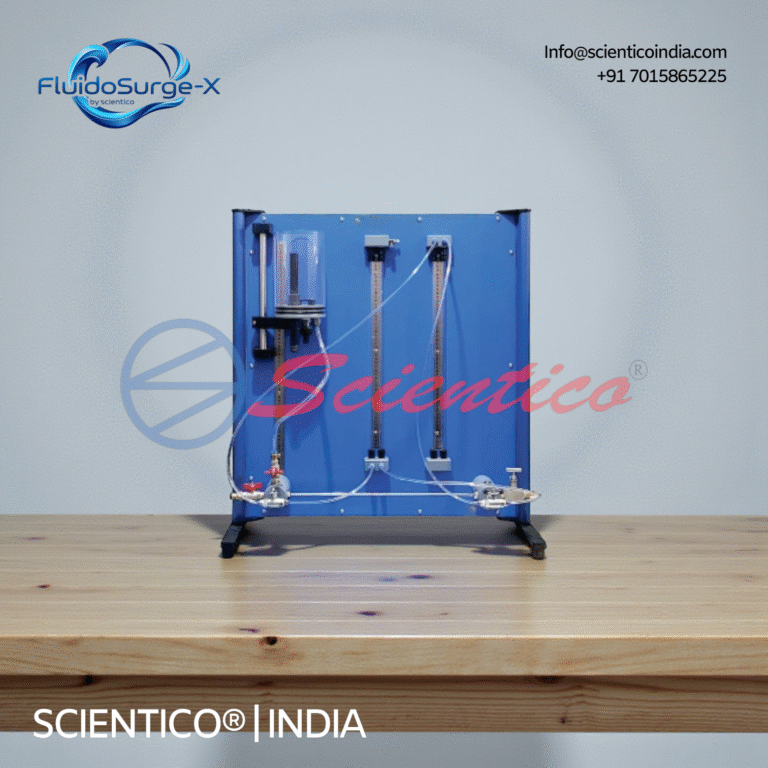
Pipe Friction Apparatus | FluidoSurge-X 168
The Pipe Friction Apparatus FluidoSurge-X 168 is designed for experimental determination of friction losses in pipe flow. It enables study of both laminar and turbulent flow regimes under controlled conditions. The apparatus allows measurement of head loss and determination of critical Reynolds number. It is suitable for fluid mechanics laboratory instruction and experimental analysis.
View product detailsWhat does the Reynolds number actually represent?
Imagine water moving through a pipe. Two competing forces act on it. Inertial force is the fluid’s tendency to keep moving and resist changes in motion, it grows with speed and density. Viscous force is the internal friction that resists deformation and keeps layers moving in an orderly way, it grows with viscosity.
The Reynolds number is simply the ratio between these two. When viscosity wins (low Re), the fluid moves in neat parallel layers. When inertia wins (high Re), small disturbances amplify into swirling eddies and the flow turns turbulent. Because it is a ratio of two forces with the same units, the result is dimensionless, the same number applies whether you measure in SI or any other consistent unit system, which is exactly why it is so useful for scaling lab experiments up to real machinery.
What is the Reynolds number formula?
For flow through a circular pipe, the Reynolds number is:
Re = (ρ × v × D) / μ
An equivalent form uses kinematic viscosity (ν = μ/ρ):
Re = (v × D) / ν
What do the variables mean?
| Symbol | Quantity | SI Unit |
|---|---|---|
| ρ (rho) | Density of the fluid | kg/m³ |
| v | Mean flow velocity | m/s |
| D | Characteristic length (pipe internal diameter) | m |
| μ (mu) | Dynamic viscosity | Pa·s (N·s/m²) |
| ν (nu) | Kinematic viscosity | m²/s |
For non-circular ducts or open channels, the diameter D is replaced by the hydraulic diameter (4 × cross-sectional area / wetted perimeter), so the same formula still applies.
What are laminar, transitional, and turbulent flow ranges?
For flow inside a pipe, the commonly accepted critical ranges are:
| Reynolds Number (Re) | Flow Regime | Behaviour |
|---|---|---|
| Re < 2000 | Laminar | Smooth, parallel streamlines; predictable; dye stays as a thin straight line |
| 2000 – 4000 | Transitional | Unstable; intermittent bursts of mixing; dye begins to wobble |
| Re > 4000 | Turbulent | Chaotic eddies; rapid mixing; dye disperses across the whole pipe |
These thresholds are for internal pipe flow. The critical value changes with geometry, flow over a flat plate, around a sphere, or in an open channel each have different transition points. That is why students should always note which characteristic length and which flow situation a given Reynolds number refers to.
Why is the Reynolds number significant in engineering?
The Reynolds number matters because it lets engineers predict flow behaviour before building anything. A few practical reasons it is taught in every mechanical, civil, chemical, and aeronautical engineering programme:
- Pipe and duct design: Pressure drop and friction factor depend on whether flow is laminar or turbulent. Re tells you which equation to use (Hagen–Poiseuille for laminar, Colebrook/Moody for turbulent).
- Pump and fan selection: Energy losses differ sharply between regimes, affecting power requirements.
- Heat transfer: Turbulent flow mixes fluid and transfers heat far more effectively, which is critical in heat exchangers and cooling systems.
- Model testing and scaling: Because Re is dimensionless, a small wind-tunnel or water-channel model behaves like the full-size aircraft, ship, or bridge if their Reynolds numbers match (dynamic similarity).
- Mixing and chemical reactors: Turbulence improves blending of reactants; laminar flow is needed for delicate processes.
How is the Reynolds number demonstrated in a fluid mechanics lab?
The classic experiment is Reynolds’ apparatus (also called the Osborne Reynolds demonstration), named after the engineer who first published these observations in 1883. It is a staple of the fluid mechanics laboratory in engineering colleges and polytechnics because it makes an abstract number visible to the eye.
What does the apparatus consist of?
A typical Reynolds apparatus includes a constant-head water tank to keep inlet conditions steady, a smooth transparent (usually glass or acrylic) observation tube where the flow is watched, a dye injection system with a fine nozzle and a coloured-dye reservoir, and a flow-control valve with a measuring tank or rotameter to find the discharge.
How is the experiment performed?
- Fill the head tank and let the water settle so the inlet is calm and bubble-free.
- Open the outlet valve slightly to allow a low, steady flow through the glass tube.
- Introduce a thin filament of dye at the tube entrance.
- Observe the dye: at low velocity it travels as a clean straight thread, this is laminar flow.
- Gradually open the valve to increase velocity. The dye thread begins to waver (transitional) and then breaks up and mixes completely across the tube (turbulent).
- At each setting, measure the discharge using the measuring tank and stopwatch (or rotameter), calculate the velocity, and compute Re using the tube diameter and water properties.
- Tabulate Re against the observed flow pattern and compare with the standard ranges above.
Students typically record water temperature too, since viscosity changes with temperature and therefore affects the calculated Reynolds number, a small but instructive detail that reinforces why μ appears in the formula.
What makes a good demonstration unit for a teaching lab?
For reliable, repeatable results, a teaching apparatus needs a stable constant-head arrangement, a genuinely transparent and smooth observation tube, a controllable dye supply that produces a clean filament, and an accurate way to measure discharge. Build quality matters: leak-free joints, a well-machined bell-mouth inlet to avoid entry disturbance, and corrosion-resistant materials keep the demonstration clear year after year. Equipment of this type belongs to the broader Fluid Mechanics Lab Equipment category used in engineering and polytechnic laboratories.
Scientico India is an ISO 9001:2015 and model-specific manufacturer and exporter of engineering and technical laboratory equipment, based in Ambala, Haryana, and supplying institutions in India and 30+ countries since 1993. Calibration and conformity documentation is provided with supplied apparatus, and for export buyers a CIF proforma invoice can be issued within 24 hours via WhatsApp at +91-7015865225 or through GeM for government-funded institutions.
How do you calculate Reynolds number? A worked example
Suppose water at 20°C (ρ ≈ 998 kg/m³, μ ≈ 0.001 Pa·s) flows through a 25 mm (0.025 m) pipe at 0.5 m/s.
Re = (998 × 0.5 × 0.025) / 0.001 = 12,475
Since 12,475 is well above 4000, the flow is turbulent. To make this flow laminar (Re < 2000), you would need to drop the velocity below roughly 0.08 m/s, which shows how easily everyday pipe flows become turbulent.
Key takeaways
- The Reynolds number is a dimensionless ratio of inertial to viscous forces that predicts laminar vs turbulent flow.
- Formula: Re = ρvD/μ (or vD/ν).
- For pipe flow: laminar below 2000, transitional 2000–4000, turbulent above 4000.
- It underpins pipe design, heat transfer, pump sizing, and model-testing through dynamic similarity.
- The Osborne Reynolds dye experiment is the standard way to demonstrate it in a fluid mechanics lab.
Frequently Asked Questions
What is the Reynolds number in simple terms?
The Reynolds number is a dimensionless number that tells you whether a fluid will flow smoothly (laminar) or chaotically (turbulent). It compares inertial forces, which push the fluid forward, against viscous forces, which keep it orderly. A low value means smooth flow; a high value means turbulent flow.
What is the formula for Reynolds number?
Re = (ρ × v × D) / μ, where ρ is fluid density, v is mean velocity, D is the pipe diameter (characteristic length), and μ is dynamic viscosity. An equivalent form is Re = vD/ν, where ν is the kinematic viscosity.
What are the laminar and turbulent flow ranges?
For flow inside a pipe, flow is laminar when Re is below 2000, transitional between 2000 and 4000, and turbulent above 4000. These critical values change for other geometries such as flow over a plate or around a sphere.
Why is the Reynolds number dimensionless?
Because it is the ratio of two quantities with the same units (inertial force divided by viscous force), all units cancel out. This is what allows a scaled-down lab model to behave like full-size equipment when their Reynolds numbers match, a principle called dynamic similarity.
How is the Reynolds number demonstrated in a lab?
Using Reynolds’ apparatus: water flows from a constant-head tank through a transparent tube while a thin dye filament is injected. At low velocity the dye stays a straight line (laminar); as velocity increases the dye wavers and then disperses (turbulent). Discharge is measured at each step to compute Re.
Does Scientico India supply fluid mechanics lab equipment?
Scientico India is an ISO 9001:2015 and model-specific manufacturer and exporter based in Ambala, Haryana, supplying engineering laboratory equipment to institutions in India and 30+ countries since 1993. It is GeM-registered, includes calibration and conformity documentation, and can issue a model-specific CIF proforma invoice after technical review via WhatsApp at +91-7015865225.
The transition between laminar and turbulent flow is measured in the lab on a pipe friction apparatus.
Choosing between visualisation, manometer and horizontal configurations? Use the Osborne Reynolds apparatus comparison and selection guide before preparing the experiment specification.
One honest ask
We don't gate anything on this site. You just read the whole thing free. If it was useful, leave your email and two things happen: we send you this page as a plain-text block you can paste into a tender file or an internal email, and we notify you the next time we publish a buyer tool like this one. Nothing else. No drip sequence, no sales calls booked without asking.