
Equipment mentioned in this guide
Review the product information, specifications and model before requesting a quotation.
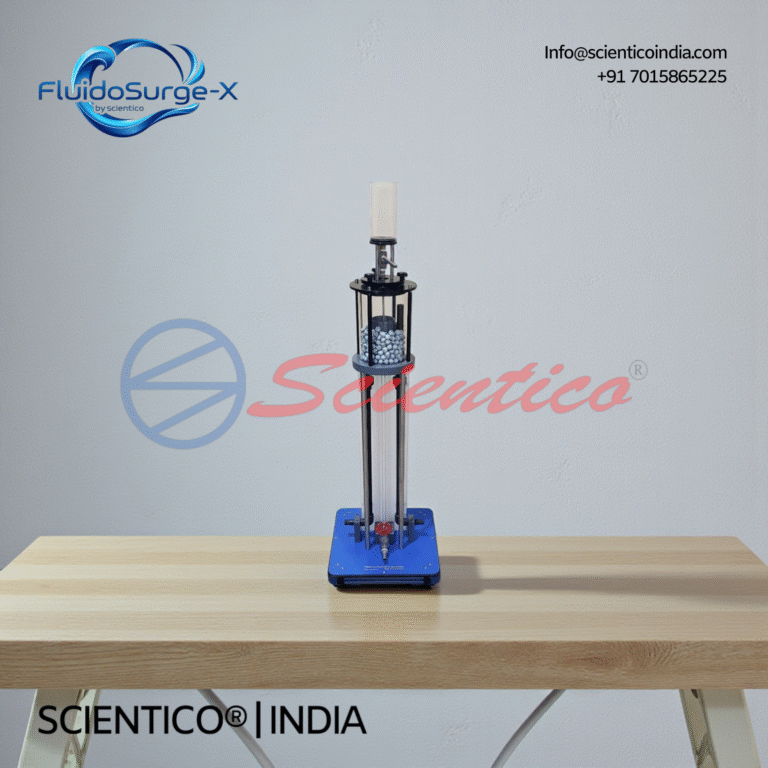
Osborne Reynold’s Apparatus | FluidoSurge-X 132
The Osborne Reynold's Apparatus FluidoSurge-X 132 is designed to demonstrate fundamental flow regimes in fluid mechanics. It enables visualization of laminar, transitional, and turbulent flow in a controlled environment. The apparatus allows determination of Reynolds number based on measured flow velocity. It is suitable for academic laboratory teaching and demonstration of classical flow behavior.
View product details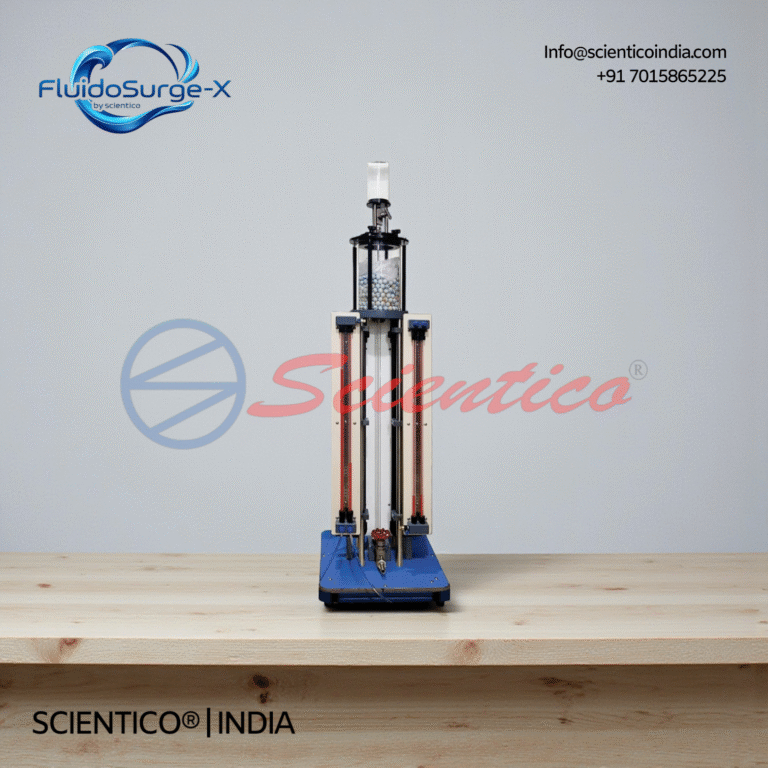
Osborne Reynold’s Apparatus with Manometer | FluidoSurge-X 133
The Osborne Reynold's Apparatus with Manometer FluidoSurge-X 133 is designed to study fundamental flow regimes in fluid mechanics. It enables visualization of laminar, transitional, and turbulent flow while measuring pressure differences along a test pipe. The apparatus supports determination of Reynolds number using volumetric flow measurement. It is suitable for structured laboratory teaching and demonstration of classical flow behavior.
View product details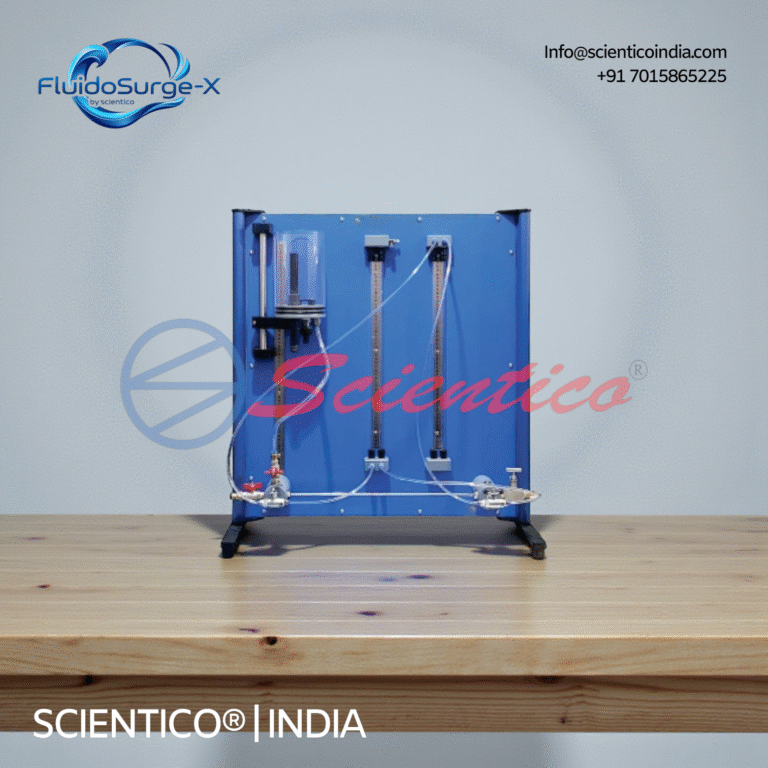
Pipe Friction Apparatus | FluidoSurge-X 168
The Pipe Friction Apparatus FluidoSurge-X 168 is designed for experimental determination of friction losses in pipe flow. It enables study of both laminar and turbulent flow regimes under controlled conditions. The apparatus allows measurement of head loss and determination of critical Reynolds number. It is suitable for fluid mechanics laboratory instruction and experimental analysis.
View product detailsAim of the Experiment
To study the nature of fluid flow (laminar, transitional, or turbulent) in a pipe and to determine the Reynolds number at which flow transitions occur.
Apparatus Required
- Reynolds number apparatus (transparent pipe with dye injection)
- Overhead dye reservoir (with food colouring or fluorescent dye)
- Flow control valve
- Measuring tank and stopwatch
- Thermometer
Theory
The Reynolds number (Re) is a dimensionless parameter that predicts the flow regime in a pipe. It is defined as:
Re = ρVD / μ = VD / ν
Where: ρ = fluid density (kg/m³), V = mean flow velocity (m/s), D = pipe internal diameter (m), μ = dynamic viscosity (Pa·s), ν = kinematic viscosity (m²/s).
Flow regimes: Re < 2000 → Laminar | 2000 < Re < 4000 → Transitional | Re > 4000 → Turbulent
Procedure
- Set up the apparatus and fill the overhead tank with water. Allow flow to stabilise.
- Open the dye injection valve slightly so a thin thread of dye enters the pipe.
- Start with a very low flow rate. Observe the dye thread, a straight, unbroken thread indicates laminar flow.
- Gradually increase the flow rate using the control valve.
- Note the flow rate at which the dye thread begins to waver (transitional flow).
- Continue increasing flow until the dye disperses completely across the pipe cross-section (turbulent flow).
- For each flow condition, collect water in the measuring tank over a known time and calculate discharge Q.
- Calculate velocity V = Q/A, then Re = VD/ν using the kinematic viscosity of water at the measured temperature.
Observation Table
| Sr. No. | Volume (L) | Time (s) | Q (m³/s) | V (m/s) | Re | Flow Type |
|---|---|---|---|---|---|---|
| 1 | Laminar | |||||
| 2 | Transitional | |||||
| 3 | Turbulent |
Result
Laminar flow observed up to Re = _______ | Transition begins at Re ≈ 2000 | Turbulent flow confirmed at Re > 4000. The experimental observations match the theoretical classification of flow regimes.
Precautions
- Use a very small quantity of dye to avoid disturbing the flow.
- Allow the flow to fully stabilise before taking observations.
- Record water temperature to obtain accurate kinematic viscosity values.
Internal Links
Related resources: Fluid Mechanics Lab Equipment | Pipe Friction Experiment | Bernoulli’s Theorem Experiment | Civil Engineering Lab Equipment List
Get Fluid Mechanics Lab Equipment
Scientico India manufactures ISO 9001:2015 and model-specific lab apparatus. Contact us for specifications and CIF pricing.
Scientico India manufactures this and the full range of Fluid Mechanics Lab equipment, model-specific and supplied to engineering colleges worldwide.
Explore Fluid Mechanics Lab Equipment → or request a quoteReynolds Number Experiment, Detailed Procedure and Observation Table
Step-by-Step Procedure
- Fill the Osborne Reynolds apparatus tank with water. Allow it to settle for 10–15 minutes to remove turbulence.
- Open the inlet valve slowly to allow water to flow through the glass visualisation tube at very low velocity.
- Open the dye injector valve to introduce a thin stream of coloured dye into the flow.
- Observe the dye filament: at very low flow, the dye forms a straight, undisturbed line, this is laminar flow.
- Gradually increase the flow rate by opening the outlet valve.
- At a certain flow rate, the dye filament begins to waver, this is the transition zone.
- At higher flow rates, the dye mixes completely with the water, this is turbulent flow.
- For each observation, collect water in a measuring cylinder over a timed period to calculate flow rate Q.
- Calculate velocity V = Q/A, then Re = ρVD/μ.
Observation Table
| Obs. No. | Volume collected (mL) | Time (s) | Q (m³/s) | V (m/s) | Re | Flow Type |
|---|---|---|---|---|---|---|
| 1 | Laminar | |||||
| 2 | Transitional | |||||
| 3 | Turbulent |
Sample Calculation
Pipe diameter D = 0.025 m, A = π×D²/4 = 4.91×10⁻⁴ m²
Water density ρ = 997 kg/m³ at 25°C
Dynamic viscosity μ = 8.9×10⁻⁴ Pa·s at 25°C
Collected volume = 1500 mL in 30 s → Q = 1.5×10⁻³/30 = 5×10⁻⁵ m³/s
V = Q/A = 5×10⁻⁵ / 4.91×10⁻⁴ = 0.102 m/s
Re = ρVD/μ = 997 × 0.102 × 0.025 / 8.9×10⁻⁴ = 2,856 (transitional flow)
Critical Reynolds Numbers
- Re < 2000: Laminar flow, dye stream remains straight and stable
- 2000 < Re < 4000: Transitional flow, unstable, fluctuating between laminar and turbulent
- Re > 4000: Turbulent flow, dye mixes completely, flow chaotic
Significance in Engineering
The Reynolds number governs pipe flow design, heat exchanger performance, pump and turbine selection, aerodynamic drag, and chemical reactor mixing. For pipe flow, the friction factor (needed for pressure drop calculation) depends on Re and the Moody chart.
Choosing between visualisation, manometer and horizontal configurations? Use the Osborne Reynolds apparatus comparison and selection guide before preparing the experiment specification.
One honest ask
We don't gate anything on this site. You just read the whole thing free. If it was useful, leave your email and two things happen: we send you this page as a plain-text block you can paste into a tender file or an internal email, and we notify you the next time we publish a buyer tool like this one. Nothing else. No drip sequence, no sales calls booked without asking.