Temperature Control Training System | NexuMation 67
The Temperature Control Training System NexuMation 67 is an experimental unit for learning control engineering fundamentals using a heated metal bar. This temperature control training system uses a Peltier element rated 382W at 300K and 443W at 50°C, with three K-Type Thermocouples along the bar axis. Temperature control range is approx. 0…100°C. A software-activated fan generates disturbances, and LabVIEW-style software configures P, PI, PID and switching control via USB under Windows 10.
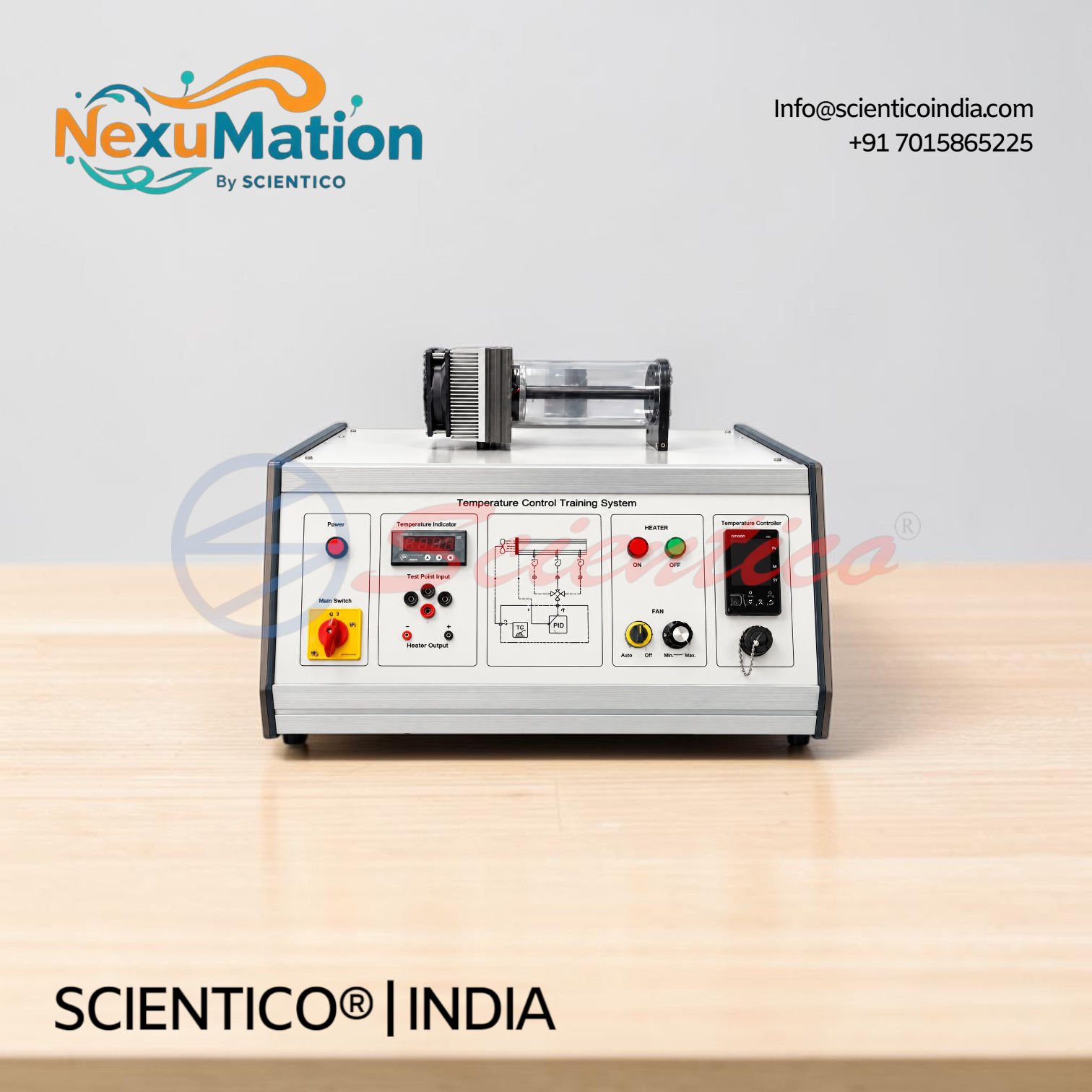
The Temperature Control Training System NexuMation 67 offers a way to learn the basic fundamentals of control engineering. This temperature control training system uses a metal bar heated or cooled at one end by a Peltier element. The experimental set-up is mounted on a housing which accommodates all the electronics.
Product Overview
The temperature control training system has a metal bar placed inside a transparent casing. One end is heated or cooled by a Peltier element.
Three temperature transducers along the axis of the bar allow the variation in temperature along the bar’s length to be obtained. This gives the associated thermal lags for differing operating conditions. A dial temperature indicator allows the temperature to be read off directly at any time. Temperature is measured using K-Type Thermocouples.
The sensor output signal is sent to the software controller. The output signal from the controller influences the operating voltage of the Peltier element and hence the heating capacity. A fan that dissipates part of the heating power can be activated by the software to investigate the influence of disturbance variables.
The powerful state-of-the-art software is an integral part of the training system and embodies the principle of hardware/software integration (HSI). It enables experiments to be conducted and evaluated in a user-friendly manner. The link between the experimental unit and the PC is made via a USB port.
Temperature Control Training System NexuMation 67: Technical Specifications
| Parameter | Value |
|---|---|
| Unit Type | Experimental unit for control engineering experiments |
| Housing | Accommodates all electronics |
| Process | Temperature control of a heated metal bar |
| Heating/Cooling | Peltier element |
| Temperature Sensing | 3 K-Type Thermocouples along bar axis |
| Disturbance Generation | Software-activated fan |
| Front Panel | Process schematic |
| Data Acquisition | DAQ with simulation software via USB under Windows 10 |
| Controller Configurations | P, PI, PID and switching controller |
Technical Data
| Parameter | Value |
|---|---|
| Peltier element power consumption | 382W at 300K, 443W at 50°C |
| Peltier element operation | DC voltage |
| Heated bar | D x L: 15x140mm, aluminum |
| Temperature sensor | K-Type Thermocouple |
| Temperature indicator | Digital |
| Fan power consumption | 2W |
| Fan max flow rate | 40m³/h |
| Temperature control range | approx. 0…100°C |
Key Features
- Application: temperature control training system for control engineering fundamentals
- Housing: accommodates all electronics
- Heated Bar: aluminum, D x L 15x140mm
- Heating/Cooling: Peltier element, DC voltage, 382W at 300K / 443W at 50°C
- Temperature Sensing: 3 K-Type Thermocouples, digital indicator
- Disturbance Generation: software-activated fan, 2W, 40m³/h
- Control Range: approx. 0…100°C
- Controller: software configurable as P, PI, PID and switching
- Software: hardware/software integration (HSI)
- Connection: USB, Windows 10
Experiments
- Fundamentals of control engineering based on the example of a temperature control system
- System dead time can be obtained from the response
- Open loop control response
- Effects of different controller parameters and methods on the response of the closed loop system
- Recording of step responses (Reference variable / Disturbance variable)
Construction and Design
The Temperature Control Training System NexuMation 67 is mounted on a housing that accommodates all the electronics. A metal bar sits inside a transparent casing. One end of the bar is heated or cooled by a Peltier element.
Three temperature transducers are placed along the axis of the bar. They establish thermal lags at different operating conditions. A dial temperature indicator gives a direct reading. Temperature is measured using K-Type Thermocouples.
A fan dissipates part of the heating power. It can be activated by the software to generate disturbance variables. The temperature control training system has a process schematic on the front panel. The experimental unit connects to the PC via a USB port.
Software
- Powerful state-of-the-art software, integral part of the training system
- Hardware/software integration (HSI)
- DAQ with simulation software via USB under Windows 10
- Configurable as P, PI, PID and switching controller
- Process schematic with controller type selection: manual, continuous controller, two or three-point controller, programmer
- Disturbance variable input
Q1. What does the temperature control training system teach?
It teaches the basic fundamentals of control engineering, using a heated metal bar as the example.
Q2. How is the bar heated and cooled?
By a Peltier element, operated by DC voltage. Power consumption is 382W at 300K and 443W at 50°C.
Q3. How is temperature measured?
By three K-Type Thermocouples along the axis of the bar, with a digital temperature indicator for direct reading.
Q4. How are disturbances introduced?
A fan that dissipates part of the heating power is activated by the software. It consumes 2W with a max flow rate of 40m³/h.
Q5. Which controller types can be configured?
The software controller is configurable as P, PI, PID and switching controller. Manual, continuous, two or three-point controller, and programmer options are also selectable.
Need Assistance? We're Here to Help!
Connect with our team for product specifications, pricing, and customized solutions for your institution or project.