
What is Coefficient of Performance (COP)?
The Coefficient of Performance (COP) is a measure of the efficiency of a refrigeration or heat pump system. It is the ratio of useful heat energy moved to the work energy input required to move it.
A higher COP means greater efficiency — more cooling or heating is achieved per unit of electrical energy consumed.
COP Formula for Refrigerators
COP_refrigerator = Q_L / W_net
Where:
- Q_L = Heat removed from the cold reservoir (refrigeration effect), kJ
- W_net = Net work input to the compressor, kJ
For a Carnot refrigerator (theoretical maximum):
COP_Carnot = T_L / (T_H – T_L)
Where T_H and T_L are the absolute temperatures (Kelvin) of the hot and cold reservoirs.
COP Formula for Heat Pumps
COP_HP = Q_H / W_net = COP_R + 1
A heat pump always has COP > 1, and COP_HP = COP_R + 1 (where COP_R is the COP of the same system used as a refrigerator).
Vapour Compression Refrigeration Cycle
The standard refrigeration cycle consists of four processes:
- 1→2: Isentropic Compression — refrigerant compressed in the compressor (work input)
- 2→3: Condensation — refrigerant rejects heat Q_H at constant pressure in condenser
- 3→4: Throttling (Expansion) — pressure drop through expansion valve (irreversible, no work output)
- 4→1: Evaporation — refrigerant absorbs heat Q_L at constant pressure in evaporator
P-H Diagram for Refrigeration
The vapour compression cycle is best analysed on a Pressure-Enthalpy (P-H) diagram:
- Refrigerating effect: Q_L = h₁ – h₄ (enthalpy at evaporator outlet minus inlet)
- Compressor work: W = h₂ – h₁
- Heat rejected: Q_H = h₂ – h₃
- COP = Q_L / W = (h₁ – h₄) / (h₂ – h₁)
Factors Affecting COP
| Factor | Effect on COP |
|---|---|
| Lower evaporator temperature | Reduces COP (greater temperature lift) |
| Higher condenser temperature | Reduces COP |
| Refrigerant type | Different P-H properties; R-134a, R-410A, R-32 used in modern systems |
| Compressor efficiency | Higher isentropic efficiency → higher COP |
| Sub-cooling in condenser | Increases refrigerating effect, improves COP slightly |
| Super-heating in evaporator | Increases compressor work; slight increase in Q_L |
Refrigeration Cycle Experiment
Using the Refrigeration Trainer, students:
- Record temperatures and pressures at all four cycle points
- Measure compressor power input (kW)
- Determine enthalpy values from P-H chart for the refrigerant used
- Calculate actual COP and compare with Carnot COP
- Draw the actual cycle on the P-H diagram
Scientico India’s refrigeration trainer is available with R-134a or R-410A refrigerant, CE certified and ISO 9001:2015 compliant. Request a quote for your mechanical engineering department.
Scientico India manufactures this and the full range of Heat Transfer & Thermodynamics equipment — CE-certified and supplied to engineering colleges worldwide.
Explore Heat Transfer & Thermodynamics Equipment → or request a quote
COP Calculation — Detailed Example with Pressure-Enthalpy Diagram
Standard Vapour Compression Refrigeration Cycle
The vapour compression refrigeration cycle consists of four processes on the p-h (pressure-enthalpy) diagram:
- 1→2 (Compression): Isentropic compression in compressor. Low-pressure refrigerant vapour is compressed to high pressure. Temperature rises.
- 2→3 (Condensation): Heat rejection to atmosphere in condenser. High-pressure vapour condenses to liquid at constant pressure.
- 3→4 (Expansion): Throttling through expansion valve. High-pressure liquid flashes to low-pressure wet vapour at constant enthalpy (h₃ = h₄).
- 4→1 (Evaporation): Heat absorption from refrigerated space in evaporator. Wet vapour evaporates at constant pressure and temperature.
COP Formula and Calculation
COP = Refrigerating effect / Work input = (h₁ – h₄) / (h₂ – h₁)
where h₁, h₂, h₃, h₄ are enthalpies at states 1, 2, 3, 4 respectively.
Sample Calculation (R-134a at Typical Lab Conditions)
Evaporator temperature: -10°C → Evaporator pressure ≈ 2.0 bar
Condenser temperature: 40°C → Condenser pressure ≈ 10.2 bar
From R-134a tables:
h₁ = 392.4 kJ/kg (saturated vapour at -10°C)
h₂ = 430.5 kJ/kg (superheated at 10.2 bar, after isentropic compression)
h₃ = 256.5 kJ/kg (saturated liquid at 40°C)
h₄ = h₃ = 256.5 kJ/kg (throttling, constant enthalpy)
Refrigerating effect = h₁ – h₄ = 392.4 – 256.5 = 135.9 kJ/kg
Work input = h₂ – h₁ = 430.5 – 392.4 = 38.1 kJ/kg
COP_actual = 135.9/38.1 = 3.57
COP_Carnot = T_L/(T_H – T_L) = 263/(313-263) = 5.26
Refrigerating efficiency = COP_actual / COP_Carnot = 3.57/5.26 = 67.9%
Factors Affecting COP
- Higher evaporator temperature → higher COP
- Lower condenser temperature → higher COP
- Superheating at compressor inlet → slight improvement (drier compression)
- Subcooling at condenser exit → increases refrigerating effect → improves COP
- Compressor efficiency (mechanical and volumetric) → lower actual COP than ideal
Lab Equipment Featured in This Guide
Manufactured in-house by Scientico India — ISO 9001:2015 & CE certified, exported to 60+ countries. Request a CIF quote within 24 hours.
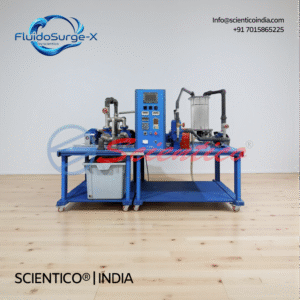 Multi Pump Test Rig with 4 Pumps | FluidoSurge-X 345View details & get quote →
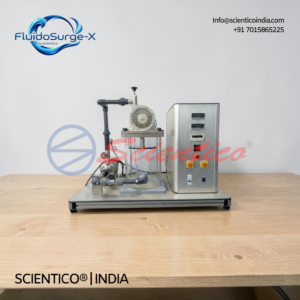 Turbine Service Unit | FluidoSurge-X 394View details & get quote →
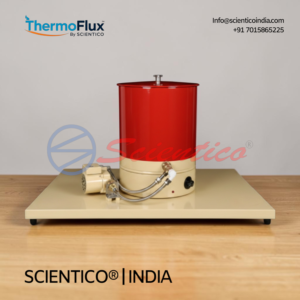 Unsteady State Heat Transfer Module | ThermoFlux – 7049/5View details & get quote →
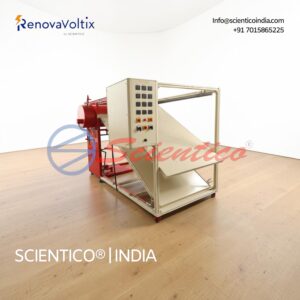 Solar Thermal Trainer | RVX-010View details & get quote →
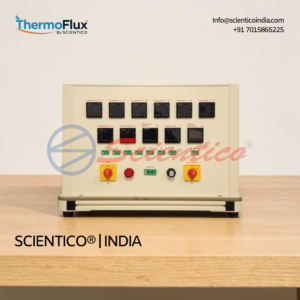 Heat Transfer Service Unit | ThermoFlux – 7049View details & get quote →
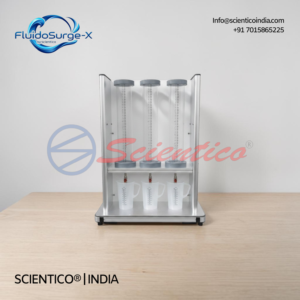 Demonstration Infiltration Apparatus | FluidoSurge-X 396View details & get quote →