
Equipment mentioned in this guide
Review the product information, specifications and model before requesting a quotation.
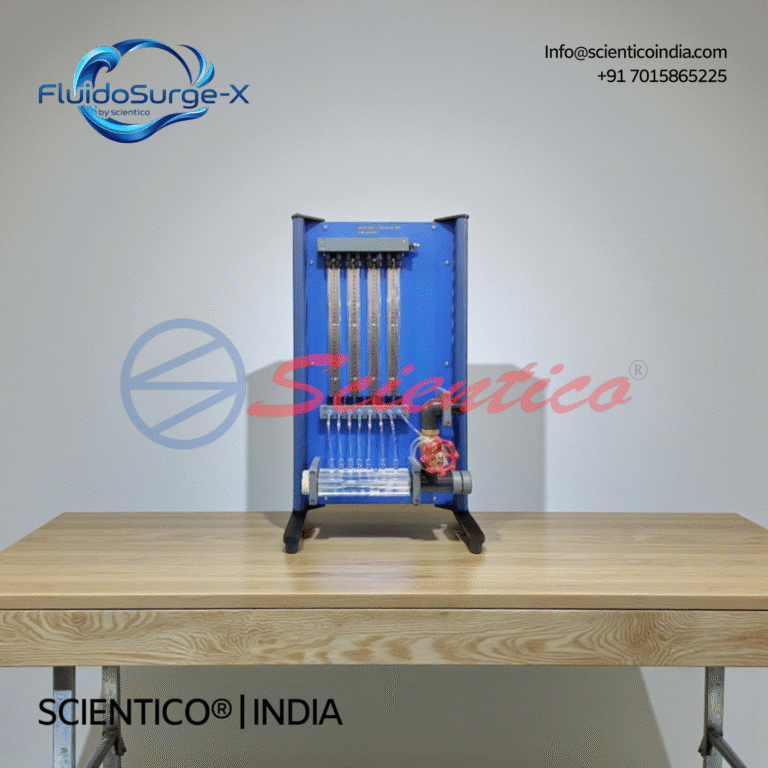
Bernoulli’s Theorem Apparatus | FluidoSurge-X 120
The Bernoulli's Theorem Apparatus FluidoSurge-X 120 is designed for experimental verification of Bernoulli’s principle in fluid mechanics laboratories. It enables detailed study of pressure, velocity, and energy variations along a converging and diverging duct. The apparatus uses a transparent Venturi test section with multiple pressure tapping points. It is intended for structured academic experiments and analytical comparison with theoretical flow behavior.
View product detailsBernoulli’s Equation
Bernoulli’s equation is one of the most important equations in fluid mechanics. It expresses the conservation of energy along a streamline for steady, incompressible, inviscid flow:
P/ρg + V²/2g + z = constant
Or equivalently:
P₁/ρg + V₁²/2g + z₁ = P₂/ρg + V₂²/2g + z₂
Where:
- P = static pressure (Pa)
- ρ = fluid density (kg/m³)
- g = gravitational acceleration (9.81 m/s²)
- V = fluid velocity (m/s)
- z = elevation above datum (m)
Each term represents a head (pressure head + velocity head + elevation head = total head = constant).
Derivation from Work-Energy Theorem
Bernoulli’s equation can be derived by applying Newton’s second law (F = ma) along a streamline to a fluid element, or by applying the first law of thermodynamics to a control volume of inviscid, steady, incompressible flow. Key steps:
- Consider a fluid element of mass dm moving along a streamline
- Forces acting: pressure forces on both faces + component of gravity
- Apply F = ma along the streamline (Euler’s equation)
- Integrate Euler’s equation along the streamline
- Result: P + ½ρV² + ρgz = constant
Assumptions of Bernoulli’s Equation
- Steady flow, fluid properties at any point do not change with time
- Incompressible flow, constant fluid density (valid for liquids; gases below Mach 0.3)
- Inviscid flow, no viscous (frictional) effects (no energy loss)
- Along a streamline, the equation applies between two points on the same streamline
- No work or heat transfer between the two points considered
Applications of Bernoulli’s Equation
| Application | How Bernoulli’s is Used |
|---|---|
| Venturi meter | Pressure difference between throat and inlet gives flow velocity |
| Pitot tube | Stagnation pressure minus static pressure gives velocity |
| Orifice plate | Flow rate from upstream and throat pressures |
| Aerofoil / aircraft lift | Higher velocity over the upper surface → lower pressure → lift |
| Carburetor | High-velocity air in venturi creates low pressure, draws fuel |
| Siphon | Negative gauge pressure at the top of the siphon drives flow |
Limitations of Bernoulli’s Equation
- Not valid for viscous flow, ignores friction losses (pipe flow needs the Darcy-Weisbach equation)
- Not valid for compressible flow at high Mach numbers
- Not valid across turbomachinery (pumps, fans, turbines), work is added or extracted
- Not valid across shock waves
- Only along a streamline, different streamlines can have different Bernoulli constants unless flow is irrotational
Modified Bernoulli’s Equation (with Head Loss)
For real fluid flow with friction losses and/or pump work:
P₁/ρg + V₁²/2g + z₁ + h_pump = P₂/ρg + V₂²/2g + z₂ + h_L
Where h_pump = energy added by pump per unit weight, and h_L = head loss due to friction and minor losses.
Lab Experiment
The Bernoulli’s Theorem Apparatus consists of a convergent-divergent section with pressure tappings at multiple points. Students:
- Set a steady flow rate through the apparatus
- Read the piezometric (static) head at each tapping using a manometer bank
- Measure the flow velocity using a rotameter or by timing collection
- Calculate the total head at each tapping and verify it is constant (Bernoulli’s theorem)
- Observe how static pressure decreases and velocity increases at the throat
Contact Scientico India for model-specific Bernoulli’s Theorem Apparatus for your fluid mechanics lab.
Scientico India manufactures this and the full range of Fluid Mechanics Lab equipment, model-specific and supplied to engineering colleges worldwide.
One honest ask
We don't gate anything on this site. You just read the whole thing free. If it was useful, leave your email and two things happen: we send you this page as a plain-text block you can paste into a tender file or an internal email, and we notify you the next time we publish a buyer tool like this one. Nothing else. No drip sequence, no sales calls booked without asking.