
The IC engine performance test loads an internal combustion engine on a dynamometer to measure its brake power, indicated power, efficiencies, and specific fuel consumption. It is one of the most important thermodynamics and automobile-engineering practicals, turning the theory of the engine cycle into real performance curves.
Equipment mentioned in this guide
Review the product information, specifications and model before requesting a quotation.
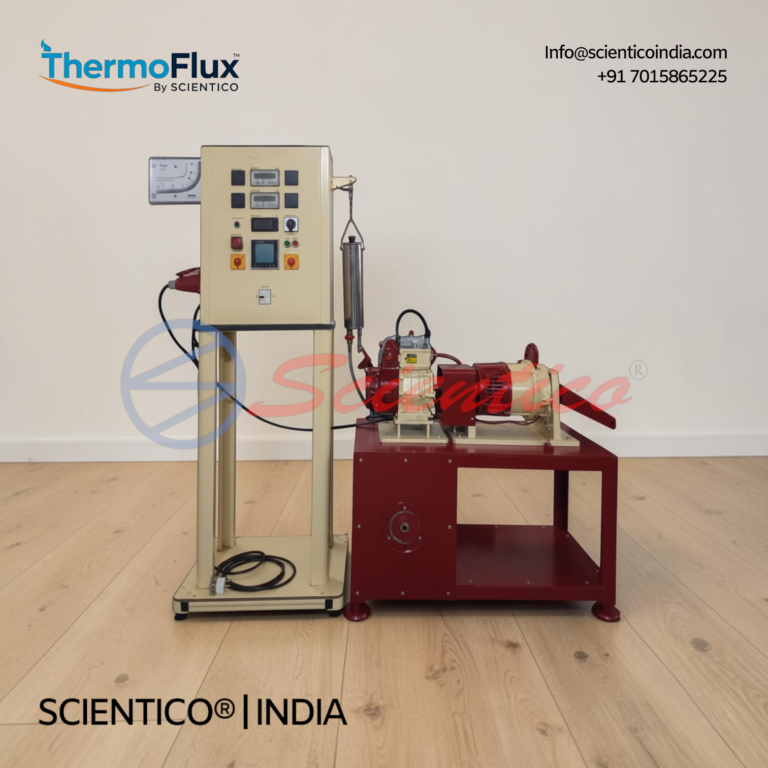
Engine Test Bed | ThermoFlux – 7080
The Engine Test Bed ThermoFlux - 7080 is a self-contained, bench-mounting laboratory unit designed for the investigation of internal combustion engine performance, efficiency, and fuel consumption across multiple engine types. This engine test bed is supplied with three interchangeable engines as standard, a single-cylinder four-stroke gasoline engine, a single-cylinder four-stroke diesel engine, and a higher-capacity four-stroke diesel engine, along with an eddy current dynamometer, dual fuel tanks, air induction system, and full instrumentation for comprehensive engine testing.
View product detailsAim of the experiment
To conduct a load test on a petrol or diesel engine and determine its brake power, indicated power, mechanical efficiency, brake thermal efficiency, and specific fuel consumption.
Theory and key formulas
Brake power (BP) is the useful power available at the engine shaft, measured with a dynamometer:
BP = 2πNT / 60000 (kW), where N is speed (rpm) and T is torque (N·m), with T = load × brake-arm radius.
Indicated power (IP) is the power actually developed inside the cylinder. It equals brake power plus the power lost to friction:
IP = BP + FP (friction power FP is found from a Morse test on multi-cylinder engines or a Willan’s line on diesel engines).
Mechanical efficiency = BP / IP. Brake thermal efficiency = BP / (mf × CV), where mf is fuel mass flow rate (kg/s) and CV is the calorific value of the fuel (kJ/kg). Specific fuel consumption (SFC) = mf / BP (kg/kWh), the fuel used per unit of power output.
Apparatus required
- IC engine test rig (petrol or diesel) with a dynamometer (rope brake, hydraulic, or eddy-current)
- Fuel measuring burette and stopwatch
- Tachometer and load-measuring arrangement
- Cooling-water and exhaust-gas instrumentation (for a heat balance)
Procedure
- Start the engine and let it reach the rated speed and steady temperature.
- Apply load in increments using the dynamometer.
- At each load, record speed, load (torque), and the time taken to consume a fixed volume of fuel.
- Compute BP, SFC, and the efficiencies at each load.
- Plot performance curves: BP versus SFC, BP versus brake thermal efficiency, and BP versus mechanical efficiency.
Observations and result
The performance curves show how the engine behaves with load: brake thermal efficiency rises and then levels off, while specific fuel consumption is lowest near the engine’s most efficient operating point. These curves are what manufacturers use to rate and tune engines.
Applications
Engine performance testing underpins automobile, generator-set, and pump engine development, tuning, and emissions work. The calorific value used in the thermal-efficiency calculation comes from the bomb calorimeter experiment, and the air-compression side is studied on a compressor test rig. For the cooling and refrigeration side of thermodynamics, see the refrigeration cycle experiment and the terms in our engineering lab glossary.
Frequently asked questions
What is the difference between brake power and indicated power?
Indicated power is the power developed inside the cylinder; brake power is the useful power at the shaft. The difference is the friction power lost in the engine.
What is specific fuel consumption?
Specific fuel consumption (SFC) is the mass of fuel used per unit of power output (kg/kWh); a lower SFC means a more economical engine.
How is mechanical efficiency of an engine found?
Mechanical efficiency is the ratio of brake power to indicated power; indicated power is obtained by adding the friction power (from a Morse or Willan’s test) to the measured brake power.
Need an IC engine test rig with dynamometer for your lab? Request a quote from Scientico India, ISO 9001:2015 certified, documentation reviewed per model, exporting to 30+ countries, reply within 24 hours.
One honest ask
We don't gate anything on this site. You just read the whole thing free. If it was useful, leave your email and two things happen: we send you this page as a plain-text block you can paste into a tender file or an internal email, and we notify you the next time we publish a buyer tool like this one. Nothing else. No drip sequence, no sales calls booked without asking.