
The plate heat exchanger experiment determines the heat duty, log mean temperature difference (LMTD), overall heat-transfer coefficient, and effectiveness of a plate-type exchanger in both parallel- and counter-flow. Plate heat exchangers deliver very high heat transfer in a compact size, which is why they dominate dairy, HVAC, and process cooling.
Equipment mentioned in this guide
Review the product information, specifications and model before requesting a quotation.
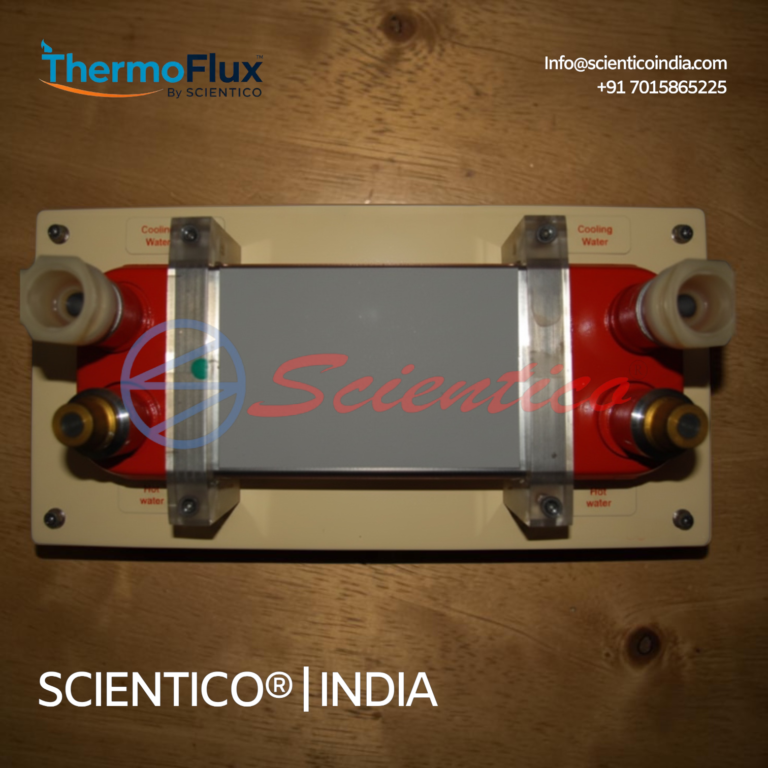
Plate Type Heat Exchanger | ThermoFlux – 7108/1
The Plate Type Heat Exchanger ThermoFlux - 7108/1 is a laboratory heat transfer unit for studying heat exchange between hot and cold water through a plate heat exchanger under parallel flow and counter flow configurations. This plate type heat exchanger features stainless steel sealed plates, an anodized aluminium structure, and a front panel with a process diagram matching the real unit layout. Hot and cold water temperatures are measured at both inlet and outlet, with a pump for hot water circulation and a cold water valve for flow type selection.
View product detailsAim of the experiment
To determine the LMTD, overall heat-transfer coefficient (U), and effectiveness of a plate heat exchanger in parallel and counter flow.
Theory and formulas
The heat lost by the hot fluid equals the heat gained by the cold fluid:
- Q = mh ch (Th,in − Th,out) = mc cc (Tc,out − Tc,in)
- LMTD: ΔTlm = (ΔT₁ − ΔT₂) / ln(ΔT₁/ΔT₂)
- Overall coefficient: U = Q / (A · ΔTlm)
- Effectiveness: ε = Qactual / Qmax, where Qmax = Cmin(Th,in − Tc,in)
For the same terminal temperatures, counter-flow gives a larger LMTD than parallel-flow, so it transfers more heat, the key practical takeaway.
Apparatus required
- Plate heat exchanger test rig with a corrugated plate pack
- Hot-water tank with heater and a cold-water supply
- Flow-control valves to switch between parallel and counter flow
- Flow meters and inlet/outlet thermometers on both streams
Procedure
- Set the hot and cold flow rates and switch the valves to parallel flow.
- Allow temperatures to stabilise; record all four inlet/outlet temperatures and both flow rates.
- Switch to counter flow and repeat the readings.
- Compute Q, LMTD, U, and effectiveness for each arrangement and compare.
Result
Counter-flow shows a higher LMTD, overall coefficient, and effectiveness than parallel-flow, demonstrating why industrial exchangers are run counter-flow.
Applications
Plate heat exchangers are used in dairy pasteurisation, HVAC, and chemical process heating and cooling. Compare them with the double-pipe heat exchanger and shell-and-tube heat exchanger experiments; LMTD and effectiveness are defined in the engineering lab glossary.
Frequently asked questions
Why is a plate heat exchanger more efficient than a shell-and-tube?
The corrugated plates create turbulence and provide a very large surface area per unit volume, giving a higher heat-transfer coefficient in a compact unit.
Why does counter-flow transfer more heat than parallel-flow?
Counter-flow maintains a larger and more uniform temperature difference along the exchanger, which gives a higher LMTD and more heat transfer.
What is the overall heat-transfer coefficient U?
U combines the convective and conductive resistances of the exchanger and is found from U = Q / (A · LMTD).
Need a plate heat exchanger test rig for your lab? Request a quote from Scientico India, ISO 9001:2015 certified, documentation reviewed per model, exporting to 30+ countries, reply within 24 hours.
Specify the heat-exchanger experiment around the energy balance
The useful result comes from stable hot- and cold-side inlet and outlet measurements, known flow rates and a declared flow arrangement. The RFQ should say whether students must compare co-current and counter-current operation, calculate LMTD, estimate an overall coefficient or study effectiveness. Sensor placement and the way flow is measured affect every calculation.
What to confirm before requesting a quotation
- Identify the required flow arrangements and plate configuration.
- Confirm temperature and flow measuring points, ranges and indication.
- State heating, cooling-water, pump and electrical requirements.
- Ask for the experiment method, calculation sheet and included hoses or valves.
For an international order, also state the quantity, destination, electrical supply, documentation, installation or training needs and requested delivery basis. Treat catalogue information as a starting point; the current model page, datasheet and written quotation must confirm the exact configuration.
Plate heat exchanger trainer: measurements and operating scope
One honest ask
We don't gate anything on this site. You just read the whole thing free. If it was useful, leave your email and two things happen: we send you this page as a plain-text block you can paste into a tender file or an internal email, and we notify you the next time we publish a buyer tool like this one. Nothing else. No drip sequence, no sales calls booked without asking.
Choosing the plate heat-exchanger apparatus: what the published record must show
A plate heat-exchanger offer is comparable only when the plate arrangement, limits and instrumentation are stated. The Scientico record for the plate type heat exchanger ThermoFlux-7108-1 publishes the facts below; use them as the comparison baseline for any offer.
| Decision | What the record must state | ThermoFlux-7108-1 published fact |
|---|---|---|
| Plate construction | Plate material and sealing method | Stainless steel plates, sealed plates |
| Plate count | Maximum number of plates offered | 10 or more |
| Transfer area | Total heat-transfer area | More than 0.21 m² |
| Circuit capacities | Internal and external circuit volumes | Internal more than 0.250 L; external 0.250 L |
| Operating limits | Maximum flow and working pressure | 30 m³/h maximum flow; 30 bar maximum working pressure |
| Hot-side circulation | How the hot circuit is driven | Pump-driven hot-water circulation |
| Cold-side supply | Cold-water source requirement | External source, e.g. a hydraulic bench, with cold-water valve selection |
| Measurement | Which temperatures are measured and where | Hot and cold water at inlet and outlet |
| Panel and materials | Construction and process display | Anodized aluminium structure, HDF panel, stainless steel or brass water-contact elements, front-panel process diagram |
LMTD and effectiveness need four temperatures. The experiment requires hot and cold inlet/outlet temperatures simultaneously, so confirm all four measurement points are included rather than inferred. Where the cold side runs from a hydraulic bench, state the bench model in the enquiry so connections are quoted correctly.
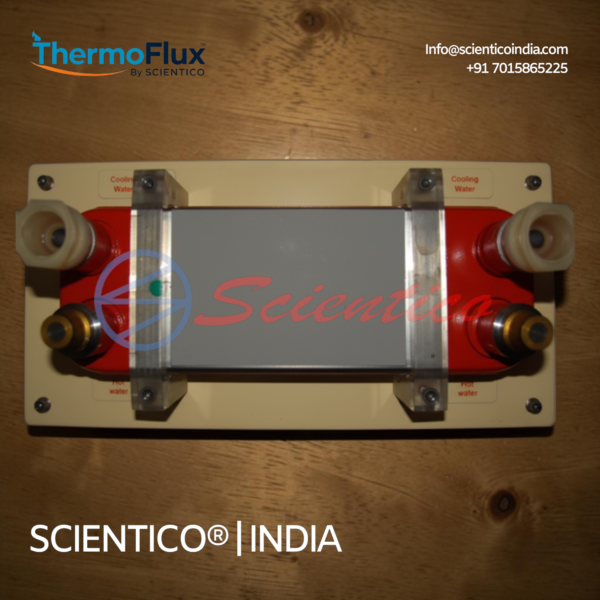 VERIFIED SCIENTICO PRODUCT PATHPlate Type Heat Exchanger | ThermoFlux – 7108/1
Open the current product record, then confirm the offered measurement points, accessories, utilities and documentation in the quotation.
Review the product →