
Every mechanical and civil engineering programme runs a fluid mechanics laboratory, and the syllabus — whether AICTE model curriculum, a state technical university scheme, or an international programme aligned to ABET — converges on the same core experiment set. This guide lists the 15 experiments that appear in virtually every fluid mechanics lab manual, the apparatus each one requires, and what students actually learn from it. It is written from our experience at Scientico India manufacturing and installing fluid mechanics labs for engineering colleges in India and 60+ countries since 1993.
The 15 Core Fluid Mechanics Lab Experiments
| # | Experiment | Apparatus required | Core concept verified |
|---|---|---|---|
| 1 | Verification of Bernoulli’s theorem | Bernoulli’s theorem apparatus + hydraulic bench | Energy conservation along a streamline |
| 2 | Reynolds number & flow regimes | Reynolds apparatus (dye injection) | Laminar vs turbulent transition (~Re 2300) |
| 3 | Discharge through a venturimeter | Venturimeter test rig | Cd determination, differential head flow measurement |
| 4 | Discharge through an orificemeter | Orificemeter test rig | Cd comparison against venturimeter |
| 5 | Flow over notches (V & rectangular) | Notch tank / hydraulic bench accessory | Open-channel discharge measurement |
| 6 | Friction losses in pipes | Pipe friction apparatus | Darcy-Weisbach friction factor |
| 7 | Minor losses in pipe fittings | Losses-in-fittings apparatus | K-values for bends, elbows, sudden expansion |
| 8 | Impact of jet on vanes | Impact of jet apparatus | Momentum equation, force on flat/curved vanes |
| 9 | Metacentric height of a floating body | Metacentric height apparatus | Buoyancy and floating stability |
| 10 | Orifice & mouthpiece coefficients | Orifice & mouthpiece apparatus | Cc, Cv, Cd determination |
| 11 | Pitot tube velocity measurement | Pitot tube apparatus | Stagnation vs static pressure |
| 12 | Centrifugal pump characteristics | Centrifugal pump test rig | Head-discharge-efficiency curves |
| 13 | Pelton wheel turbine performance | Pelton wheel turbine test rig | Impulse turbine efficiency curves |
| 14 | Francis/Kaplan turbine performance | Reaction turbine test rig | Reaction turbine characteristics |
| 15 | Free & forced vortex | Vortex apparatus | Vortex surface profiles |
The Hydraulic Bench: the Backbone of the Lab
Experiments 1, 3, 4, 5, 8, 9 and 10 are all bench-mounted accessories that share one hydraulic bench as their water supply and measuring station. This is the single most important purchasing decision in a fluid mechanics lab: a bench with a stable pump (typically 0.5–1 HP), a volumetric measuring tank with sight gauge, and quick-coupling connections lets one bench serve six or more experiments. Colleges that buy standalone rigs for each experiment typically spend 30–40% more and need double the floor space.
What the Key Experiments Teach (and Where They Go Wrong)
Bernoulli’s theorem
Students measure piezometric head along a convergent–divergent duct and verify that total head stays (nearly) constant. The classic failure mode is air bubbles in the manometer lines — good apparatus includes bleed valves at every tapping. See our Bernoulli’s theorem apparatus specification for the 14-tapping design we supply.
Reynolds experiment
The dye filament visualisation is the most memorable demonstration in the course — laminar flow shows a straight dye line, turbulence disperses it. The critical detail is a constant-head inlet tank; without it the transition Reynolds number drifts between runs.
Pipe friction
Students plot friction factor against Reynolds number and compare with the Moody chart. Rigs should offer at least two pipe diameters so students see the diameter effect on head loss — a requirement in most university lab manuals.
Pelton wheel
The efficiency-versus-speed curve peaks near half the jet velocity, exactly as theory predicts — one of the few undergraduate experiments where theory and measurement agree within a few percent on well-made apparatus. A spring balance or rope brake dynamometer plus a spear valve for flow control are essential.
Planning the Lab: Space, Water and Power
- Floor space: a 12-experiment lab for 30 students fits comfortably in 90–120 m² with bench-based planning.
- Water: closed-circuit apparatus (each unit has its own sump and pump) avoids continuous mains water — important where supply is intermittent.
- Power: most rigs run on single-phase 230 V; only larger turbine and pump test rigs need three-phase supply.
- Drainage: a perimeter floor drain saves years of housekeeping trouble.
Budgeting and Procurement
A complete 15-experiment fluid mechanics lab, ISO 9001:2015 and CE certified, is typically the least expensive of the core mechanical labs — browse the full fluid mechanics equipment range for specifications. For pump experiments beyond the single centrifugal rig, a multi pump test rig adds series and parallel operation to the same syllabus slot. If you are setting up a lab for accreditation, our guide to ABET and Washington Accord lab equipment requirements maps each experiment to the relevant student outcome, and the engineering lab glossary gives the formula and units for every quantity measured above. For a CIF quotation covering the full list, Scientico India issues a proforma invoice within 24 hours.
Frequently Asked Questions
How many experiments does a fluid mechanics lab need for university approval?
Most Indian technical universities prescribe 8–12 experiments per semester course; the 15 listed here cover every mainstream syllabus including electives. International programmes under the Washington Accord look for outcome coverage rather than a fixed count.
Can one hydraulic bench really run multiple experiments?
Yes — bench-mounted accessories (Bernoulli, venturimeter, orifice, notches, impact of jet, metacentric height) are designed to interchange on a common bench in under five minutes, which is how most modern labs are specified.
What is the typical delivery time for a complete lab?
For a full fluid mechanics lab, manufacture and testing typically takes 4–6 weeks, plus shipping. Scientico supplies with calibration certificates, IS/ISO-referenced test reports, and installation manuals in English.
Which experiments matter most if the budget only covers half the list?
Prioritise the hydraulic bench with Bernoulli, venturimeter/orifice, pipe friction, impact of jet, and one pump or turbine rig — these cover energy, flow measurement, losses, momentum and machines: the five pillars every examiner expects.
Lab Equipment Featured in This Guide
Manufactured in-house by Scientico India — ISO 9001:2015 & CE certified, exported to 60+ countries. Request a CIF quote within 24 hours.
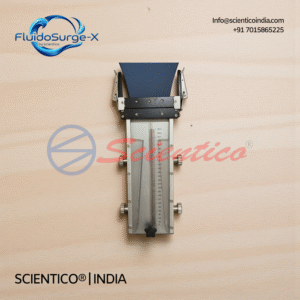 Boundary Layers Module | FluidoSurge-X 356View details & get quote →
 Advanced Hydrological Investigations Apparatus | FluidoSurge-X 278View details & get quote →
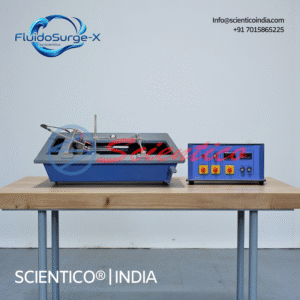 Visualization of Flow Fields | FluidoSurge-X 298View details & get quote →
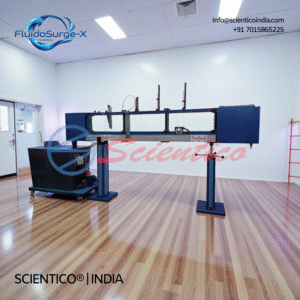 Multi-Purpose Teaching Flume (Length 2.5 m) | FluidoSurge-X 236View details & get quote →
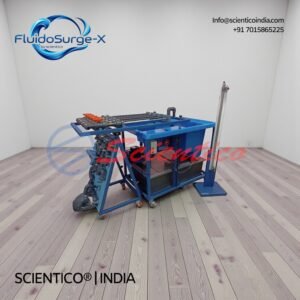 Pipe Network Apparatus | FluidoSurge-X 228View details & get quote →
 Radial Fan Flow Apparatus | FluidoSurge-X 252View details & get quote →