Sieve Tray Column | OperatiX – 07
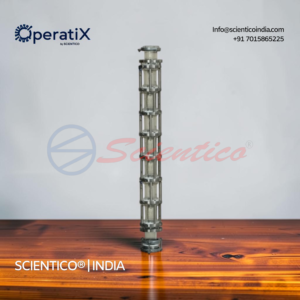
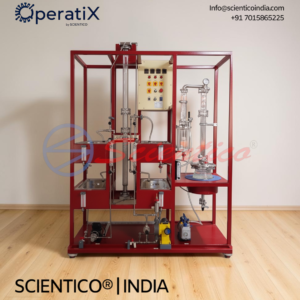
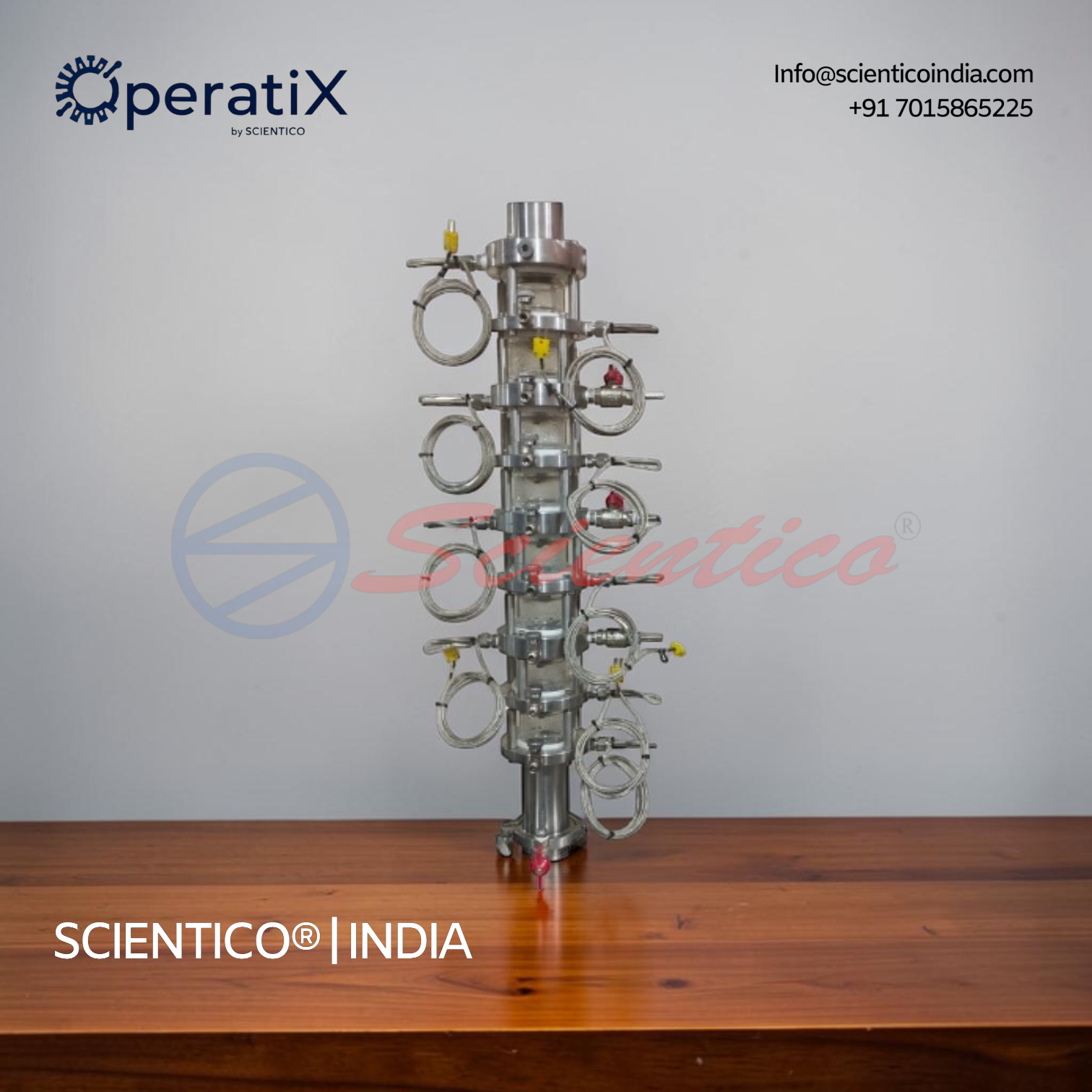
The Sieve Tray Column OperatiX – 07 is a glass sieve tray column, 750mm high and 50mm in diameter, with 7 trays. This Sieve Tray Column demonstrates vapor-liquid contact through perforated trays, downcomers, and weirs. It illustrates key phenomena such as weeping and flooding in cross-flow plate operation. The column includes 3 input ports and tray count can be increased as per demand.
The Sieve Tray Column OperatiX – 07 is a cross-flow plate column of the sieve tray variety, built for vapor-liquid contact demonstration. This Sieve Tray Column uses perforated trays to allow vapor to bubble uniformly through liquid as it moves across the tray floor. It is constructed with a glass column body for visual observation of tray operation.
Product Overview
The simplest variety of cross-flow plate is the sieve plate. The tray has perforations on the tray deck and small, round holes throughout. Through the tiny holes in the tray’s bottom, vapor rises and uniformly bubbles through the liquid. The liquid then moves across the tray floor, over the weir, and into the tray below through the downcomer.
The tray’s holes create the appearance of several orifices. The liquid is prevented from draining through the perforations by the vapor velocity. Downcomers and weirs move the liquid flow to the overflow mechanism on the plate’s side from the tower.
The upward-flowing motion of the gas prevents liquid from flowing through the sieve tray holes in sieve plates. When the gas flow is low, part or all of the liquid may drain through the perforations and effectively bypass areas of the contacting zone. This is referred to as weeping.
A tray’s purpose is to combine vapor and liquid to generate a foam. Vapors rise through the tray sieve holes, where they make direct contact with the liquid. The fluid on the tray is a froth or foam-like blend of vapor and liquid. On the tray and in the downcomer, this foam should break back into a vapor and a liquid. If the foam from a downcomer cannot drain fast onto the tray below, the foamy liquid will back up onto the tray above. This is known as flooding. This behavior can be studied directly on the Sieve Tray Column.
Sieve Tray Column OperatiX – 07, Technical Specifications
| Specification | Detail |
|---|---|
| Type | Sieve tray |
| Diameter | 50mm |
| Height | 750mm |
| Material | Glass |
| Trays | 7 (can be increased as per demand) |
| Input ports | 3 |
Technical Data
Column
| Parameter | Value |
|---|---|
| Type | Sieve tray |
| Diameter | 50mm |
| Height | 750mm |
| Material | Glass |
| Trays | 7 (can be increased as per demand) |
| Input ports | 3 |
Key Features
- Column Type: sieve tray
- Diameter: 50mm
- Height: 750mm
- Material: glass, for visual observation
- Tray Count: 7, expandable on demand
- Input Ports: 3
- Vapor-Liquid Contact: foam generation through sieve holes, demonstrated on this Sieve Tray Column
- Weeping Behavior: observable liquid drainage through perforations at low gas flow
- Flooding Behavior: observable foam backup when downcomer drainage is insufficient
Construction and Design
The Sieve Tray Column OperatiX – 07 is built as a glass column, 750mm in height and 50mm in diameter. It contains 7 sieve trays, with tray count expandable as per demand. Each tray has perforations on the tray deck with small, round holes throughout. Downcomers and weirs move liquid flow to the overflow mechanism on the plate’s side of the tower. The column includes 3 input ports.
Q: What type of tray does the Sieve Tray Column OperatiX – 07 use?
A: It uses a sieve tray, the simplest variety of cross-flow plate, with perforations on the tray deck.
Q: How many trays does the column have?
A: The column has 7 trays, which can be increased as per demand.
Q: What material is the column made of?
A: The column is made of glass.
Q: What is weeping in a sieve tray column?
A: Weeping occurs when gas flow is low and part or all of the liquid drains through the perforations, bypassing areas of the contacting zone.
Q: What is flooding in a sieve tray column?
A: Flooding occurs when foam from a downcomer cannot drain fast enough onto the tray below, causing the foamy liquid to back up onto the tray above.
Need Assistance? We're Here to Help!
Connect with our team for product specifications, pricing, and customized solutions for your institution or project.