
“Gas calorimeter” is an incomplete tender line because the purchased apparatus must work with a particular fuel supply, water circuit and measurement procedure. Scientico’s Boys Gas Calorimeter ProzessiX PX-05 product record describes a Hyde-type wet gas meter paired with a non-recording Boys calorimeter, burner, water-flow measurement and temperature observations. A buyer’s central question is whether the offered package and the laboratory’s services can support the intended supervised calorific-value experiment. This guide converts the catalogue into a utility schedule, accessory list and acceptance plan for an engineering college or distributor.
Equipment mentioned in this guide
Review the product information, specifications and model before requesting a quotation.
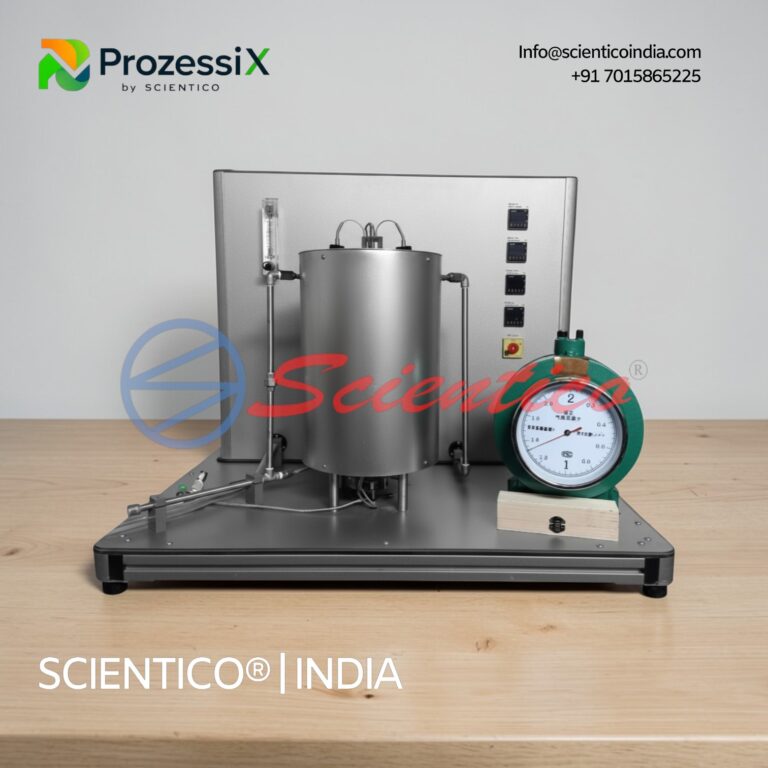
Boys Gas Calorimeter | ProzessiX PX-05
The Boys Gas Calorimeter – ProzessiX PX-05 is a laboratory apparatus designed for determining the calorific value of gaseous fuels through controlled combustion and heat transfer measurement. Manufactured by SCIENTICO, this system forms part of the ProzessiX series developed for process engineering and energy analysis laboratories.
View product detailsIdentify the fuel and the assessed calculation first
The product page lists a range of gaseous fuels as potential subjects, including natural gas, methane and propane. That list should not be read as a promise that every gas can be connected without a different burner, regulator, fitting or local permission. Name the actual teaching gas available at the institution, its supply source and the intended experiment. Ask Scientico to confirm the current PX-05 configuration for that fuel, including burner, connection, pressure regulation, metering and operating instructions. If the department has no approved fuel-gas service, resolve that facilities decision before comparing equipment prices.
State what the student is expected to calculate and report. A basic calorific-value practical needs a measured volume of fuel gas, the quantity of water heated and the inlet-to-outlet water-temperature difference. The product record also lists effluent-gas and ambient temperature measurements and condensate collection. Ask the academic lead whether the assessment uses a gross or net calorific-value treatment, a particular correction method, or only a demonstration of heat balance. The instrument and worksheet must support the chosen method. Avoid putting an unqualified “accurate calorific value” claim into the tender without defining the calculation and the evidence.
Review the wet gas meter as its own BOQ component
The PX-05 page describes a Hyde-type wet gas meter with a water-sealed rotating drum. Its table lists 0.002 m³ per drum revolution, 0.2 m³/h rated flow, 0.3 m³/h excess flow and a normal pressure value of 1,000 Pa. These are catalogue figures for a particular instrument, not universal gas-service settings. Ask for the current meter identification, scale, operating water level, correction information, cleaning and verification instructions. The quotation should say whether the meter, its connecting tubing, valves and any required mounting hardware are included in the apparatus price.
Put meter compatibility in the acceptance plan. The supplier should show how gas volume is read during the agreed supervised run and how the reading enters the student calculation. If a tender requires a calibration certificate, specify it explicitly and ask what range, date and instrument it covers. A certificate for a temperature sensor does not validate a wet gas meter, and a website statement about documentation is not a substitute for the exact delivered record. Ask the instructor to review the resolution needed for the intended duration of a practical class.
Define the water path and temperature observations
The calorimeter transfers heat from combustion gas to flowing water. Scientico lists a 1–7 L/min water rotameter, a constant-head overhead funnel, connection tubes, measuring cylinders and vessels. A lab must still identify its water source, pressure or head, drainage point and method of collecting or measuring water outflow. Send the supplier a plan of the room’s water and drain services and request a connection drawing with hose sizes, placement and any fittings not supplied. A statement that the room has a tap cannot establish controlled flow through the calorimeter.
The published temperature points are water inlet, water outlet, effluent gas and ambient. The page gives a broad thermometer measurement range of −100 to 400°C. That range should not be treated as the temperature at which the experiment is to be run. Request the current thermometer type, graduation or readout, probe position and any calibration evidence required by the course or tender. If the assessment depends on a small water-temperature rise, reading resolution matters as much as the maximum range. Ask for the method of avoiding a false comparison between runs with different water flows or inlet conditions.
Separate supplied accessories from room infrastructure
The product record mentions a non-recording calorimeter, gas meter, burner, gas control valve, thermometers, measuring cylinders and condensate collection vessels. Ask the quotation to list each component and its quantity, as well as glassware replacements, tubing, clamps, regulators and fittings. Some of those last items may depend on the approved local gas supply and should be identified as included or excluded rather than assumed. Request the complete packing list and a diagram that shows the installed path from gas source through meter and burner, and from water source through the calorimeter to drain.
Room readiness is a separate approval. The responsible facilities and safety staff should assess fuel-gas supply, isolation, ventilation, exhaust or combustion-product handling, ignition procedure, emergency shutoff, fire protection, water spillage and supervision. Ask the manufacturer for current installation and operating requirements for the actual offered fuel. The equipment page describes an educational apparatus; it does not establish that an arbitrary room or fuel cylinder arrangement is approved for use. No student practical should be scheduled before the institution’s own site review and commissioning.
Decide whether digital acquisition adds value
The PX-05 product record describes a LabVIEW-based data-acquisition software option. If the teaching method uses manually read gas volume, water volume and temperatures, the base experiment may be assessed from a signed observation sheet. If the school expects computer capture, specify the required channels, interface, operating system, licence, exported file and computer responsibility. Ask whether digital sensors, cabling and software setup are included with the option, and which of the four published temperature points are actually captured. Do not merge the optional software into the standard apparatus line without a price and inclusion list.
A digital trace does not replace the need to understand the measurement method. Request a sample student worksheet showing raw readings, units, calculation stages and any corrections the course expects. For a distributor, this worksheet is a useful way to validate the end buyer’s requirement before promising equivalence. If a bidder offers a different type of gas calorimeter, ask how its gas-volume measurement, water circuit and measured temperatures map to the same assessed calculation.
Issue a comparable RFQ and acceptance schedule
A BOQ can read: “Boys Gas Calorimeter, Scientico ProzessiX PX-05 or technically evaluated equivalent, with wet gas meter, calorimeter and burner, water-flow measurement, four specified temperature observations, measuring vessels, connections and operating manual.” Add the actual fuel type, available supply conditions, water and drain services, quantity, destination, documentation requirement and tender deadline. Ask suppliers to identify the offered meter, burner and accessory package and mark each line included, optional or excluded. Keep any site gas infrastructure and optional software on separate lines.
At delivery, check the nameplates, gas meter, calorimeter, burner, instruments and glassware against the signed schedule. Have qualified staff install and inspect the gas and water connections under the manufacturer’s instructions and local rules. Agree on a supervised demonstration using the approved fuel: record gas volume, water quantity and temperature observations at stable conditions, then show how the teaching calculation uses those measurements. Verify any software only if it was purchased. Record the supplied manuals, calibration documents, warranty and service terms before final acceptance. The purpose is to prove that the quoted apparatus and local services form a usable teaching experiment.
Scientico’s process-engineering equipment range helps place the PX-05 alongside other unit operations. The bomb-calorimeter experiment guide concerns a different calorimetry route; use it only if the syllabus requires solid-fuel work as well. This page addresses the specific gas-meter, water-circuit and installation decisions for the PX-05.
Request a PX-05 configuration
Send the approved fuel, gas and water-service details, assessed calculation, optional software needs, quantity, destination and tender date. Ask Scientico to return an itemised apparatus and utility schedule.
One honest ask
This article and public product information are available to browse without an account. To open a product datasheet, complete the contact form shown with its download link. If this article was useful, leave your email and two things happen: we send you this page as a plain-text block you can paste into a tender file or an internal email, and we notify you the next time we publish a buyer tool like this one. Nothing else. No drip sequence, no sales calls booked without asking.