
A quotation for a refrigeration “base unit” can leave a department with a working condensing unit but no complete student experiment. Scientico’s PolarX-584 refrigeration and air-conditioning training base is designed to accept model modules through refrigerant hoses and electrical cables. Its published scope of delivery names one base unit and one instructional manual. The PolarX-588 refrigerator model and PolarX-592 refrigeration and freezing-stage model are separate product records. This guide helps a buyer state the complete teaching system, module pairing and software scope before comparing prices or issuing a tender.
Equipment mentioned in this guide
Review the product information, specifications and model before requesting a quotation.
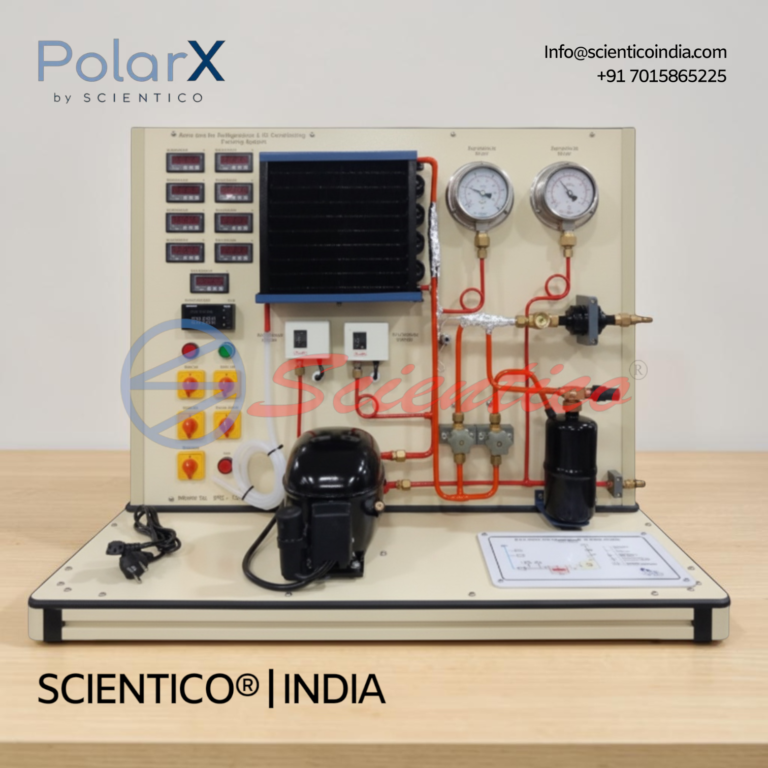
Base unit for Refrigeration & Air Conditioning Training System | PolarX – 584
The Base unit for Refrigeration & Air Conditioning Training System PolarX - 584 can be extended into a full refrigeration circuit depending on the experiment's objectives. This Base unit for Refrigeration & Air Conditioning Training System supports various available models, including the refrigerator module, a refrigeration system with both cooling and freezing stages, or an air conditioning module.
View product details
Refrigerator Model | PolarX – 588
The Refrigerator Model PolarX - 588 is part of the Hardware/Software Integration (HSI) training system for refrigeration and air conditioning technology. When used with the base unit PolarX - 588, this Refrigerator Model forms a functional model of a domestic refrigerator.
View product details
Model of a Refrigeration System with Refrigeration and Freezing Stage | PolarX – 592
The Model of a Refrigeration System with Refrigeration and Freezing Stage PolarX - 592 is a component of the Hardware/Software Integration (HSI) training system for refrigeration and air conditioning technology. When combined with the base unit PolarX - 592, sold separately, this Model of a Refrigeration System with Refrigeration and Freezing Stage forms a complete refrigeration system that includes both refrigeration and freezing stages.
View product detailsDefine the complete experiment, then choose the module
The PolarX-584 page describes a core condensing unit: hermetically sealed compressor, forced-air condenser, liquid receiver, filter drier, sight glass and connecting arrangement. The model module supplies the application that turns these parts into a recognisable refrigeration circuit. Decide whether the course assesses a domestic refrigerator chamber, refrigeration plus freezing stages, or another air-conditioning module. If students must compare expansion devices and cooling load in a domestic refrigerator, the PolarX-588 record is relevant. It describes a transparent chamber, heater as load and a choice between capillary tube and thermostatic expansion valve through solenoid valves.
If students must compare refrigeration and freezing arrangements, review PolarX-592. Its product record describes two transparent chambers, evaporators that can be configured in series or parallel, an evaporation-pressure controller and several expansion choices. A syllabus that asks learners to vary evaporator arrangement has a different apparatus requirement from one that asks only for a single refrigerator chamber. Put the assessed circuit configurations and expected observations into the RFQ. A buyer should not assume that adding any one module automatically covers all cooling, freezing and air-conditioning practicals named in a course catalogue.
Resolve the base-unit compatibility wording before ordering
The PolarX-584 base page recommends PolarX-588 and PolarX-592 as optional accessories, and describes attaching models with fasteners, self-sealing refrigerant couplings and electrical cables. However, the companion product pages refer to a “base unit PolarX-588” or “base unit PolarX-592” in places. That wording is inconsistent with the separately titled PolarX-584 base record. Do not silently treat it as proof that all references mean the same physical interface. Ask Scientico for a current compatibility matrix naming the exact base model, every module, hose and electrical connector set, control interface and software module required for the chosen combination. Get the final matched model numbers in the written quotation.
Compatibility is also a practical installation issue. Ask whether the quote includes all refrigerant hoses, self-sealing couplings, fasteners, electrical cables, module supports and any commissioning connection work. Request a drawing or photograph of the combined setup, including footprint and clearance. A college with an existing PolarX module should provide its nameplate and connector details for written confirmation rather than assuming it will fit a newly supplied base. The RFQ should make the base-only price and each complete base-plus-module price visible.
Understand what the base actually measures
The PolarX-584 table lists a hermetically sealed compressor with 470 W refrigeration capacity and 280 W power consumption, a 0.7 L liquid receiver, three temperature sensors, one intake-side pressure sensor and two delivery-side pressure sensors. It also names a power analyser that displays compressor power, voltage and current, plus electronic high- and low-pressure switches. These are useful catalogue anchors for a technical comparison, but an instrument range is not an operating target. Ask for the current refrigerant, allowed pressure envelope, electrical supply, safety-switch settings, sensor locations and applicable maintenance instructions for the offered combination.
The base page gives R134a as the published refrigerant and says other refrigerants are available on demand. If the institution’s tender or local rules specify a refrigerant, make that a written requirement and request the exact charge, component compatibility, documentation and servicing method proposed. Do not infer that a different refrigerant is automatically available for every module or destination. The technical lead should approve the operating procedure before students use the assembled circuit.
Price software as an explicit decision
The page describes USB or LAN PC connection, real-time display and educational software, while its specifications and software section identify HSI technology and DAQ functions as optional in places. Companion module pages also refer to optional software for fault simulation and p-h diagram tracking. This makes the offered software bundle a central RFQ question. Request a line-by-line schedule: base control, data acquisition, module-specific teaching content, authoring tool, licence count, PC compatibility, required sensors and interfaces. Ask which functions operate without the option and which need it.
Students may only need to record pressure, temperature and electrical readings manually, or their assessment may require online p-h plotting and exported data. State that requirement rather than asking for “software included.” If the institution expects to switch between modules during a term, ask whether each module requires a separate software module and whether the quotation includes those licences. Also clarify who installs and demonstrates the software at handover. A generic USB cable entry cannot establish that the desired data fields will be available to students.
Make the BOQ complete enough to evaluate
A purchase schedule can use separate lines for “PolarX-584 base unit,” “PolarX-588 refrigerator module,” “PolarX-592 refrigeration and freezing-stage module,” and “software and interface package,” selecting only the modules the syllabus needs. For each line, identify the included hoses, connectors, electrical cables, fasteners, sensors, operating manual and training material. Add any maintenance kit as another optional line. Include quantity, room power, available floor area, destination, tender date, warranty, installation and training responsibilities. Require bidders to state alternatives and exclusions beside each line.
Ask for an experiment-to-hardware map. If the requirement is “compare capillary and thermostatic expansion,” identify which offered module and valve arrangement enables it. If the requirement is “compare series and parallel evaporators,” identify the selected module and the procedure for reconfiguration. If the requirement is “track the cycle on a p-h diagram,” identify the software, sensors and licence included. This map is more valuable than comparing a list of refrigeration components with no indication of how students will use them.
Agree on acceptance for the assembled system
At delivery, first compare the base, module and connector labels with the signed compatibility matrix. Check the manual and the agreed refrigerant and electrical information. A qualified technician should commission the circuit according to the supplier’s procedure and document protective-device checks. The instructor can then witness one approved run for each purchased module, recording the pressure, temperature and power readings required by the practical. If software was purchased, demonstrate live display and export for the chosen module. Record any missing hoses, licences, fasteners or documents before signing acceptance.
The refrigeration trainer selection guide compares standalone and modular equipment families. The refrigeration and air-conditioning category shows other course options. This page focuses on the narrower PolarX-584 base-plus-module purchase and the compatibility evidence needed to make that purchase useful.
Request a complete PolarX-584 configuration
Send the experiments, selected modules, software and export needs, existing equipment details, quantity, destination and tender date. Ask for the current compatibility matrix and a separate price for each included module.
One honest ask
This article and public product information are available to browse without an account. To open a product datasheet, complete the contact form shown with its download link. If this article was useful, leave your email and two things happen: we send you this page as a plain-text block you can paste into a tender file or an internal email, and we notify you the next time we publish a buyer tool like this one. Nothing else. No drip sequence, no sales calls booked without asking.