
The core difference between a centrifugal vs reciprocating pump is the energy-transfer mechanism: a centrifugal pump is a rotodynamic machine that adds kinetic energy to the fluid through a spinning impeller and converts it to pressure, while a reciprocating pump is a positive-displacement machine that traps a fixed volume in a cylinder and pushes it out with a piston or plunger. As a result, centrifugal pumps deliver high, continuous flow at moderate head, whereas reciprocating pumps deliver low flow at very high pressure with a pulsating discharge.
Equipment mentioned in this guide
Review the product information, specifications and model before requesting a quotation.
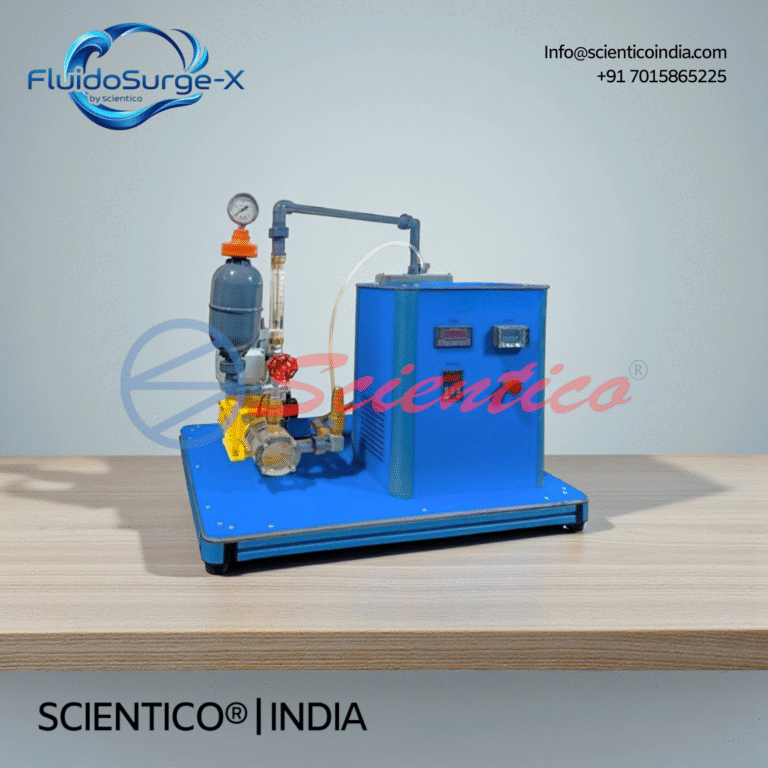
Reciprocating Pump Demonstration Unit | FluidoSurge-X 264
The Reciprocating Pump Demonstration Unit FluidoSurge-X 264 is a laboratory apparatus designed to study the operating characteristics of a reciprocating pump. Manufactured by SCIENTICO, the unit enables experimental determination of pump performance, pressure behavior, and pulsation effects. It is intended for instructional use in fluid mechanics and hydraulic machinery laboratories. Optional data acquisition software supports detailed analysis.
View product details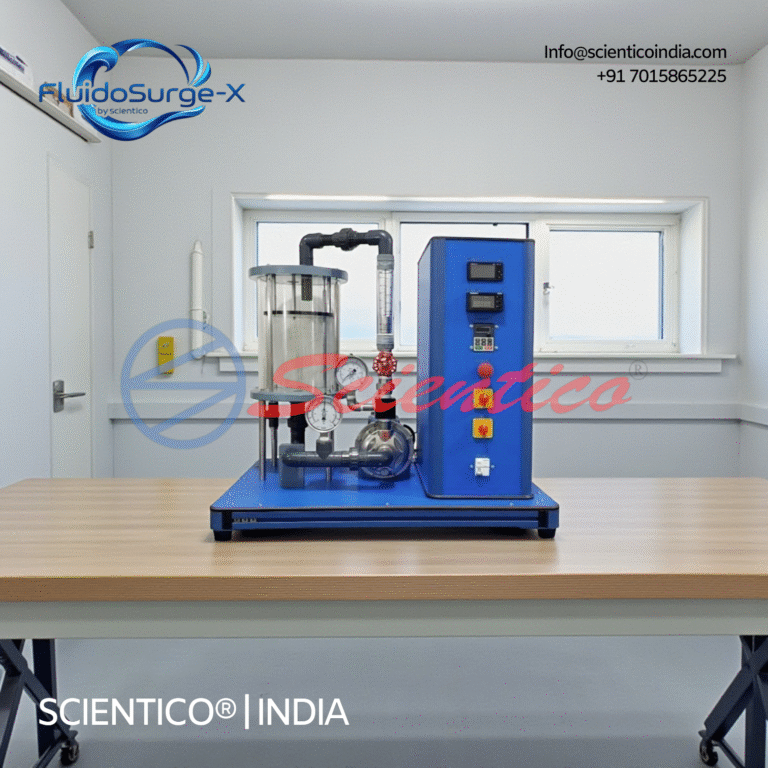
Centrifugal Pump | FluidoSurge-X 188
The Centrifugal Pump FluidoSurge-X 188 is designed for instructional demonstration and experimental study of centrifugal pump performance. It enables controlled investigation of pump characteristics under variable speed and head conditions. The apparatus integrates measurement of flow rate, pressure, and rotational speed. It is suitable for fluid mechanics and hydraulic machinery laboratories.
View product detailsWhat is a centrifugal pump?
A centrifugal pump uses a rotating impeller to impart velocity (kinetic energy) to the liquid. The high-velocity fluid then enters a volute or diffuser, where the cross-section widens and velocity is converted into pressure head (Bernoulli’s principle). Because there is no sealed displacement chamber, discharge is smooth and continuous.
Key relations
- Head developed (Euler equation, ideal): H = (u₂ · Vw2) / g, where u₂ is impeller tip speed (m/s) and Vw2 is the whirl velocity at outlet.
- Affinity laws: Q ∝ N, H ∝ N², P ∝ N³ (N = impeller speed, rev/min).
- Head is independent of fluid pressure but depends on impeller diameter and speed.
What is a reciprocating pump?
A reciprocating pump converts rotary motion (via a crank and connecting rod) into the to-and-fro motion of a piston or plunger inside a cylinder. On the suction stroke the suction valve opens and fluid fills the cylinder; on the delivery stroke the delivery valve opens and the trapped volume is forced out. Because a definite volume is displaced each stroke, flow is nearly independent of discharge head, making these pumps suited to high-pressure, low-flow duties such as metering and hydraulic test rigs.
Key relations
- Theoretical discharge (single-acting): Qth = (A · L · N) / 60 (m³/s), where A = piston area (m²), L = stroke length (m), N = crank speed (rev/min).
- Double-acting: Qth ≈ 2 · (A · L · N)/60 (neglecting piston-rod area).
- Coefficient of discharge: Cd = Qactual / Qtheoretical. Slip = Qth − Qact.
How do centrifugal and reciprocating pumps compare?
| Attribute | Centrifugal Pump | Reciprocating Pump |
|---|---|---|
| Pump type | Rotodynamic (kinetic) | Positive displacement |
| Action | Impeller rotation | Piston/plunger reciprocation |
| Discharge | High, continuous, smooth | Low, pulsating (needs air vessel) |
| Head / pressure | Low to moderate head | Very high pressure |
| Flow vs head | Flow falls as head rises | Flow nearly constant with head |
| Self-priming | No (needs priming) | Yes (largely self-priming) |
| Efficiency at high head | Lower | Higher |
| Viscous / handling solids | Handles suspended solids well | Poor with solids; clean liquids only |
| Speed | High (direct motor coupling) | Low (geared) |
| Air vessel | Not required | Used to smooth flow |
| Maintenance | Low; few moving parts | Higher; valves, packing wear |
| Size / weight for given flow | Compact, light | Bulky, heavy |
| Initial cost | Lower | Higher |
| Typical use | Water supply, irrigation, drainage | Metering, dosing, high-pressure injection |
Which pump should you select?
Selection follows from the required combination of flow rate (Q) and head (H), the fluid properties, and the duty cycle.
Choose a centrifugal pump when
- You need large, continuous flow at low-to-moderate head (water supply, irrigation, cooling, drainage).
- The liquid contains suspended solids or is mildly abrasive.
- Compact size, low cost, and minimal maintenance matter.
- Smooth, pulsation-free delivery is required.
Choose a reciprocating pump when
- You need high pressure at low flow (hydraulic test benches, high-pressure cleaning, oil injection).
- Accurate, repeatable dosing or metering is required, since discharge is proportional to speed.
- The pump must be self-priming and handle clean, solids-free liquids.
- Constant flow is needed despite a varying or very high discharge head.
Quick decision rule
- High Q, low H → centrifugal.
- Low Q, high H, precise dosing → reciprocating.
How is this measured in a teaching lab?
Both pumps are characterised on a test rig fitted with a calibrated tank (or rotameter) for flow, pressure and vacuum gauges at delivery and suction, and a means of measuring input power (motor watt-meter or dynamometer).
Key measured quantities
- Discharge Q by collecting tank: Q = (Atank · rise in level) / time (m³/s).
- Total head H = (pd − ps)/(ρg) + datum + velocity head, where pd, ps are delivery and suction pressures (Pa).
- Output (water) power: Po = ρ g Q H (watts).
- Overall efficiency: η = Po / Pinput × 100%.
For the centrifugal pump, students plot characteristic curves of H, P and η against Q at constant speed and verify the affinity laws. For the reciprocating pump, they compute theoretical discharge from A, L and N, compare it with the measured value to find the coefficient of discharge and percentage slip, and observe how the air vessel smooths the pulsating flow. Together these experiments let students contrast rotodynamic and positive-displacement behaviour directly.
Scientico India, an ISO 9001:2015 and model-specific manufacturer and exporter of engineering and science laboratory equipment, supplies pump test rigs and instructional apparatus for these experiments. Explore the full range under Fluid Mechanics Lab Equipment.
Frequently Asked Questions
What is the main difference between a centrifugal and a reciprocating pump?
A centrifugal pump is a rotodynamic machine that uses a rotating impeller to add kinetic energy that is converted to pressure, giving high continuous flow at moderate head. A reciprocating pump is a positive-displacement machine that pushes a fixed trapped volume out with a piston or plunger, giving low but high-pressure, pulsating flow.
Which pump is better for high pressure?
A reciprocating pump is better for high pressure. Because it displaces a definite volume each stroke, its flow is nearly independent of discharge head, so it can develop very high pressures at low flow rates, making it ideal for metering, dosing and hydraulic test duties.
Why does a centrifugal pump need priming but a reciprocating pump does not?
A centrifugal pump cannot generate enough head to evacuate air from the suction line, so its casing must be filled (primed) with liquid before starting. A reciprocating pump creates a strong vacuum on the suction stroke through positive displacement, so it is largely self-priming.
How is pump efficiency measured in a lab?
Output (water) power is calculated as P = ρgQH using the measured discharge Q and total head H, while input power is read from a watt-meter or dynamometer. Overall efficiency is the ratio of output to input power, expressed as a percentage, and is plotted against flow to form the pump characteristic curve.
What is slip in a reciprocating pump?
Slip is the difference between the theoretical discharge (A × L × N / 60) and the actual measured discharge, caused mainly by valve leakage and delayed valve closing. It is often expressed as percentage slip or captured by the coefficient of discharge, Cd = actual discharge / theoretical discharge.
One honest ask
We don't gate anything on this site. You just read the whole thing free. If it was useful, leave your email and two things happen: we send you this page as a plain-text block you can paste into a tender file or an internal email, and we notify you the next time we publish a buyer tool like this one. Nothing else. No drip sequence, no sales calls booked without asking.