
Aim: To determine the performance characteristics of a centrifugal pump, head vs. discharge (H-Q), efficiency vs. discharge (η-Q), and power vs. discharge (P-Q) curves at constant speed.
Equipment mentioned in this guide
Review the product information, specifications and model before requesting a quotation.
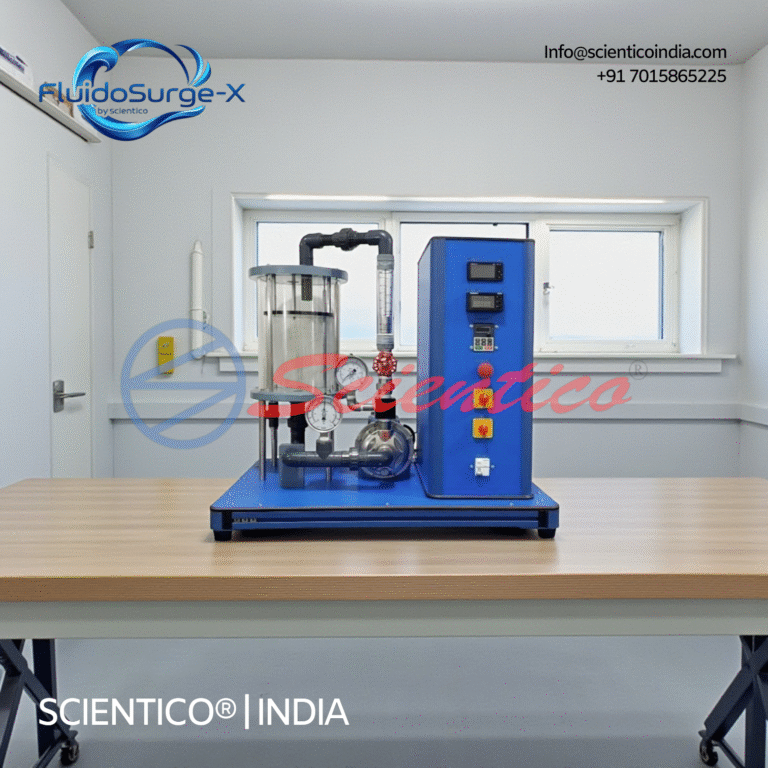
Centrifugal Pump | FluidoSurge-X 188
The Centrifugal Pump FluidoSurge-X 188 is designed for instructional demonstration and experimental study of centrifugal pump performance. It enables controlled investigation of pump characteristics under variable speed and head conditions. The apparatus integrates measurement of flow rate, pressure, and rotational speed. It is suitable for fluid mechanics and hydraulic machinery laboratories.
View product details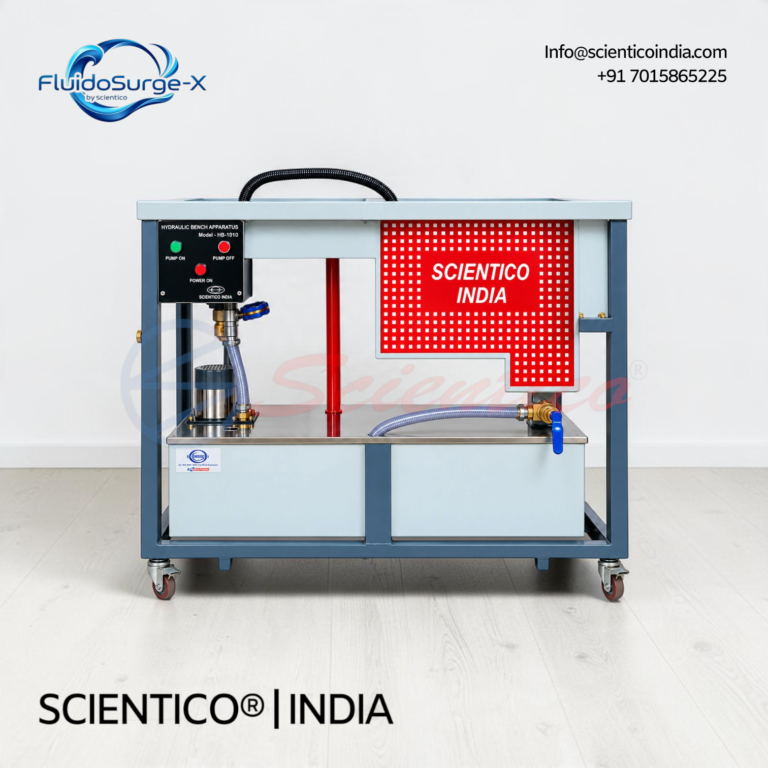
Hydraulic Bench Apparatus | FluidoSurgeX 101
The SCIENTICO FluidoSurgeX 101 Hydraulic Bench Apparatus is a basic supply and measurement unit used in fluid mechanics laboratories. It enables the circulation, measurement, and collection of water for a wide range of experimental modules.The system operates on a closed-loop water circuit consisting of a storage tank, centrifugal pump, and an elevated measuring tank. Volumetric flow rates are determined using stepped measuring tanks and a calibrated measuring beaker, supported by manual stopwatch timing.An integrated work surface with a built-in flume allows experiments involving weirs while ensuring safe placement of accessories and controlled collection of return water.
View product detailsApparatus Required
- Centrifugal Pump Test Rig with suction and delivery gauges, energy meter, and measuring tank
- Tachometer (to measure pump speed)
- Stopwatch
- Measuring scale
Theory
A centrifugal pump converts mechanical energy into hydraulic energy through centrifugal action. Key performance parameters: Total Head (H) = delivery head + suction head + velocity head difference; Discharge (Q) measured volumetrically; Input Power (P) calculated from energy meter; Output Power = ρgQH; Efficiency (η) = Output Power / Input Power × 100%.
Procedure
- Prime the pump by filling with water. Check all connections for leaks.
- Start the pump motor and allow it to reach steady speed. Note the speed using tachometer.
- Set the delivery valve to fully open position for maximum flow (no load condition).
- Record suction gauge reading (Ps), delivery gauge reading (Pd), energy meter reading, and measure discharge Q using measuring tank and stopwatch.
- Partially close the delivery valve to reduce flow. Record all parameters at 5–6 different valve positions (from fully open to nearly closed).
- Record the fully closed condition (zero flow) to get the shutoff head.
Observation Table
| Obs. No. | Suction Head Hs (m) | Delivery Head Hd (m) | Total Head H (m) | Volume (L) | Time (s) | Q (L/s) | Input Power P (W) | Output Power (W) | Efficiency η (%) |
|---|---|---|---|---|---|---|---|---|---|
| 1 (fully open) | – | – | – | – | – | – | – | – | – |
| 2 | – | – | – | – | – | – | – | – | – |
| 3 | – | – | – | – | – | – | – | – | – |
| 4 | – | – | – | – | – | – | – | – | – |
| 5 | – | – | – | – | – | – | – | – | – |
Calculations
Total Head: H = Hd + Hs + (Vd² – Vs²)/2g (m of water)
Discharge: Q = Volume/Time (m³/s)
Output Power: Po = ρgQH (W)
Input Power from energy meter: Pi = (n × 3600 × 1000) / (EMC × t) W, where n = meter disc revolutions, EMC = energy meter constant
Efficiency: η = (Po/Pi) × 100 %
Graph and Results
Plot: (1) H vs Q, shows the pump characteristic curve (head drops as discharge increases); (2) η vs Q, shows efficiency peaks at Best Efficiency Point (BEP); (3) P vs Q, shows shaft power variation. The BEP is where efficiency is maximum, this is the design operating point.
Frequently Asked Questions
What is the Best Efficiency Point (BEP) of a centrifugal pump?
The Best Efficiency Point (BEP) is the discharge at which the pump operates at its highest efficiency. On the η-Q curve, this is the peak of the efficiency curve. Pumps should ideally be selected and operated near their BEP to minimise energy consumption and reduce wear.
Why does head increase when discharge decreases in a centrifugal pump?
In a centrifugal pump, reducing the discharge (by closing the delivery valve) causes the impeller to work against less flow, energy accumulates as pressure. This results in higher head at lower discharge. The maximum head occurs at zero discharge (shutoff head).
How is the efficiency of a centrifugal pump calculated?
Pump efficiency = (Output Hydraulic Power / Input Shaft Power) × 100%. Output hydraulic power = ρgQH (watts). Input shaft power is measured from the energy meter disc revolutions and meter constant.
Get Fluid Mechanics Lab Equipment
Scientico India manufactures ISO 9001:2015 and model-specific fluid mechanics lab apparatus. Contact us for specifications and CIF pricing.
Scientico India manufactures this and the full range of Fluid Mechanics Lab equipment, model-specific and supplied to engineering colleges worldwide.
Explore Fluid Mechanics Lab Equipment → or request a quote